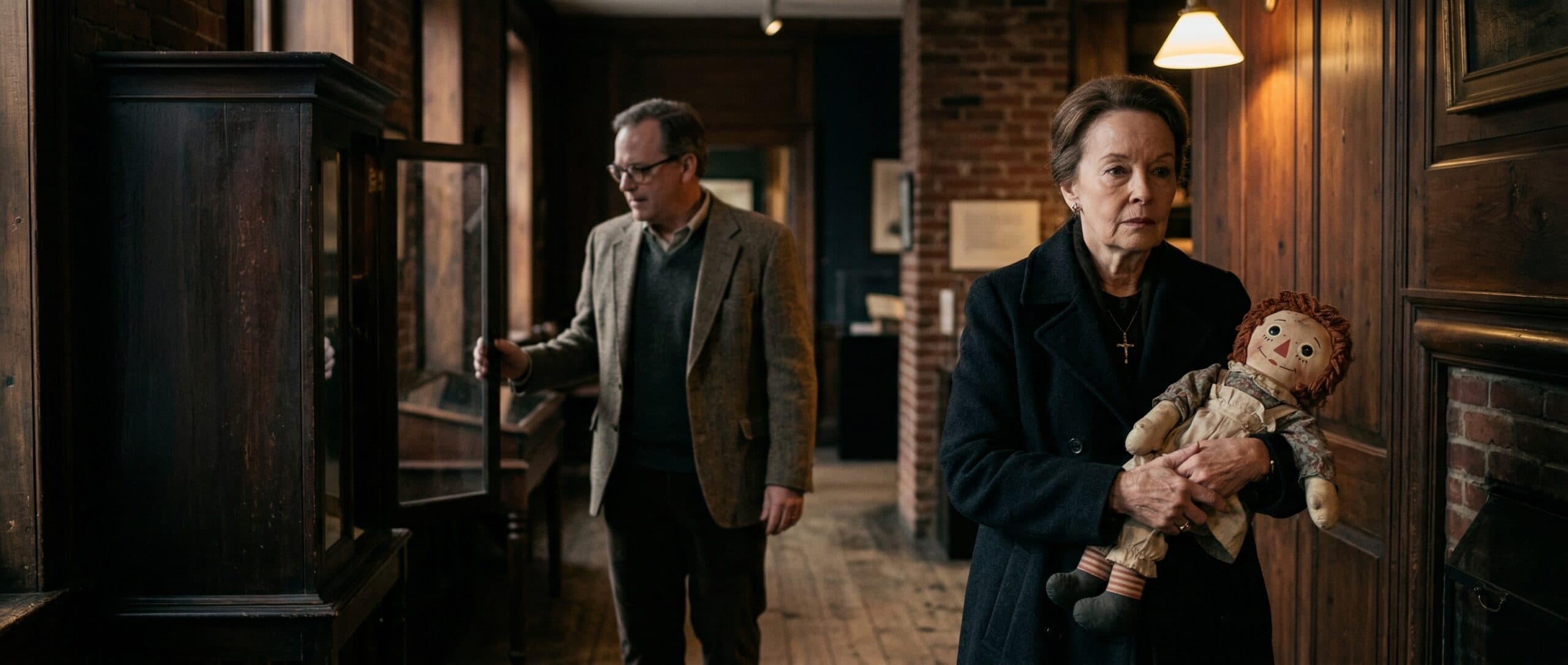
Few paranormal stories spread faster than one involving Annabelle, the allegedly haunted doll long linked to Ed and Lorraine Warren. The latest twist is almost too perfectly calibrated for the internet: a proposal tied to a new Warren-branded museum could bring the doll to Salem, Massachusetts, the country’s most recognizable city for witchcraft lore and supernatural tourism. That possibility has turned a local planning story into a national obsession.
At the center of the buzz is a proposal for The Haunted Warren Museum at 259 Essex Street in Salem. Reporting from Hearst Connecticut Media’s Middletown Press says city discussions moved forward on March 26, with plans that reportedly include 14 exhibit spaces dedicated to paranormal artifacts from around the world. The project has also drawn attention because it reportedly involves creator and entertainer Elton Castee through Haunted Warren Museum, LLC, giving the story a modern influencer-era dimension on top of the Warrens’ already famous legacy.
Why Salem changes the scale of the story
Annabelle is already one of the few occult objects that exists far beyond ghost-hunting circles. The doll’s reputation was built first through Warren case files and later magnified by books, television, and especially the Conjuring universe. Even people who know almost nothing about paranormal history often recognize the name. Put that level of pop-culture visibility into Salem, and the result is immediate attention from tourists, skeptics, believers, and local residents alike.
Salem is not just another New England town with a haunted attraction. It is a place where the memory of the 1692 Salem witch trials coexists with a massive tourism economy built around the supernatural, folklore, and dark history. That makes the city an unusually potent backdrop for a Warren museum. A haunted object exhibit might feel niche somewhere else; in Salem, it becomes a direct addition to an already mature ecosystem of ghost tours, museums, seasonal events, and occult branding.
The real issue is bigger than one doll
That is why the proposed move has generated so much debate. Annabelle may be the headline magnet, but the deeper story is about what happens when legacy paranormal mythology meets city permitting, neighborhood concerns, and a hyper-commercial tourism district. According to the reporting around the proposal, discussion has focused less on whether the artifacts are genuinely supernatural and more on practical matters such as operating hours, crowd flow, security, and the effect a high-profile occult attraction could have on the surrounding area.
In other words, this is not simply a ghost story. It is a story about how a famous paranormal brand attempts to scale into a destination business. The Warrens remain central figures in American haunting mythology, but their legacy now exists inside a much more contemporary media landscape, one shaped by viral clips, creator-driven promotion, and fandom culture. That combination makes the Salem museum proposal feel like a collision between old-school demonology lore and the logic of modern entertainment IP.
Why Annabelle still works as a cultural symbol
Part of the reason the story has caught fire is that Annabelle functions as an unusually efficient symbol. The real artifact associated with the Warrens is a Raggedy Ann doll, while the film version transformed the concept into something far more visibly sinister. The gap between the historical object and the cinematic icon has only made the legend more durable. It allows believers to attach meaning to the original case while casual audiences respond to the broader mythology popularized by mainstream horror media.
That kind of recognition matters in tourism. A museum full of lesser-known cursed items might draw dedicated paranormal fans, but Annabelle is the object that cuts through to everyone else. She is instantly legible, visually memorable, and easy to package in headlines, thumbnails, and social media debates. Salem, meanwhile, is one of the few places in the United States where that recognition can be converted almost immediately into foot traffic.
The backlash is part of the attraction
Stories like this also feed on resistance. The more residents worry about traffic, spectacle, or the continued commercialization of Salem’s supernatural identity, the more attention the museum receives. That tension keeps the story moving because it creates two narratives at once: a paranormal tourism expansion for fans and a civic debate for everyone else. The controversy is not separate from the attraction. It is part of what gives the museum proposal its public energy.
There is also a broader question underneath the arguments about zoning and operations. What exactly is a Warren museum in 2026 supposed to be? Is it a preservation effort for artifacts tied to one of America’s most famous paranormal families, a theatrical attraction built for tourists, or a hybrid of both? Salem is an ideal place for that question because the city has spent decades navigating the line between historical memory and supernatural spectacle.
What happens next
For now, the proposal’s significance lies in how neatly it captures the current state of paranormal culture. Haunted objects are no longer just relics from old case files. They are brands, attractions, conversation pieces, and engines for viral storytelling. If Annabelle does end up in Salem, the city may become an even stronger center of haunted-object tourism than it already is. If the proposal stalls, the attention it has generated still proves the same thing: the American appetite for organized, commercialized encounters with the unexplained is only getting stronger.
Either way, the story has already escaped the limits of local news. It now sits at the intersection of folklore, business, internet fame, and municipal politics. That is why the idea of Annabelle in Salem has spread so quickly. It does not just sound spooky. It sounds inevitable.
Related Articles
- Is Syracuse University Haunted? Why the Campus Ghost Story Keeps Growing
- St. Mary’s Paranormal Pajama Party Shows How Haunted Tourism Is Evolving
- Blood Moon Prophecy Keeps Returning in Times of Fear
This article was created using Media Blaster – Your content production specialist. Visit www.mediablaster.io for more information.