April 2026 Prophecy Claims Are Everywhere: How Prediction Culture Turns Anxiety Into Authority | Unexplained
End Times
April 2026 Prophecy Claims Are Everywhere: How Prediction Culture Turns Anxiety Into Authority
April 2026 prophecy chatter is spreading for the same reason prophecy waves always spread: a volatile news cycle, a ready-made online belief community, and creators who know how to frame uncertainty as confirmation.…
Art Grindstone is the hard-nosed storyteller behind Unexplained.co, a veteran investigator whose life’s work sits at the crossroads of the paranormal, fringe science, and the shadows most people try not to look into. With decades spent chasing impossible stories — black-budget psychic programs, vanished Cold War experiments, desert rituals that sparked UFO waves, and the strange phenomena buried in America’s forgotten backroads — Art brings a rare combination of skepticism, awe, and journalistic precision. He’s not here to debunk. He’s not here to blindly believe. He follows the evidence wherever it leads — even when it leads someplace deeply uncomfortable. Known for his immersive, cinematic style and his ability to turn obscure research into gripping narrative, Art has built a devoted following across podcasts, long-form features, documentaries, and serialized investigations. His interviews are direct. His analysis is unflinching. His voice has become a staple in the modern paranormal renaissance — the guy people turn to when a story is too strange, too complex, or too dangerous for anyone else to touch. Off-mic, Art works with a distributed network of researchers, archivists, and field operatives who help surface the stories mainstream media ignores. On-mic, he transforms their findings into meticulous, high-impact reporting that refuses to insult the intelligence of true believers. His philosophy is simple: Take the phenomenon seriously. Treat the audience with respect. Tell the story as if the world depends on it — because sometimes it does. When Art Grindstone digs into a case, he isn’t just chasing a mystery. He’s tracing the fault lines of reality itself.
5 min · 1,231 words
In This Report(13)
April 2026 prophecy chatter is spreading for the same reason prophecy waves always spread: a volatile news cycle, a ready-made online belief community, and creators who know how to frame uncertainty as confirmation. What looks like a sudden eruption of psychic forecasts is really a feedback loop where fear, algorithms, and monetized certainty all reinforce one another.
Here is the core answer. There is no verified evidence that April 2026 is uniquely destined for cosmic or geopolitical upheaval. What exists is a surge of prediction content from psychics, remote viewers, and prophecy channels tying current anxieties to older narratives, then presenting those narratives as if unfolding events are validating them in real time.
That distinction matters because prophecy culture rarely succeeds by being precise. It succeeds by being adaptable. A vague forecast can be stretched around almost any development, and once audiences begin watching current events through that lens, nearly every headline starts to feel like evidence. Broader reporting on online extremity and belief dynamics from outlets like Pew Research Center and analysis of digital amplification patterns at Brookings help explain why these narratives find such fertile ground.
Advertisement
What This Story Actually Says
Across fringe forums, prophecy channels, and social media communities, creators have been circulating claims that April 2026 would bring major world events, spiritual turning points, or disclosure-level revelations. Some of these claims are being connected to UFO narratives, while others are framed through broader religious, psychic, or end-times language.
What makes this surge notable is not one single prophecy, but the way multiple subcultures are converging around the same month. Remote-viewing communities, online psychics, and apocalypse-focused creators are all packaging contemporary uncertainty as if it were foreseen. That creates the impression of confirmation even when the actual predictions are broad, recycled, or contradictory.
This also helps explain why familiar names and older claims keep getting pulled back into circulation. Once an audience believes a forecaster was “right once,” later statements are treated as heightened warning signals rather than as new claims that still need evidence.
Why Prophecy Content Spreads So Easily
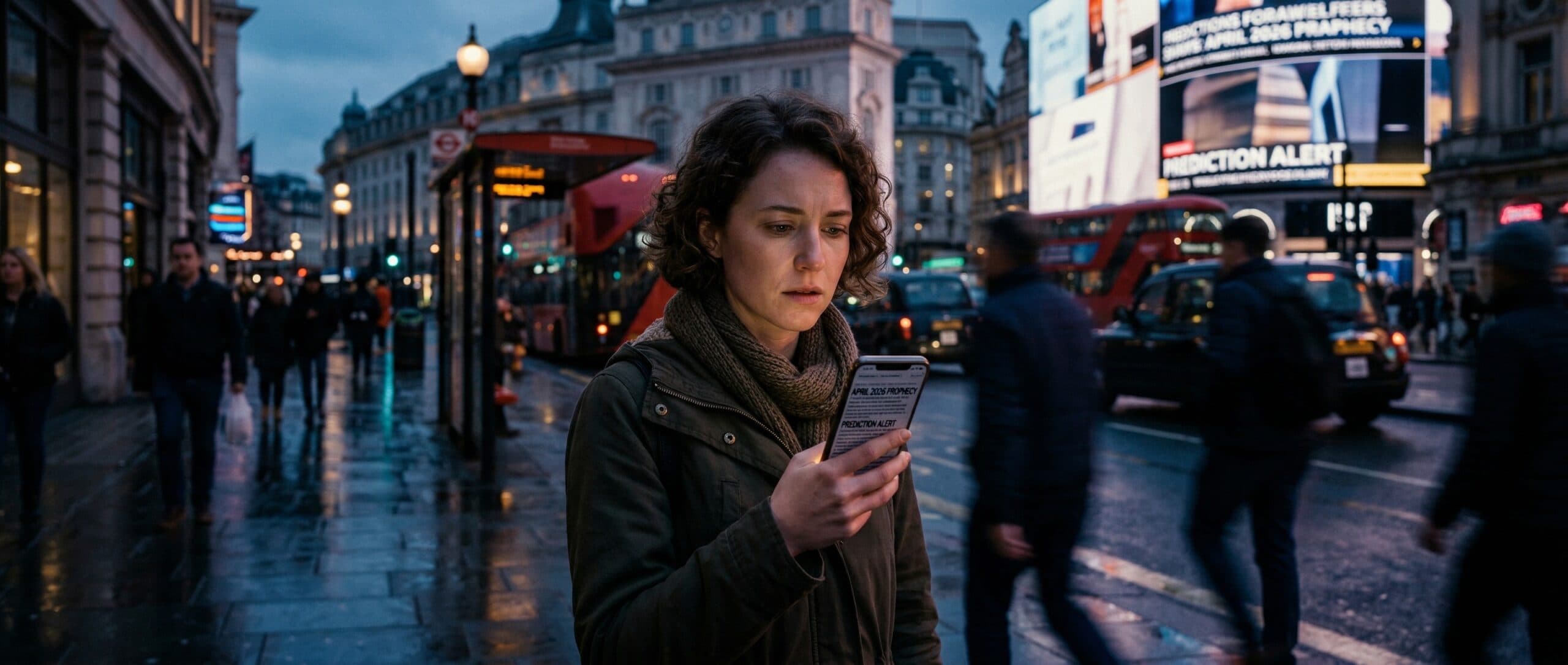
Prediction content thrives when the audience already feels unstable. Political turbulence, disclosure chatter, economic stress, and online fear loops create exactly the emotional environment in which prophecy narratives gain traction. People do not just want information in those moments. They want orientation.
1957 Electrogravitics Secret: The Classified Research Program Whose Watchers Have All ‘Gone’
A viral essay claims that classified electrogravitics research made real progress in the 1950s — and that everyone who knew the truth about it has since disappeared from the public record. The story is spreading through high-strangeness forums.
May 13, 2026 • 7 min read
Conspiracy Theories
Obama Says UFO Disclosure Won’t Happen — ‘Government Is Terrible at Keeping Secrets’
Former President Obama’s unexpected remarks on UFO disclosure and government secrecy are spreading across Reddit and UAP forums. Is it an off-hand joke or a genuine signal from a former commander-in-chief?
May 12, 2026 • 5 min read
Conspiracy Theories
Japan Just Confirmed It Has UAP Footage, and Is Analyzing Pentagon Files Near Its Borders
Japan’s formal entry into the UAP transparency wave signals an international domino effect. What the country knows about UAP encounters near Japanese territory and why it matters now.
May 14, 2026 • 5 min read
Prophecy creators offer something mainstream reporting cannot: certainty. Even when that certainty is artificial, it feels useful. It turns a messy present into a pattern and gives followers the sense that someone is already reading the map.
Algorithms amplify this dynamic because emotionally charged, high-stakes content outperforms calm analysis. A claim that a psychic foresaw upheaval or that a remote viewer predicted major events in April is inherently more clickable than a measured explanation of coincidence, selective memory, or narrative reframing.
What the Evidence Actually Supports
The evidence here supports the existence of a powerful online prediction culture, not the truth of any specific prophecy. What can be observed directly is the distribution mechanism: repeated posting, mutual amplification between creators, audience reinforcement, and strategic linking of broad predictions to unfolding events.
In practice, most viral prophecy claims are difficult to falsify because they are framed elastically. They use emotionally loaded but open-ended language, and they often gain strength after events occur, when followers retrospectively fit headlines into an earlier statement.
That is why the key evidence question is not “did someone make a prediction?” but “was the prediction specific, dated, testable, and documented before the event?” Without those standards, prophecy culture becomes a machine for generating perceived hits while quietly discarding misses. Media literacy work from groups like The News Literacy Project and broader misinformation research at First Draft remain useful frameworks for judging these claims more critically.
What Skeptics and Former Believers Would Say
Skeptics would argue that prophecy communities are often better at narrative maintenance than prediction. They reinterpret misses, narrow their claims after the fact, and borrow significance from unrelated events. Former believers often describe the same dynamic more personally: they were drawn in by certainty, then kept in place by community pressure and the emotional cost of admitting a prediction failed.
There is also a monetization layer that deserves attention. Paid memberships, donation funnels, private groups, and exclusive briefings can all turn prophecy into a business model. When attention becomes income, there is a built-in incentive to keep the next warning cycle alive.
That does not mean every person sharing predictions is acting cynically. But it does mean audiences should distinguish between spiritual expression, speculative interpretation, and a system that rewards escalating fear.
Why This Story Matters Right Now
The April 2026 prophecy wave matters because these narratives can affect real behavior. People do not consume them passively. They make emotional, social, and sometimes financial decisions based on what they think is coming. In extreme cases, prophecy ecosystems can fuel panic, isolation, compulsive doomscrolling, or harmful group dynamics.
Advertisement
It also matters because prophecy content increasingly overlaps with UFO and disclosure culture. Once those worlds merge, political developments, government secrecy, spiritual warfare, and cosmic expectation all get folded into the same story universe. That makes the content feel larger, more urgent, and harder for followers to step back from critically.
The Bigger Pattern Behind Prediction Surges
The deeper pattern here is that prophecy communities are highly adaptive. They do not need certainty to function. They need momentum. A predicted month, a symbolic date, or a charged news event can provide enough narrative fuel to restart the cycle again and again.
That is why the most important question is not whether one forecast comes true. It is why broad, emotionally resonant prediction systems remain so persuasive when precise accuracy is so rare. The answer usually lies in psychology, community identity, and the comfort of feeling that chaos is secretly organized.
Final Assessment
The April 2026 prophecy surge is best understood as a media and belief phenomenon rather than as evidence of verified foresight. It shows how quickly uncertainty can be reframed as validation when audiences, creators, and algorithms are all pointing in the same direction. The real story is not that prophecy has been proven. It is that in anxious moments, prediction culture can make itself feel uncannily right even when the underlying evidence stays weak.
Frequently Asked Questions
Are April 2026 prophecy claims verified?
No. What is verifiable is the spread of prediction content and the way online communities are amplifying it, not proof that any specific prophecy is true.
Why do prediction channels gain traction during tense periods?
Because they offer certainty, meaning, and emotional orientation when mainstream events feel chaotic or difficult to interpret.
How can readers judge a prophecy claim fairly?
Check whether it was clearly documented before the event, whether it was specific and testable, and whether failed predictions are being ignored or reinterpreted.
Why does this overlap with UFO culture?
Because both spaces are drawn to hidden meaning, elite secrecy, revelation narratives, and the idea that major truth is about to break into public view.
Art Grindstone is the hard-nosed storyteller behind Unexplained.co, a veteran investigator whose life’s work sits at the crossroads of the paranormal, fringe science, and the shadows most people try not to look into. With decades spent chasing impossible stories — black-budget psychic programs, vanished Cold War experiments, desert rituals that sparked UFO waves, and the strange phenomena buried in America’s forgotten backroads — Art brings a rare combination of skepticism, awe, and journalistic precision. He’s not here to debunk. He’s not here to blindly believe. He follows the evidence wherever it leads — even when it leads someplace deeply uncomfortable. Known for his immersive, cinematic style and his ability to turn obscure research into gripping narrative, Art has built a devoted following across podcasts, long-form features, documentaries, and serialized investigations. His interviews are direct. His analysis is unflinching. His voice has become a staple in the modern paranormal renaissance — the guy people turn to when a story is too strange, too complex, or too dangerous for anyone else to touch. Off-mic, Art works with a distributed network of researchers, archivists, and field operatives who help surface the stories mainstream media ignores. On-mic, he transforms their findings into meticulous, high-impact reporting that refuses to insult the intelligence of true believers. His philosophy is simple: Take the phenomenon seriously. Treat the audience with respect. Tell the story as if the world depends on it — because sometimes it does. When Art Grindstone digs into a case, he isn’t just chasing a mystery. He’s tracing the fault lines of reality itself.