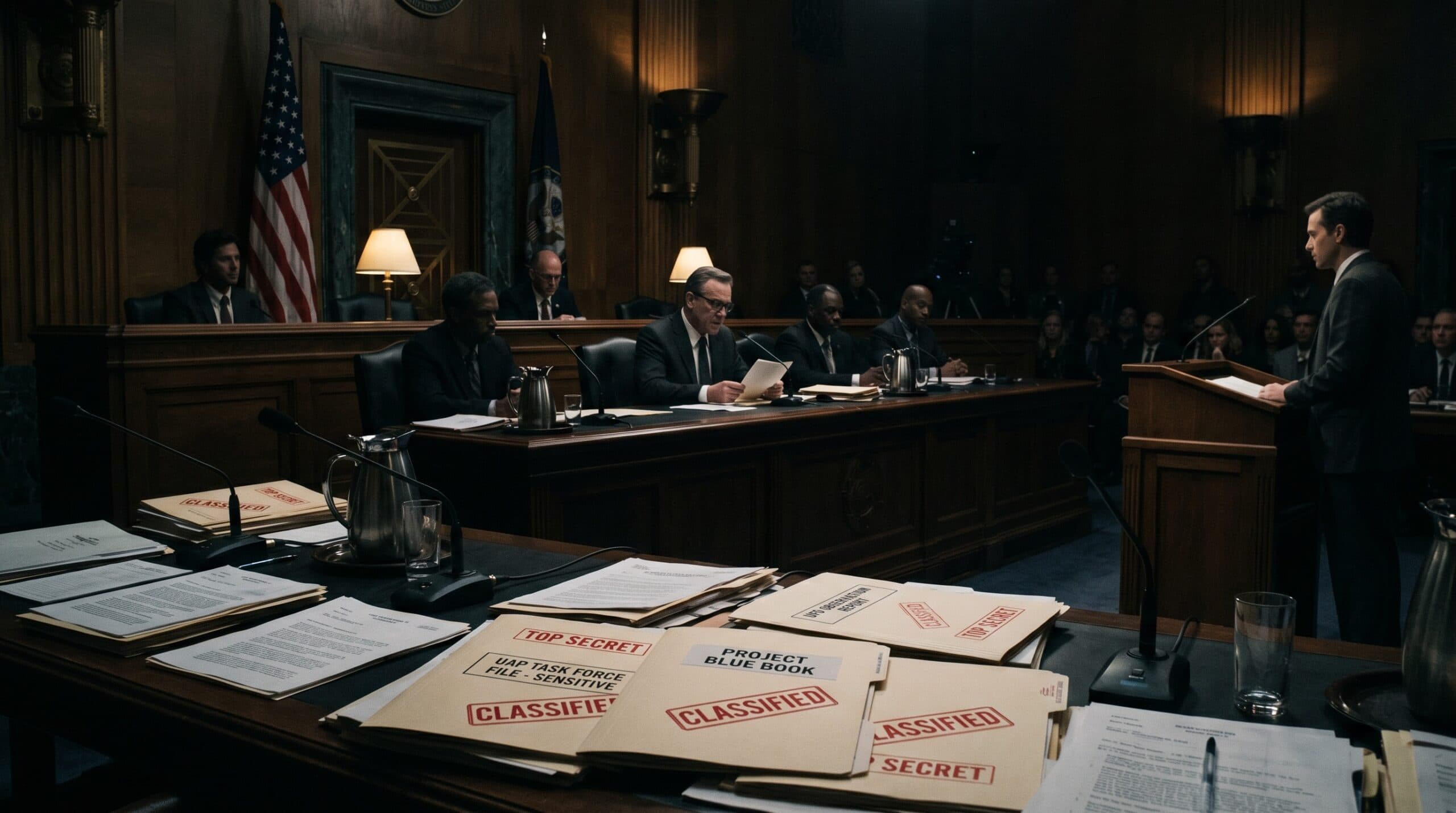
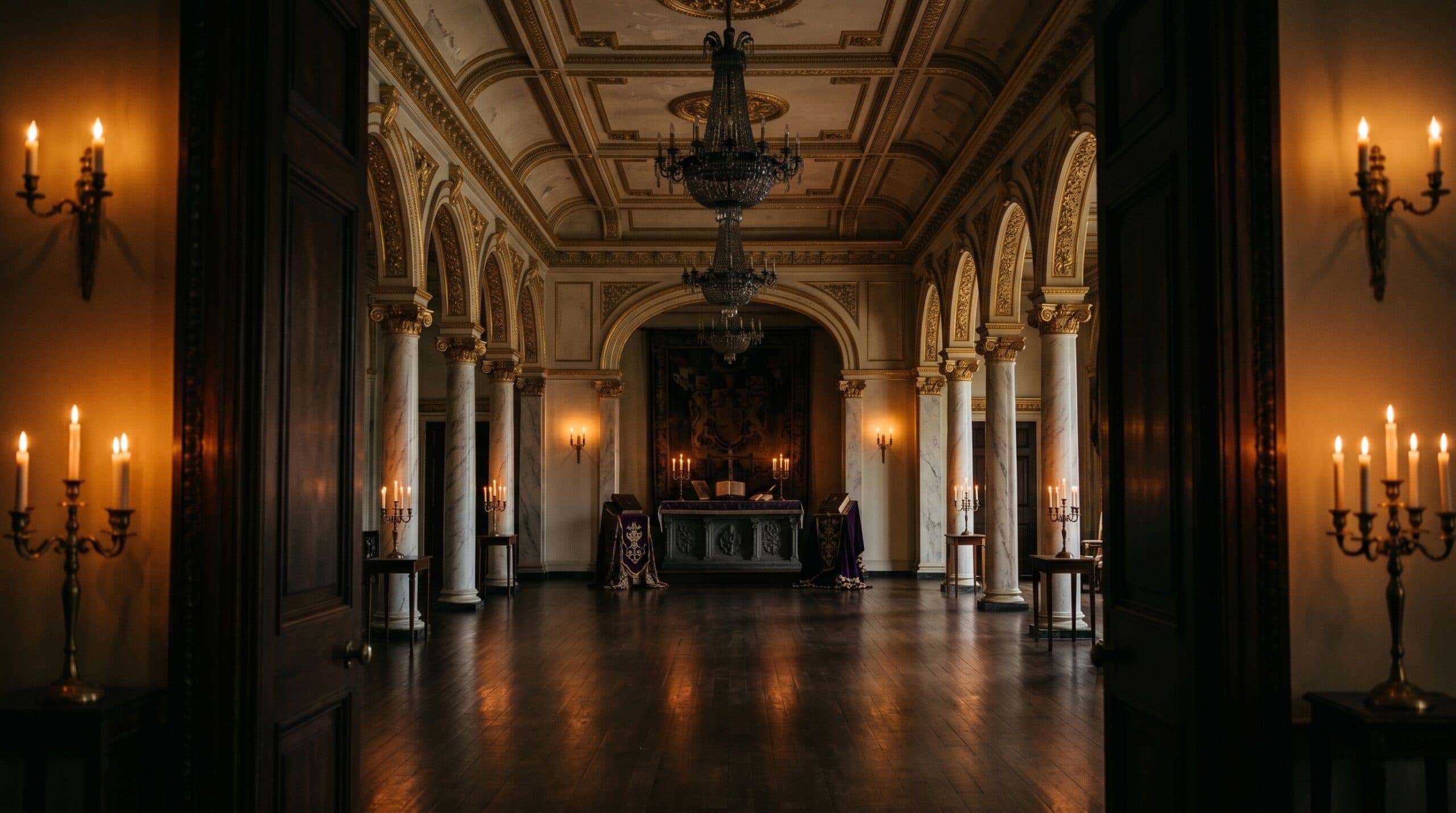
You’re not supposed to notice. That’s the whole point. When you first hear someone whisper that “the ballroom” isn’t a place you can dance in — that it’s a code word hiding something far older and far more deliberate than anyone let on — something inside you either shuts down or wakes up. There’s no middle ground. For millions who’ve stumbled into this labyrinth over the last eighteen months, waking up felt like remembering something they’d always known. The ballroom isn’t a room. The ballroom is a veil. And behind it sits a structure that certain lineages have been protecting, renaming, and quietly renovating for longer than modern history wants to admit.
It starts with a feeling — that prickling certainty that the word “ballroom” appears in places it has no business being. A leaked transcript here. An obfuscated memo there. A casual remark from a figure who should have been vetted, should have been scripted, should absolutely have stayed on message. Instead, they said it. The Ballroom. And then they moved on as though nothing had happened. But for the ones watching — the ones who’d already pieced together fragments from older threads about Milano Cortina Olympics occult symbolism debate — it was the same click you get when two puzzle pieces snap together. Not proof. Not yet. But a signal. A breadcrumb. And once you’ve seen one, you start seeing the trail.
What the Ballroom theory claims
At its core, the Ballroom theory proposes that “the ballroom” functions as a deliberately inserted substitute word across documents, broadcasts, architecture, and coded correspondence for what the theory calls “the Temple.” The Temple is intentionally kept vague in discussions, because precision would hand the conversation to people who only want to mock it. What the Temple represents, according to the most coherent versions of the theory, is a physical or organizational nexus: a location or network where symbolic rituals, initiatory practices, and structural power arrangements converge with deliberate intent. Not a single building with a plaque, but a system. A protocol. A grammar of control dressed up as tradition.
The claim isn’t that everyone who says “ballroom” is winking at you. The claim is that at certain levels, in certain documents, the word is being used knowingly. It’s a shibboleth — if you recognize it, you’re already inside the conversation. If you don’t, it reads as mundane. And that’s exactly how a code word is supposed to function.
What makes the theory so gripping is that it doesn’t ask you to accept a single explosive claim. It asks you to notice a pattern. The ballroom appears in planning documents adjacent to events that independent researchers have long flagged as symbolically loaded. It appears in architectural references that align with sacred geometry patterns people have been cataloging for decades — the same geometric alignment you’d expect in a space designed with intentional symbolism, not one built for social dancing.
The people pushing the Ballroom argument don’t all agree on every detail, and that’s part of what makes the theory feel organic rather than manufactured. Some argue the Temple is purely metaphorical — a designation for a class of people operating under an older cosmology. Others point to satellite imagery, architectural plans, and declassified documents they say corroborate a physical reading. Still others think the Temple is both — a physical structure exists, but the word’s real power comes from functioning on two registers simultaneously: literal for the initiated, decorative for everyone else.
What all versions agree on: the substitution isn’t accidental. And once you accept that substitution is happening, you face a follow-up question that changes everything.
Why now?
Why is the ballroom appearing more frequently in publicly accessible materials over the last several years than at any point in living memory? Why are people finding references in contexts that couldn’t have been planted, in documents predating the current discussion by decades? Why does the pattern hold up under scrutiny — not conclusively, but consistently enough that the people decoding it keep finding more, not less, the deeper they go?
None of these questions have clean answers. That’s the nature of working with material someone deliberately obscured. But absence of clean answers isn’t the same as absence of a pattern. And the pattern is what has millions hooked.
Where the idea first surfaced
The Ballroom theory did not emerge from a single viral post or a famous whistleblower. It emerged slowly, in fragmented form, across communities that had been working on adjacent puzzles for years without realizing they were looking at different faces of the same structure.
The earliest credible seed traces to discussions on imageboards and encrypted chat groups in late 2024, where users started cataloging instances of “ballroom” appearing in anomalous contexts. A municipal planning document for a building complex that didn’t match its stated function. A reference in a declassified intelligence document where the word appeared adjacent to organizational structure discussions rather than physical space. Individually, each could be chalked up to eccentric naming or poor drafting. Collectively, they started to look like something else entirely.
The conversation caught fire when a viral Imgur album that sparked discussion across multiple platforms compiled over sixty instances of “ballroom” appearing in documents, transcripts, and architectural references spanning a forty-year period. The album didn’t argue — it displayed. It let the material speak for itself, and that restraint was its own kind of genius. When people are handed a finished argument, they resist. When they’re handed raw material and invited to look, they lean in. That album was the match.
From there, the conversation migrated to a r/conspiracy thread with 5387 points that ballooned into thousands of comments, with users cross-referencing instances of the word against historical temple construction records, Masonic documentation, and organizational charts from institutions with known esoteric affiliations. The more people looked, the more they found.
What surprised seasoned researchers was how quickly the Ballroom discussion connected to older threads of investigation that had gone dormant. People tracking MKUltra continuation claims found that vocabulary used in those older documents occasionally used “ballroom” in ways that mapped onto the theory’s framework. Others working on Credo Mutwa and the aliens noticed that certain African temple traditions described spatial arrangements mirroring what Ballroom documents seemed to reference. Even researchers exploring the Giant of Kandahar encounter reported finding the word “ballroom” in adjacent documents in ways too contextually strange to dismiss.
None of these connections proved anything. But they did something more valuable for a conspiracy community: they created resonance. When a theory connects to other investigations people have already invested years into, it doesn’t feel like a new theory. It feels like a missing piece. And that feeling is enormously powerful. It creates movement. It creates the kind of distributed investigation that no single researcher could ever replicate.
The Ballroom theory didn’t emerge as a polished product. It emerged as a question. And the right questions are far more durable than answers.
Why people are finding the same symbols in different places
Here is where the Ballroom theory stops being about a single code word and becomes about something much larger — the claim that a persistent symbolic architecture threads through institutions, media, and physical spaces that most people walk through without noticing. The ballroom is the entry point. What it opens onto is a conversation about why certain symbols, shapes, and organizational patterns keep showing up in places that should have nothing to do with each other.
Inside the Ballroom community, you start recognizing what researchers themselves recognize: the theory is fundamentally about pattern persistence. Why does the same geometric ratio appear in the floor plan of a private club building in London and in a government-adjacent complex in the United States, both referencing a “ballroom” in documents describing internal functions? Why do ceremonial sequences documented in nineteenth-century temple records match the sequencing of events described in contemporary documents that use “the ballroom” as a descriptor? Why do the same symbolic motifs — compass-adjacent angles, tripartite spatial divisions, deliberate cardinal orientation — appear across institutions that officially have no relationship?
The theory’s proponents don’t claim to have mapped the entire structure. What they claim is that they’ve identified enough of its grammar to suspect that the structure is intentional, persistent, and operating with continuity across decades — possibly centuries — of institutional development. The ballroom, in this reading, is one of the theory’s most valuable discoveries because it’s a word never meant to be found as a code word. It was meant to function as camouflage. A ballroom is harmless. A ballroom is socially acceptable. A ballroom raises no eyebrows.
Which is exactly why it makes perfect sense as a designation for something not supposed to be discussed openly.
The people working on this are cataloging architectural blueprints where ballroom floor dimensions match temple proportions from older traditions. They’re transcribing audio from events where the word is used with tonal emphasis that suggests referential loading — speakers stressing it in ways that feel deliberate, almost ritual. They’re building databases. They’re connecting instances. They’re doing the tedious, unglamorous work of pattern documentation that every credible investigation eventually requires.
And the patterns don’t dissolve under scrutiny — they compound.
It’s worth noting that this work intersects heavily with broader occult symbolism research that academics have conducted for over a century, though the academic and Ballroom communities operate in almost entirely separate spheres. Where academics study occult symbolism as a historical phenomenon, Ballroom researchers are investigating it as a living system. They’re not looking backward. They’re looking at the present and asking whether the symbolic architecture historians have documented is still actively being used — still hiding in plain sight.
The answer, increasingly, seems to be yes. Once you accept that possibility, the ballroom stops being a mystery about a single word and becomes a doorway into a conversation about how power organizes itself, how institutions preserve internal culture across generations, and how carefully chosen language functions as both shield and signal for people who know exactly what they’re doing.
What the academic and skeptical view says
Any investigation that takes itself seriously has to face the strongest version of its own criticism. The skeptical and academic view of the Ballroom theory isn’t monolithic, but the most substantive objections cluster around two concerns.
The first is patternicity — the well-documented cognitive tendency for humans to find meaningful patterns in random or unrelated data. Skeptics argue that the Ballroom theory is a textbook case: researchers start with a compelling premise, notice that “ballroom” appears in various documents, then retrospectively construct connections that weren’t intended by the documents’ authors. The fact that the connections feel revealing, critics say, is exactly what patternicity looks like from the inside.
The second objection is more specific. Academics specializing in institutional linguistics point out that “ballroom” was historically a common descriptive term for any large multi-purpose gathering space in government, institutional, and organizational contexts from the mid-twentieth century onward. The word wasn’t chosen to encode anything. It was chosen because it was the most common, non-specific label for a space designed to hold large groups. Under this reading, the Ballroom theory is an elaborate over-reading of mundane naming conventions.
The most generous skeptics acknowledge that some institutional documents do contain genuinely strange language. They accept that certain organizations have histories of esoteric symbolism. They even concede that the cross-referencing work being done by Ballroom researchers is impressive methodologically. What they resist is the conclusion that the code word is intentional. The patterns are real, they say, but the interpretation is backwards — the documents aren’t hiding a temple behind the word ballroom. The word is just a word, and the patterns are echoes of architectural and ceremonial traditions that influenced institutional design without functioning as active code.
Where this leaves someone investigating the Ballroom theory depends entirely on what kind of evidence they find convincing. If you require a smoking gun — a document explicitly stating that “ballroom means temple” — the theory will never satisfy you. No investigation operating at this level of opacity will ever produce that kind of admission. The whole point of a functional code word is that it never explains itself. But if you’re comfortable with cumulative evidence — with the idea that enough converging indicators can build a plausible case even without a single definitive document — the Ballroom theory offers more material to work with than most conspiracy frameworks reaching similar levels of attention.
What may be most remarkable about the Ballroom debate isn’t the theory itself, but what it reveals about how millions of people are choosing to engage with information in an era where nothing can be trusted at face value. Whether the ballroom is a temple or just a room, the fact that so many people are learning to read documents cross-referentially, to question institutional language, to trace symbolic patterns through architecture and media — that’s a cultural shift that’s going to outlast any single theory. The ballroom may or may not be hiding anything. But the people looking for it are learning to see in ways they didn’t know they could, and once you learn to see that way, you don’t go back to sleeping.