A ‘Black Hole Star’ May Be Hiding Inside the Early Universe’s Red Dots | Unexplained
Space
A ‘Black Hole Star’ May Be Hiding Inside the Early Universe’s Red Dots
One crimson point in the infant universe is so bright that ordinary starlight cannot explain it. A new Nature study argues it may be a dense gas envelope powered from within by a growing black hole.
Art Grindstone is the hard-nosed storyteller behind Unexplained.co, a veteran investigator whose life’s work sits at the crossroads of the paranormal, fringe science, and the shadows most people try not to look into. With decades spent chasing impossible stories — black-budget psychic programs, vanished Cold War experiments, desert rituals that sparked UFO waves, and the strange phenomena buried in America’s forgotten backroads — Art brings a rare combination of skepticism, awe, and journalistic precision. He’s not here to debunk. He’s not here to blindly believe. He follows the evidence wherever it leads — even when it leads someplace deeply uncomfortable. Known for his immersive, cinematic style and his ability to turn obscure research into gripping narrative, Art has built a devoted following across podcasts, long-form features, documentaries, and serialized investigations. His interviews are direct. His analysis is unflinching. His voice has become a staple in the modern paranormal renaissance — the guy people turn to when a story is too strange, too complex, or too dangerous for anyone else to touch. Off-mic, Art works with a distributed network of researchers, archivists, and field operatives who help surface the stories mainstream media ignores. On-mic, he transforms their findings into meticulous, high-impact reporting that refuses to insult the intelligence of true believers. His philosophy is simple: Take the phenomenon seriously. Treat the audience with respect. Tell the story as if the world depends on it — because sometimes it does. When Art Grindstone digs into a case, he isn’t just chasing a mystery. He’s tracing the fault lines of reality itself.
7 min · 1,556 words
In This Report(4)
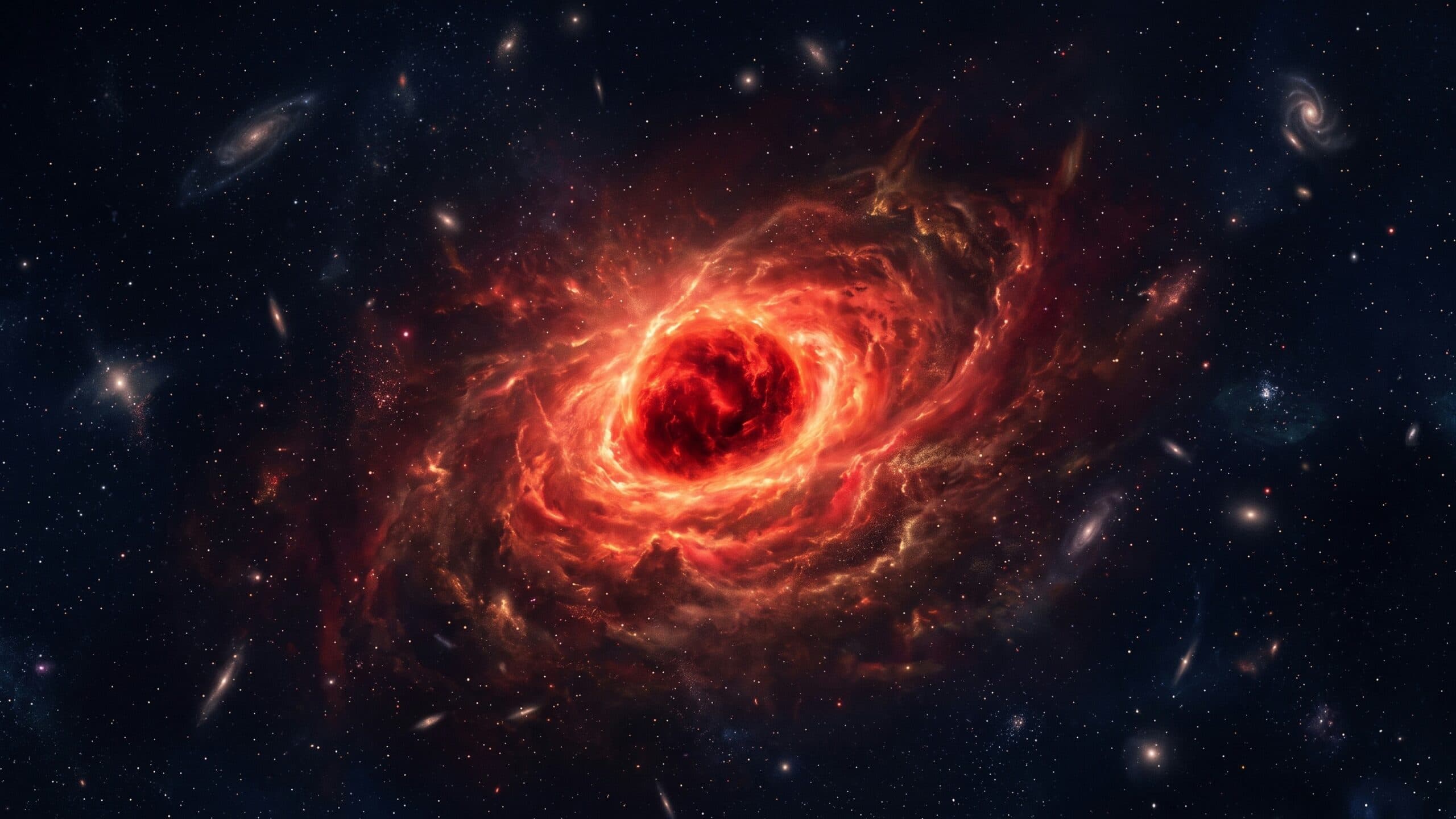
It arrived in a James Webb Space Telescope image as a point of impossible-looking red light: tiny against the black, ancient enough to have shone only a few hundred million years after the Big Bang, and bright enough to make an ordinary star seem like the wrong answer before the investigation had even properly begun.
The proposed answer has a name that sounds lifted from cosmic folklore: a **black hole star**. The object, designated MoM-BH*-1, is not supposed to be a star with a black hole nearby. In the team’s model, a rapidly feeding black hole sits inside an immense, dense envelope of hydrogen gas. From far away, the envelope can resemble a stellar atmosphere. The engine beneath it is something much hungrier.
That possibility has caught attention because Webb has been finding mysterious “little red dots” throughout the early universe. They are compact, unusually red sources that do not fit comfortably into the first simple stories astronomers told about young galaxies. For anyone drawn to the oldest unsolved riddles in the sky, this is an especially potent one: the universe may have been making objects that look like stars while being powered by black holes.
Advertisement
The red dot that would not behave like a normal star
The report comes from the Mirage or Miracle survey, a programme looking for extremely early galaxies in Webb data. Its researchers found a source that was both very red and very luminous. Redness in astronomy can sometimes be caused by dust, much as smoke can change the apparent colour of light. But the spectrum did not line up neatly with a dust-veiled galaxy.
Instead, it showed an exceptionally deep Balmer break: a sharp change in emitted light associated with hydrogen absorbing photons. In familiar stars, related signatures can come from a stellar atmosphere. Here, the feature was so extreme that it suggested a much denser, stranger environment. The object also showed very little evidence for elements heavier than hydrogen and helium.
The team’s analysis, published in Nature, tested possible ways to reproduce that combination of redness, luminosity and spectral shape. Their preferred model places a black hole of roughly 100,000 solar masses inside a thick hydrogen cocoon about the size of the solar system. Matter falling toward the black hole releases enormous energy; the surrounding gas processes that energy and presents a star-like surface to distant observers.
The scale is the part that makes the phrase “black hole star” feel less like a metaphor. MIT’s account of the research, republished by Phys.org, describes an object roughly solar-system-sized yet emitting about 100 billion times the energy that any known ordinary star could physically supply. Nuclear fusion is not the proposed power source. Accretion—the violent conversion of infalling matter into radiation near a black hole—is.
The Etruscan Well Sealed With Human Remains Is Stranger Than a Sacrifice Story
A newly reported Etruscan well in Italy was opened with offerings and sealed with human remains. The evidence reveals a ritual mystery, not a simple sacrifice tale.
Aug 18, 2026 • 7 min read
Articles
The Sunken Basilica of Iznik: Did a Lake Hide the Council of Nicaea?
A basilica beneath Lake Iznik has revived a 1,700-year-old question: was this the setting of the First Council of Nicaea, or a compelling archaeological near-miss?
Aug 18, 2026 • 6 min read
Articles
The Lonely Rock That Led Archaeologists to a 3,700-Year-Old Ritual Site
A single stone spotted by a student led archaeologists to a 3,700-year-old ritual site—and raised new questions about how ancient landscapes were read.
Aug 17, 2026 • 4 min read
This is not the familiar image of a black hole as a perfectly dark hole in space. Black holes themselves do not shine. Their surroundings can. Gas accelerated and heated as it falls inward can become among the brightest phenomena in the universe. The mystery is whether, at cosmic dawn, that process could have built a vast opaque shell that mimicked a star rather than the exposed, energetic quasar-like scene people usually imagine.
Why the “little red dots” matter
Webb was built to look back across enormous distances, which also means it looks back in time. Its infrared instruments have made the early universe feel unexpectedly crowded: galaxies and compact objects appear at epochs where astronomers expected much less structure, or at least different kinds of structure.
Little red dots are now a central part of that puzzle. They are not one confirmed class of object. Some could be small galaxies, some active black holes shrouded by dust or gas, and some may belong to categories astronomy has only begun to define. MoM-BH*-1 is notable because its spectrum appears unusually clean: the proposed black-hole-star component may outshine its host galaxy enough for researchers to study the component directly.
The new model therefore offers more than a dramatic label. It gives a testable possibility for at least some little red dots: a growing intermediate-mass black hole embedded in extraordinarily dense primordial gas. A NASA Astrophysics Data System record for the paper identifies the study as “A gas-enshrouded and gas-reddened black hole at cosmic dawn.” That more cautious scientific language is useful. The headline name is memorable, but the evidence is an observed spectrum plus models—not a photograph showing a black hole inside a star.
The finding also reaches into a much older question: how did the universe produce massive black holes so early? Astronomers have found extremely massive black holes at remarkably early cosmic times, and the route from the first collapsing gas clouds to those giants remains a major problem. A gas-fed, obscured phase could be one way black holes grew rapidly while looking unlike the objects researchers expected to find.
Confirmed observation, leading interpretation, open argument
The confirmed part is substantial. Webb observed a compact, exceptionally red and luminous source in the young universe. The spectrum includes an unusually strong Balmer break and little sign of heavy elements. The result has appeared in a peer-reviewed Nature paper, and the underlying object is not a social-media image, a simulation passed off as a telescope view, or a claim about a hidden modern object.
The leading interpretation is the black-hole-star model: a roughly 100,000-solar-mass accreting black hole enclosed by a massive, dense hydrogen atmosphere. It provides a good match to the observed properties in the team’s simulations, and it may explain why this source looks so unlike an ordinary galaxy or an ordinary star.
The disputed or unsettled part is whether that model is uniquely correct. A best-fitting model is not the same thing as direct proof of an internal structure. Alternative combinations of stars, gas, dust and active black-hole emission need continued testing; other little red dots may not share the same explanation at all. The paper’s own title describes a gas-enshrouded black hole, while “black hole star” is a useful shorthand for the proposed appearance and energy arrangement.
Speculation begins when the discovery is turned into a new cosmic species already proven to populate the early universe. It is plausible that similar objects account for some other red dots, but one exceptional source cannot settle an entire population. Nor does the finding mean a black hole can literally replace the fusion core of a normal star in today’s universe. The proposed object belongs to an extreme early setting, rich in primordial gas and radically different from the neighbourhood around the Sun.
A better mystery than a cosmic monster story
The phrase black hole star is irresistible because it joins two things people are taught to keep separate: a star gives light; a black hole consumes it. But the real wonder is not that the categories have magically fused. It is that gravity, gas and radiation may combine under early-universe conditions to create something observationally ambiguous—an object whose outer light disguises the nature of its central engine.
That ambiguity is why the story belongs beside questions like a mushroom effect whose mechanism has not yet been isolated. In both cases, a vivid name can race ahead of the evidence. The more durable mystery lies in the disciplined gap between observation and explanation: a repeatable signature, a serious hypothesis, and the missing decisive test.
Astronomers now need more spectra, more examples, and observations designed to distinguish competing models. NASA’s Webb science programme is precisely the kind of infrared window that makes such tests possible, while the ESA Webb science archive shows how much of the mission’s value comes from turning faint ancient light into public evidence that can be examined again and again.
For now, the defensible conclusion is strange enough. One red dot at cosmic dawn is best explained, so far, by a black hole feeding inside a star-like envelope of primordial gas. Whether it is the first clear member of a new class, the key to the little-red-dot puzzle, or an exotic outlier is still unresolved. The universe has not handed us a black hole wearing a star as a costume. It has handed us the light of something that may have made the distinction far less tidy than we thought.
That is also why the next observations matter more than the name. If future Webb spectra find the same deep hydrogen signature, extreme luminosity and elemental simplicity in comparable sources, the black-hole-star interpretation will become far harder to dismiss as a one-off fit. If they do not, MoM-BH*-1 may still be valuable: a rare object that revealed a missing branch in the early universe’s catalogue. Either way, its faint red light has turned a distant dot into a concrete question about how the first hidden engines grew.
Art Grindstone is the hard-nosed storyteller behind Unexplained.co, a veteran investigator whose life’s work sits at the crossroads of the paranormal, fringe science, and the shadows most people try not to look into. With decades spent chasing impossible stories — black-budget psychic programs, vanished Cold War experiments, desert rituals that sparked UFO waves, and the strange phenomena buried in America’s forgotten backroads — Art brings a rare combination of skepticism, awe, and journalistic precision. He’s not here to debunk. He’s not here to blindly believe. He follows the evidence wherever it leads — even when it leads someplace deeply uncomfortable. Known for his immersive, cinematic style and his ability to turn obscure research into gripping narrative, Art has built a devoted following across podcasts, long-form features, documentaries, and serialized investigations. His interviews are direct. His analysis is unflinching. His voice has become a staple in the modern paranormal renaissance — the guy people turn to when a story is too strange, too complex, or too dangerous for anyone else to touch. Off-mic, Art works with a distributed network of researchers, archivists, and field operatives who help surface the stories mainstream media ignores. On-mic, he transforms their findings into meticulous, high-impact reporting that refuses to insult the intelligence of true believers. His philosophy is simple: Take the phenomenon seriously. Treat the audience with respect. Tell the story as if the world depends on it — because sometimes it does. When Art Grindstone digs into a case, he isn’t just chasing a mystery. He’s tracing the fault lines of reality itself.