Doomsday Clock at 85 Seconds to Midnight: What the Warning…
End Times
Doomsday Clock at 85 Seconds to Midnight: What the Warning Really Means
The Doomsday Clock is a symbolic warning, not a literal timer. Here’s what 85 seconds to midnight means, why it matters, and why some critics remain skeptical.
Reporting on power, policy, and institutional conflict.
8 min · 1,901 words
In This Report(13)
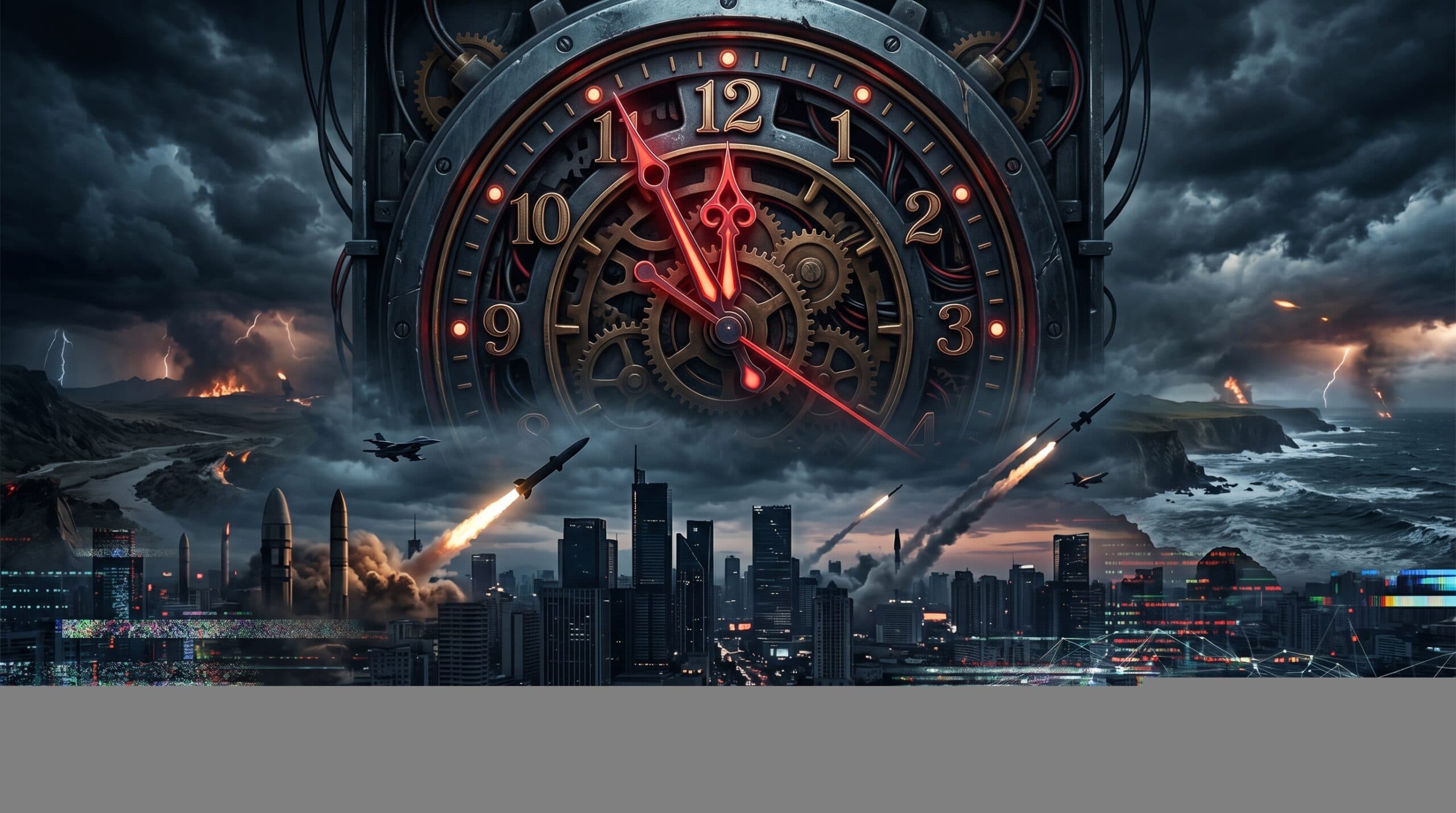
Eighty-five seconds to midnight does not mean the world has 85 literal seconds left. The Doomsday Clock is a symbol, created by the Bulletin of the Atomic Scientists to express how dangerously close humanity appears, in its judgment, to catastrophic human-made disaster. Midnight stands for global catastrophe. The shrinking distance to it is meant to feel alarming, because alarm is the point.
That is why the Clock still lands with such force. In a single image, it condenses nuclear danger, geopolitical instability, climate stress, technological risk, and failures of international cooperation into something instantly legible. Supporters see that as one of the most effective warning devices in public life. Critics see a theatrical metaphor that can make complicated policy questions sound like a cosmic countdown. Both views capture something true about why the Clock keeps returning to public conversation.
The Doomsday Clock was introduced in 1947 by the Bulletin of the Atomic Scientists, an organization founded by scientists connected to the Manhattan Project who later became deeply concerned about the dangers created by nuclear weapons. The Clock was never intended as a scientific instrument. It was designed as a public symbol—a way to translate abstract existential danger into an image almost anyone could understand at a glance.
Midnight represents civilization-ending catastrophe. When the hands move closer to midnight, the Bulletin is signaling that the international situation has become more dangerous. When they move farther away, it is signaling relative improvement. Although the Clock began in the shadow of nuclear war, the factors considered over time have broadened to include climate change, emerging technologies, misinformation, biological threats, and the weakening of the political systems needed to manage them.
So when people say the Clock stands at 85 seconds to midnight, what they really mean is this: the Bulletin believes the world is in an exceptionally dangerous moment, and it wants that warning to be difficult to ignore.
Why use a clock at all?
Because symbols move faster than reports.
Few people will sit down with a technical assessment of arms control, biosafety, climate feedback loops, or global information disorder. A clock hand edging toward midnight needs no glossary. It communicates urgency, proximity, and consequence in a single glance.
The Mushroom That Makes People See Tiny People—and the Chemical Nobody Has Found
Reports from China, Papua New Guinea and the Philippines describe the same unnerving vision after eating one mushroom: crowds of tiny people. Researchers have now connected the cases to Lanmaoa asiatica, but the active chemical remains unknown.
Aug 20, 2026 • 9 min read
Strange History
The Etruscan Well Sealed With Human Remains Is Stranger Than a Sacrifice Story
A newly reported Etruscan well in Italy was opened with offerings and sealed with human remains. The evidence reveals a ritual mystery, not a simple sacrifice tale.
Aug 18, 2026 • 7 min read
Cryptozoology
The Deep Sea Sphere: 1990s SCUBA Divers Filmed Something in the Bahamas That Still Defies Classification
A clip from the 1990s shows SCUBA divers encountering a strange, perfectly spherical creature in the Bahamas. Decades later, the footage is resurfacing — and cryptid researchers, marine biologists, and UAP watchers all have different theories about what it is.
May 14, 2026 • 6 min read
That simplicity is the source of the Clock’s power, and also the source of its limitations. It makes sprawling issues legible. It can also make them seem more unified and measurable than they truly are. Nuclear war, climate disruption, and technology-related dangers do not run on one shared schedule. They are different problems with different pathways and timelines. The Clock folds them into one image because its purpose is communication, not precision.
What 85 seconds to midnight actually means
It means the Bulletin’s leaders and advisers believe humanity remains perilously close to self-inflicted catastrophe. It does not mean disaster is mathematically due, prophetically fixed, or literally timed.
The number is best understood as a judgment rendered in symbolic form. It says that a cluster of major risks is being managed badly enough that the margin for safety has become frighteningly thin. The closer the Clock moves to midnight, the more urgently the organization is arguing that present conditions are unacceptable.
That can make the Clock sound almost mystical to people encountering it for the first time. But the Clock is not an oracle. It is an argument, compressed into a picture.
Why the warning feels so powerful
The image works because it turns sprawling danger into story. A list of risks can remain abstract no matter how grave it is. A countdown does not. Midnight carries emotional weight even before anyone explains it. It suggests endings, finality, and the moment after which there is no easy return.
That is why the Clock travels far beyond science and policy circles. It appears in conversations about apocalypse, civilizational collapse, end-times anxiety, and the broader modern feeling that history has begun to accelerate. The institution behind it is secular, but the metaphor brushes against very old human instincts. People are drawn to symbols that seem to sum up the age they are living through.
Why the Clock moves
The Bulletin adjusts the Clock when it believes the balance of global risk has shifted in a meaningful way. Historically, nuclear danger has remained central: arms races, deteriorating diplomacy, weakened treaties, and new weapons systems can all push the hands forward. In more recent decades, the organization has also emphasized climate change, biological threats, disruptive technologies, and information disorder.
The specific mix varies from year to year, but the larger message is usually consistent. The danger is not just that catastrophic threats exist. It is that the institutions capable of reducing them often appear unable or unwilling to act with enough speed, clarity, or cooperation.
That is one reason the warning can feel so bleak. It is not merely describing a hazardous world. It is describing a world in which hazards are being handled poorly.
Is the Doomsday Clock scientifically objective?
Not in the narrow sense.
The Clock is informed by expertise, but it is not the reading of a device. There is no machine that measures “seconds to midnight.” The setting reflects deliberation by scientists, policy experts, and other advisers associated with the Bulletin, who review current conditions and issue a symbolic judgment.
That does not make the Clock meaningless or arbitrary. It means it should be understood for what it is: an expert communication tool, not an empirical meter. This distinction matters because public arguments about the Clock often go wrong in opposite directions. Admirers sometimes talk about it as though it carries near-prophetic authority. Detractors sometimes ridicule it for lacking a mechanical precision it never claimed to possess.
The fairest reading is simpler than either extreme. The Clock is a serious symbolic warning, not a scientific instrument.
Why supporters defend it
Supporters argue that the Clock remains useful for several reasons.
First, it keeps existential risk visible. The gravest threats in modern life often become background noise precisely because they are slow-moving, technical, or politically exhausting. The Clock cuts through that haze.
Second, it encourages people to think about interconnected danger. Nuclear war, climate instability, disinformation, and emerging technologies may not share one timetable, but they can compound one another in a world already under strain.
Third, its long history gives it resonance. Because the Clock has been part of public life for generations, each movement invites comparison with earlier eras of fear, brinkmanship, diplomacy, and uneasy reprieve.
In that view, the drama is not a flaw but a function. A warning nobody notices is not much use as a warning.
What critics object to
Critics are not all making the same complaint. Some argue that the Clock is too theatrical, turning difficult policy debates into a press-ready image. Others worry that it can create fatalism, as though the world were trapped in an almost completed countdown. Still others say that combining very different threats under one symbol can blur more than it clarifies.
Those objections are serious. A person who hears “85 seconds to midnight” may come away with a strong feeling of dread but only a weak sense of what changed, why it changed, or what actions might reduce the danger. A symbol can concentrate emotion more efficiently than it builds understanding.
There is also the risk of repetition. If the Clock remains near midnight year after year, some audiences may grow numb to the warning. Emergency language can lose force when it becomes familiar.
Why people connect it to apocalyptic thinking
Even though the Clock comes from scientists and policy advocates, its imagery carries a mythic charge. Midnight is not merely a point on a dial. In literature, folklore, and popular imagination, it is the hour of endings, thresholds, and irreversible turns. When the public hears that humanity is seconds from midnight, the metaphor can slip easily into older patterns of thought: omens, reckonings, final warnings, and the sense that history is nearing a break point.
That does not make the Clock mystical or religious. It means symbols carry emotional cargo whether institutions intend them to or not. The image is secular. The reaction to it may be cultural, psychological, or even spiritual.
This helps explain why the Clock travels so widely. Few modern public symbols can speak at once to policy experts, casual news readers, and people already primed to interpret the moment as a sign of the end.
Does the Clock predict the future?
No. It warns; it does not predict.
That distinction is everything. Prediction suggests certainty. Warning suggests contingency. The Doomsday Clock is not saying catastrophe will arrive on schedule. It is saying that the conditions under which catastrophe becomes more likely are dangerously present.
The argument behind the image is that human choices still matter. The future is not fixed. The warning is urgent precisely because the trajectory can still, in principle, be changed.
Why the Clock keeps coming back
The Doomsday Clock endures because every era wants a symbol that can gather its anxieties into one frame. During the Cold War, the threat it evoked was stark and immediate. In the twenty-first century, the danger is broader and messier, which arguably makes the Clock more useful as a cultural shorthand and less satisfying as a precise explanation.
It also persists because the conditions that gave rise to it never truly disappeared. Nuclear arsenals remain. Climate pressures deepen. Trust in institutions frays. Powerful technologies spread faster than governance. One danger may recede for a time, only for another to sharpen into view.
The Clock returns, then, not because it is magical, but because the world keeps producing the kind of peril it was built to represent.
What a reader should take from 85 seconds to midnight
Neither panic nor contempt is especially useful.
Panic mistakes the symbol for fate. Contempt misses why the symbol exists. The more reasonable response is to treat the number as a concentrated warning from people who believe current global risk is unacceptably high. You do not need to agree with every element of the Bulletin’s framing to understand the core message.
The Clock does not tell you the exact future. It tries to make the present harder to ignore.
The meaning of the metaphor
At 85 seconds to midnight, the Doomsday Clock is doing exactly what it was designed to do: turning diffuse human-made danger into an image sharp enough to lodge in the public mind. Whether you see that as a necessary civic alarm or an imperfect piece of public theater, the symbol endures because people keep reaching for it when they want to describe a world that feels precarious.
That is the Clock’s real force. It is not a prophecy machine and not a literal timer. It is a human warning about human danger. The number is symbolic. The risks behind it are not.