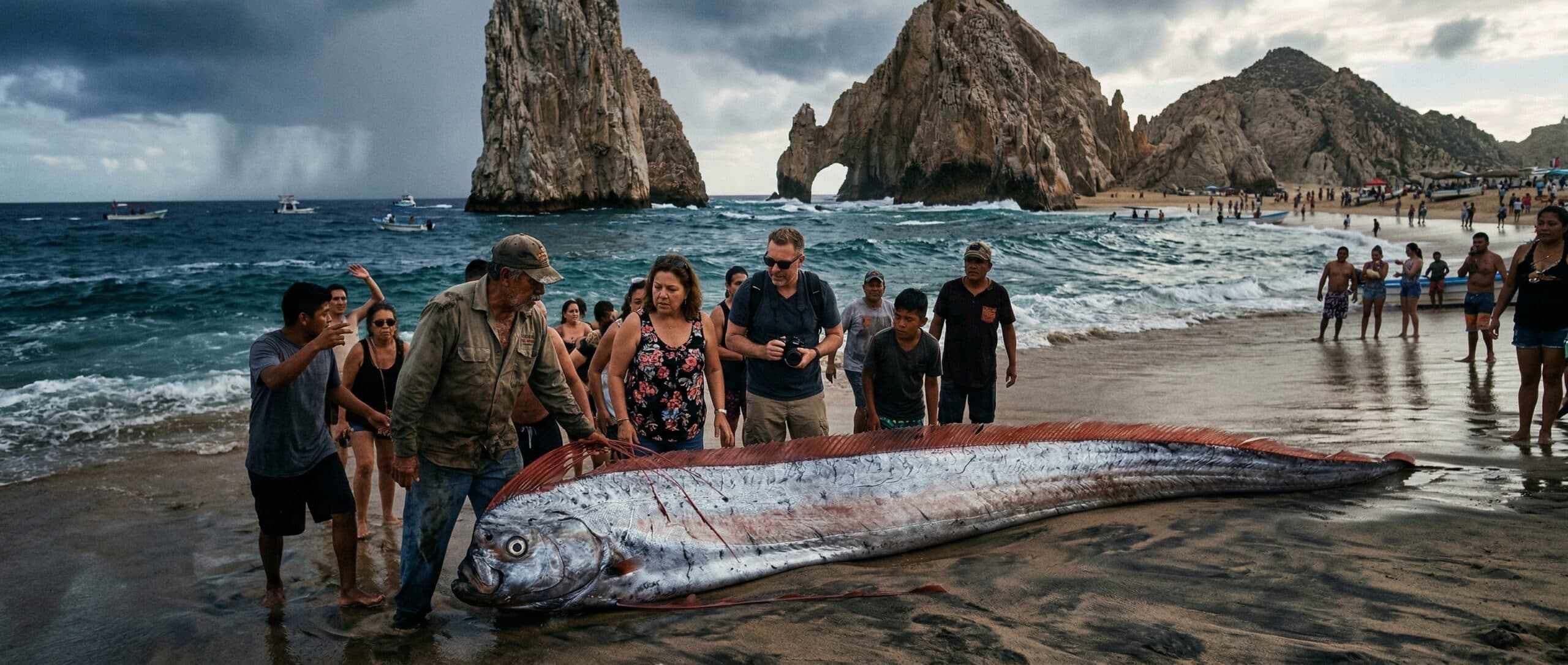
Two live oarfish washing ashore in Cabo San Lucas turned into a full-blown omen story this month, reviving the old superstition that these deep-sea creatures are “doomsday fish” whose appearance predicts earthquakes,…
Art Grindstone is the hard-nosed storyteller behind Unexplained.co, a veteran investigator whose life’s work sits at the crossroads of the paranormal, fringe science, and the shadows most people try not to look into. With decades spent chasing impossible stories — black-budget psychic programs, vanished Cold War experiments, desert rituals that sparked UFO waves, and the strange phenomena buried in America’s forgotten backroads — Art brings a rare combination of skepticism, awe, and journalistic precision. He’s not here to debunk. He’s not here to blindly believe. He follows the evidence wherever it leads — even when it leads someplace deeply uncomfortable. Known for his immersive, cinematic style and his ability to turn obscure research into gripping narrative, Art has built a devoted following across podcasts, long-form features, documentaries, and serialized investigations. His interviews are direct. His analysis is unflinching. His voice has become a staple in the modern paranormal renaissance — the guy people turn to when a story is too strange, too complex, or too dangerous for anyone else to touch. Off-mic, Art works with a distributed network of researchers, archivists, and field operatives who help surface the stories mainstream media ignores. On-mic, he transforms their findings into meticulous, high-impact reporting that refuses to insult the intelligence of true believers. His philosophy is simple: Take the phenomenon seriously. Treat the audience with respect. Tell the story as if the world depends on it — because sometimes it does. When Art Grindstone digs into a case, he isn’t just chasing a mystery. He’s tracing the fault lines of reality itself.
4 min · 922 words
In This Report(11)
Two live oarfish washing ashore in Cabo San Lucas turned into a full-blown omen story this month, reviving the old superstition that these deep-sea creatures are “doomsday fish” whose appearance predicts earthquakes, tsunamis, or other disasters. The visuals did most of the work: ribbon-like bodies, metallic sheen, crimson fins, and the rarity of seeing even one of them near shore—let alone two. According to USA Today / For The Win, this story is drawing attention well beyond its original niche.
What makes this a strong unexplained trend is the collision of folklore, viral video, and anxiety. The event itself is biological. The online reaction is mythic. Suddenly a marine-animal rescue becomes a prophecy narrative.
What Happened
The core reason this story is hot is that it turns an unusual animal encounter into a symbolic warning story people can project onto current fears. Reporting from Cabo Sun adds context to how the story is being framed.
Advertisement
Beachgoers Monica and Katie Pittenger encountered two distressed oarfish near Cabo San Lucas in late February/early March 2026.
Video of the rescue spread online and quickly triggered the “doomsday fish” framing.
USA Today’s For The Win and regional outlets pushed back on the omen narrative, noting that there is no scientific basis for the folklore claim.
The story landed in a sensitive moment for Los Cabos tourism, with local coverage trying to calm visitors after unrelated security anxieties elsewhere in Mexico.
Multiple viral and tabloid outlets amplified the supernatural angle, connecting the oarfish to Japanese folklore and historical earthquake lore.
What Evidence Exists
Here’s what is known: Two live oarfish washing ashore in Cabo San Lucas turned into a full-blown omen story this month, reviving the old superstition that these deep-sea creatures are “doomsday fish” whose appearance predicts earthquakes, tsunamis, or other disasters. The visuals did most of the work: ribbon-like bodies, metallic sheen, crimson fins, and the rarity of seeing even one of them near shore—let alone two.
The strongest evidence in stories like this is often not a final proof object, but a mixture of witness accounts, media framing, prior folklore, and the cultural weight of the subject itself. That is why separating verified facts from interpretation matters.
The Sandia Quantum Scientist Who Vanished: Ingrid Lane’s Double Life and the Mystery No One Solves
Ingrid Lane lived a double life — bipolar musician to the world, Sandia National Laboratories quantum computing scientist underneath. Then she disappeared. The story is a fixation in high-strangeness communities.
May 14, 2026 • 7 min read
Conspiracy Theories
The Sandia Quantum Scientist Who Vanished: Ingrid Lane’s Double Life and the Mystery No One Solves
Ingrid Lane lived a double life — bipolar musician to the world, Sandia National Laboratories quantum computing scientist underneath. Then she disappeared. The story is a fixation in high-strangeness communities.
May 13, 2026 • 7 min read
Ancient Civilizations
1957 Electrogravitics Secret: The Classified Research Program Whose Watchers Have All ‘Gone’
A viral essay claims that classified electrogravitics research made real progress in the 1950s — and that everyone who knew the truth about it has since disappeared from the public record. The story is spreading through high-strangeness forums.
May 13, 2026 • 7 min read
Authoritative coverage and primary reporting should stay central to the analysis, including sources such as:
Researchers and skeptics have argued that unexplained stories often grow fastest when the emotional framing is stronger than the evidentiary record. That does not mean the story is meaningless. It means the burden of proof and the burden of interpretation are not the same thing.
The most widely cited explanation is usually the least exotic one that still fits the known facts. But unresolved cases persist because the simplest explanation does not always feel emotionally complete to the audience following them.
Why It Matters
Folklore still spreads faster than scientific context
People remember “earthquake omen fish” much more easily than deep-sea disorientation, illness, or ocean-current explanations.
Viral unexplained content increasingly comes from animal behavior
Odd creatures, strange strandings, and unusual migration patterns now feed the same attention economy that once belonged mainly to UFO photos and ghost videos.
The story plugs directly into doom culture
Audiences primed for collapse narratives love anything that feels like nature sending a sign.
It’s an ideal short-form topic
The visual is immediate, the mythology is simple, and the debunk is easy to present alongside the legend.
It reveals how place-based fear can get amplified by symbolism
Even when local officials and tourism coverage try to calm things down, a powerful omen narrative can reshape how people feel about a place.
Advertisement
The Bigger Unexplained Angle
What gives this topic staying power is not just the headline claim, but the way it plugs into deeper themes: secrecy, folklore, institutional mistrust, symbolic fear, wonder, and the human tendency to keep revisiting mysteries that never fully resolve.
That is exactly why the unexplained-wordpress standard requires more than a quick summary. Strong articles need context, internal discovery, authoritative links, explicit uncertainty, and sections that can stand on their own for readers and AI systems alike.
Two live oarfish washing ashore in Cabo San Lucas turned into a full-blown omen story this month, reviving the old superstition that these deep-sea creatures are “doomsday fish” whose appearance predicts earthquakes, tsunamis, or other disasters. The visuals did most of the work: ribbon-like bodies, metallic sheen, crimson fins, and the rarity of seeing even one of them near shore—let alone two.
Why is this getting attention now?
Folklore still spreads faster than scientific context. People remember “earthquake omen fish” much more easily than deep-sea disorientation, illness, or ocean-current explanations.
Is Doomsday Fish Cabo Omen Panic proven?
No. These articles are written to separate what is verified, what is claimed, and what remains uncertain. Mystery does not automatically equal proof.
What should readers focus on?
Focus on the evidence, the source quality, the skeptical or conventional explanations, and why the story still resonates even when certainty is missing.
Art Grindstone is the hard-nosed storyteller behind Unexplained.co, a veteran investigator whose life’s work sits at the crossroads of the paranormal, fringe science, and the shadows most people try not to look into. With decades spent chasing impossible stories — black-budget psychic programs, vanished Cold War experiments, desert rituals that sparked UFO waves, and the strange phenomena buried in America’s forgotten backroads — Art brings a rare combination of skepticism, awe, and journalistic precision. He’s not here to debunk. He’s not here to blindly believe. He follows the evidence wherever it leads — even when it leads someplace deeply uncomfortable. Known for his immersive, cinematic style and his ability to turn obscure research into gripping narrative, Art has built a devoted following across podcasts, long-form features, documentaries, and serialized investigations. His interviews are direct. His analysis is unflinching. His voice has become a staple in the modern paranormal renaissance — the guy people turn to when a story is too strange, too complex, or too dangerous for anyone else to touch. Off-mic, Art works with a distributed network of researchers, archivists, and field operatives who help surface the stories mainstream media ignores. On-mic, he transforms their findings into meticulous, high-impact reporting that refuses to insult the intelligence of true believers. His philosophy is simple: Take the phenomenon seriously. Treat the audience with respect. Tell the story as if the world depends on it — because sometimes it does. When Art Grindstone digs into a case, he isn’t just chasing a mystery. He’s tracing the fault lines of reality itself.