
# Hidden in Every Human Genome: Two ‘Ghost’ Ancestors Science Has Never Found
You have never seen a photograph of them. No museum displays their bones, and no textbook names them. Yet according to a study published in Science at the end of July 2026, DNA from at least one—and likely two—unknown human relatives is living quietly inside the genome of every person reading this sentence.
The ancestors are not Neanderthals. They are not Denisovans. They are not any species for which a fossil has been found and sequenced. For the researchers behind the new work, that is precisely what makes them worth naming: “ghost lineages,” populations whose existence can be inferred from mathematics and living genomes, but whose physical remains have never been recovered—an approach that stands in notable contrast to what scientists have learned by sequencing Neanderthal DNA directly from recovered bones.
Advertisement
The finding lands at a moment when human evolution has stopped looking like a straight line and has become more like an overgrown family album. Interbreeding with Neanderthals, Denisovans, and now unidentified populations was not a footnote. It was, the evidence increasingly suggests, a central part of becoming human.
## A tool that does not need bones
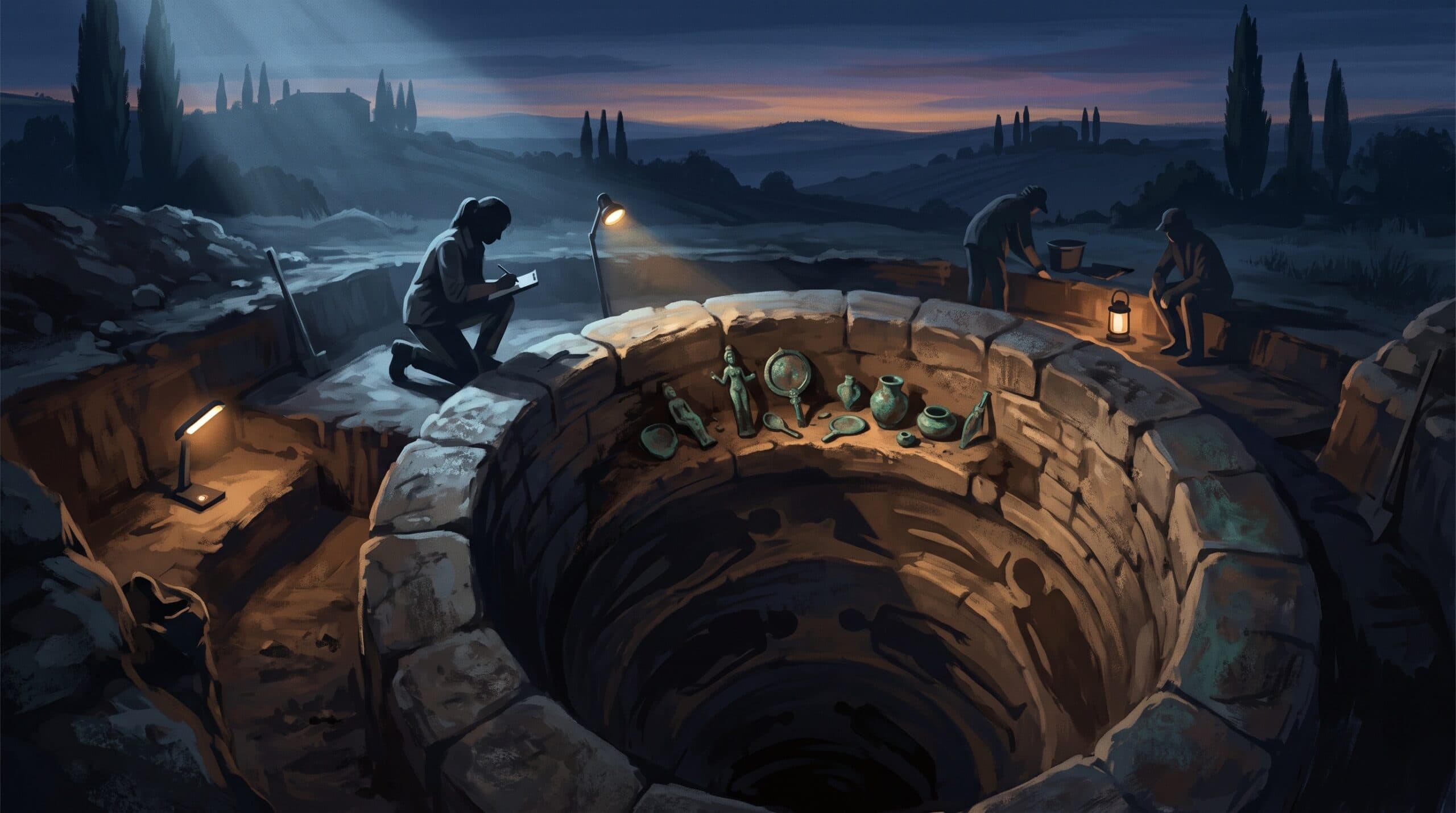
The difficulty of finding ghost ancestors has always been practical. High-quality ancient DNA degrades in hot environments. Africa, where some of the most important archaic populations almost certainly lived, has yielded only a handful of usable sequences older than a few thousand years. Archaeologists cannot sequence a fossil they do not have.
The new technique, developed by a team centered at the University of California, Berkeley, sidesteps the problem entirely. Called TRACE—short for Tracking Archaic Contributions via ARG Estimation—it works by reconstructing “ancestral recombination graphs,” enormous tree-like structures that map how pieces of DNA have been inherited over hundreds of thousands of years.
When deeply divergent populations interbreed, the event leaves a distinctive signature: unusually long genetic branches and patterns that persist for far longer than would be expected in a single, isolated group. The Debrief’s report on the study explains that TRACE searches for exactly those signatures, and it does so without needing a reference genome from a known archaic population. If a ghost left its mark, TRACE can in principle detect it.
The team first tested the approach on simulated populations, where they knew the true history, and found it achieved high accuracy with very low false-positive rates. Then they applied it to data from the 1000 Genomes Project, which spans hundreds of individuals from populations across Africa, Europe, Asia, and beyond.
TRACE successfully recovered the well-established signals of Neanderthal ancestry in Europeans and Asians, and Denisovan ancestry predominantly in Asian and Oceanian groups. That was expected. What it found next was not.
## Ghost ancestry in every population tested
The program identified segments of DNA that matched neither Neanderthals nor Denisovans, appearing in roughly 0.5 to 1.1 percent of the genome across every modern population the researchers examined. The signal was not confined to Africans, as some earlier hypotheses had predicted. It appeared at remarkably similar levels in both Africans and non-Africans.
That distribution matters. It suggests the interbreeding event happened before the great out-of-Africa dispersal roughly 50,000 to 70,000 years ago, meaning the ghost lineage contributed DNA to the common ancestors of all living humans.
The Live Science report notes that the ghost population diverged from our lineage approximately 830,000 years ago—deep in the Middle Pleistocene, a period from which the human fossil record in Africa remains frustratingly incomplete. The identity of this population is unknown, but candidates include African populations of Homo heidelbergensis or other Middle Pleistocene groups that the ancestors of modern humans encountered before leaving the continent.
Perhaps most provocative is where the ghost DNA persists. Some of it sits inside genomic regions long described as “Neanderthal and Denisovan ancestry deserts”—stretches of the modern genome that appeared to contain unusually little archaic material. Scientists had interpreted those deserts as evidence that natural selection actively removed archaic variants because the modern human versions offered some advantage.
The TRACE results complicate that story. Ghost ancestry survives inside many of the same regions, which means natural selection did not purge all archaic DNA equally. It may have treated genetic contributions from different lineages in very different ways.
## A second, older ghost in Oceania
The study did not stop at one unknown population. When the researchers looked specifically at genomes from Papua New Guinea, Vanuatu, and the Santa Cruz Islands, TRACE detected something even older—genetic segments so deeply divergent that the team calls them “super-archaic.”
These sequences were not directly inherited from the super-archaic population by modern humans. Instead, they appear to have entered the human gene pool through an intermediate: Denisovans themselves, who—as the growing body of Denisovan research shows—the evidence now suggests interbred with an extremely ancient lineage before later intermixing with modern humans.
Advertisement
The super-archaic population diverged from the human line approximately 1.77 million years ago, according to the team’s estimates. For context, that predates the split between modern humans and Neanderthals by more than a million years. The UC Berkeley press release points to Homo erectus as one plausible candidate, given its deep divergence time and wide geographic distribution across both Africa and Eurasia.
This layered pattern—modern humans inheriting DNA directly from one ghost lineage and indirectly from a much older one through Denisovan interbreeding—means the simplest available diagrams of human evolution are not just oversimplified. They are missing entire branches.
## What is confirmed, what is suggested, and what is still unknown
Separating evidence tiers matters with a story this dramatic. The confirmed elements are substantial: a method called TRACE was tested in simulations and applied to real human genomic data; it recovered known Neanderthal and Denisovan signals as expected; and it identified additional genetic material that cannot be explained by either known group. The paper appeared in Science, a peer-reviewed journal, with 102 cited references.
The leading interpretation—that this material represents genuine archaic admixture from at least two unknown populations—fits the data well. The researchers argue for a ghost lineage that interbred with the common ancestors of all modern humans before the out-of-Africa migration, and a super-archaic lineage whose DNA reached us via Denisovans. This is the best-fitting model, not the only possible one.
What remains unproven is the specific identity of either population. TRACE can detect that introgression happened; it cannot yet assign those signals to Homo heidelbergensis, Homo erectus, or any other named species without an accompanying fossil genome. The dating and divergence estimates carry genuine uncertainty. And while ghost ancestry appears to persist in ancestry deserts, the functional consequences—whether those ghost variants do anything to immune function or metabolism, for example—are early-stage observations that need far more work.
## A mystery that rewrites the question
The study is part of a wider transformation in how human origins are understood. Not long ago, the story was relatively simple: modern humans evolved in Africa and spread, replacing earlier groups without much contact. Then Neanderthal DNA was found in non-Africans. Then Denisovan DNA turned up in Asia and Oceania. Now ghost lineages are turning up everywhere.
Readers familiar with the Denisovan mystery and its reach into human ancestry will recognise the pattern. Each new method for reading old DNA makes the family tree more tangled, not less. Far from replacing earlier groups, our ancestors appear to have repeatedly encountered, intermixed with, and absorbed parts of populations whose bones may never be found.
That pattern also gives the ghost story a deeper resonance. It means we are not the product of a single lineage that triumphed over its rivals. We are partly the product of populations that no longer exist independently, but whose genetic material persists inside people alive today. The ghosts are not gone. They are inside us, hidden in stretches of DNA that were once considered purely modern.
The parallel with other revolutions in human evolution science is instructive. Each major discovery has not answered the big question—where did we come from?—so much as it has shown that the question itself was too narrow. Humanity is not a single origin story. It is a fabric woven from multiple ancestries, some of which remain invisible except for the faint, persistent signal they left behind in our genome.
## The missing bones and the next search
TRACE cannot find the fossils, but it can narrow the search. If the ghost lineage contributed DNA before the out-of-Africa migration, its remains should be sought in African Middle Pleistocene contexts—and the search has only barely begun in many of the regions where such populations would have lived. The super-archaic lineage, mediated through Denisovans, opens a different set of possibilities across Asia.
The computational approach also means that genomic datasets from understudied populations, especially in Africa and Oceania, may hold additional ghost lineages that have not yet been detected because no one has applied TRACE to their genomes. The method is freely described in the publication, and the 1000 Genomes data is publicly available, so independent replication should be possible relatively quickly.
For now, the defensible conclusion is already strange enough. Everyone you have ever met carries DNA from a human relative whose name science does not know, whose face no artist has reconstructed, and whose bones may be buried somewhere no one has thought to dig. Next to that, the search for the fossils that might finally give a face to the ghost looks less like an ending and more like the beginning of a much older mystery.
### Sources and further reading
Science: Recovering signatures of archaic hominin introgression using ancestral recombination graphs (Zhang et al., 2026); The Debrief: Mysterious ‘Ghost’ Human Ancestor Hidden in Our DNA; Live Science: Scientists discover 2 new ghost lineages in modern humans; Nature human evolution archive.