
Introduction
Number stations are clandestine radio broadcasts made up of seemingly random numbers, letters, or Morse‑code groups transmitted on short‑wave frequencies. First employed widely during the Cold War, these one‑way broadcasts enabled intelligence services to communicate securely with operatives in the field. Recent open‑source evidence (2024–2025) indicates that number stations are active once again, deployed by Russia, China, and even NATO‑aligned countries. This report explains how number stations operate, their Cold‑War history, and the renewed activity observed in the past two years.
Advertisement
Historical Context: Cold War‑Era Number Stations
Beginning in the late 1940s, dozens of short‑wave transmitters started broadcasting monotonous voices reading five‑digit groups or coded words. By the 1960s and 1970s, “numbers” traffic blanketed the HF spectrum, serving both Eastern‑Bloc and Western agencies.
- “Lincolnshire Poacher.” An English‑language station believed to have been run by Britain’s MI6 from an RAF base in Cyprus. Its signature folk tune alerted agents before numbers were read aloud. Gizmodo
- Soviet & Warsaw‑Pact stations. Numerous Russian, East‑German, and Cuban services broadcast encrypted messages throughout the Cold War. An internal Polish intelligence study in the 1950s noted West‑German transmissions aimed at Bloc agents. Wikipedia
How Number Stations Work: Transmission & Encryption
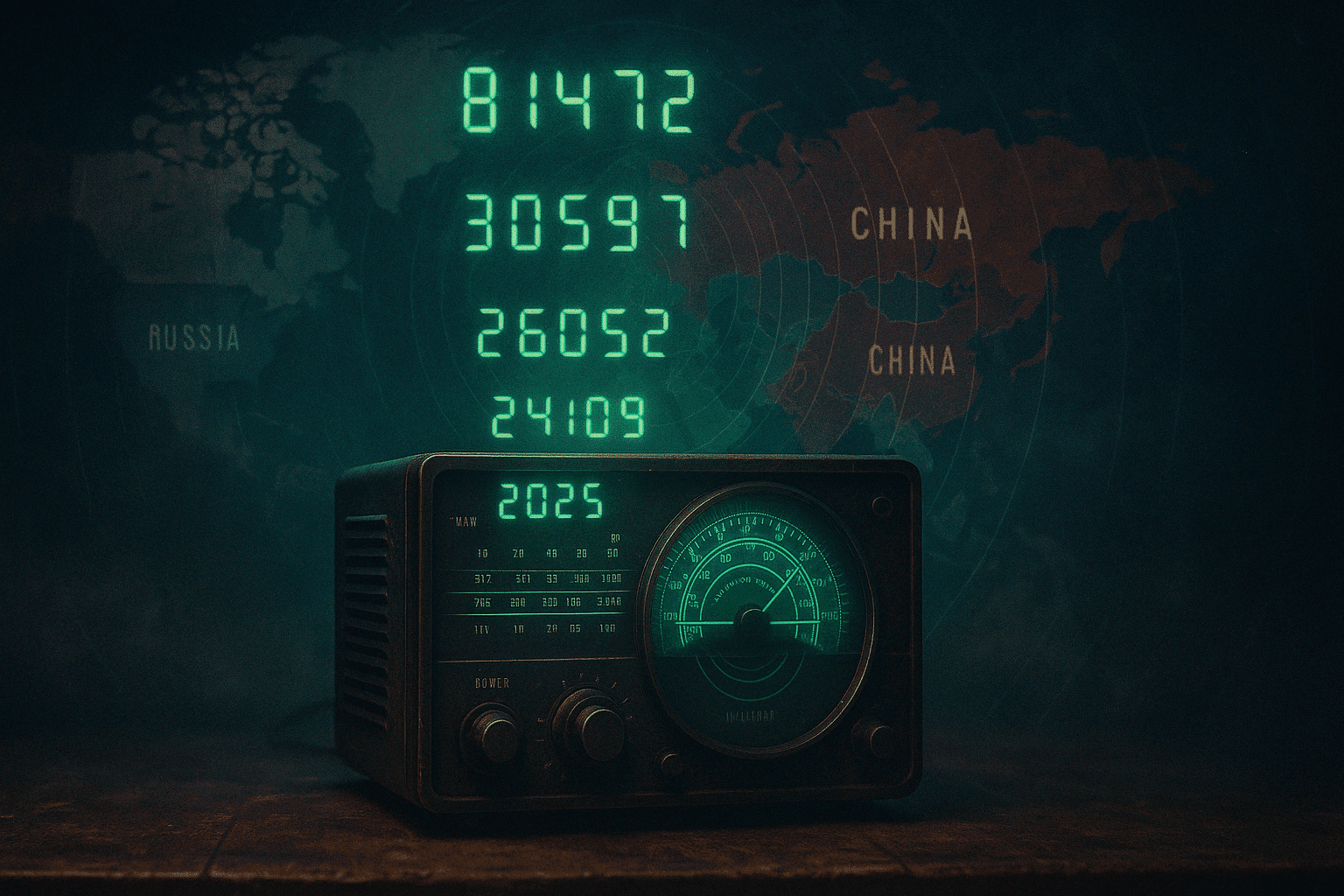
Figure: A vintage short‑wave receiver—ordinary civilian equipment a field agent could use.
- Frequency band. HF/short‑wave (3–30 MHz) signals reflect off the ionosphere, travelling thousands of kilometres with modest power. War on the Rocks
- Format. A brief interval signal (tune or tones) precedes a voice or digital burst reading groups of numbers, phonetic letters, or Morse code.
- Encryption. Virtually all stations employ one‑time pad (OTP) ciphers—mathematically unbreakable if pads are never reused. After copying the ciphertext, an agent subtracts matching pad numbers to reveal the plaintext order.