Why Every Generation Reopens the Door to the Ouija Board | Unexplained
Articles
Why Every Generation Reopens the Door to the Ouija Board
A deep investigation into why the Ouija board keeps returning in modern culture, why it still provokes haunting fear, and what its strange power reveals about ritual, folklore, and belief.
Art Grindstone is the hard-nosed storyteller behind Unexplained.co, a veteran investigator whose life’s work sits at the crossroads of the paranormal, fringe science, and the shadows most people try not to look into. With decades spent chasing impossible stories — black-budget psychic programs, vanished Cold War experiments, desert rituals that sparked UFO waves, and the strange phenomena buried in America’s forgotten backroads — Art brings a rare combination of skepticism, awe, and journalistic precision. He’s not here to debunk. He’s not here to blindly believe. He follows the evidence wherever it leads — even when it leads someplace deeply uncomfortable. Known for his immersive, cinematic style and his ability to turn obscure research into gripping narrative, Art has built a devoted following across podcasts, long-form features, documentaries, and serialized investigations. His interviews are direct. His analysis is unflinching. His voice has become a staple in the modern paranormal renaissance — the guy people turn to when a story is too strange, too complex, or too dangerous for anyone else to touch. Off-mic, Art works with a distributed network of researchers, archivists, and field operatives who help surface the stories mainstream media ignores. On-mic, he transforms their findings into meticulous, high-impact reporting that refuses to insult the intelligence of true believers. His philosophy is simple: Take the phenomenon seriously. Treat the audience with respect. Tell the story as if the world depends on it — because sometimes it does. When Art Grindstone digs into a case, he isn’t just chasing a mystery. He’s tracing the fault lines of reality itself.
13 min · 2,924 words
In This Report(17)
The Ouija board has spent more than a century doing something almost no other occult object has managed to do. It moves effortlessly between worlds. One moment it is sold as a game, a novelty, a curiosity, something to pass around at a sleepover or pull off a shelf at Halloween. The next, it is treated as a threshold object, a ritual device, a portal, a mistake waiting to happen. Few tools in modern folk occultism carry that much contradictory power. Fewer still keep surviving each new wave of skepticism, parody, and pop-cultural overexposure without losing their charge.
That is exactly why the Ouija board keeps coming back, and why it never stays dead for long in the public imagination. It is trending again in 2026 for a reason. Younger audiences rediscover it through paranormal podcasts, short-form horror clips, reactivated urban legends, and retellings of old possession or haunting cases. Each generation believes it is encountering the board fresh. In reality, it is inheriting a ritual object already loaded with stories, warnings, dare culture, religious panic, and the seductive possibility that ordinary people might be able to contact something just beyond the visible world.
This is what makes the Ouija board more than an evergreen spooky topic. It is one of the clearest examples of how an occult object can function as a cultural mirror. The board reflects what an era fears, what it wants to believe, and how it negotiates the line between play and danger. Readers who have followed the deeper history of occult practice or watched how stories like the Witch Farm case continue to shape modern haunting culture will recognize the pattern immediately. The Ouija board is not powerful because everyone agrees on what it is. It is powerful because nobody agrees, and that uncertainty itself becomes part of the ritual.
The Sunken Basilica of Iznik: Did a Lake Hide the Council of Nicaea?
A basilica beneath Lake Iznik has revived a 1,700-year-old question: was this the setting of the First Council of Nicaea, or a compelling archaeological near-miss?
Aug 18, 2026 • 6 min read
UFO & Aliens
The Pentagon Released More UAP Files—but Not the Data Needed to Solve Them
The Pentagon’s fifth UAP release reveals cold orbs and a giant triangle—but missing sensor data keeps its strangest cases unresolved and untested.
Aug 17, 2026 • 10 min read
Strange History
The Ghost Village of Lübbey: Why a Forgotten Turkish Settlement Keeps Returning in Strangeness Feeds
The village of Lübbey in Turkey was abandoned and left largely untouched — not by war, not by natural disaster, but by quiet departure. For people drawn to abandoned places, it has become a fixation.
The Ouija board lives in the unstable space between toy, ritual, and taboo
The most important thing to understand about the Ouija board is that its power is inseparable from its ambiguity. A tarot deck usually enters the room as a divination tool. A grimoire arrives carrying the weight of hidden knowledge. A Ouija board can arrive in a shopping bag, a closet, a thrift store haul, or a joke gift, and still change the emotional temperature of a room immediately. That instability is part of its enduring force. People do not only react to what the board is supposed to do. They react to what it should never have been allowed to become.
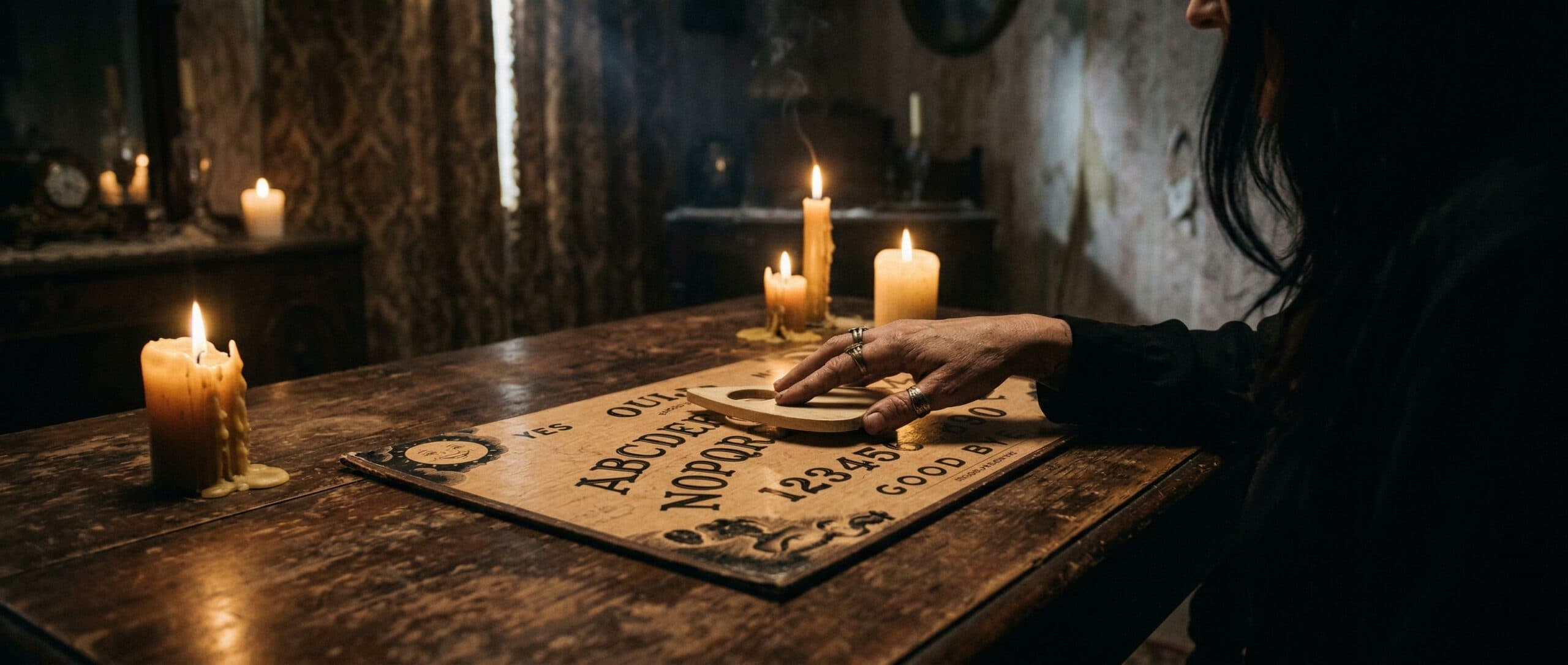
At a basic level, the board is simple: letters, numbers, yes, no, goodbye, and a planchette that appears to move beneath participants’ fingers. But culturally it is anything but simple. It sits at the point where entertainment, ritual, folk belief, spiritual experimentation, and dare culture all overlap. That is why it unsettles people who do not believe in it and fascinates people who do. It asks a dangerous-seeming question in the easiest possible form: what if communication with the unseen required almost no expertise at all?
This is also why the board feels different from many other occult tools. It democratizes contact. It does not ask for years of ceremonial study, rare texts, or complex symbolic systems. It invites beginners. It invites mockery. It invites bad faith. And then, because it is associated with movement that appears to happen under the users’ own hands, it turns even skepticism into participation. The board does not merely get used. It stages an experience, and that experience is what people carry away.
The board emerged from nineteenth-century spiritualism, not ancient occult tradition
For all its reputation as an ancient or timeless forbidden device, the Ouija board is a relatively modern product. Its roots lie in the spiritualist movement of the nineteenth century, when séances, spirit communication, automatic writing, table-turning, and mediumship became wildly popular in the United States and Europe. The board emerged from that same environment: a moment when mass grief, religious uncertainty, pseudoscientific curiosity, and fascination with unseen intelligence were all feeding into new forms of ritual contact.
Historians of occultism have long noted that spiritualism was revolutionary partly because it made the supernatural feel procedural. Contact was no longer reserved for saints, magicians, prophets, or village cunning folk. It could be attempted in parlors by ordinary middle-class participants. The Ouija board fit perfectly into that democratized landscape. As Smithsonian Magazine has documented, the board’s commercial history is tied to both spiritualist culture and patent-era entrepreneurship, which means it was never only a sacred instrument. It was also a commodity.
That strange dual identity never went away. The board was born at the intersection of belief and marketing, sincerity and performance. That is one reason it remains so hard to pin down. Unlike older ritual tools whose authority comes from antiquity, the Ouija board derives authority from modern repetition. It becomes powerful because generation after generation keeps reenchanting it.
Every generation rediscovers the Ouija board because it offers danger without complexity
There are many occult tools more elaborate than the Ouija board and many traditions more intellectually rich. Yet few have the same recurring mass appeal. That is because the board solves a cultural problem elegantly. It gives people an immediate, participatory brush with forbidden possibility without requiring much study. No initiatory structure, no memorized correspondences, no difficult ritual language. Just a board, a question, and the suggestion that something might answer back.
That simplicity makes the board unusually adaptable. Teenagers can approach it as a dare. Horror fans can approach it as a genre artifact. occult-curious audiences can approach it as a beginner’s ritual technology. Skeptics can approach it as a test of whether anything unusual really happens. The same object serves all of them. That flexibility helps explain why the board keeps reviving across media cycles. It is endlessly reusable because it can absorb whatever a generation already fears.
In 2026, the board’s revival fits especially neatly into platform culture. It performs well in short clips. It produces stories quickly. It invites reenactment. It turns uncertainty into narrative immediately. Whether a session is presented as real spirit contact, ironic experimentation, or post-midnight horror content almost does not matter. The board’s structure does the work. It gives any recording or retelling a built-in arc: question, movement, dread, interpretation.
The board became a fear object because stories gave it a personality of its own
The Ouija board did not become feared only because people used it. It became feared because stories gathered around it faster than around most other occult devices. Tales of the board rarely remain procedural. They become narrative almost at once. Someone asked the wrong question. Something followed them home. The planchette sped up. A name appeared that should not have appeared. The goodbye was ignored. A participant changed afterward. Even when these stories are secondhand, embellished, or impossible to verify, they create the sense that the board has preferences, moods, and consequences.
That is a key part of the board’s folkloric power. It stops behaving like an instrument and starts behaving like a character. People speak of it as though it can invite, mislead, deceive, or punish. That narrative shift changes how users approach it. The board becomes less like a neutral device and more like a threshold with agency. Folklore scholars have often shown that objects gain cultural force when they are embedded in cautionary storytelling, and the Ouija board may be one of the clearest modern examples of that rule.
Once that happens, every use session becomes haunted by prior stories. Participants do not begin from zero. They begin from layers of warning. That is why even a motionless session can feel charged. The board carries its archive into the room with it.
Religious warning culture helped turn the board into a forbidden threshold
No account of the Ouija board’s modern reputation would be complete without acknowledging the role of religious panic and moral warning culture. Across multiple Christian traditions, especially in the twentieth century, the board was treated not as harmless superstition but as an active invitation to deception, oppression, or demonic influence. Parents, pastors, and religious pamphleteers did not merely say the board was silly. They often said it was spiritually dangerous.
That distinction mattered enormously. Once religious authority framed the board as forbidden, the board’s cultural charge intensified. A thing condemned so strongly acquires mystique automatically. The warning itself becomes advertisement. This is one reason the Ouija board has remained more potent in popular imagination than many other mass-market occult objects. It was repeatedly named as the one object that could open the wrong door in an ordinary home.
That language still lingers even among people who no longer belong to the religious environments that spread it. Many modern users approach the board with inherited rules they cannot fully source: never use it alone, never mock it, never forget to say goodbye, never ask who will die, never burn it casually, never trust what comes through. These rules may vary, but together they form a shadow liturgy around the board. The object survives partly because the taboo does.
Psychology offers one explanation, but it does not dissolve the experience for participants
The most widely cited skeptical explanation for Ouija movement is the ideomotor effect, the phenomenon in which people make small physical movements unconsciously while sincerely feeling that they are not controlling them. Psychological research has long used this concept to explain dowsing, facilitated movement, and spirit-board sessions. From that perspective, the planchette moves because participants move it without consciously deciding to do so. The board becomes a mirror for expectation, suggestion, group dynamics, and hidden intention.
That explanation is persuasive, and for many cases it is likely sufficient. But it does not fully erase the board’s power at the level where most people actually experience it. If anything, it complicates it. The unsettling part is not only the possibility that spirits are real. It is the possibility that people can reveal things to themselves without realizing they are doing it. The board remains eerie under either reading. It either mediates something beyond the self, or it stages the return of something buried within the self. For many users, neither option feels especially safe.
This is why skeptical explanations often fail to end the fascination. They answer mechanism, but not meaning. They explain movement, but not why the room felt different, why certain answers landed so hard, or why the session seemed to expose hidden emotional currents in everyone touching the planchette. The board survives skepticism because skepticism does not entirely flatten what the experience feels like to the people inside it.
Horror media kept the Ouija board culturally alive even when belief changed
Even when direct belief in spirit communication became less common, the Ouija board never really left the cultural bloodstream. Horror cinema, paperback occult sensationalism, television hauntings, creepypasta logic, and later internet folklore all kept feeding the board new life. It became one of the few ritual objects that could be recognized instantly across generations, whether as a sincere danger, a camp icon, or a horror shortcut that needed almost no explanation.
Advertisement
That media afterlife matters because it means many people meet the board first through narrative before they ever encounter the object physically. They know what it signifies before they know its history. It means haunted contact, opened doors, and consequences that outlast the session. That symbolic condensation is incredibly efficient. Very few occult objects carry such a complete emotional script in public culture.
The board also adapts unusually well to retelling. A séance with layered ceremonial symbolism is harder to compress into a viral story. A spirit board session that spells out a name and ends badly can travel anywhere. It works in horror films, podcast episodes, TikTok reenactments, and whispered personal testimony. That portability has helped the Ouija board outlast changing belief systems and changing media forms alike.
Younger audiences keep returning because the board feels participatory and dangerously simple
The current revival makes sense partly because younger paranormal audiences are drawn to experiences that are interactive, aesthetic, and socially performable. The Ouija board does all three. It is visual. It is tactile. It can be staged easily. It produces suspense without special effects. Most importantly, it lets participants become part of the story immediately. In a culture saturated with spectatorship, that is a powerful selling point.
The board also fits the broader return of folk ritual aesthetics. Many younger audiences are interested in candles, divination, haunted objects, ancestral practices, liminal spaces, and atmospheric tools that feel old even when their current usage is highly mediated through the internet. The Ouija board sits comfortably in that ecosystem, especially because it already carries a reputation for danger. It allows users to flirt with the occult while feeling that they are not merely performing a lifestyle trend. They are risking something.
That risk may be symbolic, psychological, or theatrical, but it feels real enough to matter. The board survives because it makes the unseen feel participatory. It turns haunting into a format people can touch.
The board still matters because it dramatizes the human desire to test the unseen
Strip away the toy branding, the horror clichés, the demonic warnings, and the skeptical rebuttals, and the Ouija board still returns us to a very old human impulse. We want to know whether the boundary is permeable. We want to know whether the dead answer, whether hidden intelligences notice us, whether ordinary rooms can become charged, whether meaning can arrive through simple material forms. The board does not create that desire. It concentrates it.
That is why the object endures. It stages one of the oldest religious and paranormal questions in an almost offensively accessible way. It says: sit down, ask, wait, see what moves. That is both ridiculous and profound. It is ridiculous because the format is so commercially ordinary. It is profound because the emotional stakes people attach to the answer remain enormous.
In that sense, the Ouija board is not just a spooky artifact. It is a recurring machine for producing uncertainty. That uncertainty can be dismissed, feared, ritualized, or aestheticized, but it rarely stays inert. The board continues to matter because it turns invisible questions into visible motion.
The Ouija revival fits a wider return to ritual objects, haunted folklore, and intimate occult fear
Seen in a wider context, the 2026 return of Ouija conversation is part of a larger cultural pattern. Old ritual tools keep resurfacing because they promise intimacy with the forbidden. Not abstract conspiracy, not distant mythology, but something close enough to hold in your hands. That is also why audiences continue to respond to haunted-location narratives, witchcraft revivals, spirit-communication stories, and classic possession lore. The scale is domestic. The risk is personal. The danger comes into the room.
This is where the board connects to unexplained.co’s wider territory. It belongs alongside investigations into occult history, haunted houses, folk ritual, and the repeated ways modern audiences reinvent old fears in new media environments. It also helps explain why some objects outlive debunking. They are too symbolically useful to disappear. The Ouija board remains one of the purest examples of that survival mechanism in modern occult culture.
The board was never just a board. It was a script, a dare, a threshold, a market product, a séance machine, a warning label, and a portable haunting myth. That is why every generation eventually picks it up again. Not because the mystery was solved, but because it never really stopped asking to be touched.
Frequently Asked Questions
Why does the Ouija board still scare people so much?
Because it sits between game, ritual, and taboo, and because generations of ghost stories, religious warnings, and horror media have taught people to see it as a tool that might open the wrong kind of door.
Was the Ouija board originally an occult object?
It emerged from nineteenth-century spiritualist culture rather than ancient occult tradition, which means it has always carried a mixed identity as both commercial product and spirit-contact device.
What is the skeptical explanation for Ouija board movement?
The most common explanation is the ideomotor effect, in which people move the planchette unconsciously while sincerely feeling that they are not controlling it.
Why does the Ouija board keep returning in pop culture?
Because it is visually recognizable, easy to dramatize, and perfectly suited to stories about haunting, possession, forbidden contact, and private fear.
Why are younger audiences interested in the Ouija board again?
It feels interactive, aesthetic, and risky in a way that fits modern paranormal media culture, especially for audiences drawn to ritual objects, haunted folklore, and participatory occult experiences.
This article was created using Media Blaster – Your content production specialist. Visit www.mediablaster.io for more information.
Art Grindstone is the hard-nosed storyteller behind Unexplained.co, a veteran investigator whose life’s work sits at the crossroads of the paranormal, fringe science, and the shadows most people try not to look into. With decades spent chasing impossible stories — black-budget psychic programs, vanished Cold War experiments, desert rituals that sparked UFO waves, and the strange phenomena buried in America’s forgotten backroads — Art brings a rare combination of skepticism, awe, and journalistic precision. He’s not here to debunk. He’s not here to blindly believe. He follows the evidence wherever it leads — even when it leads someplace deeply uncomfortable. Known for his immersive, cinematic style and his ability to turn obscure research into gripping narrative, Art has built a devoted following across podcasts, long-form features, documentaries, and serialized investigations. His interviews are direct. His analysis is unflinching. His voice has become a staple in the modern paranormal renaissance — the guy people turn to when a story is too strange, too complex, or too dangerous for anyone else to touch. Off-mic, Art works with a distributed network of researchers, archivists, and field operatives who help surface the stories mainstream media ignores. On-mic, he transforms their findings into meticulous, high-impact reporting that refuses to insult the intelligence of true believers. His philosophy is simple: Take the phenomenon seriously. Treat the audience with respect. Tell the story as if the world depends on it — because sometimes it does. When Art Grindstone digs into a case, he isn’t just chasing a mystery. He’s tracing the fault lines of reality itself.