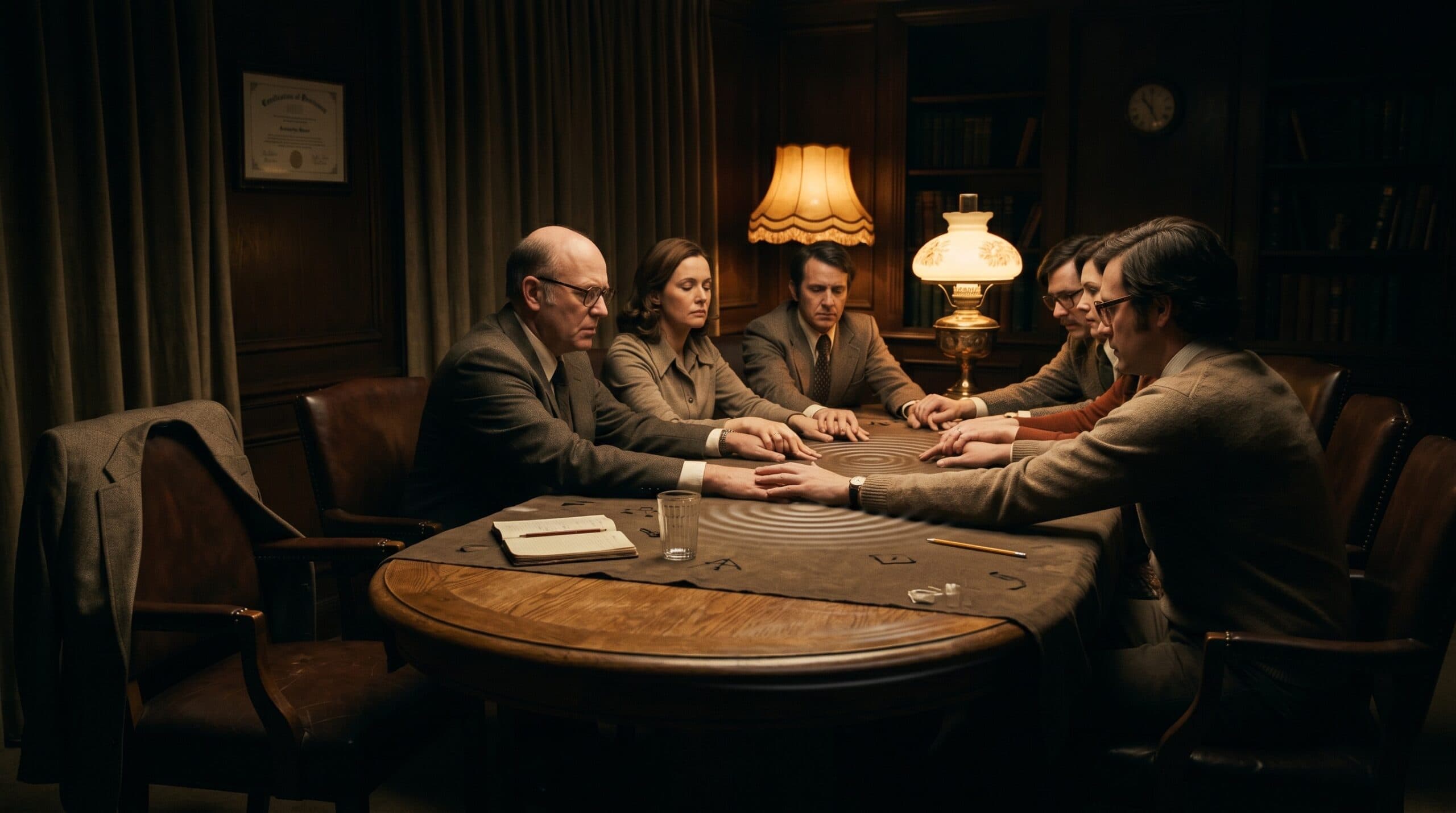
Few paranormal stories hit harder than the ones that sound reproducible. That is why the Philip Experiment ghost story refuses to die. A group of ordinary people gathered in the 1970s, invented a fake dead man, sat around a table feeding him attention, and then claimed the room began to answer back.
The quick answer is that the Philip Experiment was a Toronto-area psychical research project in which participants created a fictional 17th-century character named Philip Aylesford and then held séance-style sessions until knocks, table movement, and apparent responses seemed to appear. The broad outline preserved by the standard historical summary of the Philip Experiment, retellings such as the long-running “how to create a ghost” explainer, and new social-media fascination after a viral reel treating the case like a real-world tulpa event have made it feel uncannily modern again.
What makes the case so unnerving is not that a haunting may have happened. It is that the haunting, if anything happened at all, seems to have been invited into being by design.
Why the Philip Experiment still feels dangerous
Most ghost stories begin with a place. A house, a hospital, a battlefield, a hallway where something lingers. The Philip Experiment begins with intention. That is the part that gets under the skin. The group did not stumble into a presence. They sat down and tried to manufacture one.
That idea has only become more potent in the internet age. A story about collective attention shaping reality lands differently now than it did in the 1970s. People raised on tulpas, egregores, manifestation discourse, and memetic ritual do not hear the Philip case as a quaint paranormal curiosity. They hear it as a prototype.
It sits naturally beside stories like Antoine’s ghost photo, the Riverview pentagram image, and modern jinn obsession narratives. In each case, the real hook is not only whether the phenomenon is objectively real. It is whether attention itself starts to behave like a door.
What the group said happened in the room
The core setup is one of the strangest in paranormal history. Participants built out Philip Aylesford as a fully fictional biography — a man who never existed — and then focused on him through repeated group sessions. Later accounts say the group experienced raps, apparent yes-or-no responses, and table activity strong enough to turn a made-up ghost into a lasting legend.
That structure is why believers remain fascinated. If a haunted house answers back, maybe the house was always carrying something. But if a nonexistent ghost begins producing effects, the implication feels darker. It suggests that concentrated belief, emotional energy, or some unknown group dynamic might be able to sculpt a presence where there was none before.
Even readers who doubt every paranormal claim can feel why the story travels. It turns the séance from a method of contact into a method of construction. That is a much more unsettling possibility.
Why tulpa culture keeps reviving the case
The Philip Experiment has become internet-native because its logic matches the way online occult culture already thinks. Communities now talk casually about thoughtforms, entities fed by repetition, and symbols that gain force as more people participate in them. Philip sounds like a retro version of that entire worldview.
Once framed that way, the old experiment stops looking dusty. It looks prophetic. A circle of people in a room rehearsing a fictional being into apparent existence feels like an analog ancestor of the modern belief that stories, symbols, and coordinated minds can thicken into something with agency.
That is also why the case keeps pulling in readers who are not traditional ghost believers. It touches psychology, ritual, folklore, performance, and the uncomfortable suspicion that consciousness may be stranger in groups than it is alone.
What the experiment can and cannot prove
This is where the atmosphere gives way to limits.
The Philip Experiment is a real story with real participants and documented claims. It is not, however, a settled proof that a ghost was literally created. Group expectation, unconscious movement, suggestibility, performance effects, selective memory, and the theatrical conditions of the séances all offer grounded ways to interpret what happened. The fictional nature of Philip makes the story more provocative, but not automatically more evidential.
Still, that uncertainty is exactly why the case survives. It cannot be locked down cleanly either way. If nothing paranormal happened, the experiment still exposed how weird collective human behavior can become around ritual. If something did happen, then the implications are enormous. Either way, the room did not feel empty for long, and that is enough to keep Philip Aylesford wandering through the modern imagination like a ghost that may have been built rather than born.