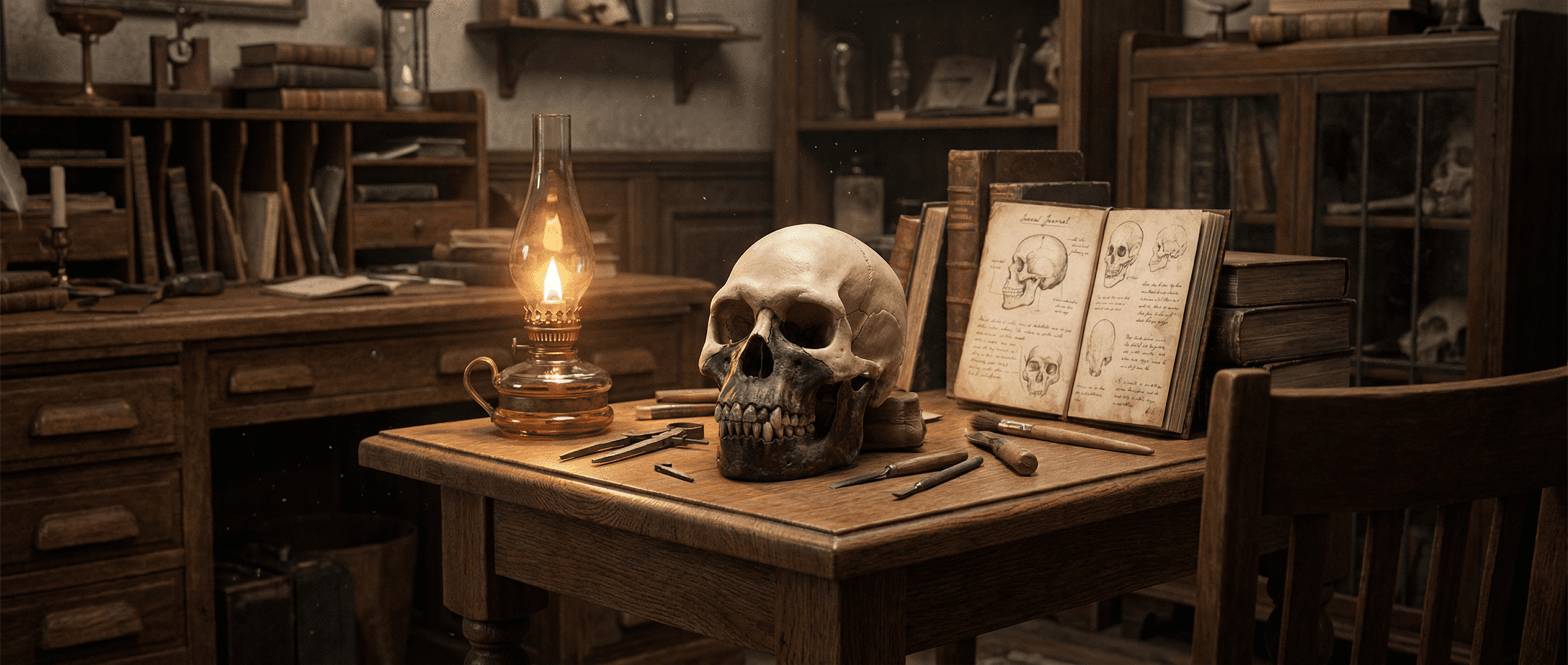

In 1912, a remarkable discovery was made near the village of Piltdown in Sussex, England. An amateur antiquarian claimed to have found a human skull and a fossilized ape jawbone. It was called “Piltdown Man” and was going to revolutionize our understanding of human evolution. There was just one problem: It was a fake.
In 1912, the scientific world was hungry for evidence of human evolution. Darwin’s theory was controversial, and the quest for the “missing link” was on. Then, near the village of Piltdown in Sussex, England, an amateur antiquarian named Charles Dawson made a discovery that seemed to answer every prayer.
Advertisement
The Discovery
What Dawson found in a gravel pit was remarkable: a skull cap that looked human and a jawbone that looked like an ape’s. Together, it appeared to be the “missing link” between apes and humans — the evolutionary bridge that scientists had been searching for.
The timing was perfect. The scientific community was hungry for evidence, and Piltdown Man was going to provide it. The find was celebrated as one of the most important archaeological finds ever. It became famous overnight.
As the Natural History Museum notes, the specimen was a combination of a medieval human skull cap and the mandible of an orangutan, with the teeth filed down to make them appear more human-like. Both bones had been chemically stained to make them appear old and fossilized.
The Hoax Revealed
For 40 years, Piltdown Man was accepted as genuine. It wasn’t until 1953 that scientists finally exposed it as a forgery.
How the hoax worked:
- The skull was actually human — but from the medieval period, not ancient
- The jaw was from an orangutan — also modern, not fossilized
- Both were chemically treated to make them look old
- The teeth were filed down to make them look more “transitional”
It took four decades for modern dating techniques to reveal the truth. When the hoax was finally exposed, it embarrassed the entire scientific establishment.
Who Did It?
The identity of the forger was never definitively proven, but suspects include:
Charles Dawson: The man who “found” the bones. He had a history of fabrications and is considered the primary suspect.