
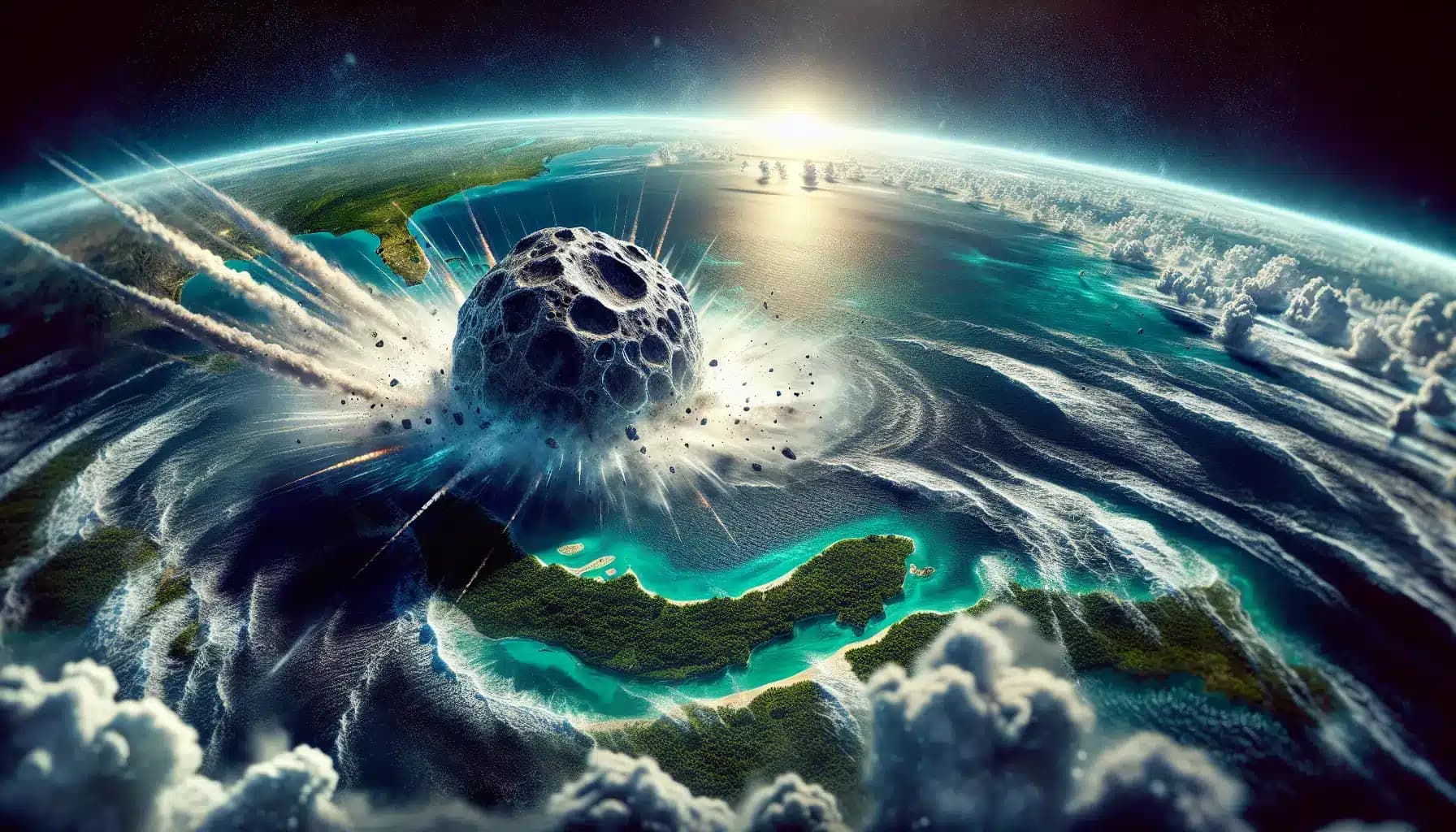

Imagine a colossal object 6 miles wide hurling through space at 12 miles per second toward Earth. This is not science fiction; it happened 66 million years ago when an asteroid slammed into what is now the Yucatan Peninsula, forming the Chicxulub crater and triggering a mass extinction event. Today, our planet continues to be threatened by near-Earth objects (NEOs), including asteroids and comets. While NASA and other space agencies have made significant strides in tracking and understanding these potential threats, the risk remains. Advanced technology is at work to monitor and mitigate these threats, from kinetic strikes to gravity tractors. Humanity is developing strategies to protect our world from these stellar invaders. But what would happen if another Chicxulub-sized asteroid were on a collision course with Earth today? How prepared are we for such a catastrophic event? Join us to learn about planetary defense—the history, science, and future against such impressive threats.
Key Takeaways
- The Chicxulub impact 66 million years ago caused the extinction of about 75% of all species on Earth.
- Near-Earth objects (NEOs) include asteroids and comets that pose potential threats to our planet.
- NASA and other agencies are actively tracking NEOs and developing strategies for planetary defense.
- Advanced technologies, including artificial intelligence, are enhancing our ability to detect and track these celestial bodies.
The Chicxulub Impact: A Catastrophic Event
66 million years ago, an event occurred on Earth that was so catastrophic that it changed the course of life on the planet. The asteroid, about 6 miles in diameter, slammed into the Yucatan Peninsula in present-day Mexico, forming what we now call the Chicxulub crater. The immediate aftermath was nothing short of apocalyptic. The collision released energy equivalent to billions of nuclear bombs, caused forest fires and tsunamis, and threw huge amounts of debris into the atmosphere.
The impact’s most significant and long-lasting effect was the release of dust, soot, and sulfur aerosols into the atmosphere. These particles created a global cloud that blocked sunlight for an extended period, a phenomenon often referred to as “impact winter.” New research has shed light on the critical role of fine dust particles in this cataclysmic event. A study published in October 2023 found that fine dust, particularly particles between 0.8 and 8 micrometers in diameter, played a significant role in abrupt climate change.
The Role of Near-Earth Objects (NEOs)
So, what are near-Earth objects? NEOs are asteroids, comets, and other celestial bodies whose orbits bring them close to Earth. These objects vary in size from small harmless rocks to massive bodies capable of causing global catastrophes. Asteroids are the rocky remnants of the early solar system, mostly found in the asteroid belt between Mars and Jupiter. Comets, on the other hand, originate from the outer regions of the solar system and are composed of ice, dust, and rocky material.
The danger posed by these objects depends on their size and trajectory. While most NEOs are too small to cause significant damage, some, like the Chicxulub impactor, are capable of causing global catastrophes. To mitigate these risks, space agencies such as NASA and the European Space Agency have developed extensive programs to track and detect NEOs. Telescopes around the world are constantly scanning the sky, identifying and cataloging objects that are approaching Earth’s orbit.
Advancements in Detection and Tracking
One of the key instruments in this work is the Wide-field Infrared Survey Explorer, which has been repurposed for the NEOWISE mission. Hundreds of near-Earth asteroids have been discovered and characterized using this space telescope. The role of artificial intelligence in detecting unobserved asteroids is becoming increasingly important. In May 2024, an AI-based algorithm known as Tracklet-less Heliocentric Orbit Recovery (THOR) detected more than 27,000 previously unobserved asteroids in archival telescope images.
This artificial intelligence tool analyzes huge amounts of data, identifying and tracking objects with remarkable efficiency. It can process up to 1.7 billion points of light in a single telescope image, connecting them into asteroid trajectories. The Vera C. Rubin Observatory, set to begin operation next year, will further enhance our ability to detect NEOs, equipped with advanced artificial intelligence software.
Planetary Defense Strategies
To protect Earth from potential asteroid impacts, scientists have developed several planetary defense mechanisms. Each is designed to prevent potential collisions. One of the main methods is the kinetic impact strategy, which involves sending a spacecraft to collide with an asteroid at high speed, altering its trajectory. This method relies on momentum transfer to move an asteroid into a safer orbit. NASA’s 2022 mission, the Double Asteroid Redirection Test (DART), was the first test of this method.
Another proposed method is the gravity tractor, which uses the gravitational pull of a spacecraft to slowly change the trajectory of an asteroid over time. By maintaining a stable position near an asteroid, the spacecraft’s gravity can gradually alter the object’s trajectory. Although this method is still theoretical and has not yet been tested in space, it is a promising approach for dealing with potential threats identified in advance.
In extreme cases, however, nuclear explosions could be used to deflect or destroy an asteroid. This approach involves detonating a nuclear device at a safe distance from the asteroid, vaporizing part of its surface and creating a recoil effect that moves the asteroid off course. However, this method is controversial due to the potential risks and legal implications of using nuclear weapons in space.
The Importance of International Cooperation
To prepare for potential asteroid impacts, international space agencies regularly conduct simulations and drills. These exercises help refine detection, tracking, and deflection strategies. Planetary defense is a global issue that requires cooperation and coordination among countries. For example, in 2021, NASA participated in an international planetary defense exercise organized by the International Asteroid Warning Network and the United Nations Office for Outer Space Affairs.
As we continue to develop and refine our planetary defense strategies, international cooperation and technological advances will play a key role in protecting our world from any space-based threats. Understanding the diverse nature of the objects that threaten us is essential for ensuring a safer future for generations to come.