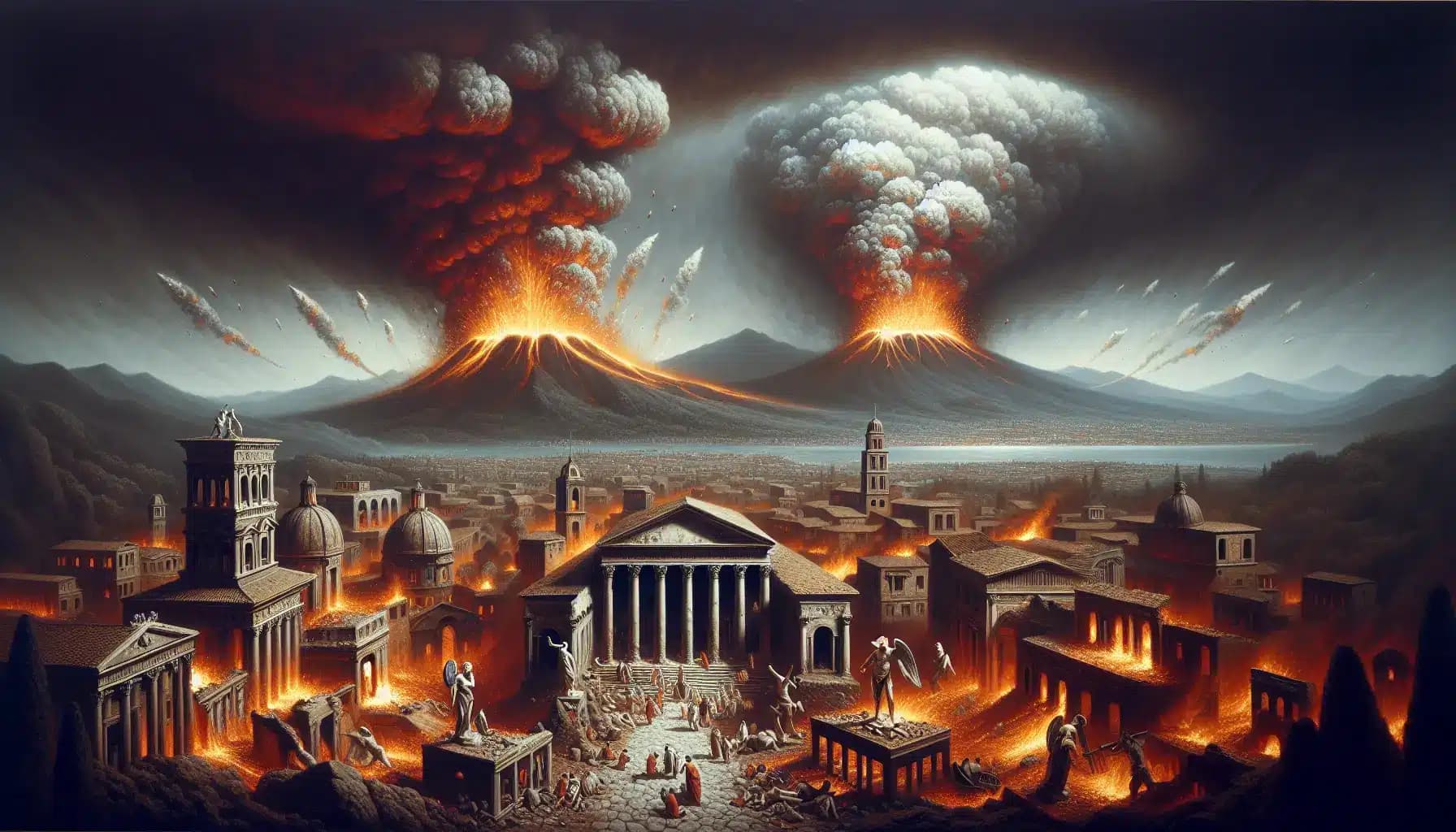

Until now, the victims of Pompeii were primarily thought to have perished due to the volcanic eruption of Mount Vesuvius. However, a new study has revealed a more complex and harrowing narrative of the ancient city’s destruction. It appears that Pompeii suffered a double calamity: not only did its inhabitants face the fury of Vesuvius, but they also endured powerful earthquakes that contributed significantly to the devastation. This new research was conducted by a team of geologists and archaeologists from the INGV and the University of Naples Federico II.
Key Takeaways
- Pompeii’s destruction involved both volcanic eruptions and powerful earthquakes.
- New evidence suggests that some victims died due to earthquake-induced building collapses.
- Recent excavations have uncovered insights into daily life and economic activities in Pompeii.
The Double Calamity of Pompeii
The study’s findings are based on excavations and examinations of preserved buildings and human remains. In one particular structure, researchers discovered two bodies that exhibited injuries consistent with those typically observed in earthquake victims. This discovery prompted the team to reconsider the established narrative of Pompeii’s demise.
The researchers noted that the damage patterns observed were inconsistent with the effects of volcanic phenomena previously documented in Pompeii. This inconsistency led the researchers to explore alternative explanations for the destruction they witnessed.
The Sequence of Events
The sequence of events on that fateful day in 79 AD is now believed to have unfolded as follows:
- Mount Vesuvius erupted around 1:00 PM, showering Pompeii with pumice rocks and ash for approximately 18 hours.
- Many inhabitants sought shelter during this initial phase.
- When the eruption temporarily subsided, some survivors may have believed the worst was over.
- However, their relief was short-lived as powerful earthquakes began to shake the already weakened structures of the city.
The researchers suggest that those who remained in their shelters likely met their end due to earthquake-induced collapses of buildings already burdened by volcanic debris. This appears to be the fate of the two individuals whose remains were recovered during the study.
The Final Moments of the Victims
The researchers found compelling evidence that these two victims did not succumb to ash inhalation or extreme heat from pyroclastic surges, which were previously thought to be the primary causes of death for most Pompeiians. Instead, their final moments tell a different story.
Both skeletons were found resting on a layer of volcanic deposits, indicating that they had survived the initial phase of the eruption. The first individual, a man around 50 years old at the time of his death, appears to have been suddenly crushed by a large wall fragment that collapsed during the seismic activity. His remains show severe trauma and broken bones consistent with such an event.
The second victim, also a man of similar age, seems to have been aware of the impending danger. In a scene frozen in time, he appears to have sought protection by crouching in a corner of the room and attempting to shield himself with a round wooden object. Tragically, his efforts were in vain as he too was crushed to death.
Insights into Daily Life and Burial Practices
While the recent discoveries about earthquake-related deaths provide new insights into the city’s final moments, ongoing excavations are also shedding light on the daily lives and burial practices of Pompeii’s inhabitants. During routine work to create an air chamber for moisture control in the new library of the Pompeii Archaeological Park, archaeologists stumbled upon a remarkable find: a semicircular tomb known as a schola tomb.
This type of funerary monument, while not uncommon in Pompeii, immediately caught the attention of researchers due to its location and the promise of information it might hold. The decision to expand the excavation proved fruitful as the tomb revealed an inscription that has excited historians and classicists alike.
The Story of Numerius Augustinus
The epitaph etched into the back of the bench tells the story of a man named Numerius Augustinus, son of Numerius. It’s not just the name that’s important; it’s the titles and honors bestowed upon this Roman citizen that paint a more vivid picture of his life and the interconnected world of the early Roman Empire.
Numerius Augustinus, we learn, was a just knight, a military tribune, and twice held the position of duumvir in Pompeii, the highest magistracy in the city. These titles alone would mark him as a man of considerable importance in Pompeian society. However, it’s another title that has truly captured the imagination of researchers: praefectus fabrum, or prefect of the craftsmen.
Economic and Artisanal Activities
As our exploration of Pompeii continues, we uncover yet another fascinating aspect of daily life in this ancient Roman city. Recent excavations have revealed evidence of a thriving mat-making industry alongside the remnants of a restaurant. The POMPEII 114 Project, a collaborative effort between the University of Naples Federico II and the Parco Archeologico di Pompei, has been excavating the building complex known as Insula 1 of 14 since 2022.
In zones D and E of the complex, archaeologists made a remarkable discovery: well-preserved remains of reed mats. Alongside the mats, researchers found facilities related to their production, including a large shallow vat and a drainage system.
These findings suggest that in the years leading up to the catastrophic eruption of Vesuvius in 79 AD, part of this building was dedicated to the craft of mat-making. Meanwhile, the evidence of the restaurant paints a picture of Pompeian culinary life. Remnants of olives, figs, and poultry bones hint at the menu that might have been offered to diners. A particularly intriguing find is a collection of small round cakes baked with poppy seeds that show the desserts enjoyed by ancient Pompeians.
These findings show the diversity of economic and artisanal activities that took place in Pompeii just before its tragic end. They remind us that Pompeii was not just a city frozen in its final moments but a living, breathing urban center with a complex economic life. The inhabitants of this building complex were not just passive victims of the volcano’s fury but active participants in a vibrant commercial ecosystem.
As researchers continue to study these findings, we can expect to gain even more insights into the economic life of Pompeii. The close relationship between this building and the known mat-making workshop next door suggests a level of economic specialization and possibly even cooperation between neighboring businesses.