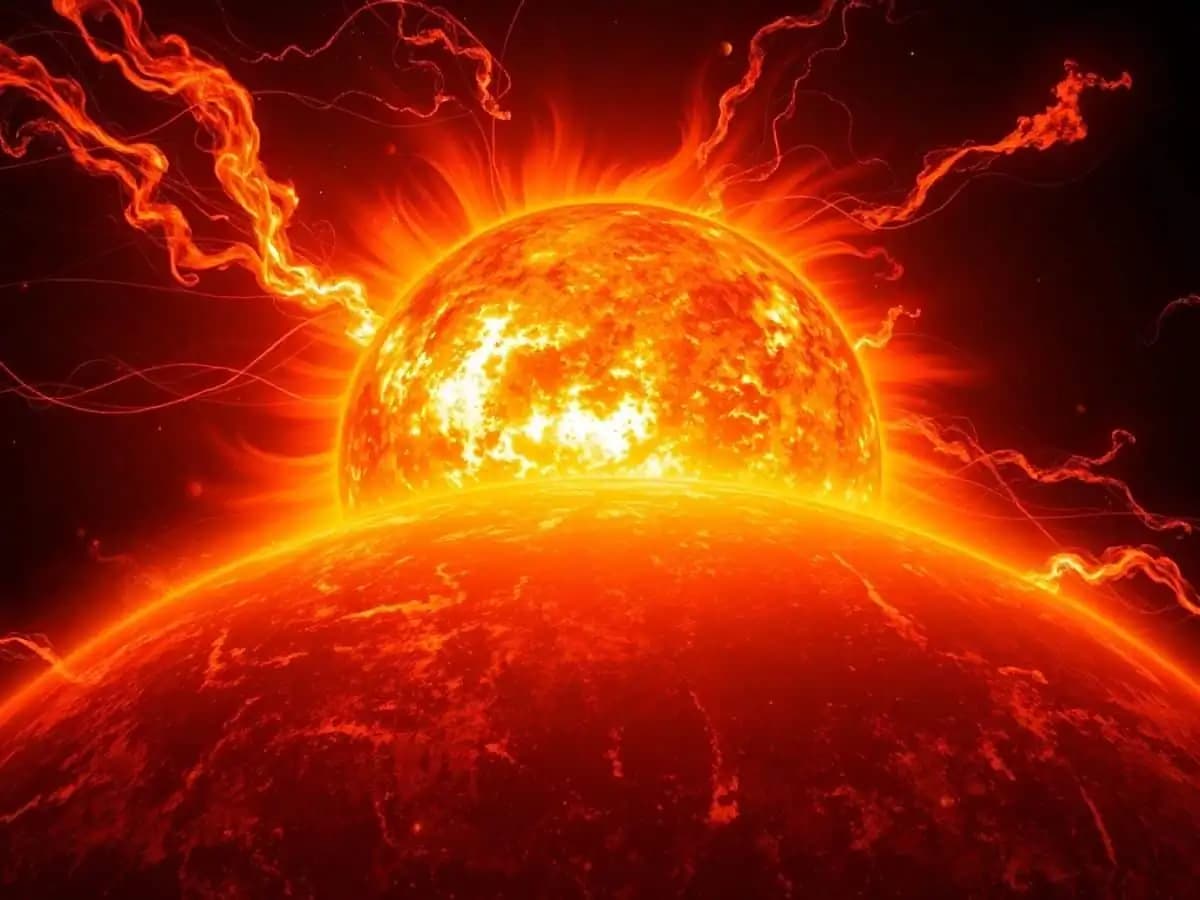

NASA has officially announced that the Sun has reached its peak in its 11-year cycle, marking the beginning of the solar maximum period of Solar Cycle 25. This event brings with it a series of fascinating phenomena that will impact our planet in the coming months.
Key Takeaways
- The Sun’s magnetic field has flipped, indicating the arrival of solar maximum.
- Expect increased solar activity, including solar flares and coronal mass ejections.
- The solar maximum period is expected to last for about a year.
- Historical solar events have had significant impacts on Earth.
- Solar activity has a minimal effect on global warming.
On May 1st, 2024, a seemingly ordinary sunspot appeared on the eastern edge of the Sun. Initially, it was just another sunspot, but it quickly grew to a size 17 times larger than Earth. Scientists labeled it Active Region 3664, and it soon unleashed fierce solar flares, some powerful enough to trigger coronal mass ejections aimed straight at Earth. The result? One of the most dazzling aurora displays in recorded history, with vibrant lights stretching across the globe.
According to NASA, this was the most powerful geomagnetic storm in 500 years, even rattling observatories deep underground. The Sun didn’t calm down after May; it continued to unleash bursts of M and mild X-class flares, keeping space weather experts on high alert.
Advertisement
On October 3rd, the Sun released an enormous X9.0 flare, the strongest seen in seven years. Within a week, a powerful G4 geomagnetic storm hit Earth, lighting up the skies with vibrant auroras in places unaccustomed to such displays and disrupting radio communications.
Understanding the Solar Cycle
The Sun undergoes a dramatic transformation every 11 years, known as the solar cycle. This cycle involves changes in the Sun’s activity, magnetism, and appearance. The discovery of the solar cycle dates back to the late 1700s when astronomers noticed that sunspots appeared in a predictable pattern.
- Solar Magnetic Field: The Sun’s magnetic field undergoes a complete reversal of polarity with each solar cycle, marking the solar maximum.
- Solar Activity: Solar wind, flares, and coronal mass ejections reach their peak during the solar maximum.
Currently, we are in Solar Cycle 25. Each cycle has unique characteristics, and while most follow the expected pattern, there have been unexplained periods of low solar activity, such as the (1645-1715) and the (1790-1830). These periods coincided with cooler global temperatures, raising questions about the relationship between solar activity and climate.