
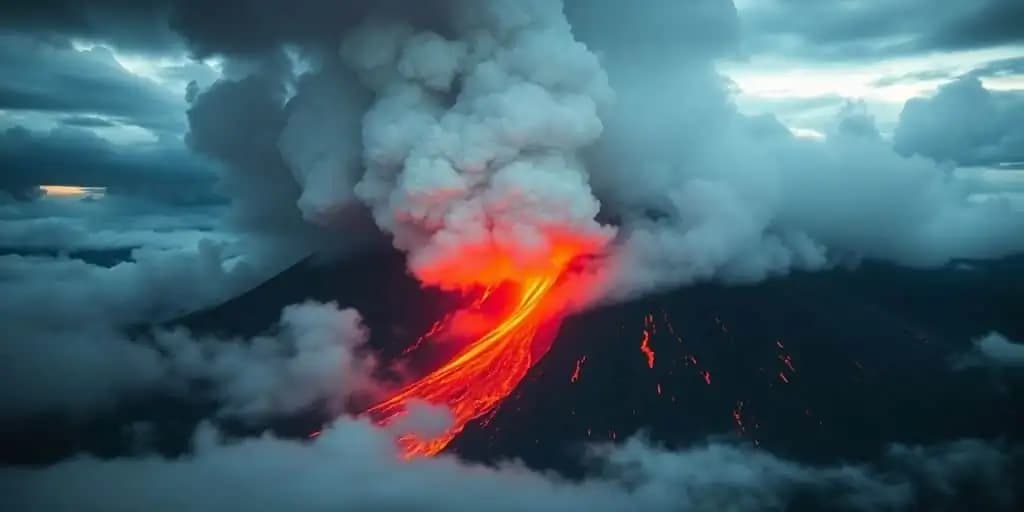

In April of 1815, Mount Tambora erupted, causing one of the most catastrophic volcanic events in history. This eruption not only reshaped the local landscape but also had far-reaching effects on global climate and human history. The aftermath was felt worldwide, leading to crop failures and famine.
Key Takeaways
- The eruption occurred in April 1815, releasing 150 cubic miles of ash.
- It caused immediate devastation in Indonesia and a global climate crisis.
- The year 1816 became known as “The Year Without a Summer” due to temperature drops.
- Approximately 990,000 people perished as a result of the eruption and its aftermath.
The Eruption of Mount Tambora
Mount Tambora, located on the Indonesian island of Sumbawa, erupted with a force that was unprecedented in modern times. This eruption was the result of geological activity that had been building for thousands of years. The volcano sits at the convergent boundary of the Indo-Australian and Eurasian tectonic plates, where one plate subducts beneath the other. Over centuries, magma accumulated in the volcano’s chamber, leading to a catastrophic explosion.
In April 1815, seismic activity indicated growing instability within Tambora. The magma chamber became over-pressurized, creating conditions ripe for an explosion. When it erupted, it reached a volcanic explosivity index (VEI) of 7, making it one of the largest eruptions in the last 10,000 years.
Immediate Impact
The initial eruption released a towering column of ash, gas, and pumice, followed by pyroclastic flows that devastated the surrounding areas. While there were some warning signs, the scale of the disaster was beyond what anyone could have predicted. The eruption expelled an estimated 150 cubic miles of ash into the atmosphere, more than ten times the material released by the 1883 Krakatoa eruption.
The ash plume reached an estimated height of 30 miles, breaching the stratosphere and affecting global weather patterns. The immediate vicinity experienced apocalyptic conditions, with entire villages buried under ash and tens of thousands of people killed instantly. Those who survived faced famine and disease as crops were destroyed, water sources contaminated, and livestock perished.
Global Consequences
The eruption’s impact extended far beyond Indonesia. The massive injection of volcanic ash and sulfur dioxide into the stratosphere created a reflective haze that spread across the globe. This phenomenon, known as volcanic winter, significantly reduced sunlight reaching the Earth’s surface, leading to a drop in temperatures by an average of 2°C, especially in the Northern Hemisphere.
The year 1816 became known as “The Year Without a Summer.” In Europe, incessant rain and unseasonable cold ruined harvests, leading to food shortages and famine. In New England, snow fell in June, and frost was reported in July and August. Other regions, including China and India, faced severe monsoon disruptions, exacerbating food crises and spreading disease.
Lasting Effects
The ash from Tambora settled over a vast area, with fine particles traveling as far as the Arctic and Antarctic regions. Heavier debris buried areas closer to the eruption site under meters of ash. The volcanic aerosol particles remained suspended in the atmosphere for several years, scattering sunlight and intensifying climatic anomalies. This eruption also produced breathtaking sunsets and a hazy twilight glow observed worldwide, famously inspiring artists like J.M.W. Turner.
A Lesson in Nature’s Power
The Mount Tambora eruption was at least ten times more powerful than Krakatoa, which erupted in 1883. Tambora’s global climatic effects were more prolonged and severe due to the sheer volume of sulfur dioxide and ash ejected into the atmosphere. This event profoundly altered human history, exposing the fragility of societies dependent on stable agricultural conditions.
The eruption also sparked early scientific interest in the relationship between volcanic activity and climate change, laying the groundwork for modern volcanology and atmospheric science. In retrospect, the lack of advanced monitoring systems and understanding of volcanic activity at the time meant that Tambora’s eruption came with no meaningful warnings.
Conclusion
The 1815 eruption of Mount Tambora was a natural disaster of unparalleled scale and impact. It devastated local populations, disrupted global climate, and brought about a year without a summer that affected millions worldwide. With 150 cubic miles of ash released into the atmosphere and a VEI of 7, Tambora dwarfed Krakatoa in magnitude and consequences. This event serves as a stark reminder of the power of nature and the delicate balance that sustains human civilization. The massive sulfate dust cloud enveloped the Earth, cooling temperatures and disrupting major weather systems for more than three years, leading to famine, disease, and civil unrest on a catastrophic scale.