The History of the Occult, From Ancient Magic to Modern Esotericism | Unexplained
The Occult
The History of the Occult, From Ancient Magic to Modern Esotericism
The history of the occult is not one straight line and it is not one single tradition. It is a tangled story made of ancient temple rituals, hidden books, mystical philosophy, forbidden experiments, visionary movements,…
Art Grindstone is the hard-nosed storyteller behind Unexplained.co, a veteran investigator whose life’s work sits at the crossroads of the paranormal, fringe science, and the shadows most people try not to look into. With decades spent chasing impossible stories — black-budget psychic programs, vanished Cold War experiments, desert rituals that sparked UFO waves, and the strange phenomena buried in America’s forgotten backroads — Art brings a rare combination of skepticism, awe, and journalistic precision. He’s not here to debunk. He’s not here to blindly believe. He follows the evidence wherever it leads — even when it leads someplace deeply uncomfortable. Known for his immersive, cinematic style and his ability to turn obscure research into gripping narrative, Art has built a devoted following across podcasts, long-form features, documentaries, and serialized investigations. His interviews are direct. His analysis is unflinching. His voice has become a staple in the modern paranormal renaissance — the guy people turn to when a story is too strange, too complex, or too dangerous for anyone else to touch. Off-mic, Art works with a distributed network of researchers, archivists, and field operatives who help surface the stories mainstream media ignores. On-mic, he transforms their findings into meticulous, high-impact reporting that refuses to insult the intelligence of true believers. His philosophy is simple: Take the phenomenon seriously. Treat the audience with respect. Tell the story as if the world depends on it — because sometimes it does. When Art Grindstone digs into a case, he isn’t just chasing a mystery. He’s tracing the fault lines of reality itself.
17 min · 3,717 words
In This Report(22)
The history of the occult is not one straight line and it is not one single tradition. It is a tangled story made of ancient temple rituals, hidden books, mystical philosophy, forbidden experiments, visionary movements, and recurring waves of fear. Across thousands of years, ideas now grouped under the word occult have moved through Mesopotamia, Egypt, Greece, the Islamic world, medieval Europe, Renaissance courts, secret societies, séance parlors, modern witchcraft circles, and the internet. What changes from era to era is not just the practice itself, but the meaning people assign to hidden knowledge.
At its core, the occult concerns what is concealed. The word comes from the Latin occultus, meaning hidden or secret. In practice, it usually refers to systems of knowledge and ritual that claim access to unseen forces, symbolic truths, spiritual realities, or techniques of transformation that are not obvious to ordinary perception. That broad umbrella can include astrology, alchemy, ceremonial magic, Kabbalah, divination, spirit communication, mysticism, talismanic practice, and later movements such as Rosicrucianism, Theosophy, the Golden Dawn, and Wicca.
This history matters because occult ideas have never stayed neatly outside mainstream culture. They have influenced religion, medicine, art, literature, science, psychology, and politics, sometimes quietly and sometimes in ways that changed entire eras. Even during periods of persecution, occult traditions survived by adapting, disguising themselves, or passing through elite and underground networks. If you want to understand why the occult still grips modern audiences, you have to start with the long arc of hidden knowledge itself, and with the recurring human suspicion that reality is stranger than it first appears.
Obama Says UFO Disclosure Won’t Happen — ‘Government Is Terrible at Keeping Secrets’
Former President Obama’s unexpected remarks on UFO disclosure and government secrecy are spreading across Reddit and UAP forums. Is it an off-hand joke or a genuine signal from a former commander-in-chief?
May 12, 2026 • 5 min read
Strange History
The Etruscan Well Sealed With Human Remains Is Stranger Than a Sacrifice Story
A newly reported Etruscan well in Italy was opened with offerings and sealed with human remains. The evidence reveals a ritual mystery, not a simple sacrifice tale.
Aug 18, 2026 • 7 min read
Articles
The Sunken Basilica of Iznik: Did a Lake Hide the Council of Nicaea?
A basilica beneath Lake Iznik has revived a 1,700-year-old question: was this the setting of the First Council of Nicaea, or a compelling archaeological near-miss?
Today, many people hear the word occult and think only of black magic, demons, satanic imagery, or forbidden ritual. Historically, that is far too narrow. The occult has often referred to bodies of hidden knowledge about how the cosmos works and how the human soul fits into it. In some periods, occult practice was treated as sacred philosophy. In others, it was denounced as fraud, heresy, or dangerous superstition. The category keeps changing, which is part of why the subject is so difficult to pin down.
Scholars of Western esotericism often group the occult under a broader family of traditions that emphasize symbolic correspondences, initiation, secrecy, spiritual transformation, and the idea that hidden truths lie beneath visible reality. That means occult history is not only about spell books or ritual circles. It is also about attempts to read the universe as a coded system, where planets, metals, angels, sacred letters, dreams, and natural forces all reflect one another.
For readers coming to this topic fresh, the simplest working definition is this: the occult is the pursuit of hidden knowledge, hidden forces, or hidden methods of transformation. Sometimes that pursuit is mystical and contemplative. Sometimes it is practical and ritualized. Sometimes it leans toward religion, and sometimes toward proto-science. Often it blurs those boundaries entirely.
Ancient occult practices began as attempts to read a living cosmos
The earliest roots of occult history appear in ancient civilizations that treated the world as charged with signs. In Mesopotamia, priests developed highly structured systems of divination, including celestial omen reading and extispicy, the interpretation of animal livers. These were not fringe hobbies. They were state-level technologies of prediction and meaning. Kings wanted to know what the heavens were saying, whether war was favored, and how disaster might be prevented.
In ancient Egypt, ritual and magic were woven deeply into religion and daily life. Protective amulets, funerary texts, temple invocations, and sacred names all belonged to a worldview in which words and symbols could shape reality. Texts now associated with the Egyptian Book of the Dead were not casual superstitions. They were carefully preserved instructions for navigating the afterlife, aligning with divine order, and surviving cosmic judgment.
These ancient systems matter because they reveal a pattern that persists throughout occult history: hidden knowledge is often treated as power, and power belongs to those who know how to interpret the signs. The priest, astrologer, diviner, or initiate becomes important not because he or she invents a fantasy world, but because that person claims to read the deeper structure beneath ordinary events.
At this stage, the occult was not yet a separate category. Divination, temple ritual, healing, and sacred cosmology were woven into public religion and governance. Only later would these practices be split into approved knowledge and forbidden knowledge, a division that would shape the rest of occult history.
The classical and Hellenistic worlds turned hidden knowledge into philosophy
The Greek and Hellenistic periods added an intellectual framework that changed occult history forever. Mystery cults such as the Eleusinian Mysteries offered initiation into sacred rites that promised revelation, transformation, and a deeper relationship to death and rebirth. These traditions emphasized secrecy, symbolic drama, and experiential knowledge. To know was not just to think. It was to be changed.
Later, in the cosmopolitan atmosphere of Hellenistic Egypt, especially Alexandria, ideas from Greek, Egyptian, Persian, and Jewish traditions mixed in fertile and often unstable ways. This produced some of the most influential currents in occult history, including Hermeticism, Gnosticism, astrological synthesis, and magical papyri. The writings attributed to Hermes Trismegistus framed the universe as a spiritually layered reality in which humans could ascend through knowledge, discipline, and divine insight.
Hermetic thought introduced a language that would echo for centuries: as above, so below; the human being as microcosm of the cosmos; spiritual ascent through hidden wisdom; and the belief that symbols, planets, numbers, and elements interlock in meaningful ways. These were not just mystical slogans. They became the backbone of later ceremonial magic, alchemy, and esoteric philosophy.
At the same time, Jewish mystical traditions laid early foundations for what would later develop into Kabbalah. Sacred language, numerology, angelology, and the hidden dimensions of scripture all contributed to a view of reality as layered, encoded, and spiritually active. That idea, that letters and names carry metaphysical force, would become one of the most enduring themes in occult thought.
Occult traditions survived the medieval world by moving through religion, scholarship, and secrecy
The medieval period is often imagined as an age of pure suppression, but the actual history is more complicated. Hidden knowledge did not disappear. It moved. It was translated, commented on, condemned, adapted, and quietly preserved. One of the most important bridges came through the Islamic world, where scholars translated and developed Greek philosophical, astrological, and alchemical texts. Without this transmission, much of what later fueled the European occult revival might have vanished.
Alchemy matured significantly in Arabic intellectual culture, where it became both an experimental and symbolic art. While many later myths exaggerate the search for literal gold, alchemy was also a theory of matter, transformation, purification, and hidden processes in nature. It influenced medicine, metallurgy, and early natural philosophy. Some of that legacy would eventually feed directly into the scientific tradition, even as alchemy itself was later dismissed.
Meanwhile, Jewish Kabbalah developed more fully in medieval Spain and Provence. The emergence of texts such as the Zohar turned mystical interpretation, divine emanation, and sacred language into a profound symbolic system. Kabbalah would later be adapted into Christian and occult contexts, often in distorted ways, but its core importance in esoteric history is enormous.
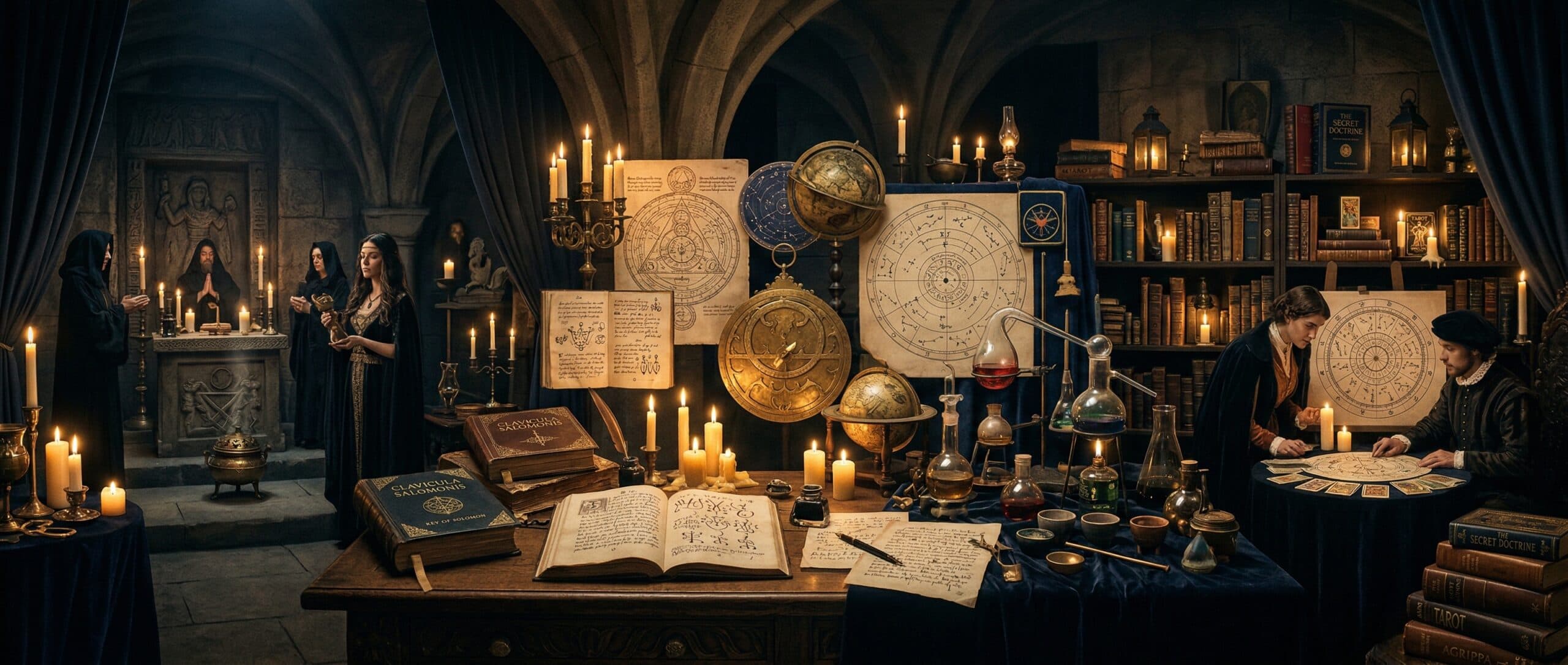
Medieval Europe also saw the circulation of grimoires, manuals of ritual magic often attributed to ancient authorities. Texts associated with Solomon became especially influential. These works blended prayers, astrological timing, sacred names, talismans, spirits, and ritual procedures into systems that promised access to hidden powers. Some practitioners framed this as licit magic aligned with divine order. Others crossed into forms that church authorities considered illicit, dangerous, or demonic.
This is where an important division hardens in occult history. Certain forms of hidden knowledge could be tolerated when framed as natural philosophy or sanctioned religious mysticism. The same ideas, placed in the wrong hands or stripped of orthodoxy, could be condemned as sorcery.
The Renaissance made the occult look like a lost science of the soul
The Renaissance revived interest in antiquity, but it also revived the dream that ancient wisdom contained forgotten truths about the structure of reality. Thinkers such as Marsilio Ficino, Giovanni Pico della Mirandola, and Heinrich Cornelius Agrippa helped transform occult currents into an ambitious intellectual project. Their work treated Hermetic writings, astrology, natural magic, Christian theology, and Kabbalah as parts of a deeper wisdom tradition that might reunite human beings with cosmic truth.
In this period, occult philosophy often presented itself not as rebellion but as restoration. The idea was that hidden knowledge had once been known by sages, priests, prophets, and initiates, then fragmented or corrupted over time. To recover that wisdom was to restore a lost harmony between mind, nature, and the divine.
Agrippa’s Three Books of Occult Philosophy became especially important because it tried to synthesize correspondences between the elemental, celestial, and divine worlds. This model suggested that the universe could be navigated through symbols, planetary influences, sacred names, and ritual techniques. The occult, in other words, became systematized.
Paracelsus added another crucial strand by linking occult correspondences to healing and medicine. He challenged established medical orthodoxies and treated nature as filled with signatures, hidden properties, and spiritual forces. That approach now looks alien to modern medicine, but in its time it blurred the boundary between mystical speculation and empirical curiosity. Even figures later remembered as pillars of science, including Isaac Newton, spent substantial energy on alchemy and biblical chronology. The line between occult inquiry and scientific inquiry was not yet cleanly drawn.
Fear, heresy, and witch hunts transformed the occult into a zone of suspicion
From the late medieval period into the early modern era, Europe entered one of the darkest chapters in occult history. Between roughly 1450 and 1750, tens of thousands of people were prosecuted and executed in witch trials, with the peak occurring between about 1580 and 1650. These persecutions were not a simple response to occult practice as such. They emerged from a volatile mix of religious conflict, local panic, legal change, misogyny, political instability, and demonological imagination.
The rise of witch-hunting changed the emotional meaning of hidden practice. What had once been framed as natural magic, folk healing, blessing, cunning craft, or mystical knowledge could now be recoded as satanic conspiracy. Manuals such as the Malleus Maleficarum helped build a worldview in which secret ritual was not merely suspect but existentially dangerous.
This legacy still shapes modern perceptions. Many contemporary fears about the occult, especially in popular media, descend less from actual occult traditions than from the propaganda of demonology and panic. The witch hunts did not just kill people. They rewired the cultural imagination, making hidden knowledge seem inseparable from threat.
And yet, even under that pressure, occult traditions did not vanish. Folk magic persisted. Grimoires circulated. Astrologers still advised clients. Alchemical laboratories continued to operate. The occult survived not because persecution was weak, but because the appetite for hidden explanation remained stronger than official attempts to erase it.
Secret societies helped keep esoteric ideas alive in the age of reason
The Enlightenment is often framed as the triumph of rationality over magic, but the historical reality is more paradoxical. While skepticism and scientific method gained authority, esoteric traditions reorganized themselves through new networks. Rosicrucian manifestos, published in the early 17th century, presented the image of a hidden brotherhood guarding transformative wisdom. Whether the group existed exactly as claimed mattered less than the power of the idea. Secret initiates, hidden masters, and encoded truth became enduring features of occult imagination.
Freemasonry, formally organized in the early 18th century, was not simply an occult order, but it became deeply entangled with esoteric symbolism, ritual initiation, sacred geometry, temple imagery, and the language of hidden enlightenment. For many later movements, Masonry provided a structure, a symbolic grammar, and a social model for how secret knowledge could be transmitted in modernity.
At the same time, underground and elite circles alike continued exploring astrology, ceremonial practice, Christian mysticism, alchemy, and speculative correspondences. The occult no longer occupied the center of learned culture, but neither had it been fully expelled. Instead, it adapted to a world increasingly divided between public rationality and private initiation.
The 19th century occult revival brought hidden knowledge back into public life
If the Renaissance intellectualized the occult, the 19th century democratized and sensationalized it. Industrial modernity created enormous spiritual anxiety. Scientific progress, urbanization, mass media, colonial contact, and religious doubt all pushed people to seek alternative frameworks. The occult revival answered that need by offering mystery, meaning, and access to realities beyond mechanistic materialism.
Spiritualism exploded after 1848, when the Fox sisters became associated with spirit communication in the United States. Séances, table-rapping, trance mediumship, and ghost photography all helped turn contact with the dead into a mass phenomenon. What made Spiritualism so powerful was its hybrid nature. It looked emotional and supernatural, but it also borrowed the language of experiment, evidence, and investigation. The séance room became a strange cousin to the laboratory.
At the same time, the Theosophical Society, founded in 1875 by Helena Petrovna Blavatsky and others, fused esoteric philosophy with global religious synthesis. Theosophy drew on Hindu, Buddhist, Hermetic, Kabbalistic, and occult concepts to construct a grand narrative of hidden masters, spiritual evolution, and lost wisdom traditions. Many later New Age and occult currents owe an enormous debt to that framework.
Advertisement
The Hermetic Order of the Golden Dawn, founded in 1888, brought another major shift. It systematized ritual magic with a level of structure and symbolic integration that still influences modern practitioners. Drawing from Kabbalah, tarot, astrology, alchemy, Enochian systems, and ceremonial liturgy, the Golden Dawn turned occult initiation into a highly articulated spiritual technology. From this world emerged figures such as Aleister Crowley, one of the most famous and controversial occultists of the 20th century.
The 20th century turned the occult into a modern spiritual marketplace
In the 20th century, occult traditions did not disappear into nostalgia. They diversified. Some movements became more formal and initiatory. Others became more personal, eclectic, and experimental. Crowley’s Thelema reframed occult work around will, ritual, and personal spiritual destiny. Dion Fortune brought psychology and esotericism into closer conversation. Later, Gerald Gardner helped launch modern Wicca, which would become one of the most influential forms of contemporary Pagan practice.
Postwar occult culture also absorbed the language of therapy, self-development, altered consciousness, and liberation. Tarot moved beyond elite or clandestine circles into a broad symbolic tool for reflection and divination. Astrology returned in mass-market form through newspapers, magazines, and later digital platforms. New Age culture blended Eastern spirituality, channeling, crystal work, alternative healing, and esoteric symbolism into a looser but highly influential spiritual ecosystem.
By the late 20th century, chaos magic pushed things even further. Instead of treating occult systems as fixed inheritances, chaos practitioners often treated belief itself as a tool. Symbols, sigils, ritual scripts, and identities could be adopted, discarded, and recombined according to results. This was a radical break from older lineage-based structures, and it anticipated the hyper-fluid, remix culture of the internet age.
Meanwhile, academic scholarship became more serious about the subject. Historians of religion and specialists in esotericism increasingly treated occult traditions not as embarrassing leftovers, but as central threads in the history of ideas. That scholarly shift matters because it gave the occult a new kind of legitimacy: not spiritual legitimacy, but historical importance.
The occult still matters because the hunger for hidden meaning never disappeared
The modern revival of occult interest is not just a trend driven by aesthetics, though aesthetics certainly help. Social media has made tarot spreads, sigil magic, folk witchcraft, lunar rituals, and ceremonial symbolism more visible than ever. But visibility is only part of the story. The deeper reason the occult still matters is that modern life continues to generate the same anxieties that fueled earlier revivals: uncertainty, dislocation, institutional distrust, and the sense that official explanations are incomplete.
For some people, the occult offers spiritual agency outside organized religion. For others, it offers symbolic tools for self-reflection, ritual structure, or a language for private transformation. For still others, it provides access to mystery in a world that often feels over-measured and under-explained. Even skeptics remain fascinated by it because occult history keeps colliding with questions about belief, power, secrecy, altered states of consciousness, and who gets to define what counts as legitimate knowledge.
The occult also remains culturally influential because it has become a bridge subject. It connects to conspiracy culture, psychology, folklore, comparative religion, art history, UFO belief, hidden-history narratives, and the continuing public obsession with secret societies. Once you start tracing its history, you realize the occult is not a strange side corridor of civilization. It is one of the recurring languages people use to talk about forces they feel but cannot fully explain.
That is why the history of the occult remains so enduring. It is not just the history of hidden rites. It is the history of a recurring human suspicion that visible reality is only the surface.
Related mysteries and adjacent unexplained subjects
If you are exploring the history of the occult, the next step is often not just more occultism, but neighboring subjects that reveal how hidden knowledge mutates across time. Readers interested in secrecy, ritual, and hidden systems of influence often move naturally into Operation Midnight Climax, where state power, mind control fears, and psychological experimentation create a grim modern echo of forbidden knowledge.
Others may want to go deeper into symbolic interpretation and unexplained signals through subjects such as the Wow! Signal, where the mystery is not ritual but whether humanity may already have brushed against something beyond current explanation. There is also a natural bridge into lost-civilization and hidden-history narratives, such as the Lost City of Z and Lemuria and Mu, both of which show how esoteric speculation and pseudo-historical mythology often overlap.
For a more spiritual continuation, this pillar topic also belongs in conversation with witchcraft revivals, ceremonial magic lineages, Kabbalistic influence, hermetic revivalism, and modern paranormal belief systems. The history of the occult works as a true hub topic because so many later mysteries, movements, and obsessions branch outward from it.
Conclusion
The history of the occult is really the history of hidden explanations. From Mesopotamian diviners and Egyptian funerary magic to Hermetic philosophy, medieval grimoires, Renaissance magi, Victorian séances, and modern occult revivalism, the same underlying pattern keeps returning. Human beings repeatedly imagine that the universe contains veiled structures, and that some combination of symbol, ritual, insight, and discipline can reveal them.
What changes is the cultural frame. In one era, occult knowledge is priestly and sacred. In another, it is criminalized. In another, it becomes fashionable among intellectuals. In another, it is repackaged for mass media and digital culture. That flexibility explains why the occult has endured for so long. It is not one doctrine. It is a way of approaching mystery itself.
If you want the shortest answer to why occult history still matters, it is this: the occult survives because people keep feeling that the official map of reality is incomplete. Whether that instinct leads to revelation, illusion, spiritual practice, philosophical insight, or cultural mythology depends on the era and the interpreter. But the instinct itself has never gone away.
Frequently Asked Questions
What does the word occult actually mean?
The word occult comes from the Latin occultus, meaning hidden or concealed. It usually refers to traditions, practices, or systems of thought that claim access to hidden forces, hidden knowledge, or spiritual realities beyond ordinary perception.
Is the occult the same thing as magic?
Not exactly. Magic is one part of occult history, but the occult also includes alchemy, astrology, divination, mystical philosophy, sacred symbolism, Kabbalah, spirit communication, and esoteric religious systems. It is a broader category than spellwork alone.
When did occult practices begin?
Occult practices have roots in ancient civilizations, especially Mesopotamia and Egypt, where divination, ritual protection, sacred symbols, and hidden cosmological knowledge were part of religious and political life thousands of years ago.
Why did the occult survive periods of persecution?
Occult traditions survived by adapting to new cultural forms. Some were preserved in religious mysticism, some in scholarly translation, some in folk practice, and some in secretive or initiatory groups. The ideas kept resurfacing because the desire for hidden explanation never disappeared.
How is the occult connected to science?
Before the modern separation between science and spirituality became rigid, many figures explored both. Alchemy influenced early chemistry, astrology shaped early astronomy, and thinkers such as Isaac Newton studied both natural law and esoteric subjects. The relationship was once far more intertwined than modern readers often assume.
Why is the occult popular again today?
The occult has regained visibility because it offers meaning, symbolism, ritual, and alternative frameworks at a time when many people feel alienated from institutional religion and unconvinced by purely material explanations. Social media has amplified the aesthetics, but the deeper draw is existential and spiritual.
Suggested SEO Title: The History of the Occult, From Ancient Magic to Modern Esotericism
Suggested Meta Description: Explore the history of the occult from Mesopotamian divination and Egyptian ritual magic to Hermeticism, witch hunts, secret societies, Spiritualism, and modern esotericism.
This article was created using Media Blaster – Your content production specialist. Visit www.mediablaster.io for more information.
↑
05
Occult traditions survived the medieval world by moving through religion, scholarship, and secrecy
Art Grindstone is the hard-nosed storyteller behind Unexplained.co, a veteran investigator whose life’s work sits at the crossroads of the paranormal, fringe science, and the shadows most people try not to look into. With decades spent chasing impossible stories — black-budget psychic programs, vanished Cold War experiments, desert rituals that sparked UFO waves, and the strange phenomena buried in America’s forgotten backroads — Art brings a rare combination of skepticism, awe, and journalistic precision. He’s not here to debunk. He’s not here to blindly believe. He follows the evidence wherever it leads — even when it leads someplace deeply uncomfortable. Known for his immersive, cinematic style and his ability to turn obscure research into gripping narrative, Art has built a devoted following across podcasts, long-form features, documentaries, and serialized investigations. His interviews are direct. His analysis is unflinching. His voice has become a staple in the modern paranormal renaissance — the guy people turn to when a story is too strange, too complex, or too dangerous for anyone else to touch. Off-mic, Art works with a distributed network of researchers, archivists, and field operatives who help surface the stories mainstream media ignores. On-mic, he transforms their findings into meticulous, high-impact reporting that refuses to insult the intelligence of true believers. His philosophy is simple: Take the phenomenon seriously. Treat the audience with respect. Tell the story as if the world depends on it — because sometimes it does. When Art Grindstone digs into a case, he isn’t just chasing a mystery. He’s tracing the fault lines of reality itself.