
A long-debated metallic specimen linked in UFO lore to Roswell-era crash debris is back in the headlines after analysis involving the U.S. government’s All-domain Anomaly Resolution Office (AARO) and Oak Ridge National Laboratory (ORNL) resurfaced in mainstream coverage. For years, enthusiasts argued the object might be an exotic metamaterial — something engineered beyond known terrestrial technology. The official lab result is much less dramatic, but the story remains important for one reason: this is what happens when UFO mythology collides with actual materials science.
The specimen’s renewed visibility matters because “lab-tested UFO metal” is one of those phrases that instantly bridges disclosure culture, celebrity ufology, Roswell lore, and the politics of evidence.
What the Lab Found
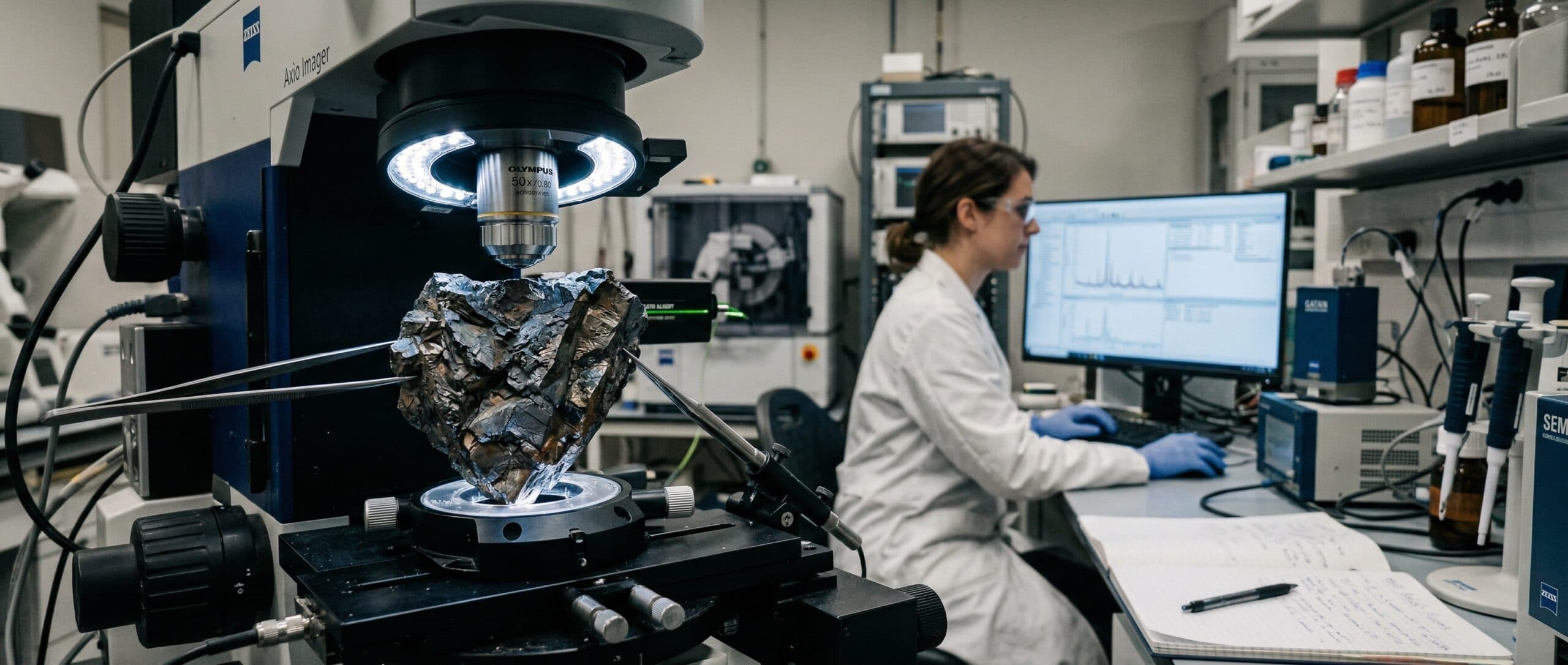
According to Popular Mechanics, AARO had Oak Ridge National Laboratory examine the metallic sample in 2022. Researchers analyzed composition, structure, isotope ratios, and whether the material displayed any unusual electromagnetic behavior that might support the more exotic claims surrounding it.
Advertisement
The result was grounded and unglamorous: the object appears to be a terrestrial magnesium-zinc alloy with bismuth, lead, and trace elements. No definitive public evidence emerged showing alien origin, impossible structure, or extraordinary performance.
AARO’s own supplement to ORNL’s analysis reinforces that conclusion. In other words, the chemistry is interesting but mundane.
Why the Story Still Matters
The object itself may not be revolutionary, but the fact that it moved through recognizable institutions absolutely matters. For years, “mystery materials” in UFO culture lived mostly in rumor-space. Here, a UFO-adjacent sample was at least serious enough to be examined under the oversight of AARO and tested by ORNL.
That gives this case unusual value. It is a rare concrete example of what the modern disclosure ecosystem looks like when physical evidence, however underwhelming, enters the pipeline.
The Gap Between Investigation and Imagination
This is where the story gets more interesting. Believers often focus on the fact of the testing itself — the idea that government offices and a national lab considered the sample worthy of analysis. Skeptics focus on the result, which appears to collapse the alien-material narrative into ordinary metallurgy.