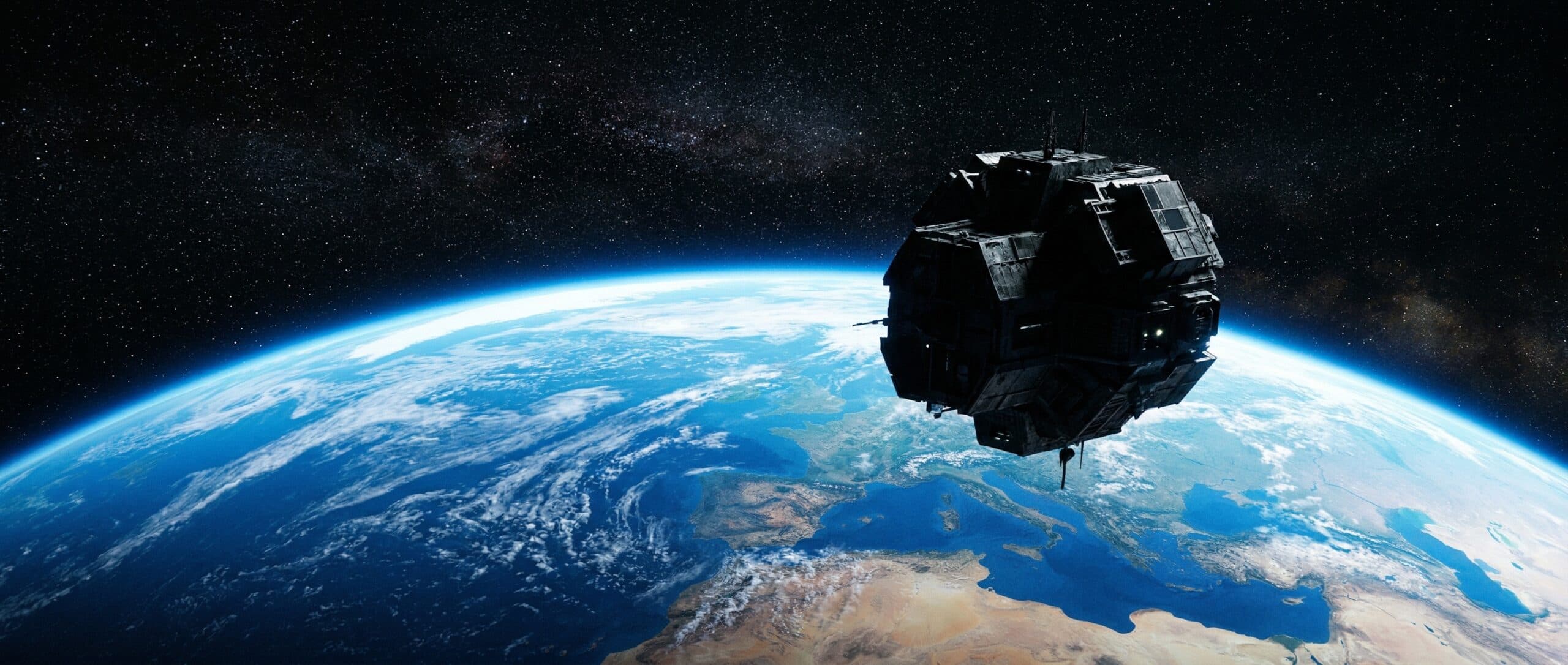
The Black Knight satellite conspiracy is trending again after fresh explainer coverage revived one of the most durable myths in UFO culture: the claim that an artificial object of extraterrestrial origin has been orbiting Earth for thousands of years. The theory ties together Nikola Tesla, mysterious radio signals, pre-space-age satellite rumors, delayed echoes, and NASA imagery into one long-running cosmic mystery.
That is exactly why it keeps coming back. The Black Knight story is not a single event. It is a collage — a conspiracy built by stitching unrelated anomalies across more than a century into one seductive narrative about alien surveillance hiding in plain sight.
What the Black Knight Satellite Theory Claims
The basic claim is simple and irresistible: a dark, silent object of nonhuman origin has been circling Earth for thousands of years, quietly watching us from orbit. Depending on the version, it is described as an alien probe, an ancient monitoring device, or proof that humanity has been under observation long before the modern space age.
As The Economic Times recently summarized, believers often tie the story to a 13,000-year-old orbital object, while mainstream explanations point instead to a chain of misunderstood events — especially debris and thermal insulation associated with NASA’s STS-88 mission.
How the Myth Was Built
The Black Knight legend survives because it pulls from multiple real incidents, each weird enough to sound meaningful when pulled out of context.
- Nikola Tesla’s 1899 radio experiments: Tesla reported strange repeating signals, which later storytellers folded into alien-contact speculation.
- Long-delayed radio echoes: unusual signal behavior in the early 20th century became fuel for theories about artificial objects in orbit.
- Donald Keyhoe’s 1954 satellite claims: before the space age fully matured, public confusion about unidentified orbital objects fed the myth.
- NASA’s 1998 STS-88 images: photographs showing a dark object above Earth became the most iconic “evidence” for the Black Knight theory.
As Space.com explains, the object in the STS-88 imagery is widely understood to have been a thermal insulation blanket lost during a spacewalk, not extraterrestrial hardware.
And yet the image still looks uncanny enough to keep the theory alive.
Why Debunking Never Kills It
This is what makes the Black Knight story such a perfect case study in conspiracy culture. It does not depend on one piece of evidence. It thrives by bundling ambiguity.
That gives it three major advantages:
- It stitches unrelated anomalies into a single grand narrative.
- It weaponizes uncertainty. Old signals, poor-quality images, and misunderstood equipment all become proof-like fragments.
- It survives debunking. In many cases, debunking gives it a fresh media cycle and introduces it to a new audience.
That is why myths like this do not disappear. They mutate. Every new explainer, TikTok recap, Reddit thread, or UFO documentary gives the legend another generation of believers and skeptics to feed on.
Tesla, NASA, and the Power of Pattern-Seeking
The deeper appeal of the Black Knight myth is psychological as much as extraterrestrial. It gives people a way to connect scattered weirdness across time into one coherent, thrilling possibility.
Tesla’s signal reports become prophetic. Delayed echoes become evidence of surveillance. A floating blanket becomes a silent alien machine. The result is less an argument than a mood: the sense that the truth has been visible for decades, if only you know how to connect the dots.
As background summaries of the theory note, the Black Knight narrative is not based on one continuous line of evidence. It is a patchwork assembled after the fact. But for many people, that patchwork quality is part of the charm.
Mystery, Mythmaking, and Media Literacy
For The Unexplained Company, this story is valuable not just as a UFO article but as a media-literacy article. It lets us ask a better question than “is the Black Knight real?”
The more interesting question is: why do some myths become effectively immortal?
The answer may be that they balance wonder and plausibility in just the right way. The Black Knight is spooky but not absurd, debunked but not dead, familiar but still open enough to invite fresh speculation.
That makes it the perfect evergreen conspiracy — one that keeps re-entering culture every time a new audience discovers the image, the Tesla story, or the idea that the most famous alien satellite in history may have been just a drifting space blanket.
For a deeper dive, listen to our podcast episode: The Black Knight Satellite: Alien Probe or Space Myth?. You can also read related coverage on spy radio mysteries, aliens.gov and disclosure culture, and Bob Lazar and the return of classic UFO mythology.