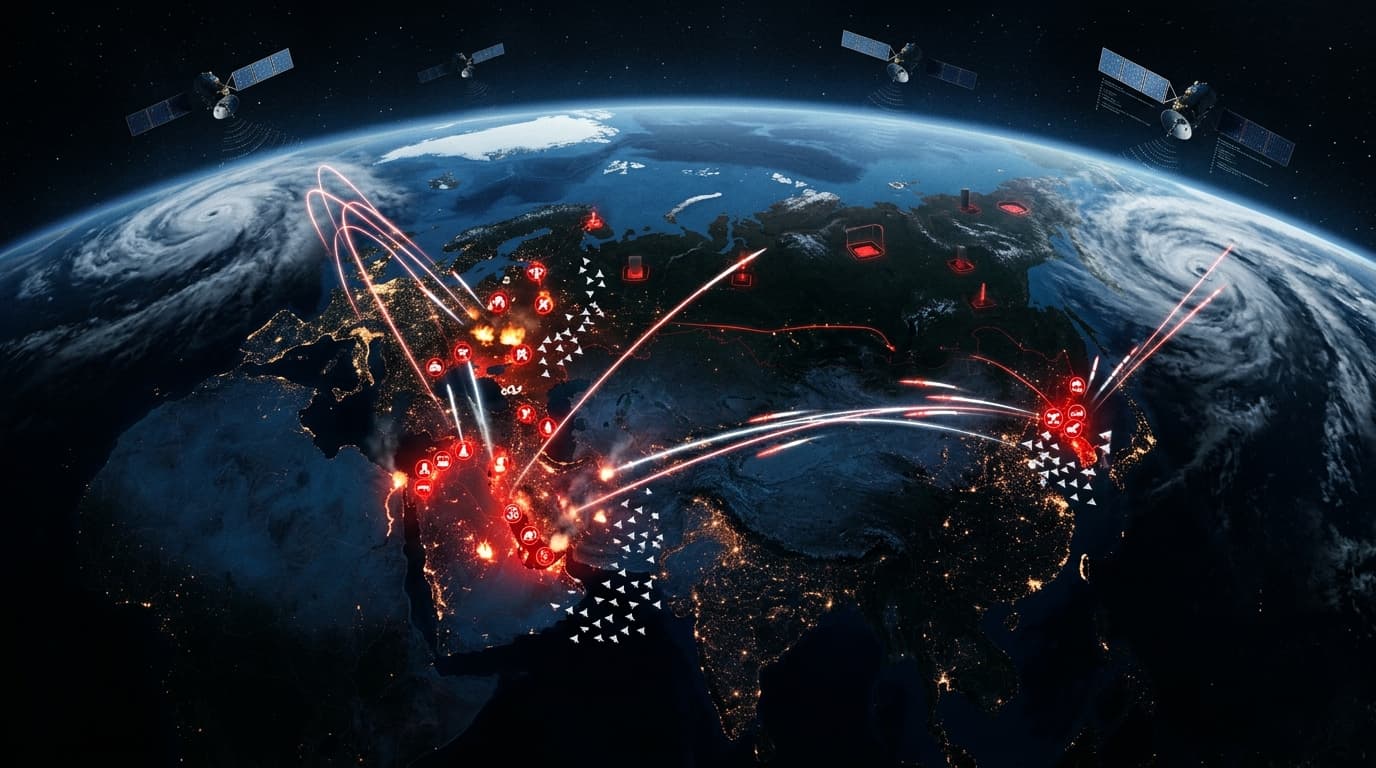
As tensions escalate across the Middle East, Eastern Europe, and the Korean Peninsula, the world watches nervously. Here’s where things stand in the three conflicts that have experts warning about the prospect of World War III.
The phrase “World War III” has been tossed around so frequently in recent years that it has lost much of its meaning. Yet as we enter March 2026, the global situation has never been more precarious. Three separate theaters of conflict are developing simultaneously — and each has the potential to draw in major world powers.
The Middle East: Iran at War
The most immediate crisis is unfolding in the Middle East, where Israel and the United States are engaged in direct military action against Iran.
According to the Institute for the Study of War, the conflict has escalated dramatically. As of mid-March 2026:
- Iran has fired over 500 ballistic and naval missiles and almost 2,000 drones since February 28
- About 40% of those launches targeted Israel
- About 60% were fired toward US targets
- Hezbollah claimed 43 attacks targeting Israeli forces in northern Israel and southern Lebanon in a single 24-hour period
Israel has launched extensive strikes across Iran, including on fuel depots in Tehran. Iran’s foreign minister has accused Israel of “ecocide” — arguing the strikes on fuel facilities constitute war crimes due to the long-term health and environmental impacts on Iranian civilians.
As The Guardian reports, Israel continues to launch more attacks across Iran. The conflict shows no signs of de-escalation.
Eastern Europe: The Grinding War in Ukraine
Meanwhile, the war in Ukraine continues into its fifth year with no end in sight. The conflict has evolved from a rapid Russian invasion into a grinding war of attrition.
According to analysis from the Institute for the Study of War and Russia Matters:
- Russia has lost 57 square miles of Ukrainian territory over the past four weeks — a notable shift from the 182 square miles they gained in the previous four-week period
- Ukrainian forces are intensifying long-range strikes against Russian military and oil infrastructure
- Ukraine is increasing its use of first-person view (FPV) drones across all frontline sectors
- France has agreed to provide Ukraine with the newest version of the SAMP/T NG anti-aircraft missile system in 2026
Russian President Putin’s December 2022 decree on simplified citizenship processes for Ukrainian children has been formalized into permanent policy as of March 2026, facilitating further integration of occupied territories.
The Korean Peninsula: Kim’s Show of Force
On the other side of the world, North Korea is demonstrating its military capabilities in response to US-South Korean exercises.
North Korea fired approximately 10 ballistic missiles toward the eastern sea on March 14, staging its own show of force as the rival South conducts joint military exercises with the United States.
The Freedom Shield exercises, involving 18,000 South Korean and US military personnel, began on March 9 and are scheduled to run for 10 days. North Korean leader Kim Jong Un has denounced the exercises as “muscle-flexing” and ordered his military to respond.
As Al Jazeera reports, North Korea also conducted a live-fire test of its KN-25 multiple rocket launch system, highlighting its tactical nuclear strike capability.
Are We Heading Toward World War III?
According to Foreign Policy, while these conflicts are serious, they remain regional wars — for now.
“While Russia’s invasion of Ukraine and the U.S.-Israeli war against Iran are two serious conflicts with devastating consequences for the nations involved, they are both regional wars,” the publication notes. “A world war has considerably more profound effects on great power politics, stability, economic growth, and the international system.”
A recent Politico poll found that a majority of respondents in Britain, Canada, France, and the United States believed that World War III is more likely than not to happen within the next five years.
The concern is real. As The Guardian reports, fears about nuclear war are reaching a fever pitch. Australia has sent reconnaissance aircraft to help protect Gulf airspace. Reports suggest Iran may be activating “sleeper cells” around the world. Russia and North Korea’s deepening military cooperation adds another wildcard to the equation.
The Connecting Threads
What makes the current moment particularly dangerous is not any single conflict — it’s how they interconnect:
- Russia and Iran: Both nations face Western sanctions and have incentive to support each other
- North Korea and Russia: The two have deepened military ties, with North Korean troops reportedly fighting in Ukraine
- China’s position: Beijing watches all three theaters closely, its stance could tip the balance
- Energy security: The Strait of Hormuz remains a flashpoint that could disrupt global oil supplies
As Foreign Policy notes, while a spiraling war in the Middle East could have profound effects beyond the region, for any conflict to become a true world war would require direct great power confrontation — something that has not yet happened, but cannot be ruled out.
For now, the world holds its breath and watches three separate wars unfold. Whether they remain separate or ignite a broader conflict may depend on decisions made in the coming weeks and months.
Read more about the global tension on The Guardian.