Why the Black Monk and Barney and Betty Hill Still Haunt Us | Unexplained
Prophecy
Why the Black Monk and Barney and Betty Hill Still Haunt Us
A deep investigation into why classic paranormal cold cases like the Black Monk of Pontefract and the Barney and Betty Hill abduction story keep returning while newer mysteries quickly fade.
Art Grindstone is the hard-nosed storyteller behind Unexplained.co, a veteran investigator whose life’s work sits at the crossroads of the paranormal, fringe science, and the shadows most people try not to look into. With decades spent chasing impossible stories — black-budget psychic programs, vanished Cold War experiments, desert rituals that sparked UFO waves, and the strange phenomena buried in America’s forgotten backroads — Art brings a rare combination of skepticism, awe, and journalistic precision. He’s not here to debunk. He’s not here to blindly believe. He follows the evidence wherever it leads — even when it leads someplace deeply uncomfortable. Known for his immersive, cinematic style and his ability to turn obscure research into gripping narrative, Art has built a devoted following across podcasts, long-form features, documentaries, and serialized investigations. His interviews are direct. His analysis is unflinching. His voice has become a staple in the modern paranormal renaissance — the guy people turn to when a story is too strange, too complex, or too dangerous for anyone else to touch. Off-mic, Art works with a distributed network of researchers, archivists, and field operatives who help surface the stories mainstream media ignores. On-mic, he transforms their findings into meticulous, high-impact reporting that refuses to insult the intelligence of true believers. His philosophy is simple: Take the phenomenon seriously. Treat the audience with respect. Tell the story as if the world depends on it — because sometimes it does. When Art Grindstone digs into a case, he isn’t just chasing a mystery. He’s tracing the fault lines of reality itself.
11 min · 2,556 words
In This Report(17)
Paranormal culture has a memory problem, but it also has an immortality problem. New videos, fresh sightings, viral ghost clips, and rapidly spreading conspiracy threads appear every week, yet most of them vanish almost as fast as they arrive. Then there are the cases that do not die. They survive format changes, skeptical reappraisal, media cycles, and generational turnover. They keep resurfacing as if they were never fully finished with us. The Black Monk of Pontefract is one of those cases. So is the Barney and Betty Hill abduction story. Both remain active in public imagination not because they are the newest mysteries, but because they satisfy something deeper than novelty ever can.
That is why renewed 2026 interest in classic paranormal cold cases matters. This is not just another nostalgia wave. It is evidence that some unexplained stories become permanent cultural property. They move beyond their original witnesses and become frameworks through which later audiences understand haunting, abduction, terror, testimony, and the possibility that a single case can define an entire subgenre. Modern paranormal media keeps rediscovering these stories because they still outperform plenty of newer material on the level that matters most, symbolic durability.
This is the real pillar angle. The question is not merely why these two cases are famous. It is why certain paranormal cold cases become immortal while others collapse into footnotes. Readers who have followed how the Westall UFO mystery still shapes witness culture or seen why Borley Rectory remains the template for haunted-house myth will recognize the pattern. The strongest paranormal cases do not survive because they are solved, but because they remain useful to the imagination. They survive because they are narratively complete enough to feel real and unresolved enough to stay alive.
Obama Says UFO Disclosure Won’t Happen — ‘Government Is Terrible at Keeping Secrets’
Former President Obama’s unexpected remarks on UFO disclosure and government secrecy are spreading across Reddit and UAP forums. Is it an off-hand joke or a genuine signal from a former commander-in-chief?
May 12, 2026 • 5 min read
Prophecy
Baba Vanga’s 2026 Alien Prophecy: The Blind Mystic Who Predicted Mass Alien Contact and Why People Are Taking It Seriously Again
Bulgarian mystic Baba Vanga reportedly predicted that non-human contact would occur in 2026. With UFO disclosure accelerating in real-time, the timing has prophecy watchers locked in.
May 12, 2026 • 5 min read
Ancient Civilizations
1957 Electrogravitics Secret: The Classified Research Program Whose Watchers Have All ‘Gone’
A viral essay claims that classified electrogravitics research made real progress in the 1950s — and that everyone who knew the truth about it has since disappeared from the public record. The story is spreading through high-strangeness forums.
Classic paranormal cold cases survive because they become story engines, not just old reports
Most unexplained stories flare and disappear because they never achieve full narrative architecture. They may be creepy, strange, even briefly viral, but they do not generate enough enduring structure to support endless retelling. The cases that last do something different. They become story engines. They offer memorable witnesses, emotionally charged details, symbolic settings, escalating strange events, unresolved interpretation, and enough documentation to keep both believers and skeptics engaged without closing the case.
That is what separates a durable paranormal cold case from a passing weird headline. A durable case has shapes people can remember. A room, a road, a family, a night drive, a monk, missing time, poltergeist violence, fear on the faces of witnesses, official uncertainty, and just enough evidence to argue over forever. These elements make a story portable. They allow it to live in books, television, podcasts, YouTube explainers, TikTok summaries, and campfire-style retellings without losing coherence.
In that sense, the best paranormal cold cases operate like folklore with documentation attached. They are modern legends that retain the persuasive force of named people, specific places, and archived accounts. That combination is rare, and it is one reason only a small number of old mysteries become permanently renewable.
The Black Monk of Pontefract still represents the ideal haunted-house case
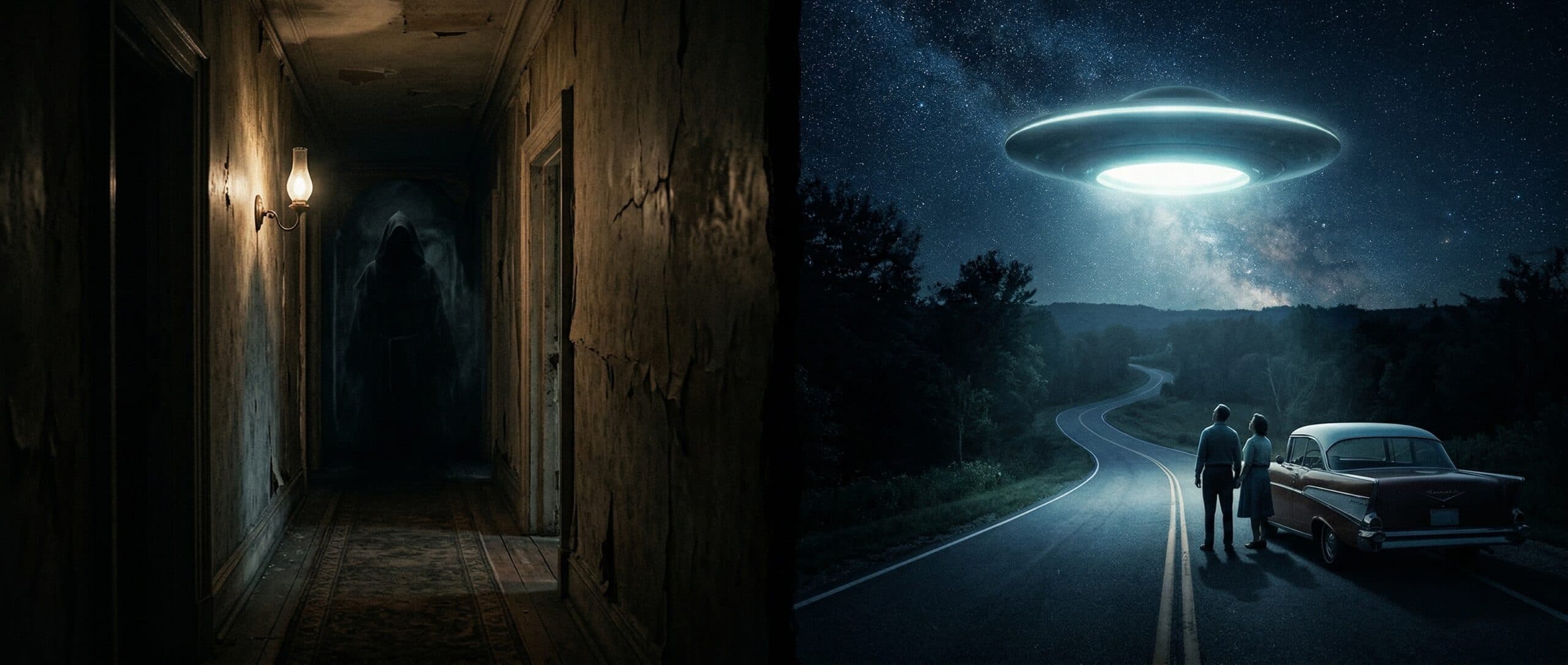
The Black Monk of Pontefract remains one of Britain’s most persistent haunting legends because it contains nearly every element a classic ghost case needs. A family home. Repeated disturbances. object movement. Physical attacks. witness fear. Apparitions. A historical backstory involving a monk. Investigators. Religious framing. Media circulation. Whether one treats the events as supernatural, psychological, exaggerated, socially contagious, or some unstable combination of all four, the case is narratively rich in a way that very few haunting stories are.
Its power comes partly from the domestic scale of the fear. A haunting works best when it invades the place that should be safe. Pontefract’s endurance has less to do with a single spectacular piece of evidence than with the layered way the case accumulated menace. The reports do not feel like one odd moment. They feel like an environment turning hostile. That kind of escalation allows audiences to imagine themselves into the story very easily.
It also helps that the Black Monk story sits comfortably between folklore and case file. The image is unforgettable, but so is the setting. The story remains vivid because it compresses haunting into a symbolic form almost anyone can grasp: the home is breached, the unseen has presence, and the past refuses to stay buried. That formula still works because it touches something older than modern paranormal branding.
Barney and Betty Hill became the template for modern alien abduction narrative
If Pontefract helped define the haunted-house cold case, Barney and Betty Hill helped define the abduction case in its modern form. Their 1961 experience in New Hampshire became one of the most influential UFO contact stories ever told, not only because of what they claimed happened but because of how the case was narrated, recorded, investigated, and culturally processed afterward. Missing time, hypnosis, recurring memory fragments, emotional trauma, road-based encounter structure, and the possibility of nonhuman contact all converged into a template that later abduction stories would echo for decades.
The Hill case remains so powerful because it feels transitional. It belongs to an older UFO era while also prefiguring the psychologically intimate abduction accounts that would dominate later discourse. It is not simply a story about lights in the sky. It is a story about what happens when witness experience becomes uncertain even to the witnesses themselves. That makes it especially durable. A case survives longer when it contains not only external mystery, but interior fracture.
It also matters that Barney and Betty Hill were real people whose testimony carried emotional complexity. Their story was never purely cinematic. It felt disorienting, human, and difficult. That quality has helped keep the case alive across generations, especially as disclosure culture and alien-contact media continue to reframe older abduction narratives as foundational texts rather than quaint early episodes.
These cases endure because they sit at the intersection of testimony, atmosphere, and cultural timing
The Black Monk and the Hill abduction look like very different paranormal stories, but they survive for related reasons. Each case offers strong atmosphere, emotionally memorable witnesses, a symbolic setting, and enough ambiguity to remain arguable. Each also emerged at a time when the surrounding culture was ready to absorb and amplify its meaning. A haunting case thrives in a culture still attuned to domestic spiritual fear. An abduction case thrives in a culture already primed by space-age anxiety, technological futurity, and the possibility of cosmic intrusion.
That balance matters. A case that is too evidentially thin will not last. A case that is too conclusively resolved also tends to lose long-term force. The immortal cases sit in a middle zone where details are strong enough to support retelling but uncertain enough to resist closure. They invite perpetual reinterpretation. That is exactly what contemporary media wants from legacy mystery content.
This is also why audiences keep comparing old cases to newer ones. The older stories feel denser. They carry accumulated interpretation. They have had time to become myth without losing their documentary traces. Newer cases often arrive raw and scattered. The classics arrive already shaped.
Modern podcasts, documentaries, and social clips keep reanimating legacy mysteries
One reason classic paranormal cold cases are surging again is structural. Modern media formats are unusually well suited to reviving them. Podcasts reward layered storytelling and witness reconstruction. YouTube essays reward archival collage and theory comparison. Short-form clips reward a single unforgettable image or detail. Streaming documentaries reward atmosphere, reenactment, and open-ended interpretation. A good old case can now be redistributed across every format at once.
This gives legacy mysteries a major advantage over newer reports that may lack narrative density. An older case comes preloaded with chronology, context, secondary commentary, and decades of accumulated cultural residue. Creators do not have to invent the gravity. They inherit it. That is why a story like the Black Monk or the Hill abduction can be repackaged endlessly without feeling exhausted. Each retelling borrows prestige from every previous retelling.
This same engine helps explain the continued success of other legacy mysteries on unexplained.co, from Westall to long-lived haunting narratives and revived sky anomalies. Old cases scale well because they already know how to survive interpretation.
Believers and skeptics both help keep the best cold cases alive
One of the least appreciated truths about paranormal survival is that skeptical attention can be as important as believing attention. A case that only believers discuss may remain within a subculture. A case that skeptics, historians, psychologists, folklorists, and debunkers keep revisiting becomes harder to bury. Every argument extends the shelf life. Every attempted explanation becomes another chapter in the case’s afterlife.
The Black Monk benefits from this dynamic because haunting cases invite questions about suggestion, fraud, family stress, religious imagination, and mass influence. The Hill case benefits because abduction narratives raise issues of memory, hypnosis, trauma, cultural contamination, and UFO belief formation. In both cases, skepticism does not erase the story. It thickens it. It gives it more layers to survive on.
That is why true cold-case durability often depends on interpretive conflict. If everyone agreed entirely, the case would settle. The immortal paranormal case remains alive because it never stops producing productive disagreement.
Many newer paranormal stories fail because they produce reaction without mythic structure
Modern internet culture can make almost any unexplained clip feel huge for 48 hours. But virality is not the same as mythic staying power. Many newer cases fail because they generate immediate reaction without building durable symbolic structure. There may be a strange video, a dramatic caption, a wave of commentary, and then nothing to hold onto. No strong witness arc. No layered setting. No emotional core. No room for long-term reinterpretation.
Advertisement
By contrast, the classic cold cases keep offering more than one thing at once. They provide incident, atmosphere, testimony, historical context, interpretive conflict, and iconic imagery. They become reusable narrative skeletons. This is why the classics keep outperforming new material. They are not simply older. They are more complete.
That completeness is not always about better evidence. Sometimes it is about better storytelling conditions. A case becomes immortal when it fuses event and myth before anyone realizes it has done so.
Immortal cases become containers for fear, belief, and identity across generations
Over time, the strongest paranormal cold cases stop functioning as isolated events and start functioning as cultural containers. People use them to think with. A haunting case becomes a way of imagining what a home means under threat. An abduction case becomes a way of imagining helplessness, contact, violation, or revelation. A witness story becomes a proxy for larger fears about authority, reality, and what kinds of experiences polite society will permit as real.
This is why such cases survive generational turnover. Younger audiences may not approach them in the same way earlier audiences did, but they still find use in them. The Black Monk can be read as folklore, trauma narrative, media artifact, or genuine haunting. The Hill case can be read as UFO history, psychological puzzle, race-era witness testimony, or foundational mythology of alien contact. The stories remain alive because they can do new work without losing their old force.
That flexibility is one of the clearest markers of paranormal immortality. A dead case cannot be repurposed. A living cold case can keep absorbing new anxieties and new interpretive styles indefinitely.
The return of classic cases says something important about the state of paranormal culture now
If classic cold cases are surging again, it may be because paranormal culture is growing more archival, not less. Audiences are no longer satisfied only by raw novelty. They want depth, lineage, and stories with enough texture to reward long attention. They want cases that feel like they matter because they have already survived scrutiny, retelling, and disagreement. In that environment, legacy mysteries become premium material.
This also suggests a broader fatigue with disposable weirdness. Endless minor anomalies can create temporary buzz, but they rarely build collective memory. The return to classic cases indicates that people still hunger for stories with weight. Not necessarily stories with answers, but stories with enough structure to support obsession.
That is why the current resurgence is more than content recycling. It is a sign that paranormal audiences still recognize the difference between a passing oddity and a case that has earned its place in the canon of the unexplained.
The paranormal cold case revival belongs to a wider hunger for durable mystery
Seen from a wider angle, the renewed fascination with classic cases belongs to a larger cultural pattern. People are gravitating toward mysteries that come with history attached, whether in UFOs, hauntings, occult revivals, or unsolved disappearances. A durable case offers continuity. It lets audiences step into a long conversation rather than consuming a single disposable moment. That continuity is valuable in an overstimulated media environment.
The Black Monk and Barney and Betty Hill continue to haunt us because they are not merely famous. They are structurally alive. They still offer fear, wonder, ambiguity, and interpretive space in proportions that newer stories rarely achieve. They remain arguable without becoming empty. They remain iconic without becoming inert.
That is the real answer to why old paranormal mysteries keep outperforming new ones. The strongest cases do not fade because they never stop functioning. They still help us rehearse the oldest questions: what happened, who can be believed, what entered the room, what crossed the road, and why some stories refuse to let the living move on.
Frequently Asked Questions
Why do classic paranormal cold cases keep returning?
Because the strongest old cases combine memorable witnesses, symbolic settings, unresolved interpretation, and enough documentation to support endless retelling across new media formats.
Why is the Black Monk of Pontefract still so famous?
It remains one of the most effective haunted-house cases ever told, combining domestic terror, repeated disturbances, apparition lore, and a setting that makes the fear feel intimate and believable.
Why does the Barney and Betty Hill case still matter?
Because it helped define the modern alien abduction narrative, especially the themes of missing time, psychological disruption, and intimate witness testimony that later cases would build on.
Do skeptics help old paranormal cases survive?
Yes. Ongoing skeptical debate adds layers to a case and keeps it active in public conversation, rather than allowing it to settle into a closed belief-only niche.
Why do many newer paranormal stories fade so quickly?
Because many generate short-term reaction without the deeper narrative structure, witness texture, and interpretive richness that allow a mystery to survive for decades.
Art Grindstone is the hard-nosed storyteller behind Unexplained.co, a veteran investigator whose life’s work sits at the crossroads of the paranormal, fringe science, and the shadows most people try not to look into. With decades spent chasing impossible stories — black-budget psychic programs, vanished Cold War experiments, desert rituals that sparked UFO waves, and the strange phenomena buried in America’s forgotten backroads — Art brings a rare combination of skepticism, awe, and journalistic precision. He’s not here to debunk. He’s not here to blindly believe. He follows the evidence wherever it leads — even when it leads someplace deeply uncomfortable. Known for his immersive, cinematic style and his ability to turn obscure research into gripping narrative, Art has built a devoted following across podcasts, long-form features, documentaries, and serialized investigations. His interviews are direct. His analysis is unflinching. His voice has become a staple in the modern paranormal renaissance — the guy people turn to when a story is too strange, too complex, or too dangerous for anyone else to touch. Off-mic, Art works with a distributed network of researchers, archivists, and field operatives who help surface the stories mainstream media ignores. On-mic, he transforms their findings into meticulous, high-impact reporting that refuses to insult the intelligence of true believers. His philosophy is simple: Take the phenomenon seriously. Treat the audience with respect. Tell the story as if the world depends on it — because sometimes it does. When Art Grindstone digs into a case, he isn’t just chasing a mystery. He’s tracing the fault lines of reality itself.