The Return of Awe, Why Disclosure Day Feels Like a Modern Echo of Close Encounters | Unexplained
UFO & Aliens
The Return of Awe, Why Disclosure Day Feels Like a Modern Echo of Close Encounters
A deep look at why Disclosure Day is being framed as a spiritual sequel to Close Encounters, and why awe-driven alien stories feel newly powerful in the age of UFO disclosure culture.
Art Grindstone is the hard-nosed storyteller behind Unexplained.co, a veteran investigator whose life’s work sits at the crossroads of the paranormal, fringe science, and the shadows most people try not to look into. With decades spent chasing impossible stories — black-budget psychic programs, vanished Cold War experiments, desert rituals that sparked UFO waves, and the strange phenomena buried in America’s forgotten backroads — Art brings a rare combination of skepticism, awe, and journalistic precision. He’s not here to debunk. He’s not here to blindly believe. He follows the evidence wherever it leads — even when it leads someplace deeply uncomfortable. Known for his immersive, cinematic style and his ability to turn obscure research into gripping narrative, Art has built a devoted following across podcasts, long-form features, documentaries, and serialized investigations. His interviews are direct. His analysis is unflinching. His voice has become a staple in the modern paranormal renaissance — the guy people turn to when a story is too strange, too complex, or too dangerous for anyone else to touch. Off-mic, Art works with a distributed network of researchers, archivists, and field operatives who help surface the stories mainstream media ignores. On-mic, he transforms their findings into meticulous, high-impact reporting that refuses to insult the intelligence of true believers. His philosophy is simple: Take the phenomenon seriously. Treat the audience with respect. Tell the story as if the world depends on it — because sometimes it does. When Art Grindstone digs into a case, he isn’t just chasing a mystery. He’s tracing the fault lines of reality itself.
14 min · 3,103 words
In This Report(17)
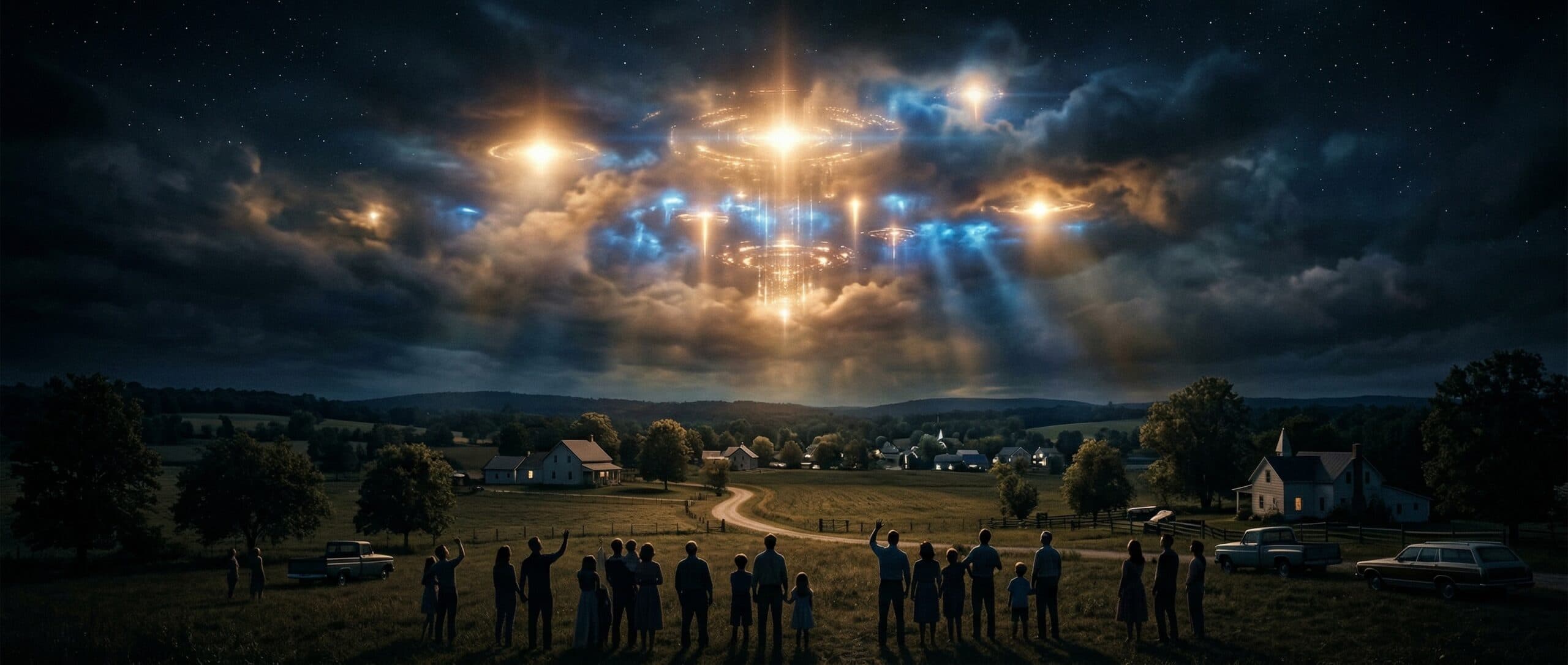
Something unusual is happening in alien storytelling again. Not just on screen, but in the culture around it. The new trailer for Disclosure Day, highlighted by Space.com in April 2026, has sparked a very specific kind of excitement: not only curiosity about whether Steven Spielberg’s latest UFO film might connect spiritually, visually, or even narratively to Close Encounters of the Third Kind, but a wider feeling that hopeful, uncanny alien cinema has returned at exactly the right cultural moment.
That matters more than the sequel theory itself, and it is the real reason this story is landing so hard right now. Whether Disclosure Day is literally a stealth continuation of Close Encounters is almost beside the point. The real story is that audiences immediately wanted it to be. Viewers saw mysterious lights, intimate contact imagery, secrecy, fear, wonder, and the promise of revelation, and they did not frame it as another invasion movie. They framed it as a return to awe. In a media climate saturated with disclosure debates, UAP hearings, online conspiracy loops, and institutional distrust, that instinct says something important about how alien fiction functions now.
This is why Disclosure Day deserves a pillar treatment on unexplained.co. It is not only a film story. It is a cultural story about why classic UFO cinema still exerts gravitational pull, why audiences are drawn back toward luminous contact narratives, and why the language of disclosure has become one of the most powerful bridges between modern nonfiction UFO discourse and mainstream entertainment. Readers who have followed how modern space coverage keeps slipping into conspiracy interpretation or how contemporary UFO witness stories still thrive on mood, ambiguity, and symbolic force will recognize the same pattern here. The film trailer becomes a cultural Rorschach test. People are not just asking what the movie is about. They are asking what kind of alien story we are ready to believe in again.
Japan Just Confirmed It Has UAP Footage, and Is Analyzing Pentagon Files Near Its Borders
Japan’s formal entry into the UAP transparency wave signals an international domino effect. What the country knows about UAP encounters near Japanese territory and why it matters now.
May 14, 2026 • 5 min read
Conspiracy Theories
Japan Just Confirmed It Has UAP Footage — and Is Analyzing Pentagon Files Near Its Borders
Japan’s formal entry into the UAP transparency wave signals an international domino effect. What the country knows about UAP encounters near Japanese territory and why it matters now.
May 13, 2026 • 5 min read
Conspiracy Theories
Obama Says UFO Disclosure Won’t Happen — ‘Government Is Terrible at Keeping Secrets’
Former President Obama’s unexpected remarks on UFO disclosure and government secrecy are spreading across Reddit and UAP forums. Is it an off-hand joke or a genuine signal from a former commander-in-chief?
Disclosure Day is being read as more than just another Spielberg sci-fi film
Disclosure Day, scheduled for release on June 12, 2026, is already being framed as a major return to alien storytelling for Spielberg. Space.com’s recent coverage of the new trailer did more than recap plot hints. It floated the idea that the film might operate as a hidden or spiritual sequel to Close Encounters of the Third Kind, Spielberg’s 1977 landmark contact film. Other entertainment coverage, including Space.com’s wider explainer on the film and additional press around the trailer, has emphasized how tightly the movie is being positioned within Spielberg’s long relationship to extraterrestrial myth, mystery, and revelation.
That framing matters because it sets audience expectation before the film even arrives. People are not approaching Disclosure Day as disposable sci-fi content. They are approaching it as a potential event in the history of alien cinema. The title alone plugs directly into one of the most charged modern words in UFO discourse: disclosure. That word does not merely suggest extraterrestrials. It suggests hidden truth, public unveiling, state secrecy, suppressed evidence, moral confrontation, and the possibility that reality itself has been managed. In other words, it places the movie in conversation with the entire modern ecosystem of UFO speculation before a ticket is ever sold.
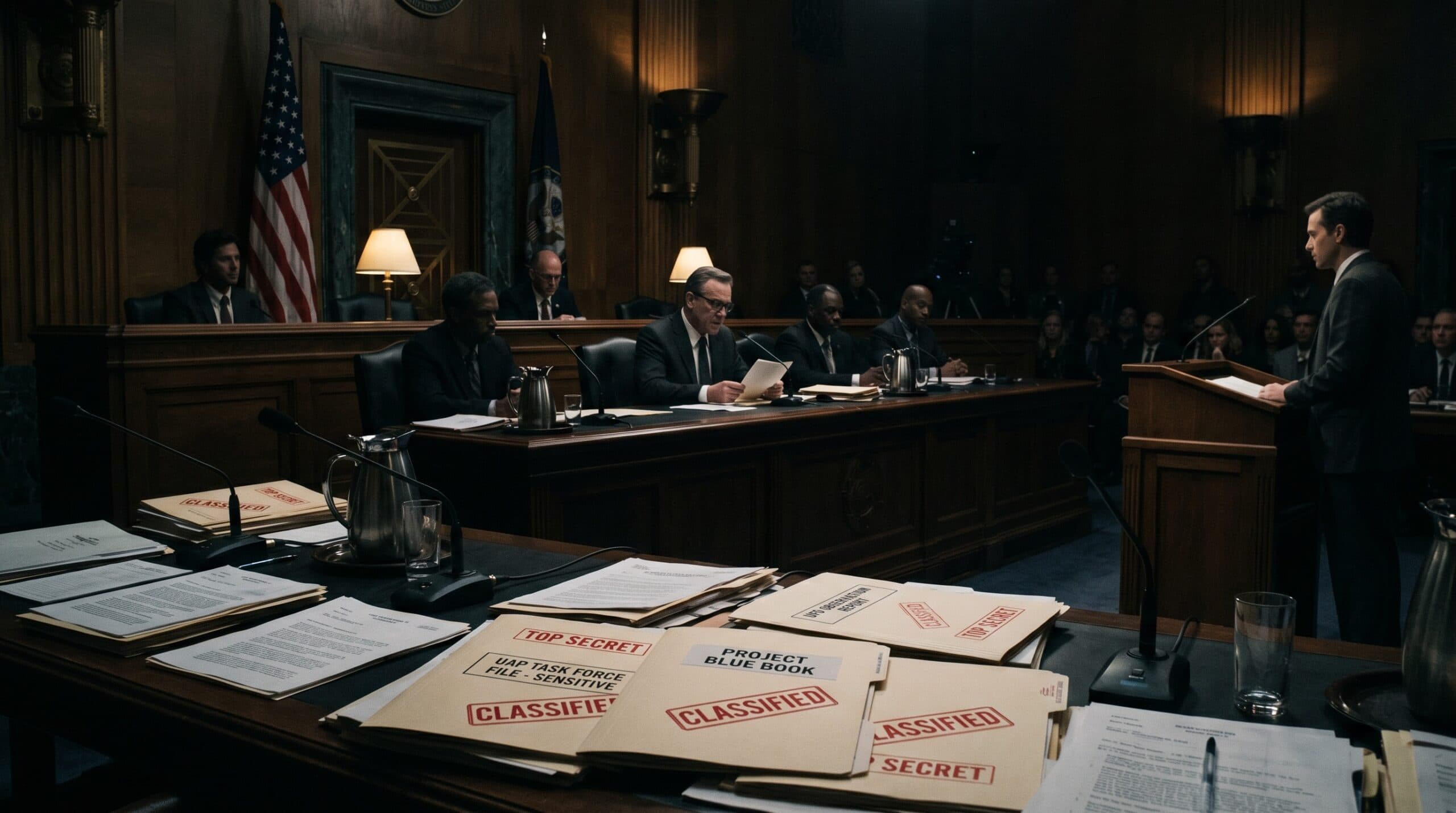
That is a profound shift from how older contact films were received. In 1977, Close Encounters emerged into a post-Watergate America full of fascination and distrust, but it was still operating largely as mythic science fiction. In 2026, any alien narrative using the language of disclosure is automatically read against congressional hearings, Pentagon ambiguity, leaked-video culture, and online communities that have spent years treating revelation as imminent. A film like this is not entering a neutral genre space. It is entering an already electrified field.
Close Encounters still defines the emotional grammar of contact cinema
To understand why the sequel theory landed so quickly, it helps to remember what Close Encounters of the Third Kind still means to audiences. The film is not simply a classic UFO movie. It is one of the most influential attempts ever made to present extraterrestrial contact as frightening, destabilizing, intimate, and awe-filled at the same time. It is not an invasion fantasy. It is a revelation narrative. Ordinary people are pulled toward something luminous and incomprehensible. Institutions struggle to manage it. Language breaks down. Music becomes a bridge. Fear and beauty coexist.
That emotional architecture remains hugely powerful. Even decades later, Close Encounters still stands apart from many later alien stories because it frames contact not mainly as war, apocalypse, or survival horror, but as a destabilizing mystery with spiritual overtones. That does not make it soft. The film is full of confusion, obsession, social unraveling, and state manipulation. But its center of gravity is wonder. It asks viewers to imagine the unknown not only as threat, but as invitation.
That matters because modern UFO culture often swings between two poles: hard suspicion and mystical yearning. On one side there is the disclosure ecosystem, dominated by secrecy, classified programs, whistleblowers, and institutional distrust. On the other there is the enduring hope that contact could also be transformative, expansive, or even corrective. Close Encounters holds both energies at once. It is no surprise that audiences, seeing images in the Disclosure Day trailer that appear to echo that tonal balance, immediately reached for the older film as their interpretive map.
The secret-sequel theory spread because audiences recognized familiar signals instantly
Secret sequel theories thrive when viewers detect a familiar emotional fingerprint before they detect a literal continuity marker. That seems to be what happened here. The trailer’s use of mysterious communication, withheld truth, possible contact, and large-scale public revelation recalls the older Spielberg mode so strongly that many viewers began treating Disclosure Day as part of the same mythic lineage. Space.com’s playful but pointed framing helped formalize a theory that fans were already primed to make: maybe this is not a direct sequel in plot terms, but it is spiritually answering questions that Close Encounters left vibrating in the air.
This is a very internet-age form of reception. Audiences no longer wait for studios to define a film’s identity. They build interpretive communities in real time, assembling clues, emotional echoes, production history, visual callbacks, title language, and creator biography into increasingly persuasive narratives. A trailer is no longer only an advertisement. It becomes evidence. It is a text to be parsed, mapped, clipped, contrasted, memed, and theorized over. In that atmosphere, even ambiguity becomes fuel.
But what makes this case especially revealing is that the theory is attractive even if it proves false. People want Disclosure Day to belong to the Close Encounters tradition because there is a hunger right now for alien stories that feel uncanny rather than purely militarized, transcendent rather than merely tactical, mysterious rather than flattened into franchise mechanics. The theory spread because it named a desire audiences were already feeling.
Disclosure culture has changed how alien fiction is received
The single most important difference between alien films of the late twentieth century and alien films now may be the meaning of the word disclosure itself. Today, disclosure is not a vague promise of someday learning the truth. It is a fully formed media category. It carries decades of UFO subculture, post-2017 mainstream reporting, whistleblower rhetoric, government file expectations, and social media escalation. It is both a hope and a trap, depending on who is using it.
That means Disclosure Day arrives with built-in resonance. The title activates entire interpretive networks before viewers know the specifics of the plot. It invites audiences to think in terms of cover-up, revelation, public readiness, and managed truth. That is exactly why a movie trailer can now feel adjacent to real-world disclosure debates. Entertainment and UFO discourse no longer occupy separate lanes. They bleed into each other constantly, just as they do in stories about the long media history of disclosure talk radio or modern political pushes for UFO transparency.
This convergence creates a fascinating loop. Nonfiction disclosure culture shapes audience expectations for fiction. Fiction then re-injects imagery, tone, and symbolic possibilities back into disclosure culture. A trailer like this can intensify both moods at once. It can operate as blockbuster marketing and as emotional reinforcement for a public already trained to look for signs, signals, and hidden continuities in official narratives.
Wonder-driven UFO stories feel newly valuable after years of darker alien narratives
For years, much of mainstream alien fiction has been dominated by threat frameworks: invasion, body horror, annihilation, surveillance, paranoia, contamination, collapse. Those stories have their place, and many are excellent. But they are not the only emotional language available to UFO storytelling. What makes the reaction to Disclosure Day so interesting is that many viewers seem relieved by the possibility of a film that leans back toward awe, mystery, and contact as a psychologically expansive event.
That does not mean the trailer looks cheerful. It does not. There is still fear, secrecy, and destabilization in what has been shown. But the emotional promise feels different from a straightforward invasion scenario. The imagery suggests revelation rather than simple destruction. The fascination surrounding the movie speaks to a broader appetite for the uncanny, especially at a time when many people feel trapped between cynical politics and exhausted apocalypse scripts. A wonder-driven UFO film offers a different imaginative horizon. It asks whether the unknown might still enlarge us instead of only threatening us.
That shift matters culturally. It may help explain why classic alien narratives keep resurfacing right now, and why newer ones are being measured against them. In an age of doom saturation, transcendence becomes marketable again. Not naïve transcendence, but charged, unstable, uncanny transcendence. That is the territory Spielberg has often understood better than almost anyone.
Spielberg remains uniquely associated with contact, fear, and transcendence
Part of the speculation around Disclosure Day only makes sense because Spielberg himself carries an enormous symbolic charge in this corner of science fiction. He is not simply a famous director returning to aliens. He is one of the primary architects of how cinematic alien contact feels in the modern imagination. From Close Encounters to E.T. to the darker panic of War of the Worlds, Spielberg’s work has repeatedly positioned extraterrestrial narratives as tests of family, trust, perception, vulnerability, and belief.
That history allows audiences to read continuity even where no official continuity has been declared. A Spielberg alien film is never just another alien film. It enters a lineage. It carries memory. It recalls visual languages and emotional assumptions that viewers have internalized for decades. The more a trailer seems to reactivate those old frequencies, the easier it becomes for audiences to imagine that an unseen bridge exists between the new film and the older canon.
This is also why the movie feels editorially rich for unexplained.co. Spielberg’s return to the genre does not only raise entertainment questions. It raises questions about why certain images of contact endure, why old alien myths keep renewing themselves, and why the cinematic imagination of disclosure remains so tied to childhood awe, institutional opacity, and trembling revelation.
The trailer is selling revelation as an emotional event, not just a plot point
One reason the trailer has generated so much discussion is that it seems to understand disclosure not merely as information release, but as atmosphere. The material presented so far suggests that the revelation itself is bigger than any one clue. The trailer is not selling a puzzle-box answer alone. It is selling the feeling of approaching truth, the collective destabilization that comes when the unimaginable begins to seem public, undeniable, and intimate.
Advertisement
That emotional framing is crucial. A lesser version of this story might have treated disclosure as generic genre shorthand for government files or hidden spacecraft. But the stronger, stranger version treats disclosure as a social and psychological threshold. How do people react when mystery stops being private and becomes collective? What happens when contact, or the claim of contact, turns from rumor into mass event? That broader question is one reason the movie is landing so hard in the current climate. It resonates with the same fascination that drives articles about persistent secrecy narratives and the repeated suspicion that official truth is always arriving half-late and half-redacted.
That is also where the spiritual Close Encounters comparison becomes most persuasive. The older film was not memorable because it solved a mystery. It was memorable because it made revelation feel numinous. If Disclosure Day can create a modern version of that sensation, then the sequel theory will have been psychologically correct even if it is factually wrong.
A skeptical reading keeps the sequel speculation in perspective without draining the intrigue
It is important to separate what is actually supported from what audiences are imaginatively building. At the moment, the available reporting does not establish that Disclosure Day is a literal sequel to Close Encounters of the Third Kind. What exists is speculation based on thematic resonance, tonal echoes, Spielberg’s authorship, trailer imagery, and the eagerness of audiences to detect continuity across a beloved body of work.
That does not make the theory worthless. It makes it interpretive. In some ways, the theory is more revealing as a cultural signal than as a factual prediction. It tells us what viewers miss, what they hope for, and what they believe modern alien cinema has been lacking. The best skeptical reading does not laugh that off. It recognizes that even an incorrect theory can be accurate about the emotional gap it is trying to fill.
That balance matters for this site. unexplained.co works best when it honors fascination without pretending speculation has become proof. In this case, the strongest claim is not that Disclosure Day secretly continues Close Encounters. It is that audiences instantly interpreted it through that lens because the cultural appetite for luminous, disclosure-era contact storytelling is stronger than many critics realized.
This story matters because alien fiction is once again speaking directly to public uncertainty
Why does this topic feel bigger than entertainment gossip? Because alien stories have always doubled as pressure gauges. They register what a culture fears, what it longs for, and how it imagines contact with a truth larger than itself. In 2026, that pressure is intense. Public trust is unstable. Institutions feel opaque. Technology alters perception constantly. Apocalypse language saturates feeds. The possibility of a wonder-centered contact movie landing in that environment is not trivial. It offers a different symbolic script.
That does not mean audiences are abandoning darker readings of the unknown. It means they may be ready for another option. A film like Disclosure Day, especially if it truly leans into awe and revelation, could function as a kind of cultural counterweight to years of paranoia-heavy narratives. It could remind viewers that the unexplained does not only terrify. Sometimes it magnetizes. Sometimes it widens the frame.
This is why a stealth-sequel theory caught fire so fast. It provided language for a longing that already existed. It said, in effect: maybe we are not just getting another alien thriller. Maybe we are getting another invitation to feel small, frightened, and astonished in the presence of something greater.
Disclosure Day belongs to a wider revival of the uncanny in mainstream culture
Seen from a wider angle, this story belongs to a larger pattern that has been building for years. UFOs have moved from fringe late-night fixation to mainstream political conversation. Paranormal aesthetics have become fashionable again. Nostalgia media keeps mining older decades of mystery and wonder. At the same time, public attention remains fixed on disclosure narratives, hidden archives, symbolism, and the possibility that reality is stranger than official language admits. Disclosure Day sits almost perfectly at the intersection of those trends.
That is why the film feels timely even before release. It arrives in a culture already primed for it. It draws power from Spielberg’s legacy, from the unfinished emotional business of Close Encounters, from the rise of disclosure as a modern myth-system, and from the persistent hunger for stories that make the unknown feel radiant again. Whether the movie ultimately delivers on that promise is a separate question. But the reaction to the trailer has already told us something real.
The public is not only interested in alien stories. It is interested in alien stories that recover wonder without losing dread, mystery without collapsing into cynicism, and revelation without flattening everything into one more lore dump. If that sounds familiar, it is because Close Encounters taught generations of viewers to want exactly that. The reason people are comparing Disclosure Day to it is simple: they are hoping for the return of awe, and they recognized the shape of it immediately.
Frequently Asked Questions
Is Disclosure Day officially a sequel to Close Encounters of the Third Kind?
No official reporting currently confirms that. The sequel idea is based on thematic and visual similarities, plus the way the trailer evokes Spielberg’s classic contact storytelling.
Why are people calling Disclosure Day a spiritual sequel?
Because the trailer appears to revive the same mix of awe, secrecy, contact, fear, and revelation that made Close Encounters so influential, even if there is no literal story connection.
Why does the word disclosure matter so much in alien storytelling now?
Because it now carries decades of UFO culture, government secrecy debates, whistleblower narratives, and online expectations that hidden truths about nonhuman intelligence might someday become public.
What makes Disclosure Day editorially interesting beyond the film itself?
It reflects a wider cultural return to wonder-driven UFO narratives at a time when audiences seem exhausted by purely dark, militarized, or apocalyptic alien stories.
Why does Close Encounters still matter in 2026?
Because it remains one of the clearest cinematic templates for extraterrestrial contact as both destabilizing and transcendent, and modern alien films are still measured against that emotional standard.
This article was created using Media Blaster – Your content production specialist. Visit www.mediablaster.io for more information.
Art Grindstone is the hard-nosed storyteller behind Unexplained.co, a veteran investigator whose life’s work sits at the crossroads of the paranormal, fringe science, and the shadows most people try not to look into. With decades spent chasing impossible stories — black-budget psychic programs, vanished Cold War experiments, desert rituals that sparked UFO waves, and the strange phenomena buried in America’s forgotten backroads — Art brings a rare combination of skepticism, awe, and journalistic precision. He’s not here to debunk. He’s not here to blindly believe. He follows the evidence wherever it leads — even when it leads someplace deeply uncomfortable. Known for his immersive, cinematic style and his ability to turn obscure research into gripping narrative, Art has built a devoted following across podcasts, long-form features, documentaries, and serialized investigations. His interviews are direct. His analysis is unflinching. His voice has become a staple in the modern paranormal renaissance — the guy people turn to when a story is too strange, too complex, or too dangerous for anyone else to touch. Off-mic, Art works with a distributed network of researchers, archivists, and field operatives who help surface the stories mainstream media ignores. On-mic, he transforms their findings into meticulous, high-impact reporting that refuses to insult the intelligence of true believers. His philosophy is simple: Take the phenomenon seriously. Treat the audience with respect. Tell the story as if the world depends on it — because sometimes it does. When Art Grindstone digs into a case, he isn’t just chasing a mystery. He’s tracing the fault lines of reality itself.