The High Frequency Active Auroral Research Program has been blamed for hurricanes, earthquakes, and even snowstorms. But what does the science actually say?
It happens every time a major weather event strikes. The phone rings at the HAARP facility in Alaska. Emails flood in. Social media explodes with the same recurring accusation: the U.S. government is weaponizing the ionosphere to control the weather.
It happened after Hurricane Helene. It happened after Hurricane Melissa. It happened when a snowstorm hit Iowa during the 2024 caucuses, with far-right influencer Laura Loomer suggesting HAARP created the blizzard to dampen voter turnout. Most recently, when geomagnetic storms caused aurora sightings as far south as Texas late last year, Facebook filled with posts claiming these lights were not natural—manufactured by scientists at HAARP for sinister purposes.
The theory has persisted for decades, despite repeated debunking by scientists, government agencies, and the facility itself.
What Actually Is HAARP?
HAARP stands for the High-frequency Active Auroral Research Program. Located in Gakona, Alaska, it is owned by the University of Alaska Fairbanks and was originally built by the U.S. military for $290 million.
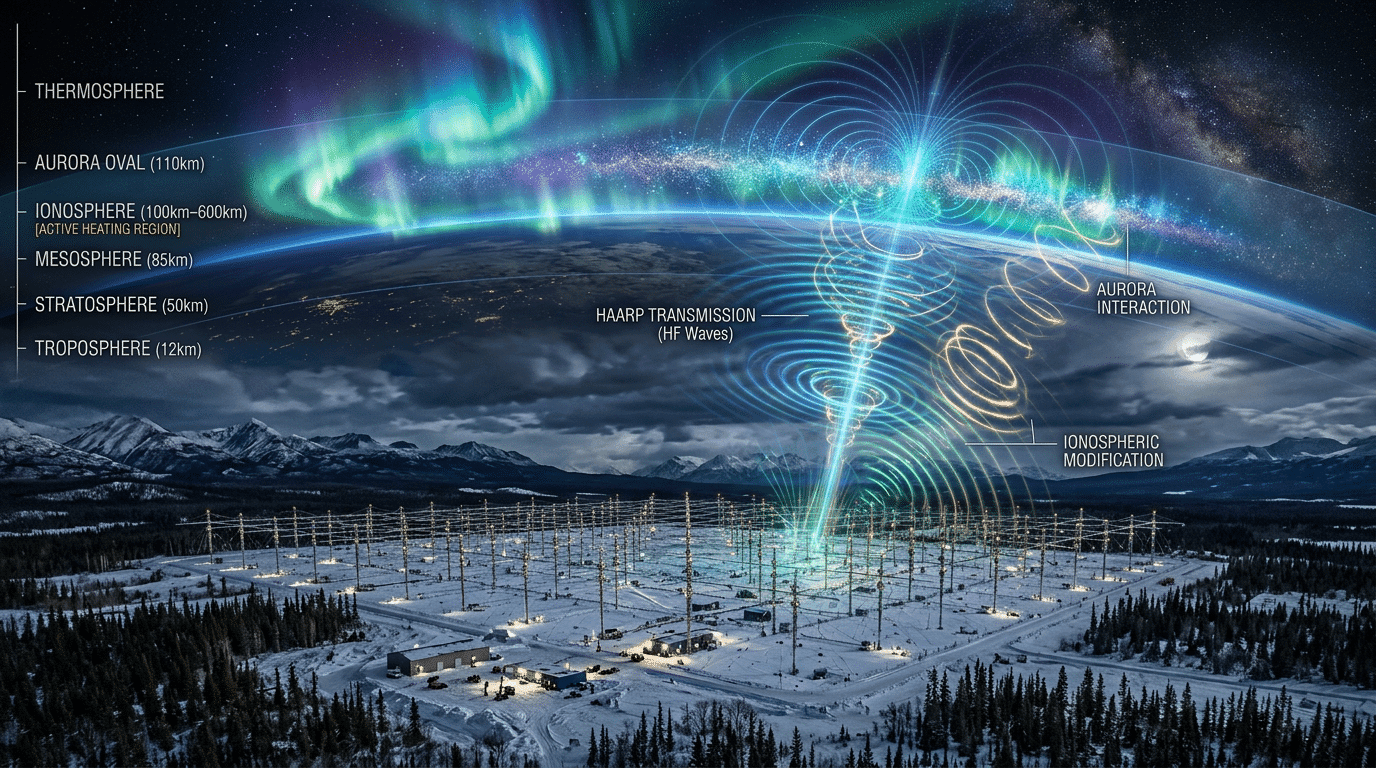
The facility consists of an array of 180 transmitters, each sitting atop a 72-foot-tall post, arranged in a grid surrounded by Alaskan wilderness. It is, essentially, the world is most powerful ionospheric heater—a high-powered radio transmitter that transmits signals into the ionosphere, the part of the upper atmosphere that begins about 30 miles above Earth is surface.
These transmissions temporarily “heat” or excite the ionosphere. The original military goals were modest: the Navy wanted to develop new forms of long-range communication, and the Air Force wanted to study “killer” electrons that sometimes damage satellites.
“The most succinct way to summarize what HAARP now studies is ‘the effects that the ionosphere has on signals, on radio-wave propagation,” David Hysell, an engineering professor at Cornell who has conducted experiments at the facility, told The Atlantic.
That is not particularly exciting. But it is also not a weather weapon.
The Science: Why HAARP Cannot Control the Weather
The fundamental problem with the conspiracy theory is one of physics.
“Claims that ionospheric heaters such as HAARP can modulate the weather are being pushed by people who have no understanding whatsoever of the physics involved in atmospheric circulation and weather systems,” Professor Brian Ward from RMIT University said.
The ionosphere that HAARP studies begins at about 30 miles above Earth is surface. Weather—the formation of clouds, hurricanes, tornadoes, and storms—occurs in the troposphere, the lowest layer of Earth is atmosphere, extending only about 7 to 12 miles up.
The energy from HAARP is simply too weak and too localized to affect the troposphere where weather is created. As the National Oceanic and Atmospheric Administration (NOAA) states plainly: “HAARP is a small National Science Foundation-funded facility in Gakona, Alaska, that conducts research on the ionosphere [30 to 600 miles above Earth]. Neither HAARP nor any other human-made system is capable of modifying the weather.”
Stanford University professor Umran Inan told Popular Science that weather-control conspiracy theories were “completely uninformed,” explaining that “there is absolutely nothing we can do to disturb the Earth is weather systems.”
To put it another way: HAARP is like shining a flashlight at the moon and expecting it to change the tides.
What HAARP Has Been Falsely Blamed For
Despite the scientific impossibility, the conspiracy theory refuses to die. A 2024 study published in Nature found that HAARP was the subject of more than one million conspiracism-inflected posts on Twitter from January 2022 to March 2023, primarily in the aftermath of natural disasters.
The list of false attributions includes:
- Hurricanes – Every major hurricane sparks fresh accusations. Hurricane Helene (2024) and Hurricane Melissa (2025) were both falsely blamed on HAARP.
- Earthquakes – Venezuelan President Hugo Chávez famously linked HAARP to the 2010 Haiti earthquake.
- Snowstorms – The Iowa caucus blizzard of 2024 was accused of being manufactured to suppress Trump voter turnout.
- Aurora borealis – Social media regularly claims HAARP creates or manipulates the northern lights.
- Even caribou – One academic paper from the Journal of the Society for the Study of the Cryptozool (yes, really) documented concerns about backward-walking caribou near the facility.
Why Does This Conspiracy Persist?
Jessica Matthews, HAARP is current director and an Air Force veteran, has spent years trying to combat misinformation about the facility. The university has held open houses, posted public information pages, and even produced irreverent merchandise. Nothing seems to work.
“If left to myself, I wouldn’t say anything,” Matthews told The Atlantic. “But that is not the right answer.”
The persistence of the conspiracy likely stems from several factors: the facility is remote and mysterious-looking, the science is genuinely complex, and there is a deep-seated distrust of government institutions. When natural disasters strike, people look for explanations—and some find it easier to believe in secret weapons than in the chaos of climate and physics.
As for the people who actually work at HAARP? They are just doing ionospheric science, trying to understand how radio waves behave in the upper atmosphere. The guy pouring beer in Anchorage put it most succinctly: “They just do the aurora.”
Nothing more. Nothing sinister. Just science.
Learn more about HAARP is research at their official website.