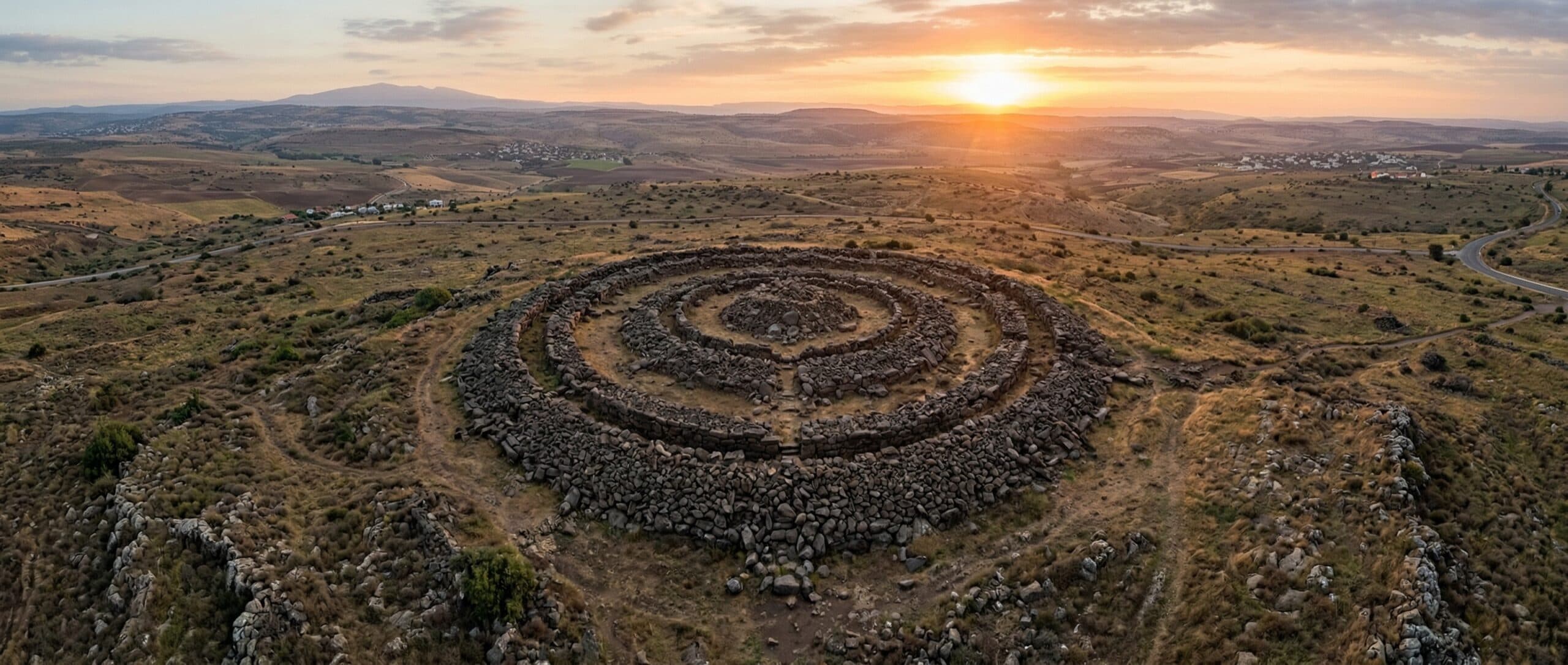
A mysterious ancient stone structure in the Golan Heights that has intrigued researchers for decades — often called the ‘Stonehenge of the East’ or the ‘Wheel of Ghosts’ — may not be unique after all. New research has identified 28 similar sites within a 25-kilometer radius, dramatically reshaping how archaeologists understand one of the Levant’s strangest prehistoric monuments.
For years, Rujm el-Hiri was treated as a singular enigma: an isolated ringed stone complex in the Golan Heights made of tens of thousands of tons of basalt. But artificial intelligence and high-resolution remote sensing have now revealed a broader pattern hidden across the landscape. Instead of one impossible mystery, researchers may be looking at an entire regional tradition.
What Is Rujm el-Hiri?
Rujm el-Hiri, also known as Gilgal Refaim, was first identified in 1968 through aerial military photography. The site consists of multiple concentric rings of basalt stones surrounding a central mound and is estimated to contain roughly 40,000 tons of rock. Depending on which interpretation archaeologists favor, it may date anywhere from about 6,500 to 3,500 years ago.
Its strange circular design has inspired comparisons to Stonehenge, though the monument is structurally distinct. Over the years, researchers have suggested it may have served as a burial site, astronomical marker, ceremonial gathering place, territorial monument, or some combination of all four.
According to The Times of Israel, the new findings challenge the long-standing assumption that Rujm el-Hiri was a one-off structure with a special, isolated purpose.
How AI Found 28 More Sites
The breakthrough came from a multidisciplinary team of archaeologists and physicists who used high-resolution satellite imagery from 2004 to 2024, including data analyzed through tools such as Google Earth Pro and CNES/Airbus platforms. Artificial intelligence was then used to process the imagery and enhance subtle traces of ancient human intervention.
This mattered because seasonal vegetation, shadows, erosion, and terrain variation can obscure archaeological forms that are difficult to spot with the human eye alone. AI helped researchers isolate repeated circular patterns that resemble the layout of Rujm el-Hiri.
As reported in the peer-reviewed PLOS ONE study, researchers documented 28 large circular structures in the immediate region, with additional comparable sites identified in Galilee and Lebanon.

Why the Discovery Changes Everything
This is the kind of finding that forces archaeologists to start over.
- Rujm el-Hiri is not unique: It appears to be the most elaborate example of a much wider monument tradition.
- Its purpose must be rethought: If dozens of similar sites exist, then explanations built around uniqueness become less persuasive.
- Regional culture comes into focus: These structures may reflect a broader social, ritual, or funerary system across the southern Levant.
- AI is rewriting field archaeology: Remote sensing is now surfacing patterns humans overlooked for decades.
As The Jerusalem Post reported, researchers emphasized that Gilgal Refaim remains the most famous example, but it can no longer be treated as an anomaly.
The Mystery of the ‘Wheel of Ghosts’ Deepens
The nickname ‘Wheel of Ghosts’ has long added an aura of mystique to the site, especially among mystery writers and alternative-history enthusiasts. The name itself evokes ancient ritual, lost peoples, and forgotten cosmologies. But the real surprise may be even stranger than the myth: the site may have been part of an entire network of monumental circles spread across the region.
That possibility raises new questions. Were these sites linked by shared religious beliefs? Did they mark seasonal gatherings, territorial boundaries, burial zones, or elite power centers? Were they built across centuries by related cultures, or do they represent repeated imitation of a sacred design?
If one site was mysterious, 28 similar sites make the puzzle far larger.
Ancient Mystery, Modern Detection
This discovery also fits a growing pattern in archaeology: AI is not replacing archaeologists, but it is changing what they can see. The Nazca discoveries in Peru, hidden structures in desert landscapes, and now circular megalithic sites in the Levant all point to the same conclusion — large-scale pattern recognition is becoming one of the most powerful tools in ancient research.
That matters because many ‘unique’ ancient sites may not be unique at all. They may only seem singular because the rest of their archaeological landscape remains partially invisible.
In that sense, the new Rujm el-Hiri findings don’t solve the mystery. They make it bigger, older, and more culturally important than anyone expected.
For more unexplained archaeology, read our coverage of AI discovering 303 new Nazca geoglyphs in Peru, Bronze Age artifacts made from meteoritic iron, and Piltdown Man and the greatest archaeological hoax in history.