Covering war, state power, and global instability.
6 min · 1,402 words
In This Report(7)
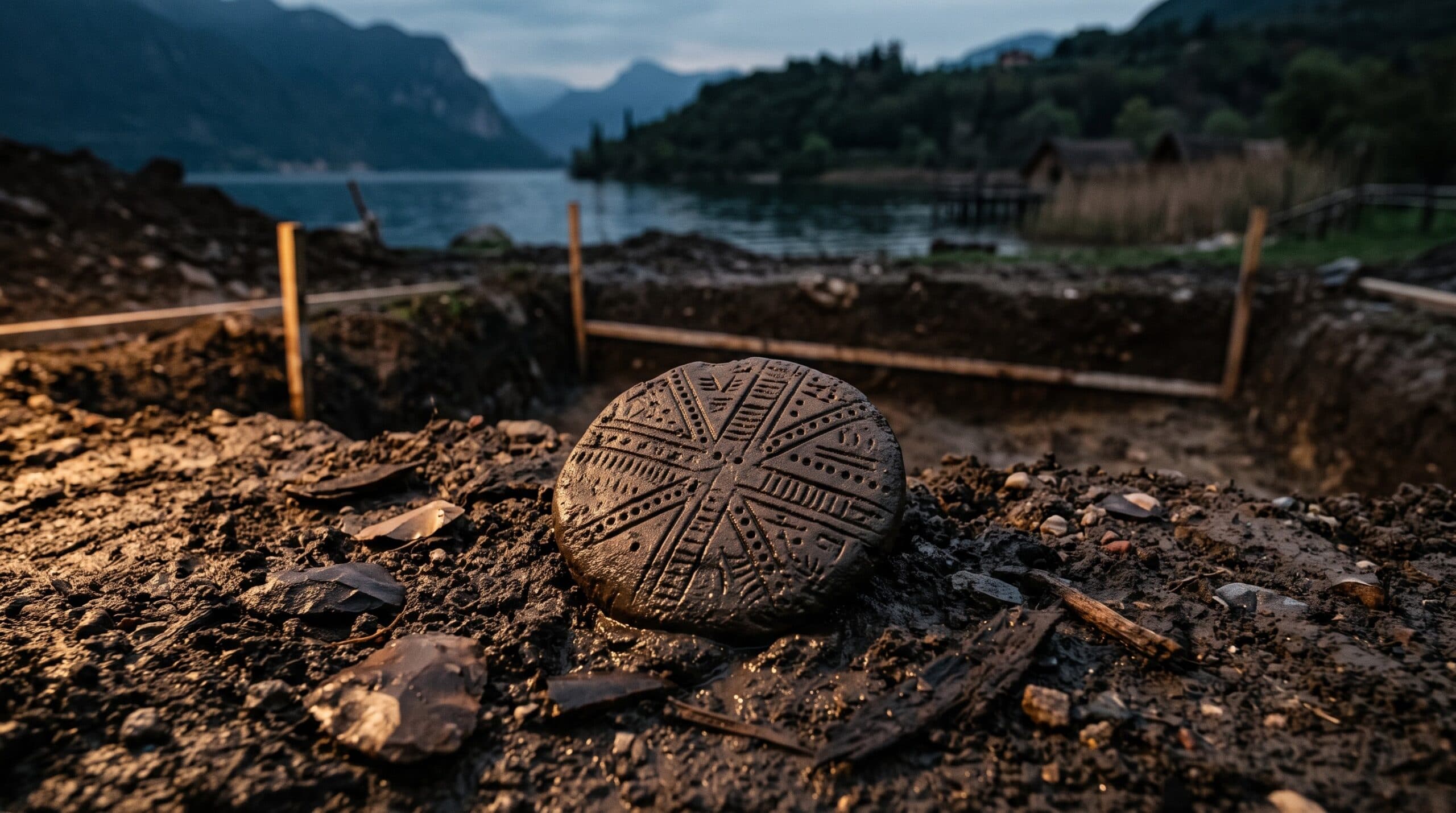
A small clay object has emerged from the soil of northern Italy carrying a message that may never have been a message at all.
Archaeologists excavating the prehistoric settlement of Lucone di Polpenazze, near Lake Garda, have uncovered an intact Bronze Age object covered with geometric markings. It belongs to the strange family of artifacts known as enigmatic tablets—rounded clay or stone pieces marked with circles, dots, triangles, squares and lines whose purpose remains unknown.[1]
The discovery is unusually important because it was found intact. Many examples are fragments, stripped from their original setting and separated from the layers that might explain how they were used. At Lucone, the new find emerged during the third week of the 2026 excavation campaign from a charcoal-rich archaeological layer identified as US 1015. It is the third enigmatic tablet recovered from Lucone’s Site D, and the 21st recorded across the settlement plain.[1]
Advertisement
That number changes the mystery. One puzzling object can be dismissed as an oddity. Twenty-one objects from one prehistoric landscape begin to look like a system.
Not a lost book written in an unknown language
The word “tablet” invites the wrong image. These are not miniature Mesopotamian documents waiting for a translator. No accepted writing system has been identified on the objects, and the markings are not known to represent sentences, names or a conventional alphabet.[1]
German-language scholarship often calls them Brotlaibidole, or “bread-loaf idols,” because many have a rounded, loaf-like form. Italian researchers use the more neutral phrase tavolette enigmatiche—enigmatic tablets. Both names reveal the central problem: archaeologists can describe their shape and markings, but not their function.
The geometric signs are not random scratches. Their repeated forms and combinations suggest deliberate manufacture. Yet deliberate does not automatically mean written language. A pattern can record ownership, count goods, identify a group, mark a ritual, map a relationship, or communicate information without being readable as prose.
That distinction matters. The most tempting version of the story is that Lucone has yielded a Bronze Age code. The evidence supports something more cautious and, in its own way, more unsettling: people were making portable visual objects according to conventions that modern observers can see but no longer understand.
The site preserves a vanished landscape
Lucone di Polpenazze once occupied a wetland basin in the hills west of Lake Garda. The settlement is part of the UNESCO World Heritage property known as the Prehistoric Pile Dwellings Around the Alps, a transnational group of 111 prehistoric settlements in six European countries.[2]
1957 Electrogravitics Secret: The Classified Research Program Whose Watchers Have All ‘Gone’
A viral essay claims that classified electrogravitics research made real progress in the 1950s — and that everyone who knew the truth about it has since disappeared from the public record. The story is spreading through high-strangeness forums.
May 14, 2026 • 7 min read
Ancient Civilizations
1957 Electrogravitics Secret: The Classified Research Program Whose Watchers Have All ‘Gone’
A viral essay claims that classified electrogravitics research made real progress in the 1950s — and that everyone who knew the truth about it has since disappeared from the public record. The story is spreading through high-strangeness forums.
May 13, 2026 • 7 min read
Articles
The Sunken Basilica of Iznik: Did a Lake Hide the Council of Nicaea?
A basilica beneath Lake Iznik has revived a 1,700-year-old question: was this the setting of the First Council of Nicaea, or a compelling archaeological near-miss?
Aug 18, 2026 • 6 min read
Wet environments are difficult places for ancient communities, but they can become extraordinary archaeological archives. Waterlogged layers may preserve organic materials that would normally disappear—wood, plant remains, food traces and the dark sediments created by repeated occupation. At Lucone, that setting gives the tablets something many isolated artifacts lack: context.
The location also helps explain why a geometric object from northern Italy may matter beyond one village. Lucone was not sealed off from the wider Bronze Age world. Archaeological work at the settlement has pointed to contacts extending toward Central Europe and the Carpathian Basin, including evidence associated with faience beads and other exchange networks.[1]
If the tablets were part of communication, their distribution may be a clue to the people moving through those networks. If they were ritual objects, their repeated forms may reveal shared beliefs. If they were tools for tracking goods or obligations, they could represent an economic system that left no surviving written archive.
In each case, the object becomes more than a mystery from the past. It becomes a possible trace of connection.
Why the markings are so difficult to interpret
Ancient writing can sometimes be deciphered because it appears in long texts, bilingual inscriptions or familiar historical settings. Enigmatic tablets offer almost the opposite conditions. They are small, the signs are limited, and the number of examples is still modest. Even when the same motif appears on multiple pieces, researchers cannot be certain whether it carries the same meaning each time.
A circle might be a symbol, a counter, a decorative element or an impression made by a tool. A repeated group might encode a quantity—or simply reflect a standard design. Without a clear contemporary inscription explaining the system, every interpretation risks becoming a modern projection.
The strongest research path is therefore comparative rather than sensational. Researchers can catalogue the marks, compare manufacturing techniques, study the clay and examine the archaeological layers where each object was found. Three-dimensional scanning and morphological analysis may show whether tablets from distant regions were made according to shared conventions.[1]
That work could eventually reveal whether particular motifs cluster by place, period or material. It may show that the signs traveled with commodities, that they belonged to particular communities, or that they changed over time. It may also show that similar-looking marks were produced independently and never formed one unified system.
Advertisement
The mystery survives either result. A shared code would tell us that Bronze Age communication was more structured than the surviving record suggests. Independent invention would show how easily humans converge on geometric ways of organizing information.
The “lost civilization” trap
Objects that cannot be explained are often recruited into stories about vanished super-civilizations, visitors from the sky or knowledge supposedly too advanced for their age. The Lucone tablet does not require any of those explanations. Its genuine strangeness is already visible in the evidence: an ancient community made a carefully marked object, preserved it in a settlement layer, and left no readable explanation for us.
That does not make the artifact less mysterious. It makes the mystery more precise.
There is no evidence that the signs describe astronomy, encode a forgotten machine or prove contact with a civilization outside Bronze Age Europe. There is also no justification for pretending the purpose is obvious. The responsible position is the narrow space between those extremes: the markings are intentional, the function is unknown, and the surrounding archaeological context may gradually reduce the possibilities.
The fact that Lucone has produced 21 examples is the most promising development. A single tablet can generate theories. A large group can be tested. Researchers can ask whether the pieces share dimensions, clay recipes, mark sequences, orientation, wear patterns or placement within buildings. They can search for correlations rather than rely on the emotional force of one unusual object.
What could happen next
The new tablet may be examined alongside the other Lucone examples and compared with related finds from the Alpine and Central European regions. If its markings match known combinations, it could strengthen the case for a wider visual tradition. If it is unlike the others, it may point to local experimentation or a different use entirely.
The most revealing evidence may come from what is not visible on the surface. Microscopic wear could show whether the tablet was handled repeatedly, tied to something, pressed into wet material or stored. Residue analysis could identify contact with pigments, food, metals or organic substances. The layer itself may help establish whether the object was lost, discarded, deposited deliberately or left behind when the settlement changed.
For now, the Lucone enigmatic tablet is not a translated message from a forgotten empire. It is something quieter and harder to dismiss: a surviving fragment of a communication world that may have made perfect sense to its creators.
The markings look simple because they are geometric. Their meaning may have depended on everything that once surrounded them—the people who made them, the goods they exchanged, the rituals they remembered and the landscape they inhabited. That surrounding world is gone. The tablet remains, asking a question it cannot answer in words.
Do you think these objects were a form of writing, a Bronze Age accounting tool, or something ritual that was never meant to be read?
Sources and Further Reading
The reporting on the excavation is based on the Lucone tablet report, which includes the excavation context and the current count of known examples. The site’s wider heritage setting is documented by the UNESCO World Heritage Centre.
[1] Arkeonews, “Rare 4,000-Year-Old ‘Enigmatic Tablet’ Found Intact at Lucone Bronze Age Village in Italy” — https://arkeonews.net/rare-4000-year-old-enigmatic-tablet-found-intact-at-lucone-bronze-age-village-in-italy/
[2] UNESCO World Heritage Centre, “Prehistoric Pile Dwellings Around the Alps” — https://whc.unesco.org/en/list/1363/