On Air: The History of Disclosure Talk Radio and How UFO Belief Learned to Broadcast Itself | Unexplained
History
On Air: The History of Disclosure Talk Radio and How UFO Belief Learned to Broadcast Itself
Long before UFO disclosure became a social-media ecosystem, a congressional talking point, or a streaming-content genre, it lived in a far more intimate medium: late-night radio. If you want to understand the emotional…
Art Grindstone is the hard-nosed storyteller behind Unexplained.co, a veteran investigator whose life’s work sits at the crossroads of the paranormal, fringe science, and the shadows most people try not to look into. With decades spent chasing impossible stories — black-budget psychic programs, vanished Cold War experiments, desert rituals that sparked UFO waves, and the strange phenomena buried in America’s forgotten backroads — Art brings a rare combination of skepticism, awe, and journalistic precision. He’s not here to debunk. He’s not here to blindly believe. He follows the evidence wherever it leads — even when it leads someplace deeply uncomfortable. Known for his immersive, cinematic style and his ability to turn obscure research into gripping narrative, Art has built a devoted following across podcasts, long-form features, documentaries, and serialized investigations. His interviews are direct. His analysis is unflinching. His voice has become a staple in the modern paranormal renaissance — the guy people turn to when a story is too strange, too complex, or too dangerous for anyone else to touch. Off-mic, Art works with a distributed network of researchers, archivists, and field operatives who help surface the stories mainstream media ignores. On-mic, he transforms their findings into meticulous, high-impact reporting that refuses to insult the intelligence of true believers. His philosophy is simple: Take the phenomenon seriously. Treat the audience with respect. Tell the story as if the world depends on it — because sometimes it does. When Art Grindstone digs into a case, he isn’t just chasing a mystery. He’s tracing the fault lines of reality itself.
10 min · 2,337 words
In This Report(20)
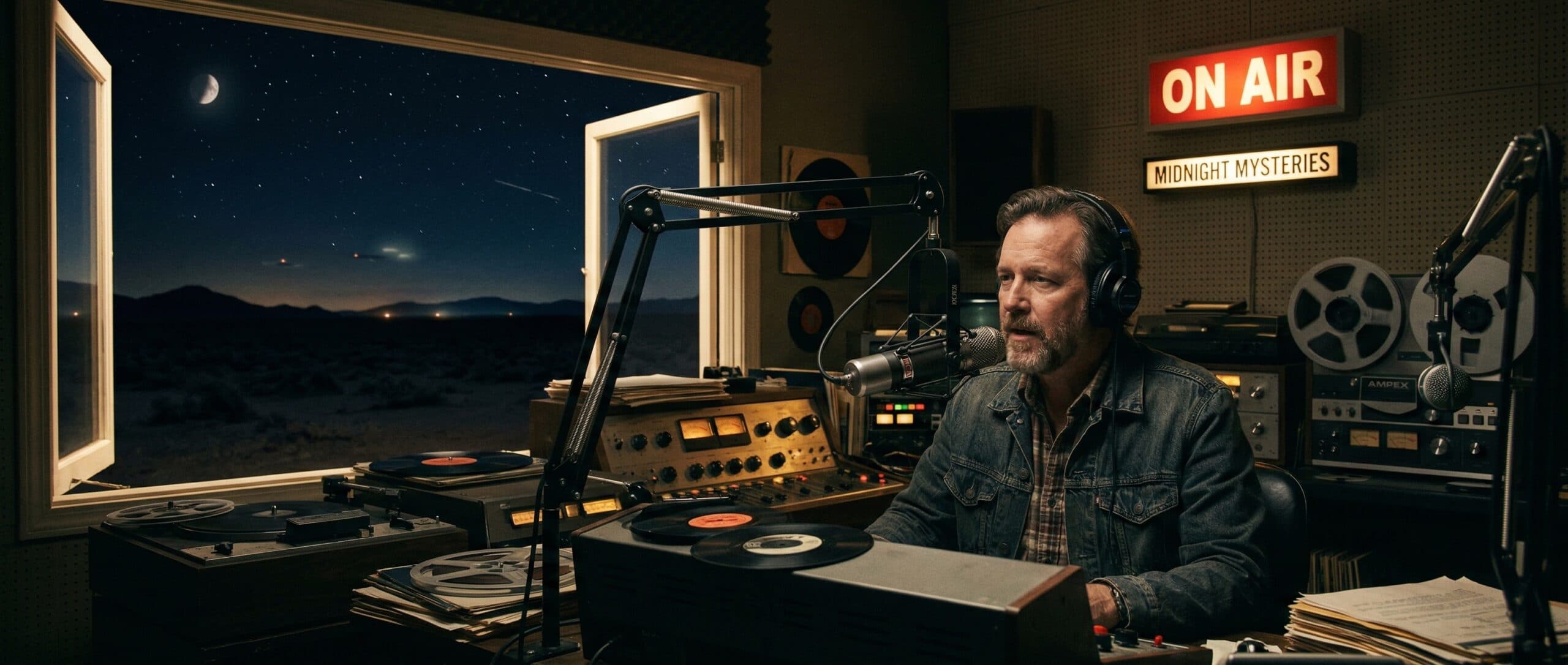
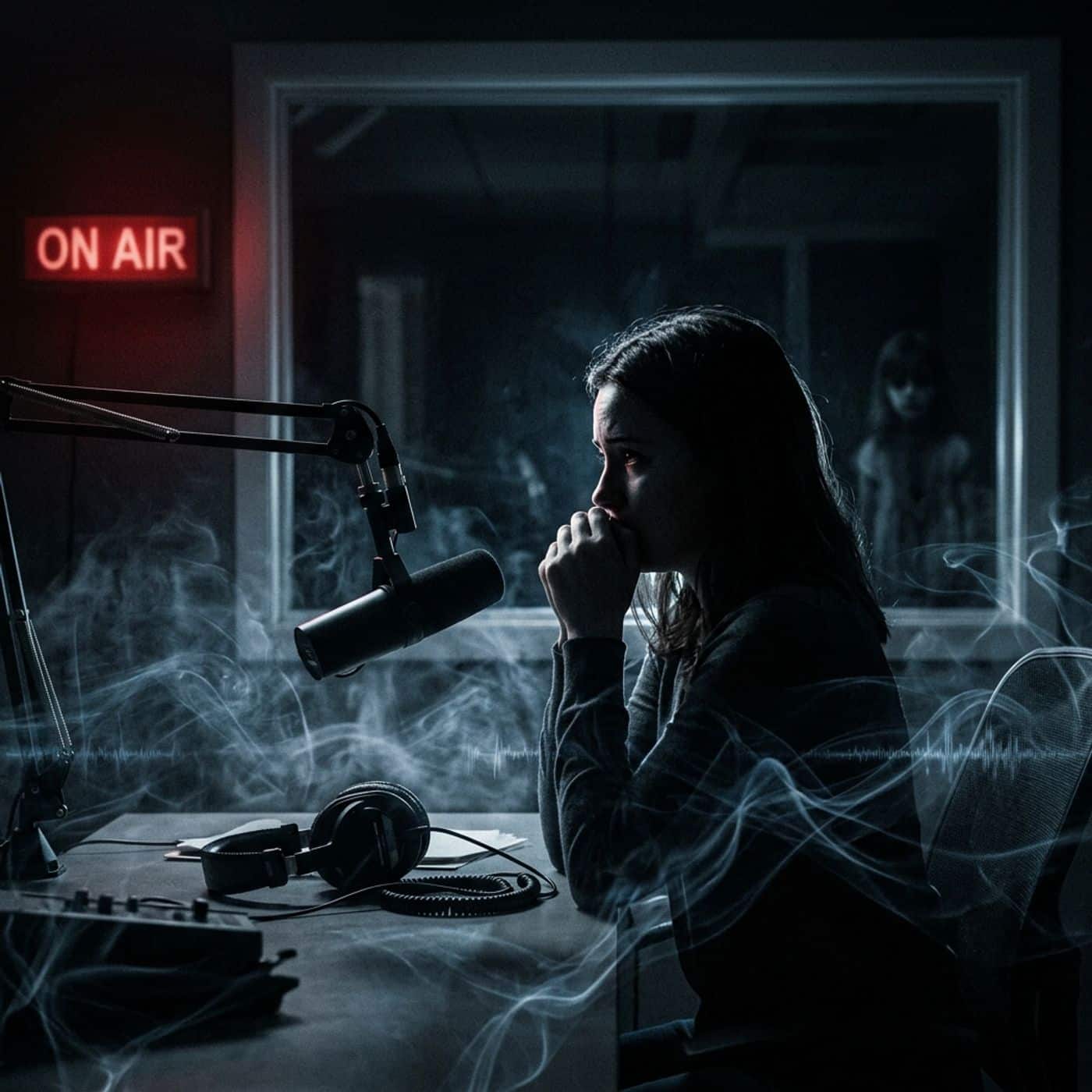
Long before UFO disclosure became a social-media ecosystem, a congressional talking point, or a streaming-content genre, it lived in a far more intimate medium: late-night radio. If you want to understand the emotional history of modern disclosure culture, you have to understand what happened when anomalous claims, whistleblower lore, government suspicion, and cosmic speculation first went On Air. The history of Disclosure Talk Radio is not just a media story. It is the story of how belief communities formed, how UFO testimony gained cultural structure, and how millions of listeners learned to hear secrecy itself as evidence.
That is the central truth this article explores. Disclosure Talk Radio did not merely report on UFO culture — it helped create the grammar of modern disclosure. It trained audiences to expect hidden files, buried witnesses, redacted truths, insider leaks, military silence, and a coming moment when the official story would collapse under its own contradictions.
In that sense, UFO disclosure was not born on podcasts or YouTube. It was born in the dark, over AM signals, under pseudonymous calls, in restless overnight hours when the line between journalism, folklore, confession, and performance was often impossible to separate.
Advertisement
What Is Disclosure Talk Radio?
Disclosure Talk Radio refers to the long tradition of radio programs, call-in shows, independent broadcasts, and later internet-radio hybrids devoted to UFOs, government secrecy, alien contact, military cover-up claims, and the broader idea that the public is being denied the truth about non-human intelligence.
At its core, Disclosure Talk Radio is less a strict genre than a recurring communications model. It usually combines:
insider testimony or alleged insider testimony
host-guided interpretation
listener participation
high trust in first-person narrative
deep suspicion of official institutions
a recurring promise that revelation is near
That structure matters because it shaped the emotional operating system of modern disclosure culture. The host was not just an interviewer. The host often acted as translator, validator, priest, gatekeeper, and community architect all at once.
Why Radio Became the Natural Home of UFO Disclosure
Radio was uniquely suited to UFO disclosure for reasons that are easy to miss now. Unlike television, it did not require visual proof. Unlike newspapers, it was conversational and immediate. Unlike academic forums, it welcomed ambiguity. And unlike later algorithm-driven platforms, it created a slower but more intimate form of audience trust.
1957 Electrogravitics Secret: The Classified Research Program Whose Watchers Have All ‘Gone’
A viral essay claims that classified electrogravitics research made real progress in the 1950s — and that everyone who knew the truth about it has since disappeared from the public record. The story is spreading through high-strangeness forums.
May 14, 2026 • 7 min read
Cryptozoology
The Deep Sea Sphere: 1990s SCUBA Divers Filmed Something in the Bahamas That Still Defies Classification
A clip from the 1990s shows SCUBA divers encountering a strange, perfectly spherical creature in the Bahamas. Decades later, the footage is resurfacing — and cryptid researchers, marine biologists, and UAP watchers all have different theories about what it is.
May 14, 2026 • 6 min read
Conspiracy Theories
The Sandia Quantum Scientist Who Vanished: Ingrid Lane’s Double Life and the Mystery No One Solves
Ingrid Lane lived a double life — bipolar musician to the world, Sandia National Laboratories quantum computing scientist underneath. Then she disappeared. The story is a fixation in high-strangeness communities.
May 14, 2026 • 7 min read
That mattered enormously for a subject like UFO disclosure, where visual evidence was often blurry, official confirmation was sparse, and witness testimony carried much of the emotional weight. Radio let people hear hesitation, fear, conviction, and personality in a way print never could.
More importantly, radio made secrecy feel personal. When someone called in claiming they had seen something impossible, worked in a hidden facility, or knew someone in the military who had been silenced, listeners were not just receiving information. They were participating in an unfolding social drama.
That participatory intimacy is one reason disclosure culture took root so deeply in radio before it fully migrated online.
The Prehistory: Flying Saucers, Contactees, and Broadcast Curiosity
The roots of Disclosure Talk Radio can be traced back to the first great UFO wave of the late 1940s and early 1950s, when flying-saucer sightings, military investigations, and contactee movements began entering public consciousness. Mainstream radio covered some of this material, but often as novelty, sensationalism, or strange-news content rather than as an organized counter-public sphere.
Still, those early years mattered because they established several patterns that would later define the genre:
the tension between official explanation and public suspicion
the appeal of direct witness accounts
the sense that radio could host material mainstream institutions treated cautiously
the fascination with messages from beyond government control
Contactee-era figures such as George Adamski and others benefited from the broader communications environment of the time, but the true maturation of disclosure radio would come later, once late-night call-in culture became central to American broadcasting.
The Late-Night Revolution: Why the Overnight Hours Mattered
The overnight radio slot proved to be the perfect incubator for disclosure media. At night, ordinary rules soften. Audiences are smaller, weirder, lonelier, and often more emotionally open. The listener at 2:00 a.m. is not the same listener as the commuter at 8:00 a.m.
This is critical to understanding how disclosure culture formed. UFO talk did not simply succeed because the subject was fascinating. It succeeded because the listening environment encouraged a different relationship to uncertainty. Night radio rewards the unresolved. It invites voices that would sound absurd in brighter contexts to become strangely plausible in darkness.
That is why so much of the disclosure tradition feels inseparable from atmosphere. The medium did not merely distribute the message. It altered the psychological conditions under which the message was received.
Art Bell and the On Air Disclosure Imagination
No serious history of Disclosure Talk Radio can avoid the central role of Art Bell. Through Coast to Coast AM and related projects, Bell became one of the most important broadcasters in the history of paranormal and fringe media. He did not invent UFO radio, but he refined its most powerful form.
Bell’s genius was not simply that he gave UFO topics airtime. It was that he made the entire act of going On Air feel like crossing into a different epistemic zone — one where government insiders, abductees, ex-military figures, prophets, conspiracy theorists, and ordinary callers all occupied the same acoustic stage.
That flattening of status mattered. A scientist, a truck driver, and an alleged Area 51 employee could all sound equally compelling at 1:30 in the morning if the atmosphere was right.
Bell’s format rewarded several key disclosure dynamics:
first-person testimony over institutional certainty
live calls that felt too raw to be fabricated
the constant possibility of an “insider breakthrough”
This is one reason Bell still looms over the subject. He turned disclosure from a topic into a feeling.
The Caller as Witness, Prophet, and Leak Channel
One of the most underappreciated features of Disclosure Talk Radio is the role of the caller. In mainstream media, callers are often treated as filler or public reaction. In UFO radio, callers became evidence channels.
They might report lights in the sky, military family stories, childhood abduction memories, insider rumors, or local incidents never covered in newspapers. The call-in format gave disclosure culture an ever-renewing bloodstream of low-verification but high-emotional-intensity material.
This had two major consequences.
First, it democratized UFO disclosure. You did not need access to classified files to enter the conversation. You only needed a voice and a story.
Second, it made the disclosure narrative structurally impossible to close. Every new caller could reopen the mystery.
That is one reason radio mattered so much. It did not merely circulate claims. It institutionalized endless testimony.
Government Secrecy as a Recurring Character
One of the defining traits of Disclosure Talk Radio is that government secrecy became more than a topic. It became a recurring character in the narrative. Even when specific evidence was weak, secrecy itself functioned as a stabilizing force for belief.
If no proof existed, that could mean it was hidden. If witnesses contradicted one another, that could mean compartmentalization. If media ignored a case, that could mean suppression. If a caller sounded unstable, that could mean trauma or intimidation. The framework was self-reinforcing.
This is not merely irrationality. It is a coherent media logic. Once an audience accepts that institutions systematically conceal the truth, every gap in the public record can be reinterpreted as indirect confirmation.
Disclosure Talk Radio helped normalize that reasoning pattern long before it became mainstream internet behavior.
From UFOs to Disclosure: A Shift in Framing
Another important development in the history of Disclosure Talk Radio is the shift from simply asking “Are UFOs real?” to asking “When will the truth finally be admitted?” That shift is subtle but foundational.
The older UFO question is observational. The disclosure question is political.
Once the framing changed, radio shows were no longer just discussing strange objects or weird encounters. They were discussing files, agencies, whistleblowers, buried technology, crash retrieval, recovered bodies, and institutional lying. The conversation moved from anomaly to suppression.
Advertisement
That rhetorical evolution is one of radio’s biggest contributions to modern UFO culture. It turned the phenomenon into an information-war story.
How Disclosure Talk Radio Built a Community, Not Just an Audience
The most powerful disclosure shows did not merely gather listeners. They built communities. Regular callers became recognizable. Hosts developed trusted styles. Recurring guests formed a semi-stable cast of interpreters. Listeners learned what counted as a plausible case, what language to use, and what names to track.
This matters because community formation is what turns isolated interest into a movement. Radio did not just broadcast ideas. It taught people how to belong inside a worldview.
That community logic later migrated almost seamlessly into internet forums, podcasts, YouTube shows, X threads, Discord servers, and livestream ecosystems. In many ways, modern disclosure media is structurally just Disclosure Talk Radio with visual supplements and faster feedback loops.
The Rise of Internet Radio and the Fragmentation of the Field
As terrestrial radio declined in cultural centrality and internet broadcasting became easier, Disclosure Talk Radio fragmented into countless smaller ecosystems. This brought gains and losses.
On one hand, niche hosts could serve hyper-specific audiences. Abduction-focused shows, whistleblower-heavy shows, technical-UFO-analysis shows, spiritual-contact shows, and conspiracy-geopolitics hybrids all flourished.
On the other hand, the field lost some of the shared mass-cultural gravity that figures like Art Bell once provided. The old model had gatekeepers. The new one had scale without coherence.
That fragmentation is one reason disclosure culture now feels both larger and less stable. More people are talking, but fewer institutions hold the conversation together.
Why Joe Rogan, Podcasts, and YouTube Still Owe a Debt to Radio
Modern long-form disclosure media often gets associated with podcasts and streaming platforms, but much of its DNA comes directly from radio. The endless-form interview. The insider witness. The patient host. The flattening of expert and non-expert into one long conversational zone. The willingness to let speculation breathe without immediate resolution. All of that was honed on radio.
Even shows that appear visually sophisticated are often still operating on radio logic. The host invites a guest with controversial or extraordinary claims, lets them build a world in real time, and allows the audience to participate in credibility assessment through tone, confidence, and narrative consistency as much as through documentation.
That is pure Disclosure Talk Radio inheritance.
The Emotional Power of Being On Air
The phrase On Air matters here for more than branding. To go on air is to cross into public risk. In disclosure culture, that crossing often carries moral weight. Witnesses are seen as brave for speaking. Hosts are seen as brave for giving them a platform. Broadcasting itself becomes a ritual of revelation.
This is one reason disclosure stories are often framed in terms of courage, retaliation, and consequence. Once a person goes on air with a secret, they are no longer merely talking. They are testifying.
That ritual dimension is part of what makes disclosure media so compelling. The microphone becomes a threshold object.
Why Disclosure Talk Radio Still Matters in 2026
In 2026, Disclosure Talk Radio still matters because the cultural infrastructure it created never really disappeared. It simply distributed itself across newer platforms. The language of suppressed truth, whistleblower testimony, hidden craft, recovered materials, and almost-imminent revelation remains central to how millions of people understand the UFO subject.
The history of Disclosure Talk Radio is the history of how UFO belief learned to scale emotionally before it scaled digitally. It created a public acoustic space where secrecy sounded plausible, witness testimony felt sacred, and unresolved claims became stronger through repetition rather than weaker.
That legacy still defines the modern disclosure era. The language changed. The platforms changed. The clips got shorter and the audiences got more fragmented. But the basic cultural script — the sense that the truth is just barely being kept off the public record, and that someone brave enough might finally go On Air and tell it — remains intact.
In that sense, Disclosure Talk Radio was never just broadcasting the UFO mystery. It was teaching listeners how to inhabit it.
Frequently Asked Questions
What is Disclosure Talk Radio?
Disclosure Talk Radio refers to radio and radio-like broadcast formats centered on UFO secrecy, government cover-up claims, whistleblower testimony, alien contact, and the broader idea that official institutions are hiding the truth.
Why was radio so important to UFO disclosure culture?
Radio was ideal for UFO disclosure because it rewarded voice, testimony, suspense, and ambiguity. It allowed strange or controversial claims to feel intimate and emotionally persuasive even when visual proof was limited.
Who was the most important host in Disclosure Talk Radio history?
Art Bell is often seen as the central figure because he helped turn late-night paranormal radio into a mass-cultural space where UFO disclosure claims could thrive.
How did Disclosure Talk Radio influence modern podcasts and UFO media?
Many modern UFO podcasts, livestreams, and long-form interview shows inherited radio’s structure: insider testimony, long conversation, audience participation, and a constant tension between evidence and atmosphere.
Why does the phrase “On Air” matter in disclosure culture?
Because going on air carries symbolic weight. In disclosure culture, speaking publicly is often framed as an act of risk, revelation, and testimony against institutional secrecy.
Art Grindstone is the hard-nosed storyteller behind Unexplained.co, a veteran investigator whose life’s work sits at the crossroads of the paranormal, fringe science, and the shadows most people try not to look into. With decades spent chasing impossible stories — black-budget psychic programs, vanished Cold War experiments, desert rituals that sparked UFO waves, and the strange phenomena buried in America’s forgotten backroads — Art brings a rare combination of skepticism, awe, and journalistic precision. He’s not here to debunk. He’s not here to blindly believe. He follows the evidence wherever it leads — even when it leads someplace deeply uncomfortable. Known for his immersive, cinematic style and his ability to turn obscure research into gripping narrative, Art has built a devoted following across podcasts, long-form features, documentaries, and serialized investigations. His interviews are direct. His analysis is unflinching. His voice has become a staple in the modern paranormal renaissance — the guy people turn to when a story is too strange, too complex, or too dangerous for anyone else to touch. Off-mic, Art works with a distributed network of researchers, archivists, and field operatives who help surface the stories mainstream media ignores. On-mic, he transforms their findings into meticulous, high-impact reporting that refuses to insult the intelligence of true believers. His philosophy is simple: Take the phenomenon seriously. Treat the audience with respect. Tell the story as if the world depends on it — because sometimes it does. When Art Grindstone digs into a case, he isn’t just chasing a mystery. He’s tracing the fault lines of reality itself.