Pentagon Century-Long UFO Study: What the Government Actually Reviewed, and Why “No Alien Proof” Isn’t the Whole Story | Unexplained
UFO & Aliens
Pentagon Century-Long UFO Study: What the Government Actually Reviewed, and Why “No Alien Proof” Isn’t the Whole Story
The latest Pentagon century-long UFO study is important not because it proves extraterrestrial visitation, but because it shows how the U.S. government now wants the public to understand unidentified aerial phenomena:…
Art Grindstone is the hard-nosed storyteller behind Unexplained.co, a veteran investigator whose life’s work sits at the crossroads of the paranormal, fringe science, and the shadows most people try not to look into. With decades spent chasing impossible stories — black-budget psychic programs, vanished Cold War experiments, desert rituals that sparked UFO waves, and the strange phenomena buried in America’s forgotten backroads — Art brings a rare combination of skepticism, awe, and journalistic precision. He’s not here to debunk. He’s not here to blindly believe. He follows the evidence wherever it leads — even when it leads someplace deeply uncomfortable. Known for his immersive, cinematic style and his ability to turn obscure research into gripping narrative, Art has built a devoted following across podcasts, long-form features, documentaries, and serialized investigations. His interviews are direct. His analysis is unflinching. His voice has become a staple in the modern paranormal renaissance — the guy people turn to when a story is too strange, too complex, or too dangerous for anyone else to touch. Off-mic, Art works with a distributed network of researchers, archivists, and field operatives who help surface the stories mainstream media ignores. On-mic, he transforms their findings into meticulous, high-impact reporting that refuses to insult the intelligence of true believers. His philosophy is simple: Take the phenomenon seriously. Treat the audience with respect. Tell the story as if the world depends on it — because sometimes it does. When Art Grindstone digs into a case, he isn’t just chasing a mystery. He’s tracing the fault lines of reality itself.
5 min · 1,230 words
In This Report(13)
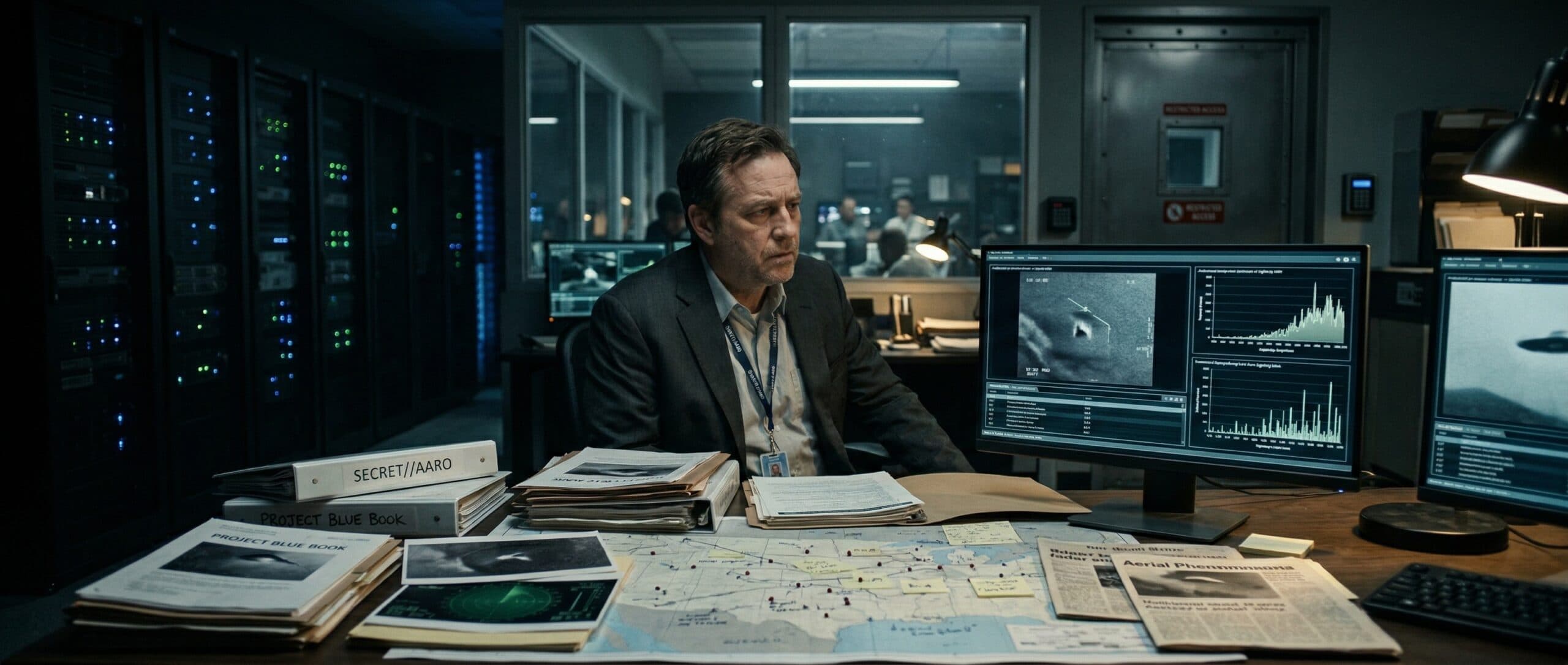
The latest Pentagon century-long UFO study is important not because it proves extraterrestrial visitation, but because it shows how the U.S. government now wants the public to understand unidentified aerial phenomena: as a long-running mix of misidentifications, reporting gaps, national-security concerns, and a smaller set of unresolved cases that remain open largely because the data is incomplete. That may sound less dramatic than online disclosure culture wants, but it is still a major shift in how the subject is framed.
Here is the clearest answer: the government’s review does not establish evidence of aliens. What it does establish is that UAP reporting has been tracked across decades, that many incidents can be explained by ordinary causes, and that some reports remain unresolved because the underlying information is fragmentary rather than because they have been proven extraordinary.
That distinction matters because the story is now being pulled in two directions at once. Mainstream coverage emphasizes the “no conclusive extraterrestrial evidence” line. Disclosure-focused communities emphasize the unresolved residue and the political pressure for more declassification. Both are drawing from the same story, but they are selling very different meanings. For baseline institutional context, readers should look to AARO’s official public site and broader defense reporting from the U.S. Department of Defense.
Advertisement
What This Story Actually Says
Coverage around the Pentagon and AARO review frames the report as a broad historical look at UAP sightings across roughly a century of records and public memory. The mainstream takeaway is straightforward: most cases appear tied to natural events, conventional aircraft, balloons, observational limitations, or incomplete reporting chains.
But the report’s unresolved category is what keeps the story alive. Those cases are not being presented as proof of non-human intelligence. They are being presented as cases where available evidence was too limited or too inconsistent to close the file confidently.
This nuance is exactly where online discourse tends to split. Skeptical readers hear “not enough evidence.” Believers hear “the government still cannot explain everything.” In practice, both reactions feed the same attention cycle.
Why This Story Spreads So Fast
The subject performs well because it lives at the intersection of secrecy and ambiguity. Once a government office formally studies UFO-related reports over long periods of time, the subject automatically sounds more legitimate to the public, even when the formal conclusions remain cautious.
Japan Just Confirmed It Has UAP Footage — and Is Analyzing Pentagon Files Near Its Borders
Japan’s formal entry into the UAP transparency wave signals an international domino effect. What the country knows about UAP encounters near Japanese territory and why it matters now.
May 13, 2026 • 5 min read
UFO & Aliens
Europe Has Been Quietly Tracking UAP Reports Since 2023
Documents reveal how the European Commission handled UAP images, what it promised to improve, and why Europe still lacks a public investigation office.
Aug 17, 2026 • 8 min read
Ancient Civilizations
1957 Electrogravitics Secret: The Classified Research Program Whose Watchers Have All ‘Gone’
A viral essay claims that classified electrogravitics research made real progress in the 1950s — and that everyone who knew the truth about it has since disappeared from the public record. The story is spreading through high-strangeness forums.
May 14, 2026 • 7 min read
It also spreads because “no proof of aliens” is not emotionally satisfying. Audiences are drawn instead to the unresolved edge of the story: the cases that remain open, the documents still classified, and the idea that institutional caution may be hiding something larger.
That emotional imbalance is important. A bureaucratic explanation rarely competes well with a disclosure narrative. So even when the report is restrained, the online conversation tends to become more dramatic than the document itself.
What the Evidence Actually Supports
The strongest evidence supports a narrower conclusion than many viral posts suggest. It supports the claim that governments take anomaly reporting seriously enough to study it, especially where aviation safety, sensor uncertainty, or military context are involved. It does not support the leap to confirmed extraterrestrial visitation.
That may feel anticlimactic, but it is not trivial. A long-term institutional review still changes the conversation. It moves UAPs away from a purely fringe frame and into one centered on observation, classification, and transparency disputes. That gives researchers and the public a more credible base of discussion even if it stops well short of disclosure mythology.
The key evidentiary issue remains the same as in many anomaly stories: incomplete data creates interpretive space. That space can be handled cautiously, or it can be filled with certainty that the record itself does not justify. For additional public-facing context, reporting from AP News and analysis from NASA’s UAP-related materials help show how mainstream institutions frame this topic differently from disclosure communities.
What Skeptics and Mainstream Analysts Would Say
Skeptics would argue that the report demonstrates something very ordinary: large datasets of sightings naturally contain residual unresolved cases because not every report is clean, timely, or well-instrumented. In other words, an unresolved file is not automatically an extraordinary file.
Mainstream analysts would likely add that the political side of the story matters too. Calls for declassification, renewed presidential attention, and public fascination all shape how the report is interpreted. The document may be careful, but the discourse around it rarely is.
That gap between document and narrative is where much of the modern UFO conversation now lives. Official language is procedural. Public reaction is mythic.
Why This Study Still Matters
It matters because it reinforces that UAP reporting is now a persistent governance issue, not just an internet fringe obsession. Aviation safety, sensor reliability, military transparency, and public trust all intersect here.
Advertisement
It also matters because the report does not close the conversation. If anything, it institutionalizes it. Once the government acknowledges that some cases remain unresolved while still rejecting alien certainty, it creates a stable middle ground that both skeptics and disclosure advocates will keep fighting over.
That makes this kind of study highly significant culturally, even when its conclusions remain cautious. It keeps the UFO subject alive not by proving the extraordinary, but by refusing to collapse all anomalies into either total explanation or total revelation.
The Bigger Pattern in 2026 Disclosure Culture
The deeper pattern is that institutional ambiguity now fuels online certainty. Every government report, hearing, or records review is treated as raw material for larger narratives about secrecy, acclimation, or slow disclosure. A cautious sentence about unresolved cases can travel online as if it were a near-confession.
That does not mean the public interest is irrational. It means the framing battle has become the story. The question is no longer just what the government found. It is how official caution interacts with a public already trained by decades of UFO mythology to treat ambiguity as evidence of concealment.
Final Assessment
The Pentagon century-long UFO study is best understood as a credibility story, not a proof story. It confirms long-term institutional attention to anomalous reports while still drawing a firm line short of verified alien evidence. The unresolved cases matter, but mainly because they keep the argument alive. In 2026, that may be the most important function of all: not to settle the UFO debate, but to keep it permanently suspended between skepticism, secrecy, and speculation.
Frequently Asked Questions
Did the Pentagon study prove aliens exist?
No. The study did not provide conclusive evidence of extraterrestrial intelligence. It mainly reviewed reports, explanations, and unresolved cases where data remained limited.
Why do unresolved cases still matter?
Because unresolved cases keep the debate open, especially when the missing answer appears to come from incomplete data rather than a fully satisfying explanation.
Why is the report getting so much attention?
Because official review gives the UFO topic mainstream legitimacy while declassification pressure and online disclosure culture push audiences toward more dramatic interpretations.
What is the smartest way to read this report?
Separate what the document formally concludes from the much louder online narratives built around it. The report shows institutional concern and uncertainty, not confirmed extraterrestrial proof.
Art Grindstone is the hard-nosed storyteller behind Unexplained.co, a veteran investigator whose life’s work sits at the crossroads of the paranormal, fringe science, and the shadows most people try not to look into. With decades spent chasing impossible stories — black-budget psychic programs, vanished Cold War experiments, desert rituals that sparked UFO waves, and the strange phenomena buried in America’s forgotten backroads — Art brings a rare combination of skepticism, awe, and journalistic precision. He’s not here to debunk. He’s not here to blindly believe. He follows the evidence wherever it leads — even when it leads someplace deeply uncomfortable. Known for his immersive, cinematic style and his ability to turn obscure research into gripping narrative, Art has built a devoted following across podcasts, long-form features, documentaries, and serialized investigations. His interviews are direct. His analysis is unflinching. His voice has become a staple in the modern paranormal renaissance — the guy people turn to when a story is too strange, too complex, or too dangerous for anyone else to touch. Off-mic, Art works with a distributed network of researchers, archivists, and field operatives who help surface the stories mainstream media ignores. On-mic, he transforms their findings into meticulous, high-impact reporting that refuses to insult the intelligence of true believers. His philosophy is simple: Take the phenomenon seriously. Treat the audience with respect. Tell the story as if the world depends on it — because sometimes it does. When Art Grindstone digs into a case, he isn’t just chasing a mystery. He’s tracing the fault lines of reality itself.