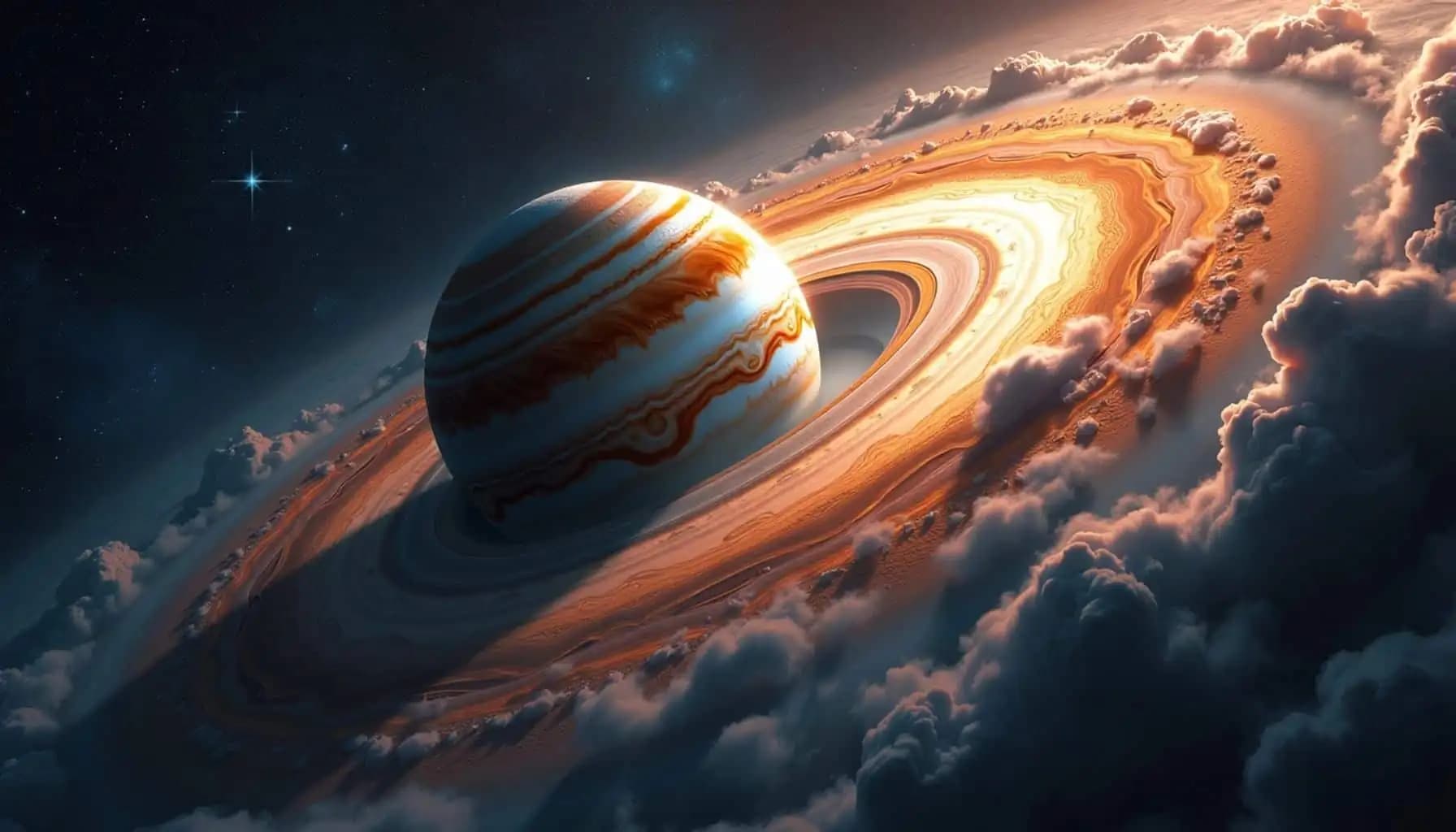

Something strange is unfolding on Jupiter, the largest planet in our solar system. As we delve deeper into its mysteries, we uncover astonishing facts that challenge our understanding of this gas giant. From its tumultuous history to its bizarre atmospheric phenomena, Jupiter continues to surprise us.
Key Takeaways
- Jupiter’s gravity played a crucial role in shaping the solar system.
- The planet has a vast ocean of liquid hydrogen beneath its clouds.
- Jupiter’s core is more complex than previously thought, possibly due to ancient collisions.
- The planet generates a powerful magnetic field, affecting its atmospheric dynamics.
The Formation of Jupiter
In the early days of the solar system, Jupiter was a massive force. As it gained mass, it began to disrupt the formation of other planets. Imagine Jupiter as a colossal space Roomba, sweeping through the debris of the early solar system, flinging asteroids and other celestial bodies in all directions. This gravitational pull halted the growth of nearby planets, including Mars, which never reached its full potential.
The Role of Saturn
Interestingly, it was the formation of Saturn that altered Jupiter’s path. As these two giants drew closer, their gravitational forces began to interact, accelerating their orbits and pushing them back to the outer solar system. This cosmic dance allowed for the formation of Earth and other inner planets.
Advertisement
The Atmosphere of Jupiter
Most of us learned that Jupiter is a dense ball of gas with a small rocky core. However, this is only partially true. The outer layer consists of thick clouds filled with ammonia and water, floating in a hydrogen and helium atmosphere. Water vapor was first detected on Jupiter in 1995, revealing that it contains millions of times more water than Earth, despite making up only 0.25% of its atmosphere.
The Water Cycle on Jupiter
The water on Jupiter exists in a unique cycle. In the upper atmosphere, water ice crystals interact with ammonia, creating a slushy mixture that leads to electrifying lightning storms. This mixture eventually falls as rain, evaporates, and rises again, perpetuating the cycle.
The Great Red Spot
One of Jupiter’s most famous features is the Great Red Spot, a storm larger than Earth. This storm extends deep into the atmosphere, reaching temperatures and pressures that create a unique environment. The storm’s height and depth are staggering, absorbing UV light and contributing to its distinctive color.
Advertisement