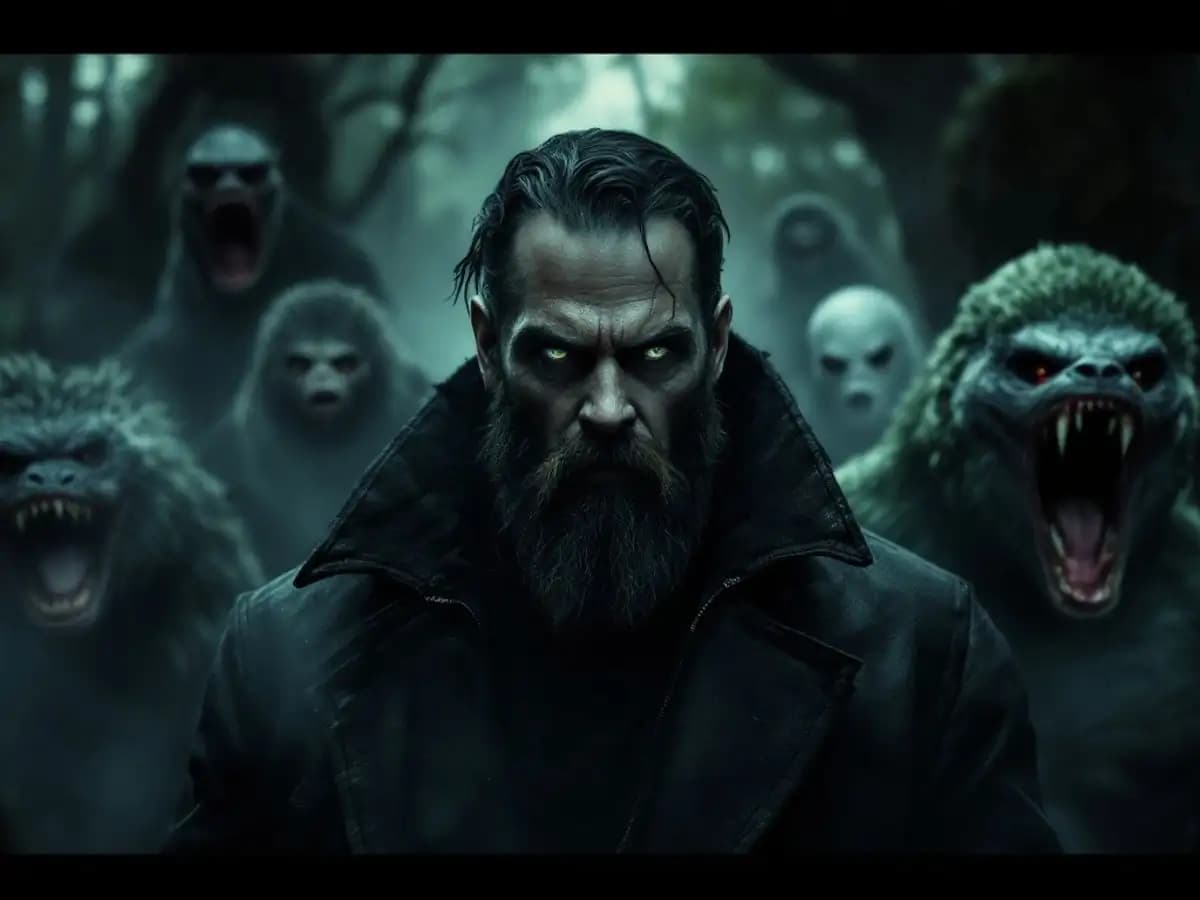

In a captivating exploration of legendary creatures, wildlife expert Forrest Galante delves into the world of cryptids, revealing the truth behind some of the most infamous animal myths. From the notorious chupacabra to the elusive M’bembe, this article uncovers the fascinating stories and scientific explanations behind these mysterious beings.
Key Takeaways
- Cryptids often stem from misidentifications of known animals.
- Eyewitness accounts can be influenced by popular culture.
- Scientific investigations can debunk long-held myths.
The Chupacabra: The Goat Sucker
The chupacabra, which translates to “goat sucker” in Spanish, has haunted the Americas with tales of its bloodthirsty nature. This creature is often described as having thick, scaly greenish-gray skin and sharp spines running down its back. Sightings have been reported from Puerto Rico to the United States.
The legend began in 1975 when a series of livestock killings in Mocha, Puerto Rico, led to the nickname “vampire of Mocha.” Victims were found drained of blood, with small circular incisions. The chupacabra truly made headlines in 1995 when eight sheep were discovered dead, each with three puncture wounds.
Advertisement
However, investigations reveal a different story. In 2011, researcher Benjamin Radford found that the descriptions of the chupacabra closely resembled a creature from the sci-fi horror film Species. Eyewitnesses had likely been influenced by this film, leading to a case of mistaken identity. Furthermore, Dr. David Morales found no evidence of blood-sucking in the supposed victims, suggesting that the sightings could be attributed to coyotes or wolves suffering from mange.
The Aanii: The Two-Legged Demon
Next on the list is the Aanii, a creature from ancient Peruvian mythology. Described as a giant, hairy, two-legged demon, it is said to punish the damned. Standing around 4 feet tall, it has thick, muscular arms and a short tail.
In 2020, Galante and his wife investigated reports of the Aanii terrorizing livestock in Peru. After setting up trail cameras, they discovered that the creature was actually a spectacle bear, a rare species native to South America. The bear’s behavior and appearance had led to the misidentification, showcasing how easily legends can arise from real animals.
The Loch Ness Monster: A Timeless Legend
The Loch Ness Monster, affectionately known as Nessie, is perhaps the most famous cryptid. Descriptions of Nessie often depict a large creature resembling a plesiosaur. The legend gained traction in 1933, but many sightings have been debunked, including the infamous surgeon’s photograph, which was revealed to be a hoax.