Key Takeaways: What the Evidence Shows
- Many people report stronger storms, shifted seasons, and more volatile weather in 2024–2026; these lived experiences are widespread on social media and in local reporting.
- Public federal datasets like the NOAA/NCEI Storm Events Database back to 1950 and NCEI ‘Billion-Dollar Weather & Climate Disasters’ time series point to climate change and natural variability such as ENSO as primary drivers for recent extremes.
- Small-scale geoengineering research like SCoPEx and local cloud-seeding programs are real and documented, but no public, verifiable evidence shows coordinated, large-scale operational weather control; key scientific and observational gaps remain unsettled.
The Night the Sky Felt Different
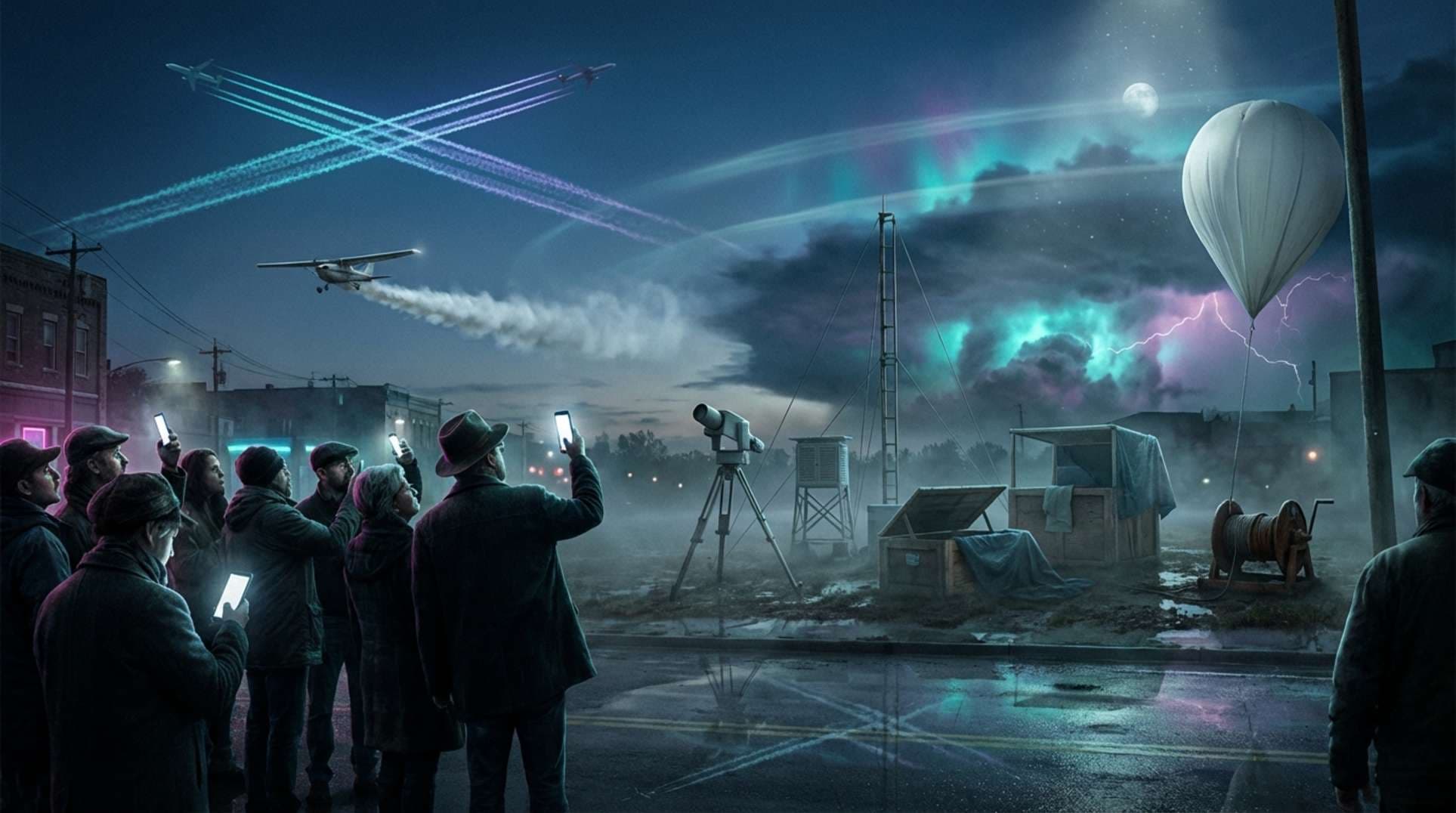
Picture this: it’s a clear evening in late 2024, and you’re stepping outside, expecting the usual calm. But the air feels thick, charged, like the sky is holding its breath. Across the country, from the Midwest plains to coastal towns, folks are sharing similar stories—storms building faster than they should, seasons flipping without warning, contrails stretching longer than memory serves. One observer in Texas recalls a heatwave hitting in what should have been early fall, the sky streaked with lines that lingered for hours, turning a routine day ominous. Another in the Pacific Northwest describes cold snaps arriving mid-summer, with clouds gathering in patterns that defy the forecasts. These accounts, clustering heavily in 2024–2026, capture a shared unease: the atmosphere isn’t acting right, and it’s not just imagination. We’re all sensing it, and it’s worth examining why.
What Witnesses and Analysts Report
Witnesses from various walks of life are speaking up, their observations painting a picture of weather gone awry. On platforms like Reddit, Twitter, and dedicated forums, reports pile up: storms intensifying rapidly, seasons shifting out of sync, and erratic tracks that leave communities scrambling. Local researchers and community groups archive these, often linking them to visible aircraft trails that persist unusually long. The chemtrails narrative runs deep here—observers point to patents, technical reports, and known cloud-seeding efforts as pieces of a larger puzzle, suggesting deliberate atmospheric interventions. Yet, there’s a tendency to blend elements: persistent contrails from high-altitude flights get mixed with documented seeding ops and solar geoengineering proposals, forming a cohesive story of intentional control. This has real effects—mistrust swells, emotions run high toward meteorologists and agencies, sparking congressional hearings and media spotlights. Investigators in these circles argue it’s more than coincidence; they’re piecing together patterns from social posts, local news clips, and forum threads, demanding answers.
Timelines, Tracks, and Hard Data
To ground this, let’s turn to the records. The NOAA/NCEI Storm Events Database offers a public archive stretching from January 1950 through October 2025, detailing U.S. storm history straight from official sources. Pair that with the NCEI ‘Billion-Dollar Weather & Climate Disasters’ time series, last updated on 13 January 2026, which tracks the rising costs and frequency of extremes. Don’t overlook the CPC ENSO update from 20 January 2026—ENSO’s swings heavily influence seasonal patterns and storm behavior, so it factors into any fair analysis. On the geoengineering side, Harvard’s SCoPEx project aimed at studying aerosol microphysics and chemistry but was publicly suspended in March 2024, with plans abandoned and platforms redirected. NOAA’s stance is clear: they’re not involved in solar geoengineering, and the U.S. Weather Modification Reporting Act mandates 10-day notifications for any modification activities. Cloud-seeding is real but limited—local ops using silver iodide typically boost precipitation by 5–15% under marginal conditions, nothing game-changing. Agencies like EPA, OSTP, and NOAA have issued fact-checks and pledged transparency amid congressional scrutiny. For clarity, here’s a summary table of key data points:
| Metric | Value | Source |
|---|---|---|
| Storm Events Database Span | January 1950–October 2025 | NOAA/NCEI |
| Billion-Dollar Disasters Update | 13 January 2026 | NCEI |
| ENSO Status Report | 20 January 2026 | CPC |
| SCoPEx Status | Suspended March 2024 | Harvard/Scientific American |
| Cloud-Seeding Impact | ~5–15% precipitation increase | Documented operations |
For deeper digs, consider FOIA requests for satellite AOD data and balloon profiles from specific regions and months—those could reveal more.
Official Story vs. What the Data Suggests
Agencies like NOAA/NCEI hold firm: their datasets show storms and climate shifts driven by anthropogenic warming and variability, with public fact-checks countering modification myths. They state outright—no solar geoengineering ops on their watch. Harvard framed SCoPEx as pure research into stratospheric aerosols, suspending it in 2024 amid concerns, redirecting to other studies. Peer-reviewed papers stress the unknowns of solar radiation management, positioning such work as uncertainty reducers, not control mechanisms. Cloud-seeding stays local, incapable of conjuring major storms from nothing. Yet community voices see patents and past experiments as signs of hidden scalability, interpreting small ops as covert proof. The dossier lacks evidence of global coordination, but that’s the rub—absence isn’t disproof. Gaps in observations, like missing stratospheric signatures, leave room for doubt. We must weigh this carefully: official lines address much, but selective community reads create plausible threads worth probing.
What It All Might Mean
Stepping back, the core evidence aligns lived weather changes with documented extremes, best explained by climate shifts and ENSO-like variability. Still, questions linger: could formal studies detect non-climate human forcings? What signatures would large-scale interventions leave in public data? How do patents translate to real capabilities? Are governance rules for SRM and seeding robust enough? And what about those observational holes in stratospheric sampling and AOD? For next steps, pull regional satellite AOD series and balloon data, catalog cited patents for their actual scope, and review attribution studies on 2024–2026 events. This matters because uncertainty breeds mistrust, and opacity from institutions only deepens it. Measuring what we can while highlighting gaps builds clearer pictures—and trust. Remember, current data doesn’t confirm or dismiss large-scale manipulation outright; that open door is why we keep watching, pushing for transparency.
Frequently Asked Questions
Yes, many people have shared firsthand accounts of stronger storms, shifted seasons, and volatile patterns during this period, widely documented on social media and local reports. These align with increased extreme events in official datasets.
Public sources like NOAA’s Storm Events Database and Billion-Dollar Disasters series attribute recent extremes to climate change and natural variability such as ENSO. They show no evidence of large-scale weather control operations.
Small-scale research like SCoPEx and local cloud-seeding exist, but no verifiable public evidence supports coordinated, large-scale weather manipulation. Gaps in data leave some questions open, warranting further investigation.
Agencies like NOAA and EPA have issued fact-checks, stated they’re not involved in solar geoengineering, and committed to transparency. Congressional hearings and media coverage have addressed the growing mistrust.
Pursue formal attribution studies, analyze satellite AOD and balloon data for signatures, review patents, and assess governance frameworks. These steps could clarify uncertainties and rebuild confidence.