Unmasking the Sea Peoples: The 1177 BCE Apocalypse and the Collapse of Bronze Age Empires | Unexplained
Ancient Civilizations
Unmasking the Sea Peoples: The 1177 BCE Apocalypse and the Collapse of Bronze Age Empires
When the Bronze Age came crashing down, it wasn’t a quiet decline but a catastrophe so profound that historians sometimes describe it as an apocalypse. Around 1177 BCE, the interconnected world of palaces, scribes and…
Rob Davenport is the founder of Rovidx Media and the creator of MediaBlaster, formerly WP Smart TV. He has spent more than a decade building WordPress-powered video, podcast and OTT platforms, including Roku apps, membership systems and custom media workflows. Rob writes from hands-on experience developing, testing and publishing streaming technology for creators, businesses and agencies.
8 min · 1,779 words
In This Report(8)
When the Bronze Age came crashing down, it wasn’t a quiet decline but a catastrophe so profound that historians sometimes describe it as an apocalypse. Around 1177 BCE, the interconnected world of palaces, scribes and merchants stretching from Greece and Anatolia to Egypt disintegrated. Cities burned, trade routes vanished and writing systems vanished. In modern popular culture this calamity is often blamed on enigmatic raiders called the Sea Peoples. Conspiracy theorists weave tales of lost civilizations, alien weapons or Atlantean refugees, while archaeologists struggle with fragmentary evidence. This article explores what we actually know about the Sea Peoples, why the Bronze Age world collapsed, and how the mystery has become a magnet for speculation.
The Bronze Age World and the Stage for Collapse
To appreciate the shock of 1177 BCE, it helps to picture the Late Bronze Age as a “globalized” network of powerful kingdoms. From c. 1500 to 1200 BCE, empires like Egypt, the Hittites and Mycenaean Greece maintained diplomatic alliances, exchanged letters and arranged royal marriages. Their economies depended on long‑distance trade: copper from Cyprus mixed with tin from as far away as Afghanistan to make bronze, while luxury goods and ideas flowed along sea lanes. This prosperity fostered monumental architecture, sophisticated writing systems and cosmopolitan port cities.
Yet this network was fragile. Scholars investigating the Bronze Age collapse note that between c. 1250 and 1150 BCE major cities were destroyed and writing systems disappeared, ushering in a “dark age” in which iron replaced bronze and trade relations were disrupted. Proposed causes range from natural catastrophes (earthquakes), climate change–induced drought and famine, internal rebellions and invasions, to a domino‑like systems collapse when trade routes failed. The Sea Peoples were once regarded as the primary culprits, but modern scholarship sees them as one piece of a larger puzzle.
Advertisement
Who Were the Sea Peoples?
The term “Sea Peoples” is not found in ancient texts; it was coined by 19th‑century Egyptologist Gaston Maspero to describe a confederacy of seaborne raiders mentioned in Egyptian inscriptions. Ancient records never identify them collectively, only listing individual groups. Egyptian sources describe a confederacy of tribes—Sherden, Shekelesh, Lukka, Tursha, Akawasha and others—who attacked coastal towns across the Mediterranean between roughly 1276 and 1178 BCE. These groups are known chiefly through battle narratives carved on Egyptian monuments: steles and temple reliefs speak of foes who “came from the sea in their war ships and none could stand against them.” The ; scholars have proposed connections to Etruscans, Philistines, Mycenaeans, Sardinians or Minoans, but no ancient inscription explains their origins.
1957 Electrogravitics Secret: The Classified Research Program Whose Watchers Have All ‘Gone’
A viral essay claims that classified electrogravitics research made real progress in the 1950s — and that everyone who knew the truth about it has since disappeared from the public record. The story is spreading through high-strangeness forums.
May 14, 2026 • 7 min read
Ancient Civilizations
1957 Electrogravitics Secret: The Classified Research Program Whose Watchers Have All ‘Gone’
A viral essay claims that classified electrogravitics research made real progress in the 1950s — and that everyone who knew the truth about it has since disappeared from the public record. The story is spreading through high-strangeness forums.
May 13, 2026 • 7 min read
Conspiracy Theories
The Sandia Quantum Scientist Who Vanished: Ingrid Lane’s Double Life and the Mystery No One Solves
Ingrid Lane lived a double life — bipolar musician to the world, Sandia National Laboratories quantum computing scientist underneath. Then she disappeared. The story is a fixation in high-strangeness communities.
May 14, 2026 • 7 min read
nationality of the Sea Peoples remains a mystery
Nine Groups and Two Battles
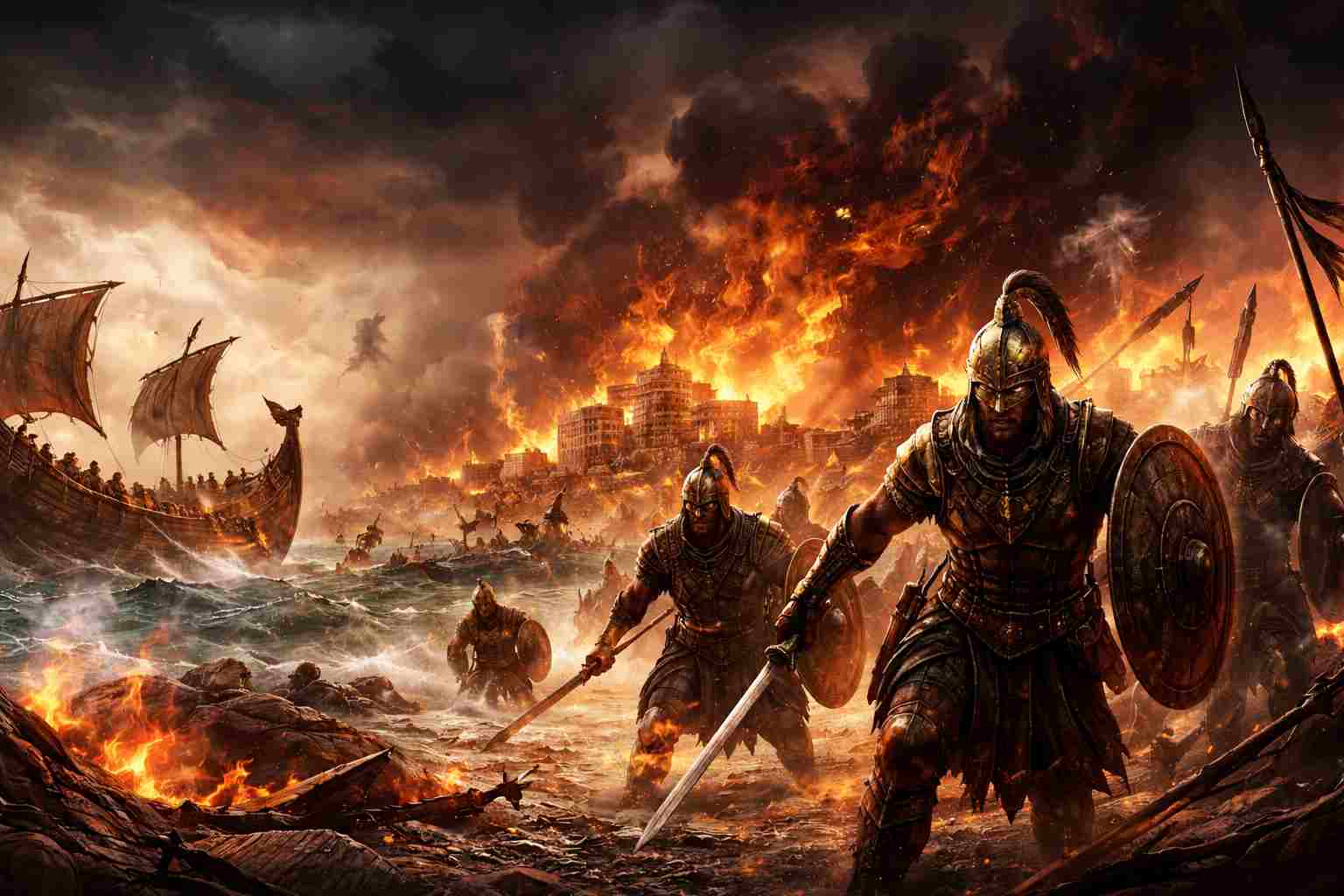
Our main evidence comes from two Egyptian pharaohs. Merneptah (r. 1213 – 1203 BCE) recorded that in his fifth regnal year (around 1207 BCE) he fought invaders identified as the Shardana, Shekelesh, Lukka, Teresh and Ekwesh. Ramesses III (r. 1186 – 1155 BCE) later claimed to have defeated a coalition that included the Shardana, Shekelesh, Tjekker, Denyen, Weshesh and Peleset. Together these inscriptions list nine distinct groups, two of which appear in both lists. Ramesses III’s temple at Medinet Habu preserves reliefs showing naval battles: ships with high prows, feathered‑helmeted warriors and Egyptian soldiers firing arrows from the shore. An inscription there boasts that “the foreign countries made a conspiracy in their islands” and that no land could withstand their arms.
These records are often interpreted as two waves of attacks—one circa 1207 BCE, another around 1177 BCE—that battered Egypt and neighboring states. The first may correspond to an invasion allied with Libyans; the second, recorded in year eight of Ramesses III, depicts a massive sea battle in which Egypt repelled the attackers. The Egyptians claimed victory, but other civilizations were less fortunate: archaeological evidence shows that cities like Hattusa (capital of the Hittite empire) and Megiddo in Canaan were destroyed.
Migrants, Mercenaries or Pirates?
Because the Sea Peoples vanish from history as suddenly as they appear, scholars debate who they were and why they attacked. Egyptian texts sometimes depict them with families in tow, suggesting they were not just raiders but migrants or refugees. One theory holds that they originated in the western Mediterranean—perhaps the Aegean, Sardinia or even the Iberian Peninsula—and were driven eastward by drought and climate change. Linguistic hints link the Lukka to Lycia in southwestern Turkey and the Sherden to Sardinia, while the Peleset are usually identified with the Philistines. Scholars such as Eric Cline emphasize that there is no consensus; the confederacy may have comprised displaced peoples from multiple regions who banded together as they moved along the eastern Mediterranean.
Others see the Sea Peoples as mercenaries. Ramesses II’s inscriptions mention them serving both with and against Egypt. They may have been skilled seafarers hired by rival powers, switching loyalties as opportunities arose. The discovery of a letter from the king of Ugarit pleading for help against unknown attackers indicates that coastal states faced maritime threats they could not identify. In this reading, the Sea Peoples were part of a broader wave of upheaval rather than its root cause.
Multiple Stressors: Drought, Earthquakes and Systems Collapse
Even if seaborne raiders contributed to the violence, modern research suggests that the Bronze Age collapse resulted from a “perfect storm” of disasters. A megadrought between roughly 1250 and 1100 BCE left the eastern Mediterranean parched, as shown by sediment cores from the Sea of Galilee. Famine years correspond to the period when Egyptian texts record invasions; Cline argues that desperate climate refugees might have been among the Sea Peoples. A rapid‑fire series of earthquakes between 1225 and 1175 BCE shook the region. When combined with epidemics, internal rebellions and the loss of trade networks that supplied bronze‑making materials, these crises overwhelmed Bronze Age systems.
Advertisement
This broader context matters. The American Society of Overseas Research notes that the Sea Peoples are known primarily from two Egyptian inscriptions and that archaeologists have long overemphasized their role. Eric Cline, author of 1177 BC: The Year Civilization Collapsed, argues that they became scapegoats; he doubts they were responsible for all the destructions attributed to them. Instead, the fall of empires likely resulted from interconnected failures—natural, economic and social—that created cascading collapses. In this sense, the Sea Peoples were as much victims of the Bronze Age collapse as they were agents of it.
Conspiracy Theories and Speculative Connections
The mystery surrounding the Sea Peoples has fueled a cottage industry of conspiracies. Because they appeared suddenly, left no written records and seem to have brought down civilizations, fringe theorists see them as evidence of lost technologies or aliens. Some claim the Sea Peoples were survivors of Atlantis, citing Plato’s tale of a seafaring civilization that sank beneath the waves. Others draw on modern television shows about “ancient aliens,” suggesting advanced beings equipped the Sea Peoples with otherworldly weapons. A few point to the absence of graves and propose that they were time travellers or interdimensional beings.
While entertaining, these theories lack evidence. The term “Sea Peoples” is itself a modern construct; ancient Egyptians merely described unknown groups who came by sea. The reliefs at Medinet Habu show ordinary warships, not anti‑gravity craft. There are no inscriptions about alien interventions. Archaeologists find that Bronze Age collapses can be explained through familiar factors: climate change, earthquakes and human migration. Even the dramatic rumours of mysterious fields or energy weapons (inspired by modern podcasts) can be traced to misreadings of battle scenes where swirling smoke and churning waves create visual confusion. Conspiracy‑minded readers may also encounter long‑tail keyword searches like “Sea Peoples aliens,” “Sea Peoples Atlantis,” “ancient apocalypse 1177 BC,” or “Bronze Age collapse conspiracy theory.” Exploring these ideas can be fun, but they should be distinguished from what the archaeological record actually supports.
Aftermath and Legacy
Despite the devastation, the collapse did not spell the end of civilization. In the centuries following 1177 BCE, new cultures emerged. The so‑called Greek Dark Age saw the rise of oral traditions that later inspired Homeric epics. The Iron Age ushered in cheaper and stronger tools and weapons; once copper and tin trade collapsed, iron production expanded. The Philistines, often identified with the Peleset group of Sea Peoples, established cities in what is now Israel; Egyptian texts suggest Ramesses III settled captured Sea Peoples in fortresses and strongholds. While the Hittite empire vanished and Mycenaean palaces fell, Egypt survived and Assyria eventually rose to dominance.
The Sea Peoples’ mystery endures because it embodies the fragility of complex societies. As modern scholars note, the Bronze Age world’s interdependence made it vulnerable to cascading failures. For readers confronting climate change, pandemics and geopolitical upheaval today, the story resonates as a warning: no civilization is immune to systemic shocks. At the same time, the collapse set the stage for renewal; the rediscovery of iron, the spread of alphabetic writing and the birth of classical Greek culture all emerged from the ashes.
Explore Further
Interested readers can dive deeper into this mystery through the Unexplained History podcast and articles. The episode “Apocalypse 1177 BC – The Mystery of the Sea Peoples” on Unexplained History introduces listeners to the catastrophe, suspects and theories of the collapse, highlighting how the Hittite empire burned, Mycenaean palaces crumbled and Egypt fought for its life. For scholarly context, Joshua J. Mark’s essay in the World History Encyclopedia provides a balanced overview of the Sea Peoples and notes that the term is modern, the tribes’ origins remain unknown and the pharaohs Ramesses II, Merneptah and Ramesses III recorded battles against them. The American Society of Overseas Research offers a nuanced perspective, cautioning that the Sea Peoples were likely scapegoats and that multiple stressors—including drought, famine and earthquakes—contributed to the collapse. Finally, the history.com article “What Caused the Bronze Age Collapse?” summarizes current research on megadroughts and earthquake storms and reminds readers that the Sea Peoples were probably both raiders and refugees. If you want an overview of the wider Bronze Age collapse, the World History Encyclopedia article explains the broader context of drought, earthquakes and systems collapse.
The mystery is unlikely to be solved completely, but that is part of its appeal. Between factual analysis and imaginative speculation lies a story that continues to inspire scholars, storytellers and conspiracy theorists alike. Whether you search for “Sea Peoples origin theories,”“Bronze Age collapse causes,” or even “Sea Peoples aliens,” remember that the truth is probably both simpler and more complex than any single explanation. The collapse of 1177 BCE reminds us that civilizations rise and fall on the tides of history—and that understanding the past can help us navigate the uncertainties of the present.
Rob Davenport is the founder of Rovidx Media and the creator of MediaBlaster, formerly WP Smart TV. He has spent more than a decade building WordPress-powered video, podcast and OTT platforms, including Roku apps, membership systems and custom media workflows. Rob writes from hands-on experience developing, testing and publishing streaming technology for creators, businesses and agencies.