The Unexplained Company Logo
Sign In
Planetary Parade 2026: Cosmic Shift or Optical Trick?

Planetary Parade 2026: Cosmic Shift or Optical Trick?

Art Grindstone

February 17, 2026
Cataclysm Survival Briefing — Access Briefing Now

Key Takeaways

  • On February 28, 2026, six planets—Mercury, Venus, Jupiter, Saturn, Uranus, and Neptune—aligned in a visual parade across the western sky, observable with varying clarity by hemisphere; some like Neptune need telescopes, while others shine bright to the naked eye.
  • Official sources from NASA, USGS, and mainstream outlets stress that these alignments are purely line-of-sight events with no significant gravitational or tidal impact on Earth, far outmatched by the Moon and Sun; claims of major geophysical disruptions lack backing from consensus science.
  • Community voices, including influencer Stefan Burns and online forums, describe this as an energetic ‘choicepoint’ linked to heightened dreams, physical sensations, and possible solar or Earth shifts; these accounts are personal and widespread but rely on anecdotes without replicated, data-driven proof of cause.

A Quiet Parade Under a February Sky

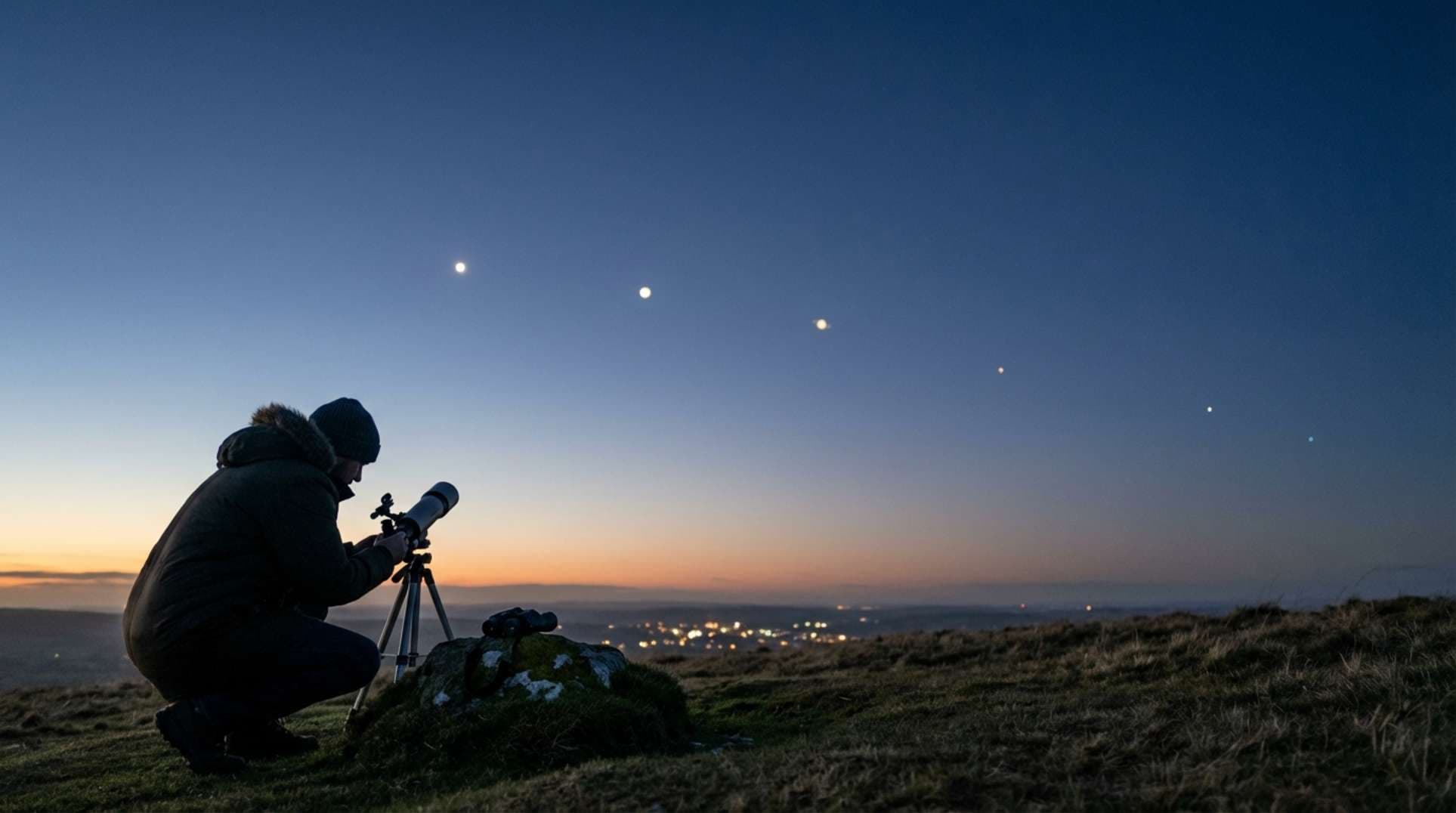
The evening of February 28, 2026, draws near. In the western sky, a rare alignment unfolds—six planets stretching across the horizon like sentinels in the dusk. Observers in the Northern Hemisphere might catch the full sweep if skies are clear, while those farther south adjust for a tilted view. The air hums with anticipation among those who’ve marked their calendars, binoculars at the ready. Whispers of something more than astronomy circulate: a convergence that could stir unseen forces. Earlier that month, on February 16, Saturn and Neptune met in their final conjunction of a triple series, fueling weeks of speculation. For the parade itself, Mercury gleams low, Venus blazes bright, Jupiter holds steady, Saturn glows at magnitude around 1.0, Uranus demands dark skies, and faint Neptune—magnitude 7.7 to 7.8—calls for a scope. The scene feels charged, a mix of celestial mechanics and human expectation hanging in the chill air.

What Witnesses and Analysts Report

Across forums and social threads, reports pile up. People describe dreams turning vivid, almost prophetic, disrupting sleep patterns in the lead-up to the alignment. Others mention bodily sensations—tingles, pressures, a sense of energy surging through them. Synchronicities appear too, like chance encounters or ideas aligning perfectly. Influencers like Stefan Burns tie these to geophysics, framing the parade as a ‘choicepoint’ where planetary positions intersect with solar activity, potentially sparking shifts in consciousness or even Earth’s magnetic field. His videos and posts gather communities who share similar stories, calling it a moment for collective awakening. Skeptics in the comments push back, asking for solid data over feelings. Still, the accounts persist, timestamped and raw, painting a picture of something felt but not yet measured.

Timelines, Tracks, and Hard Data

Let’s pin down the facts. The Saturn-Neptune conjunction hit on February 16, 2026, verified by sources like Star Walk and The Planetary Society. Then came the multi-planet parade on February 28, involving Mercury, Venus, Jupiter, Saturn, Uranus, and Neptune—some visible unaided, others needing optics under dark skies. NASA and the National Space Science Data Center state clearly: these are visual alignments, with planets too distant for notable gravitational pull on Earth. The USGS echoes this for tides and quakes, noting only the Moon and Sun matter significantly; other planets add negligible effects. A 2021 paper by Awadh explores possible links between configurations and earthquakes, but it’s preliminary and debated. Mainstream coverage from BBC Sky at Night, Space.com, Smithsonian, and The Guardian treats it as an astronomical spectacle, warning against overhyping causation.

FactDatePlanets InvolvedData/Source
Saturn-Neptune Conjunction16 February 2026Saturn, NeptuneStar Walk, Planetary Society
Multi-Planet Parade28 February 2026Mercury, Venus, Jupiter, Saturn, Uranus, NeptuneThe Guardian, Space.com
Institutional Stance on EffectsOngoingAll aligned planetsNASA/NSSDC, USGS
Exploratory Hypothesis2021Various configurationsAwadh (2021) paper

Official Story vs. What the Data Suggests

Agencies like NASA maintain the line: alignments are optical illusions from our viewpoint, with gravity too weak to budge Earth’s tides or tectonics. USGS adds that while Moon-Sun interactions might nudge shallow quakes slightly, planets don’t factor in. Community takes differ. Some point to alignments syncing with seismic upticks or geomagnetic storms, citing papers like Awadh’s 2021 work as hints of connection. Influencers argue for heliospheric ties—solar winds and planetary positions amplifying effects on Earth. Yet the evidence splits: mainstream datasets from earthquake logs and solar records show no strong correlations without cherry-picking. Subjective experiences, though—those dreams and sensations—could stem from expectation alone, spreading through networks. The gap persists: hard data leans official, but anomalies and feelings keep questions alive.

What It All Might Mean

The parade on February 28, 2026, stands as a confirmed sky event, just like the February 16 Saturn-Neptune meetup. Science from institutions dismisses big physical impacts. But subtler threads—heliospheric links or group psychology—remain unproven, worth probing. To sort it out, we’d need datasets spanning 30 days before and after: earthquake catalogs, geomagnetic Kp/Dst indices, solar flare logs, even Schumann resonance if accessible. Run cross-correlations with pre-set methods to check for patterns. Next steps? Compile that data for open analysis. Reach out to Stefan Burns for his timestamps and predictions, then balance with a USGS seismologist and a heliophysicist. The choicepoint narrative might hold clues—or it might reveal how shared stories shape our reality.

Frequently Asked Questions

The multi-planet parade was most visible on February 28, 2026, in the western sky, with visibility varying by hemisphere. It followed the Saturn-Neptune conjunction on February 16, 2026.

NASA and USGS state that planetary alignments are visual events with negligible gravitational or tidal effects on Earth, overshadowed by the Moon and Sun. They caution against linking them to geophysical changes without evidence.

Community reports include increased dream intensity, disrupted sleep, energetic bodily sensations, and synchronicities. Influencers like Stefan Burns connect these to a ‘choicepoint’ for energetic shifts, though these are anecdotal.

Mainstream data shows no significant ties, but exploratory papers like Awadh’s 2021 work suggest possible connections that need more testing. Community claims often rely on coincidences without replicated studies.

Assemble datasets from earthquake catalogs, geomagnetic indices, and solar activity around the event dates, then run pre-registered analyses. Interviews with experts and influencers could clarify testable claims.