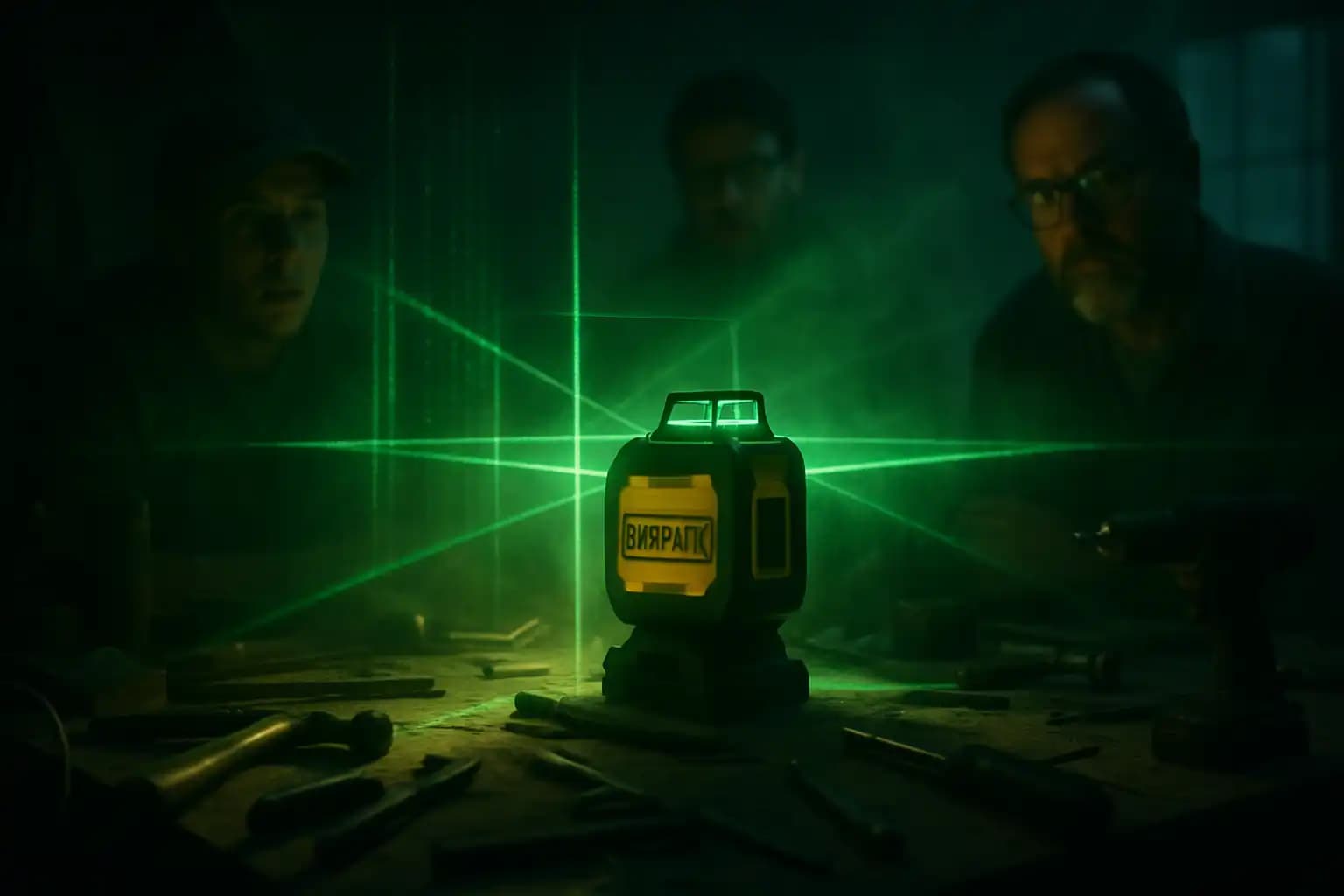

The simulation hypothesis continues to fascinate, especially when viral videos claim everyday tech like a DeWalt laser can “crack reality.” The buzz arises from YouTube clips and forum posts where users shine lasers through smoke or mist, fixating on cryptic grid patterns, “codes,” or glitches. For the gullible, it’s proof we live in a cosmic software environment. For anyone familiar with high school physics, it’s primarily an illustration of optics, psychology, and internet mythmaking. Amid these memes, is there real evidence that consumer-grade laser tricks demonstrate anything about simulation theory?
Viral Demos and Dissent: The DeWalt Laser Experiment on Trial
Tracing the origin of the DeWalt-laser-cracks-the-matrix meme proves difficult. A significant source is a series of YouTube experiments summarized on AR15.com. Participants beam a standard construction laser through reflective surfaces, claiming the geometric interference looks like “code.” This implies, either playfully or seriously, that these grids are signatures of programmed reality. Some link the patterns to psychedelic experiences, referencing the “Matrix digital rain.” Commentary fluctuates wildly as skeptics and believers debate optics versus ontological shock. But is science behind the spectacle?
If you recall meme cycles connected to everything from atrocity propaganda to emergent UFO lore, you’re on point—social contagion remains undefeated.
Advertisement
Physics in the Lab: Holograms, Lasers, and Real Simulation Research
While YouTube and forums engage in laser-fueled speculation, actual scientists conduct sophisticated experiments probing reality’s nature. Physicists at Fermilab initiated the “Holometer” experiment. They use powerful laser interferometers to investigate a potential “pixelation” of space. If spacetime comprises discrete information, noise at the smallest scales could betray hidden layers of code. A 2024 New Atlas report (Fermilab Holometer project) details the approach: splitting and recombining laser beams with near-perfect precision, researchers search for “holographic noise,” which some simulation models predict. So far, no such noise has emerged, but the quest continues, grounded in mainstream physics rather than viral tricks.
In contemporary physics, lasers serve various astonishing purposes—quantum optics, dark matter searches, and ultrafast spectroscopy among them. However, the DeWalt experiment? Mostly an optics parlor trick. The desire to find signs of code, whether intentional or random, echoes interpretive twists common in .