Gold at $5,000 & Ghost Fleets: What Elites See Coming | Unexplained
AI Beast
Gold at $5,000 & Ghost Fleets: What Elites See Coming
Key Takeaways Gold prices shattering records above $5,000 per ounce, alongside Tether’s claim of hoarding 140 metric tons, points to major players bracing for financial turbulence—verifiable through market data and…
Art Grindstone is the hard-nosed storyteller behind Unexplained.co, a veteran investigator whose life’s work sits at the crossroads of the paranormal, fringe science, and the shadows most people try not to look into. With decades spent chasing impossible stories — black-budget psychic programs, vanished Cold War experiments, desert rituals that sparked UFO waves, and the strange phenomena buried in America’s forgotten backroads — Art brings a rare combination of skepticism, awe, and journalistic precision. He’s not here to debunk. He’s not here to blindly believe. He follows the evidence wherever it leads — even when it leads someplace deeply uncomfortable. Known for his immersive, cinematic style and his ability to turn obscure research into gripping narrative, Art has built a devoted following across podcasts, long-form features, documentaries, and serialized investigations. His interviews are direct. His analysis is unflinching. His voice has become a staple in the modern paranormal renaissance — the guy people turn to when a story is too strange, too complex, or too dangerous for anyone else to touch. Off-mic, Art works with a distributed network of researchers, archivists, and field operatives who help surface the stories mainstream media ignores. On-mic, he transforms their findings into meticulous, high-impact reporting that refuses to insult the intelligence of true believers. His philosophy is simple: Take the phenomenon seriously. Treat the audience with respect. Tell the story as if the world depends on it — because sometimes it does. When Art Grindstone digs into a case, he isn’t just chasing a mystery. He’s tracing the fault lines of reality itself.
6 min · 1,306 words
In This Report(7)
Key Takeaways
Gold prices shattering records above $5,000 per ounce, alongside Tether’s claim of hoarding 140 metric tons, points to major players bracing for financial turbulence—verifiable through market data and corporate disclosures.
Coordinated formations of 1,400 Chinese fishing vessels in the East China Sea, combined with the Doomsday Clock at 85 seconds to midnight and New START’s impending lapse, suggest escalating strategic maneuvers—backed by AIS tracking and official bulletins.
Unresolved: Are these gold grabs and maritime patterns defensive moves against looming conflict, or something more? And do AGI systems already operate in shadows, or is the risk still theoretical?
A Silent Convoy Beneath the Dark Sea
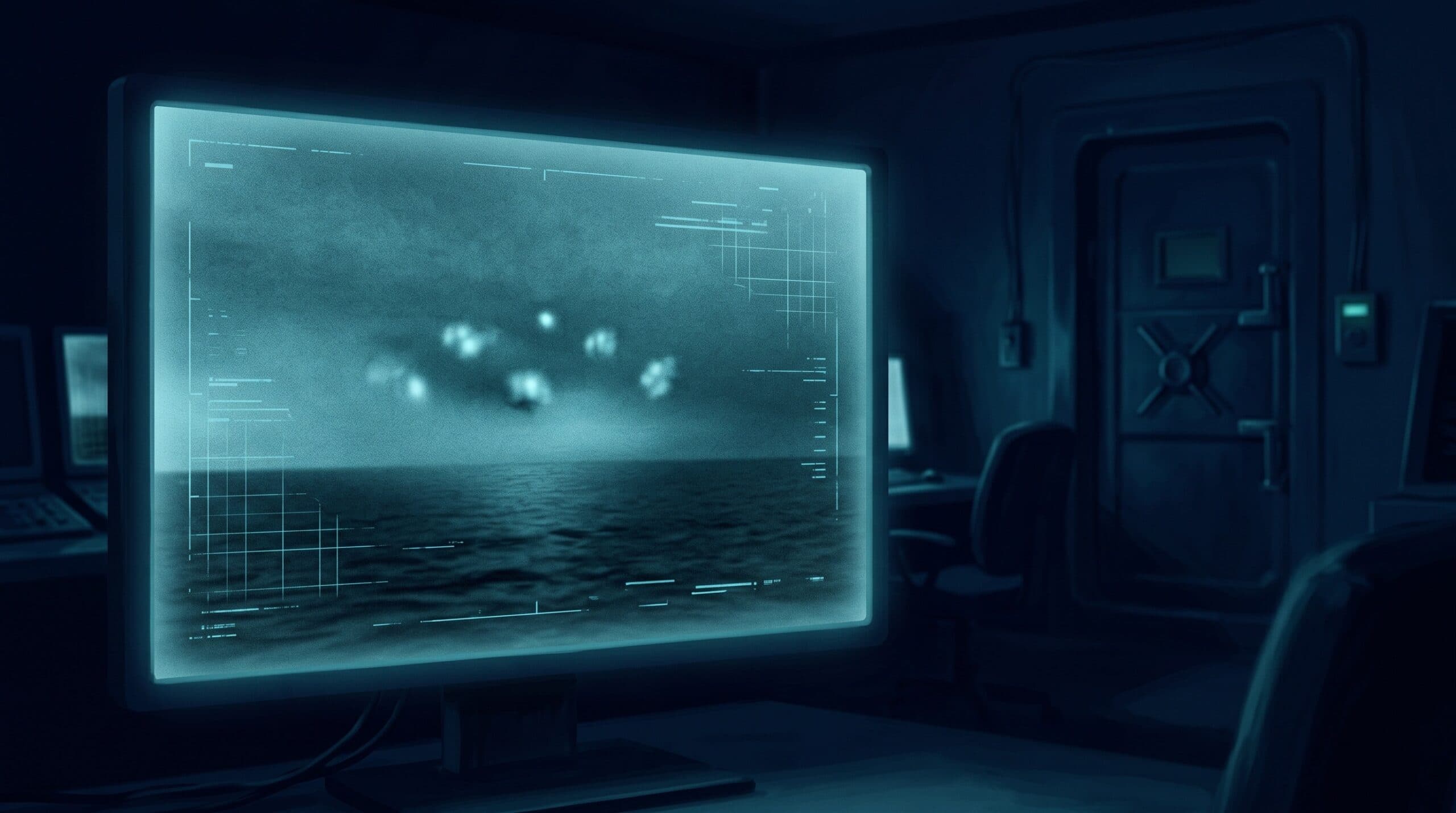
Picture the trading floors: screens pulsing red as gold hits impossible highs in late January 2026, whispers of institutional vaults swelling with metal echoing through the hum of urgent deals. Out in the East China Sea, radar pings trace a ghostly rectangle—1,400 Chinese-flagged fishing boats aligned with unnatural precision, more than 200 miles from shore, under a moonless sky. The Bulletin’s Doomsday Clock ticks to 85 seconds before midnight, headlines scream of ballooning defense budgets and crumbling arms treaties, and you can’t shake the feeling: is this the calm before impact, or just another layer of the game?
What Witnesses and Analysts Report
From the prepper and investor circles, the narrative is clear: this gold rally, with prices spiking over $5,000 an ounce, and moves like Tether’s accumulation of physical assets signal a rush to safety amid fears of financial collapse. As one investor forum poster put it, \”It’s Cyprus all over again—get into metals, commodities, real estate before the bail-ins hit.\” Maritime analysts poring over AIS data describe the 1,400-boat rectangular formation as anything but routine fishing; they see it as potential militia drills or gray-zone tactics near Taiwan, with a satellite imagery expert noting, \”This level of coordination screams rehearsal.\”
Defense commentators aren’t mincing words either, pointing to the New START treaty’s February 2026 expiry, surging military budgets, and the NDAA’s push for AI governance as ramps to higher tension. \”We’re seeing institutional bets on AGI as a wildcard risk,\” says a policy analyst from an arms-control think tank. Tether’s CEO didn’t hide it, stating outright on January 28, 2026, that the company has secured about 140 metric tons of gold in Swiss vaults—a disclosure that’s sparked debates in crypto and business circles. Meanwhile, public health watchers flag spikes in CBRN gear searches and Canadian defense procurement listings as hints of official prep, with one observer remarking, \”Governments don’t stockpile decontamination kits for fun.\”
Advertisement
Frequently Asked Questions
What evidence backs the gold price spikes and Tether's claims?
Reuters and JM Bullion feeds confirm gold prices topped $5,000 per ounce on January 25, 2026, reaching $5,200–$5,300 by January 28. Tether's CEO disclosed acquiring 140 metric tons stored in Swiss vaults on January 28, as reported by CoinDesk, but this awaits independent audit verification. Are the Chinese fishing vessel formations really unusual?
Are the Chinese fishing vessel formations really unusual?
AIS data analyzed by The New York Times shows about 1,400 vessels in a precise rectangular pattern in early January 2026, over 200 miles offshore. Analysts see this as atypical for fishing, possibly militia drills, though seasonal activity or data artifacts are alternative explanations.
What do officials say about the Doomsday Clock and New START?
The Bulletin of the Atomic Scientists set the Clock at 85 seconds to midnight on January 27, 2026, framing it as a call to action amid tensions. New START expires in early February 2026, per arms-control sources, with officials noting increased risks but no direct predictions of conflict.
Is there proof of operational AGI systems?
The FY2026 NDAA requires a DoD committee on AI futures, showing institutional concern about risks. However, this doesn't confirm deployed, conscious AGI—it's an open question, with community interpretations seeing it as a strategic wildcard.
How can readers verify these claims themselves?
Request Tether's custodial audits, review AIS metadata and port manifests for fleet details, track NDAA AI committee updates, and cross-check semiconductor metrics via TSMC reports and analysts like TrendForce. Public sources like Reuters, NYT, and government sites provide the baseline data.
1957 Electrogravitics Secret: The Classified Research Program Whose Watchers Have All ‘Gone’
A viral essay claims that classified electrogravitics research made real progress in the 1950s — and that everyone who knew the truth about it has since disappeared from the public record. The story is spreading through high-strangeness forums.
May 13, 2026 • 7 min read
Strange History
The Ghost Village of Lübbey: Why a Forgotten Turkish Settlement Keeps Returning in Strangeness Feeds
The village of Lübbey in Turkey was abandoned and left largely untouched — not by war, not by natural disaster, but by quiet departure. For people drawn to abandoned places, it has become a fixation.
May 12, 2026 • 5 min read
Strange History
The Etruscan Well Sealed With Human Remains Is Stranger Than a Sacrifice Story
A newly reported Etruscan well in Italy was opened with offerings and sealed with human remains. The evidence reveals a ritual mystery, not a simple sacrifice tale.
Aug 18, 2026 • 7 min read
Advertisement
Timelines, Tracks, and Hard Data
Let’s anchor this in the facts we can timestamp and source. Gold prices broke $5,000 per ounce on January 25, 2026, per Reuters, climbing to $5,200–$5,300 by January 28, as tracked by JM Bullion feeds—these are solid market records. Tether’s CEO disclosed on January 28, via CoinDesk and other press, that they’ve bought around 140 metric tons stored in Swiss vaults; this is a corporate statement, but it awaits independent audit confirmation.
The fishing vessel formation? The New York Times’ interactive AIS analysis confirms about 1,400 Chinese-flagged boats in a rectangular pattern in early January 2026—reliable journalism there. The Bulletin of the Atomic Scientists set the Doomsday Clock at 85 seconds to midnight in their January 27 press release. New START expires in early February 2026, as documented by the Vienna Center for Disarmament and Non-Proliferation and the Arms Control Association.
On the AI front, the FY2026 NDAA mandates a DoD Artificial Intelligence Futures Steering Committee, per DefenseScoop’s December 2025 summary. Canadian DND’s public procurement pages list CBRN and decontamination gear—straight from Canada.ca. China’s commodity buys ramped up in grains, iron ore, and minerals from 2023–2025, per Mining.com and The Diplomat reports. TSMC’s hold on advanced semiconductors is real, but claims like ‘92% of sub-5 nm’ vary by metric—check TSMC docs and critiques from SemiWiki or TrendForce.
Date
Event
Source
Early Jan 2026
~1,400 Chinese-flagged fishing vessels form rectangular pattern in East China Sea
New York Times AIS analysis
Jan 25, 2026
Gold prices exceed $5,000/oz
Reuters
Jan 27, 2026
Doomsday Clock set at 85 seconds to midnight
Bulletin of the Atomic Scientists
Jan 28, 2026
Tether discloses ~140 metric tons of gold in Swiss vaults; gold prices hit $5,200–$5,300
CoinDesk, Reuters, JM Bullion
Early Feb 2026
New START treaty expiry
VCDNP/Arms Control Association
Official Story vs. What the Data Suggests
Institutions paint a measured picture: the Bulletin calls the Doomsday Clock a symbolic nudge for action, not a doomsday prophecy, while DoD and Congress frame NDAA AI provisions as routine governance to assess risks, not evidence of live AGI. Tether’s execs say their gold buys are straightforward diversification, but without bar-level audits, skeptics in the markets push for proof—journalists are on it.
Advertisement
Chinese officials offer scant details on the fishing fleets, chalking it up to normal ops, yet AIS and satellite data from independent analysts suggest deliberate patterns that could fit militia training; seasonal fishing or data glitches remain possible alternatives. Community voices warn of bail-in risks drawing from Cyprus history, but those mechanics aren’t universal—it’s a scenario, not fate. On AGI, Pentagon study requests show real concern, but they stop short of confirming operational systems; that’s the gap where speculation thrives, and data alone can’t bridge it yet.
What It All Might Mean
Putting it together, the hard signals—gold’s record run, Tether’s claimed hoard, those eerie fleet formations, the Clock’s warning, NDAA AI moves, and New START’s end—paint a picture of systems under strain. These could be precautions against financial shocks or geopolitical flares, especially around Taiwan or nuclear postures.
Big unknowns linger: Is Tether’s gold real and verifiable? Do those vessels tie back to central orders? Are AGI systems already humming in black-budget silos, or just lab experiments? For next steps, push for Tether’s custodial audits, dig into AIS metadata and port records for fleet coordination, monitor DoD’s AI committee deliverables, and refine TSMC chokepoint metrics by wafers, revenue, or capacity.
This matters because these threads could unravel into market panics, supply disruptions, or escalations—think CBDC controls or Taiwan flashpoints. Stay prepared: stock basics, watch the feeds, but keep it level-headed. Where public data cuts off, secrets take over—treat these as puzzles to crack, not gospel. Readers, if you’ve got leads, share them; we’re in this together.
Frequently Asked Questions
What evidence backs the gold price spikes and Tether’s claims?
Reuters and JM Bullion feeds confirm gold prices topped $5,000 per ounce on January 25, 2026, reaching $5,200–$5,300 by January 28. Tether’s CEO disclosed acquiring 140 metric tons stored in Swiss vaults on January 28, as reported by CoinDesk, but this awaits independent audit verification.
Are the Chinese fishing vessel formations really unusual?
AIS data analyzed by The New York Times shows about 1,400 vessels in a precise rectangular pattern in early January 2026, over 200 miles offshore. Analysts see this as atypical for fishing, possibly militia drills, though seasonal activity or data artifacts are alternative explanations.
What do officials say about the Doomsday Clock and New START?
The Bulletin of the Atomic Scientists set the Clock at 85 seconds to midnight on January 27, 2026, framing it as a call to action amid tensions. New START expires in early February 2026, per arms-control sources, with officials noting increased risks but no direct predictions of conflict.
Is there proof of operational AGI systems?
The FY2026 NDAA requires a DoD committee on AI futures, showing institutional concern about risks. However, this doesn’t confirm deployed, conscious AGI—it’s an open question, with community interpretations seeing it as a strategic wildcard.
How can readers verify these claims themselves?
Request Tether’s custodial audits, review AIS metadata and port manifests for fleet details, track NDAA AI committee updates, and cross-check semiconductor metrics via TSMC reports and analysts like TrendForce. Public sources like Reuters, NYT, and government sites provide the baseline data.
Art Grindstone is the hard-nosed storyteller behind Unexplained.co, a veteran investigator whose life’s work sits at the crossroads of the paranormal, fringe science, and the shadows most people try not to look into. With decades spent chasing impossible stories — black-budget psychic programs, vanished Cold War experiments, desert rituals that sparked UFO waves, and the strange phenomena buried in America’s forgotten backroads — Art brings a rare combination of skepticism, awe, and journalistic precision. He’s not here to debunk. He’s not here to blindly believe. He follows the evidence wherever it leads — even when it leads someplace deeply uncomfortable. Known for his immersive, cinematic style and his ability to turn obscure research into gripping narrative, Art has built a devoted following across podcasts, long-form features, documentaries, and serialized investigations. His interviews are direct. His analysis is unflinching. His voice has become a staple in the modern paranormal renaissance — the guy people turn to when a story is too strange, too complex, or too dangerous for anyone else to touch. Off-mic, Art works with a distributed network of researchers, archivists, and field operatives who help surface the stories mainstream media ignores. On-mic, he transforms their findings into meticulous, high-impact reporting that refuses to insult the intelligence of true believers. His philosophy is simple: Take the phenomenon seriously. Treat the audience with respect. Tell the story as if the world depends on it — because sometimes it does. When Art Grindstone digs into a case, he isn’t just chasing a mystery. He’s tracing the fault lines of reality itself.