Belgorod Sub & Seized Tanker: What Really Happened
World War 3
Belgorod Sub & Seized Tanker: What Really Happened
Key Takeaways On 7 January 2026, U.S. forces boarded and seized the Russian-flagged oil tanker Marinera (formerly Bella 1) in the North Atlantic, with officials linking the action to sanctions evasion. Reports from…
Art Grindstone is the hard-nosed storyteller behind Unexplained.co, a veteran investigator whose life’s work sits at the crossroads of the paranormal, fringe science, and the shadows most people try not to look into. With decades spent chasing impossible stories — black-budget psychic programs, vanished Cold War experiments, desert rituals that sparked UFO waves, and the strange phenomena buried in America’s forgotten backroads — Art brings a rare combination of skepticism, awe, and journalistic precision. He’s not here to debunk. He’s not here to blindly believe. He follows the evidence wherever it leads — even when it leads someplace deeply uncomfortable. Known for his immersive, cinematic style and his ability to turn obscure research into gripping narrative, Art has built a devoted following across podcasts, long-form features, documentaries, and serialized investigations. His interviews are direct. His analysis is unflinching. His voice has become a staple in the modern paranormal renaissance — the guy people turn to when a story is too strange, too complex, or too dangerous for anyone else to touch. Off-mic, Art works with a distributed network of researchers, archivists, and field operatives who help surface the stories mainstream media ignores. On-mic, he transforms their findings into meticulous, high-impact reporting that refuses to insult the intelligence of true believers. His philosophy is simple: Take the phenomenon seriously. Treat the audience with respect. Tell the story as if the world depends on it — because sometimes it does. When Art Grindstone digs into a case, he isn’t just chasing a mystery. He’s tracing the fault lines of reality itself.
5 min · 1,136 words
In This Report(7)
Key Takeaways
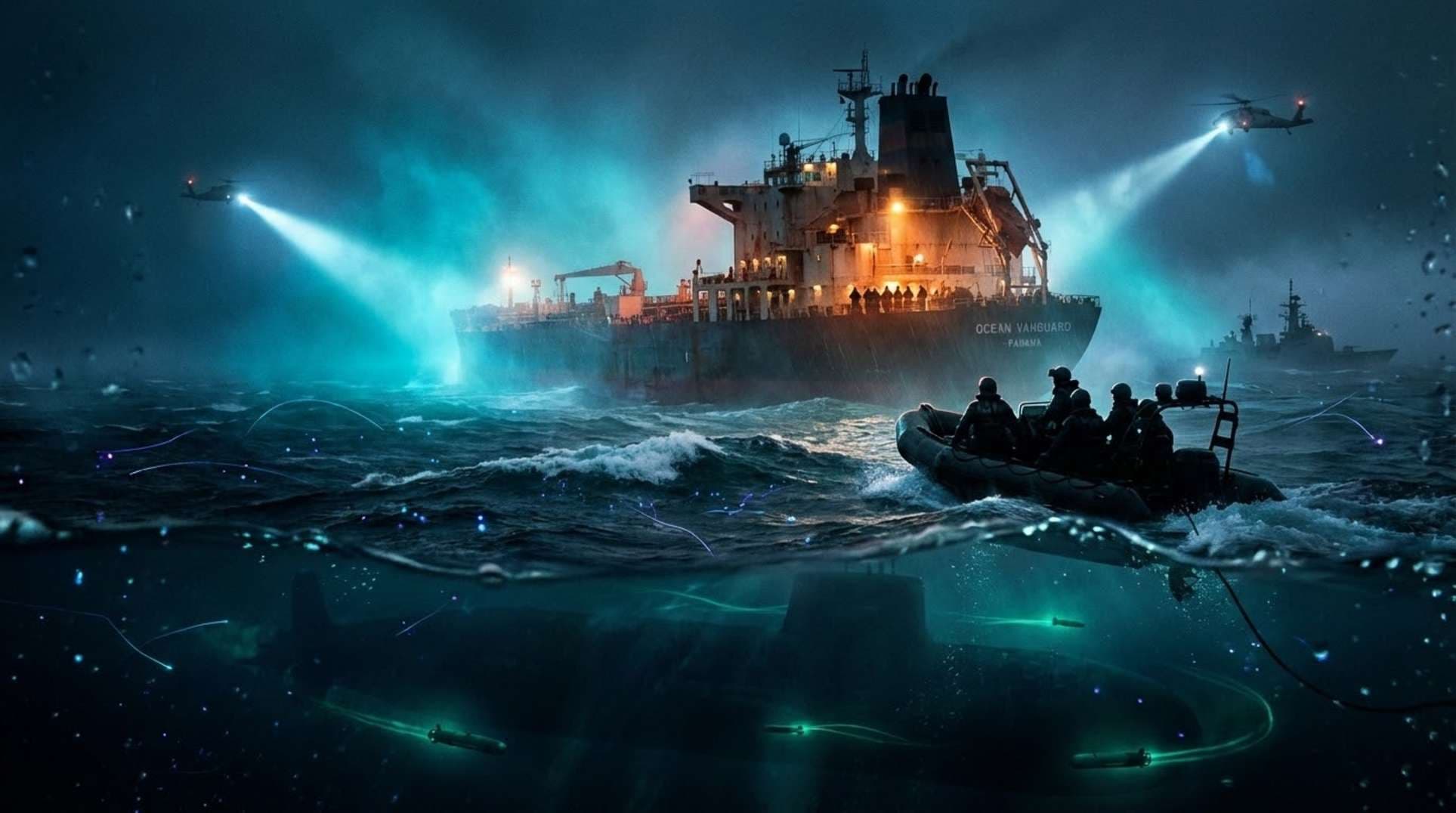
On 7 January 2026, U.S. forces boarded and seized the Russian-flagged oil tanker Marinera (formerly Bella 1) in the North Atlantic, with officials linking the action to sanctions evasion. Reports from Reuters, BBC, and NPR support this as a targeted enforcement operation after prolonged tracking.
Media and open-source trackers noted Russian naval movements in the area, including warships and at least one submarine. Outlets like The Guardian and WSJ reported these details, but a direct, verifiable link confirming the K-329 Belgorod’s specific deployment in response remains unconfirmed.
Several unknowns persist: the exact submarine involved, if any; whether Belgorod carried operational Poseidon UUVs; the full legal paperwork for the boarding; and the final status of the tanker and its crew. These gaps highlight areas for deeper scrutiny.
A Silent Convoy Beneath the Dark Sea
The North Atlantic, stretched between Iceland and the UK, turned into a theater of quiet tension on 7 January 2026. Far from shore, in open waters where winter winds bite hard, U.S. forces closed in on the tanker Marinera after weeks of evasion attempts. This patch of ocean has grown contested, a crossroads for shadow fleets dodging sanctions and enforcers pushing back.
AIS traces flickered across screens, marking the tanker’s erratic path. No explosions lit the night—just the hum of surveillance, overnight course shifts, and radio silence from military vessels. Trackers shared shipboard photos and DHS/Coast Guard video, piecing together a drama built on data points and geopolitical stakes, not spectacle.
What Witnesses and Analysts Report
From the tanker-tracking communities on platforms like TankerTrackers and MarineTraffic, solid documentation emerged. Users plotted the Marinera’s movements, noted its reflagging and name change from Bella 1, and shared AIS data with timestamps that fed into BBC and Metro coverage. High confidence here—the traces pin down locations reliably.
Advertisement
Observers circulated photos and short videos from the ship, tying them to the boarding moment and matching U.S. agency imagery released later. These lived experiences add texture to the story, showing the human side of a high-seas interception.
Multiple reports pointed to Russian naval assets responding, with some outlets citing unnamed intelligence or commercial satellite imagery of warships and a submarine in the vicinity. The Guardian and WSJ referenced these claims, though public verifiability is lower without direct sources.
Sensational channels ramped up the narrative. A YouTube video titled ‘⚡ALERT! USA Captures RUSSIAN SHIP! Russia Activates WORLDS BIGGEST NUCLEAR SUBMARINE!’ posted on 7 Jan 2026 blended verified events with speculation about nuclear platforms. We note it as an example of how stories can amplify, but we weigh it against sourced facts.
Did the U.S. really seize a Russian tanker on 7 January 2026?
Was the Russian submarine Belgorod involved?
What evidence do we have from trackers?
How did Russia respond officially?
What are the key unknowns?
Frequently Asked Questions
Did the U.S. really seize a Russian tanker on 7 January 2026?
Yes, U.S. forces boarded and seized the Marinera in the North Atlantic, citing sanctions evasion. This is supported by reports from Reuters, BBC, NPR, and official U.S. European Command statements.
Was the Russian submarine Belgorod involved?
Media like The Guardian and WSJ reported Russian naval assets, including a submarine, nearby, but there's no publicly verifiable link confirming Belgorod's specific deployment in response. It remains an unconfirmed allegation.
What evidence do we have from trackers?
Open-source communities like TankerTrackers and MarineTraffic provided AIS plots, timestamps, and photos documenting the tanker's movements and name change. These high-confidence traces informed media timelines and align with the seizure details.
How did Russia respond officially?
Russian officials, including the transport ministry and lawmakers, criticized the boarding as a violation and reported losing contact with the Marinera. This contrasts with U.S. claims of legal enforcement action.
What are the key unknowns?
Uncertainties include the specific submarine involved, if Belgorod carried Poseidon UUVs, the full legal paperwork for the boarding, and the tanker's final disposition. These gaps call for further investigation and document requests.
Europe Has Been Quietly Tracking UAP Reports Since 2023
Documents reveal how the European Commission handled UAP images, what it promised to improve, and why Europe still lacks a public investigation office.
Aug 17, 2026 • 8 min read
Conspiracy Theories
The Sandia Quantum Scientist Who Vanished: Ingrid Lane’s Double Life and the Mystery No One Solves
Ingrid Lane lived a double life — bipolar musician to the world, Sandia National Laboratories quantum computing scientist underneath. Then she disappeared. The story is a fixation in high-strangeness communities.
May 14, 2026 • 7 min read
Articles
Two New Loch Ness Reports Bring 2026 Sightings to 13—But What Was Actually Seen?
Two new reported encounters bring the 2026 Loch Ness sighting count to 13. Here is what the reports establish—and what they do not.
Aug 26, 2026 • 6 min read
Timelines, Tracks, and Hard Data
The seizure hit on 7 January 2026, as reported by Reuters. The tanker, Marinera (once Bella 1), had its reflagging and name change tracked by communities and cited in BBC and NPR stories. Location: North Atlantic, between Iceland and the UK, per BBC and RFE/RL.
U.S. European Command announced the action via statements and social media. The Coast Guard and DHS shared interdiction imagery, with involvement noted in CNN, ABC, RFE/RL, and Reuters coverage.
Tracker data from TankerTrackers and MarineTraffic provided AIS plots and timestamps that built the media timelines. Russian naval activity, including a submarine, appeared in mainstream reports from The Guardian and WSJ, often based on commercial imagery or intel sources.
On the submarine: K-329 Belgorod, an Oscar-class conversion commissioned in July 2022, measures about 184 meters with a submerged displacement around 30,000 tonnes, per Wikipedia, Naval News, and Marineforum.
It’s linked to Poseidon UUVs in open sources, with payload estimates at 6 to 8 units. But analysts in Naval-Technology, CNN, and Naval News debate its operational readiness and routine deployment.
A YouTube video from 7 Jan 2026 exemplifies hype, conflating facts with unverified claims.
Date
Asset/Event
Source
Confidence Level
7 Jan 2026
Seizure of Marinera
Reuters, BBC, NPR
High
Prior weeks
Tanker tracking and evasion
TankerTrackers, MarineTraffic
High
7 Jan 2026
Russian naval movements reported
The Guardian, WSJ
Medium
7 Jan 2026
YouTube video posted
YouTube
High (existence), Low (claims)
July 2022
Belgorod commissioned
Naval News, Wikipedia
High
Official Story vs. What the Data Suggests
U.S. European Command and agencies stated the boarding was a sanctioned enforcement action with legal backing, as covered in CNN, RFE/RL, and ABC. The UK Ministry of Defence reportedly offered surveillance and refueling support, per BBC and The Guardian.
Russia’s side: The transport ministry and lawmakers decried it as a violation, noting lost contact with the Marinera, according to Reuters.
Advertisement
Community trackers built AIS and satellite timelines that align with a planned operation. Many interpret Russian movements as a protective response.
But data splits on details. Reports of a submarine nearby don’t confirm Belgorod specifically—no public evidence ties it directly to the incident. Belgorod’s Poseidon capability is noted in sources, yet experts warn that’s not proof of live deployment here.
Legal gaps loom: U.S. claims authorization, but full warrants and chain of custody aren’t public. Russia disputes it, marking a spot for more document requests.
What It All Might Mean
We have confirmation on the U.S. seizure of the Marinera on 7 Jan 2026 in the North Atlantic, backed by agency statements and tracker data from Reuters, BBC, and U.S. EUCOM posts.
Unconfirmed: Belgorod’s direct involvement or Poseidon deployment. Media reports Russian assets nearby, but specifics stay opaque, as in The Guardian and WSJ.
If Russia shadowed the operation, it points to bolder protection of shadow fleets. Escalation hinges on engagement rules and legal frames.
Next: Pull EUCOM, DHS, and Coast Guard posts; map AIS logs for the tanker’s path; consult experts on Belgorod and Poseidon. Readers, view the seizure as fact, but submarine ‘activation’ needs hard evidence before it sticks.
Frequently Asked Questions
Yes, U.S. forces boarded and seized the Marinera in the North Atlantic, citing sanctions evasion. This is supported by reports from Reuters, BBC, NPR, and official U.S. European Command statements.
Media like The Guardian and WSJ reported Russian naval assets, including a submarine, nearby, but there’s no publicly verifiable link confirming Belgorod’s specific deployment in response. It remains an unconfirmed allegation.
Open-source communities like TankerTrackers and MarineTraffic provided AIS plots, timestamps, and photos documenting the tanker’s movements and name change. These high-confidence traces informed media timelines and align with the seizure details.
Russian officials, including the transport ministry and lawmakers, criticized the boarding as a violation and reported losing contact with the Marinera. This contrasts with U.S. claims of legal enforcement action.
Uncertainties include the specific submarine involved, if Belgorod carried Poseidon UUVs, the full legal paperwork for the boarding, and the tanker’s final disposition. These gaps call for further investigation and document requests.
Art Grindstone is the hard-nosed storyteller behind Unexplained.co, a veteran investigator whose life’s work sits at the crossroads of the paranormal, fringe science, and the shadows most people try not to look into. With decades spent chasing impossible stories — black-budget psychic programs, vanished Cold War experiments, desert rituals that sparked UFO waves, and the strange phenomena buried in America’s forgotten backroads — Art brings a rare combination of skepticism, awe, and journalistic precision. He’s not here to debunk. He’s not here to blindly believe. He follows the evidence wherever it leads — even when it leads someplace deeply uncomfortable. Known for his immersive, cinematic style and his ability to turn obscure research into gripping narrative, Art has built a devoted following across podcasts, long-form features, documentaries, and serialized investigations. His interviews are direct. His analysis is unflinching. His voice has become a staple in the modern paranormal renaissance — the guy people turn to when a story is too strange, too complex, or too dangerous for anyone else to touch. Off-mic, Art works with a distributed network of researchers, archivists, and field operatives who help surface the stories mainstream media ignores. On-mic, he transforms their findings into meticulous, high-impact reporting that refuses to insult the intelligence of true believers. His philosophy is simple: Take the phenomenon seriously. Treat the audience with respect. Tell the story as if the world depends on it — because sometimes it does. When Art Grindstone digs into a case, he isn’t just chasing a mystery. He’s tracing the fault lines of reality itself.