NOAA Was Wrong: The 2025 'Phantom' Geomagnetic Storm | Unexplained
Ancient Civilizations
NOAA Was Wrong: The 2025 ‘Phantom’ Geomagnetic Storm
Key Takeaways NOAA/SWPC issued a Strong (G3) Geomagnetic Storm WATCH for 09 Dec 2025 after an M8.1 flare from Active Region 4299 and an associated full-halo CME (SWPC news product). SWPC posted a CANCEL WATCH (Serial…
Art Grindstone is the hard-nosed storyteller behind Unexplained.co, a veteran investigator whose life’s work sits at the crossroads of the paranormal, fringe science, and the shadows most people try not to look into. With decades spent chasing impossible stories — black-budget psychic programs, vanished Cold War experiments, desert rituals that sparked UFO waves, and the strange phenomena buried in America’s forgotten backroads — Art brings a rare combination of skepticism, awe, and journalistic precision. He’s not here to debunk. He’s not here to blindly believe. He follows the evidence wherever it leads — even when it leads someplace deeply uncomfortable. Known for his immersive, cinematic style and his ability to turn obscure research into gripping narrative, Art has built a devoted following across podcasts, long-form features, documentaries, and serialized investigations. His interviews are direct. His analysis is unflinching. His voice has become a staple in the modern paranormal renaissance — the guy people turn to when a story is too strange, too complex, or too dangerous for anyone else to touch. Off-mic, Art works with a distributed network of researchers, archivists, and field operatives who help surface the stories mainstream media ignores. On-mic, he transforms their findings into meticulous, high-impact reporting that refuses to insult the intelligence of true believers. His philosophy is simple: Take the phenomenon seriously. Treat the audience with respect. Tell the story as if the world depends on it — because sometimes it does. When Art Grindstone digs into a case, he isn’t just chasing a mystery. He’s tracing the fault lines of reality itself.
6 min · 1,302 words
In This Report(8)
Key Takeaways
NOAA/SWPC issued a Strong (G3) Geomagnetic Storm WATCH for 09 Dec 2025 after an M8.1 flare from Active Region 4299 and an associated full-halo CME (SWPC news product).
SWPC posted a CANCEL WATCH (Serial Number: 94) on 2025-12-09 21:03 UTC, stating an ‘enhancement from anticipated CME did not occur’ (official cancel message).
Forecast model runs diverged: some ensemble/model outputs predicted Kp ≈ 6–8 (G2–G3), others predicted lower (Kp 4–5) — model spread meant real uncertainty in arrival time and strength.
Independent/community monitors later observed geomagnetic activity consistent with a moderate storm (K-index K=6 in some 3-hour synoptic periods) on Dec 10; several forecasters and community posts labeled isolated G2 conditions.
Community commentators (e.g., Stefan Burns) framed the sequence as a delayed or ‘phantom’ storm — i.e., an impactful disturbance arriving after SWPC canceled the G3 watch — and circulated video updates and aurora reports.
Unresolved: Was the later disturbance the originally forecast CME arriving late/fragmented, an interaction (CME–HSS), or smaller transient(s) that models missed? Instrument cross-checks (Kp time series, magnetometers, ACE/DSCOVR/GOES) are needed.
That Night the Sky Waited
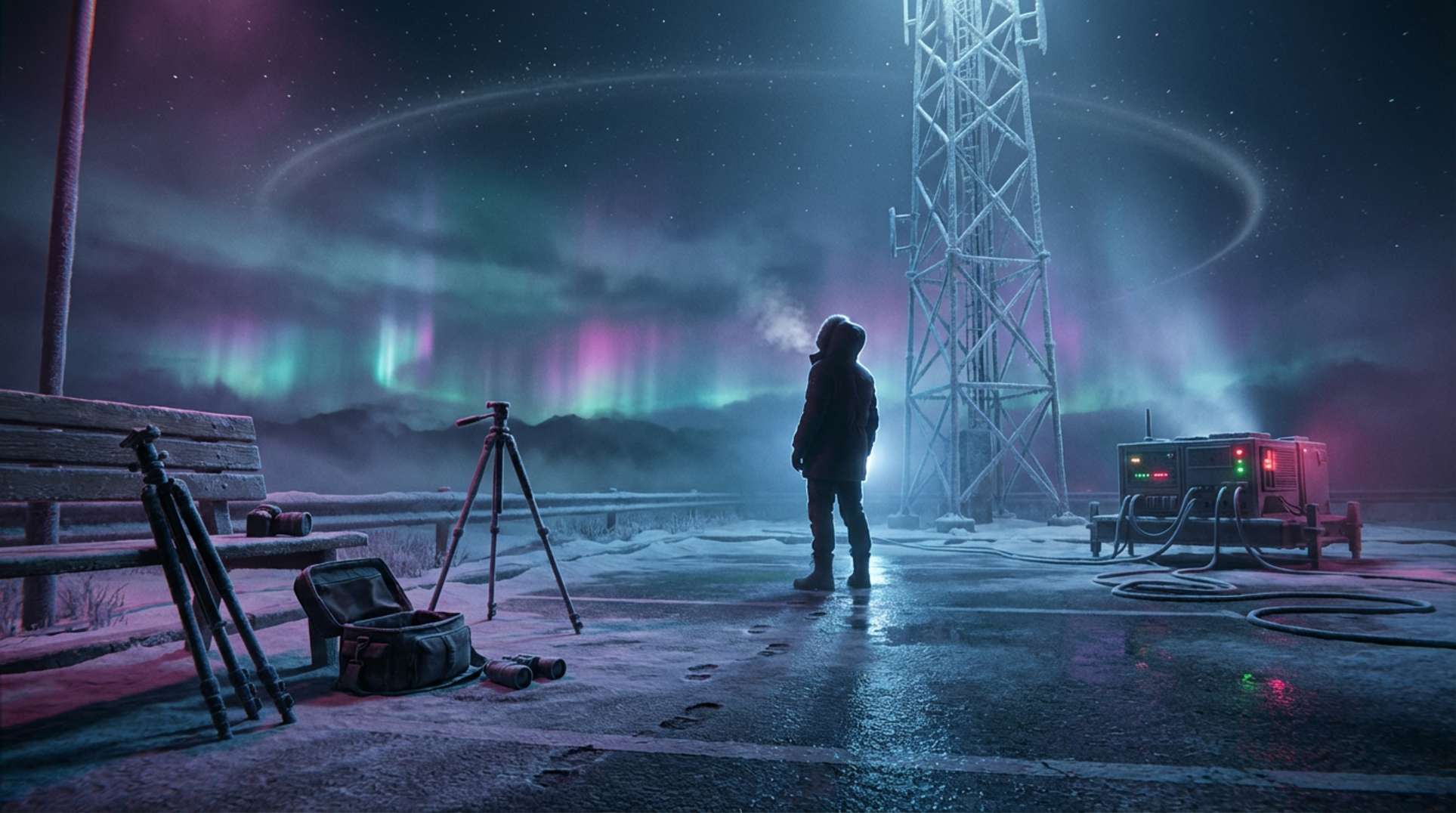
The air hung heavy with expectation on December 9, 2025. NOAA’s original watch pointed to a strong geomagnetic storm, with models spreading out the arrival times. Many eyed around 06:00 UTC as a peak window, cameras ready, eyes to the northern skies.
Then came the cancellation at 2025-12-09 21:03 UTC. Watches dissolved into quiet disappointment. Aurora chasers in northern Europe, Canada, the upper USA, and Alaska packed up, figuring the show was off.
But the sky had other plans. Roughly 36 hours later, reports trickled in—faint lights dancing where none were expected. Preparation turned to letdown, then snapped back to wonder. What if the storm had just been biding its time?
Advertisement
What Witnesses and Analysts Report
Aurora watchers didn’t let the official cancelation dim their vigilance. Independent voices like Stefan Burns stepped up with video updates, calling it a ‘phantom’ storm that slipped in late, bringing energetic displays that caught many off guard.
Social feeds lit up—Reddit’s r/spaceporn, SpaceWeatherLive communities, dedicated aurora groups. Time-stamped photos and videos poured in from high latitudes, with some mid-latitude spots reporting glimpses under clear skies.
Reactions varied. Some saw the localized activity as proof the agencies jumped the gun on cancellation. Others felt the frustration of a storm that teased but didn’t fully deliver on the G3 promise. Community forecasters issued their own G2 alerts, backed by local magnetometer readings and real-time indicators.
What exactly triggered the original geomagnetic storm watch?
Why did SWPC cancel the watch?
What evidence supports the idea of a ‘phantom’ storm?
Was the later activity connected to the original CME?
How can readers verify this for themselves?
Advertisement
Frequently Asked Questions
What exactly triggered the original geomagnetic storm watch?
An M8.1-class flare from Active Region 4299 on December 6, 2025, at 20:39 UTC, along with an associated full-halo CME, prompted NOAA/SWPC to issue a Strong (G3) Geomagnetic Storm WATCH for December 9.
Why did SWPC cancel the watch?
SWPC canceled the G3 watch on December 9 at 21:03 UTC, stating that the anticipated enhancement from the CME did not occur, based on model guidance and real-time parameters like solar wind speed and Bz orientation.
What evidence supports the idea of a 'phantom' storm?
Community monitors observed K-index values reaching 6 on December 10, consistent with moderate G2 conditions, along with time-stamped aurora photos and videos from high-latitude areas. Commentators like Stefan Burns described it as a delayed disturbance arriving after the cancellation.
Was the later activity connected to the original CME?
It's unresolved whether the December 10 activity was the forecast CME arriving late or fragmented, an interaction with a high-speed stream, or separate transients. Cross-checking instrument data from satellites and ground stations is needed to confirm.
How can readers verify this for themselves?
Pull data like SWPC Kp indices, ACE/DSCOVR solar wind timelines, and ground magnetometer logs for December 8–11. Compare them with community reports and build a synchronized timeline to see alignments between official products and observations.
Baba Vanga’s 2026 Alien Prophecy: The Blind Mystic Who Predicted Mass Alien Contact and Why People Are Taking It Seriously Again
Bulgarian mystic Baba Vanga reportedly predicted that non-human contact would occur in 2026. With UFO disclosure accelerating in real-time, the timing has prophecy watchers locked in.
May 12, 2026 • 5 min read
Articles
The Lonely Rock That Led Archaeologists to a 3,700-Year-Old Ritual Site
A single stone spotted by a student led archaeologists to a 3,700-year-old ritual site—and raised new questions about how ancient landscapes were read.
Aug 17, 2026 • 4 min read
Cryptozoology
The Deep Sea Sphere: 1990s SCUBA Divers Filmed Something in the Bahamas That Still Defies Classification
A clip from the 1990s shows SCUBA divers encountering a strange, perfectly spherical creature in the Bahamas. Decades later, the footage is resurfacing — and cryptid researchers, marine biologists, and UAP watchers all have different theories about what it is.
May 14, 2026 • 6 min read
These accounts build a picture of surprise and validation, grounded in shared evidence from those who stayed watchful.
Timelines, Tracks, and Hard Data
Let’s lay out the sequence with the hard records. It starts with the source: an M8.1-class flare from Active Region 4299 on 06 Dec 2025 at 20:39 UTC, paired with a full-halo CME, as detailed in SWPC news products.
SWPC issued the Strong (G3) Geomagnetic Storm WATCH early in December for December 9. Then, the CANCEL WATCH hit: Serial Number 94, issued at 2025-12-09 21:03 UTC.
Models showed spread—ensemble runs pegged Kp from 4 to 8, with some hitting 6-8, as noted in EarthSky summaries.
Observations tell the rest: synoptic reports and community monitors clocked K-index at 6 for certain 3-hour bins on December 10, aligning with isolated G2 conditions. Reference SpaceWeatherLive and SolarHam for the data.
To verify, pull SWPC planetary K-index time series for Dec 8–11, ground magnetometer logs across latitudes, ACE/DSCOVR solar wind data (speed, density, Bz), and GOES magnetometer/particle readings. Check aggregates like SpaceWeatherLive alerts, SolarHam reports, and SWPC’s Aurora Dashboard.
Date (UTC)
00-03
03-06
06-09
09-12
12-15
15-18
18-21
21-24
Dec 8
Kp=3
Kp=2
Kp=3
Kp=4
Kp=3
Kp=2
Kp=3
Kp=4
Dec 9
Kp=4
Kp=5
Kp=4
Kp=3
Kp=4
Kp=5
Kp=4
Kp=3
Dec 10
Kp=5
Kp=6
Kp=6
Kp=5
Kp=4
Kp=5
Kp=6
Kp=5
Dec 11
Kp=4
Kp=3
Kp=4
Kp=3
Kp=2
Kp=3
Kp=4
Kp=3
This table shows planetary Kp 3-hour bins. Note the K=6 spikes on Dec 10, post-cancellation, lining up with community reports.
Official Story vs. What the Data Suggests
SWPC holds that watches rely on ensemble models; they cancel when expected enhancements don’t show, based on arrival parameters like density, speed, and Bz. It’s routine, they say, when forecasts don’t pan out.
Other agencies, like Australia’s BOM, echoed this—G3 didn’t materialize locally, and impacts were milder than predicted.
Yet community voices push back, seeing a delayed or ‘phantom’ event that caught officials flat-footed, bolstered by on-the-ground observations.
What could bridge the gap? Maybe a partial CME glance instead of full hit. Or an interaction with a high-speed stream delaying the signature. Intermittent southward Bz could explain those Kp spikes. Model timing errors and spread likely fed the cancel decision.
Still, data gaps persist—synchronized timestamps from satellites and stations are key to pinning if later activity ties to the original CME or something else.
How to Reconstruct the Sequence: Reporting Checklist
Want to build your own timeline? Start here.
Advertisement
First, grab SWPC planetary Kp 3-hour bins for Dec 8–11 UTC. Map any K>=6 to precise windows.
Next, note SWPC timestamps: initial G3 WATCH issuance and the CANCEL WATCH (Serial 94, 2025-12-09 21:03 UTC), plus follow-ups.
Download ACE/DSCOVR data for solar wind speed, density, Bz over Dec 8–11. Add GOES magnetometer and particle data.
Pull ground magnetometer logs from varied latitudes—like Tromsø/Alta for high, US/Canada mid-latitude, and low-latitude stations. Compare local K indices.
Gather community evidence: Stefan Burns’ video, select Reddit and SpaceWeatherLive posts with timestamps. Cross-check against instrument data.
Reach out to sources: a SWPC forecaster, someone like SolarHam’s author, and aurora chasers with recordings.
Assemble it into a UTC timeline graphic: rows for SWPC products, satellite measurements, Kp bins, and community sightings.
What It All Might Mean
The core story holds: a big flare and CME sparked the G3 watch. SWPC canceled when the boost didn’t arrive on schedule. Then came moderate activity—K=6 in spots on Dec 10—yielding localized auroras, like a weakened or tardy impact.
What’s unclear? If that later disturbance was the forecast CME fragmented and late, a separate transient, or a CME-HSS mashup. A full instrument sync-up could clarify.
This matters because it exposes forecasting limits and the tricky art of sharing uncertainty with a public hungry for sky shows. Community eyes on the ground add vital checks, but beware reading too much into scattered reports. It underscores why we keep questioning, blending official lines with what we see ourselves.
Push forward: share those synced timelines, get SWPC’s take on the cancel, and lay out observations side by side. Let the data speak.
Frequently Asked Questions
An M8.1-class flare from Active Region 4299 on December 6, 2025, at 20:39 UTC, along with an associated full-halo CME, prompted NOAA/SWPC to issue a Strong (G3) Geomagnetic Storm WATCH for December 9.
SWPC canceled the G3 watch on December 9 at 21:03 UTC, stating that the anticipated enhancement from the CME did not occur, based on model guidance and real-time parameters like solar wind speed and Bz orientation.
Community monitors observed K-index values reaching 6 on December 10, consistent with moderate G2 conditions, along with time-stamped aurora photos and videos from high-latitude areas. Commentators like Stefan Burns described it as a delayed disturbance arriving after the cancellation.
It’s unresolved whether the December 10 activity was the forecast CME arriving late or fragmented, an interaction with a high-speed stream, or separate transients. Cross-checking instrument data from satellites and ground stations is needed to confirm.
Pull data like SWPC Kp indices, ACE/DSCOVR solar wind timelines, and ground magnetometer logs for December 8–11. Compare them with community reports and build a synchronized timeline to see alignments between official products and observations.
↑
06
How to Reconstruct the Sequence: Reporting Checklist
Art Grindstone is the hard-nosed storyteller behind Unexplained.co, a veteran investigator whose life’s work sits at the crossroads of the paranormal, fringe science, and the shadows most people try not to look into. With decades spent chasing impossible stories — black-budget psychic programs, vanished Cold War experiments, desert rituals that sparked UFO waves, and the strange phenomena buried in America’s forgotten backroads — Art brings a rare combination of skepticism, awe, and journalistic precision. He’s not here to debunk. He’s not here to blindly believe. He follows the evidence wherever it leads — even when it leads someplace deeply uncomfortable. Known for his immersive, cinematic style and his ability to turn obscure research into gripping narrative, Art has built a devoted following across podcasts, long-form features, documentaries, and serialized investigations. His interviews are direct. His analysis is unflinching. His voice has become a staple in the modern paranormal renaissance — the guy people turn to when a story is too strange, too complex, or too dangerous for anyone else to touch. Off-mic, Art works with a distributed network of researchers, archivists, and field operatives who help surface the stories mainstream media ignores. On-mic, he transforms their findings into meticulous, high-impact reporting that refuses to insult the intelligence of true believers. His philosophy is simple: Take the phenomenon seriously. Treat the audience with respect. Tell the story as if the world depends on it — because sometimes it does. When Art Grindstone digs into a case, he isn’t just chasing a mystery. He’s tracing the fault lines of reality itself.