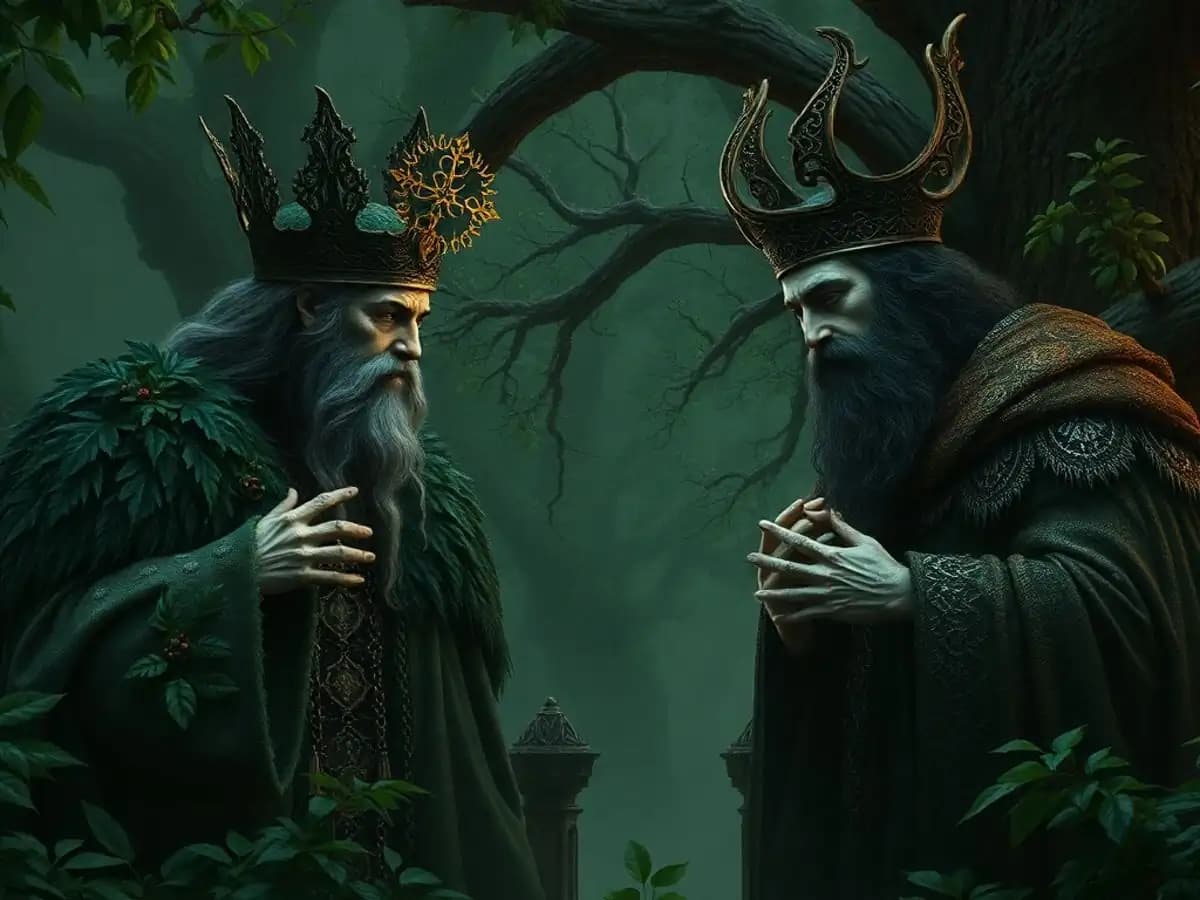

In the realm of mythology, the Holly King and Oak King stand as powerful symbols of the seasonal cycle, representing winter and summer, respectively. These figures embody the eternal struggle between light and dark, life and death, and have captured the imagination of many through various cultural narratives.
Key Takeaways
- The Holly King symbolizes winter, while the Oak King represents summer.
- Their reigns are marked by the solstices and equinoxes, reflecting the changing seasons.
- The concept of these kings is a modern interpretation, with roots in ancient pagan traditions.
- Notable pairings include Jesus and John the Baptist, as well as Lugh and Balor.
Who Are The Holly King & The Oak King?
The Holly King and Oak King are often viewed as personifications of the two halves of the year. The Holly King rules over the waning half, starting his reign at the summer solstice when he defeats the Oak King. Conversely, the Oak King takes over at the winter solstice, marking the return of longer days.
This cyclical battle between the two kings can also be seen through the lens of the equinoxes, where the Holly King reaches his peak during midwinter, the darkest time of the year, while the Oak King shines during midsummer, the brightest.
Advertisement
The Origins Of The Holly King & The Oak King
Despite their rich symbolism, the terms Holly King and Oak King do not appear in ancient texts. Their modern usage can be traced back to the works of scholars like James George Fraser, who explored themes of seasonal change in his book, The Golden Bough. However, he never explicitly used these terms.
Fraser’s references to oak and holly in relation to seasonal customs hint at the potential for these figures to emerge from ancient practices. For instance, the Jack in the Green tradition, where a figure covered in greenery dances on May Day, reflects the celebration of spring and the coming of summer.
Who Is The Divine King?
Fraser also introduced the concept of the Divine King, a figure representing the cycle of life and death. This idea suggests that the Holly King and Oak King could be seen as two aspects of a single entity, embodying the duality of nature. However, this interpretation is debated among scholars.