USS Stockdale vs Seahorse Tanker: What Really Happened
Politics
USS Stockdale vs Seahorse Tanker: What Really Happened
Key Takeaways Vessel-tracking data and reports from multiple news outlets confirm that the USS Stockdale, an Arleigh Burke-class destroyer, maneuvered to shadow or block the Russian-flagged tanker Seahorse in the…
Art Grindstone is the hard-nosed storyteller behind Unexplained.co, a veteran investigator whose life’s work sits at the crossroads of the paranormal, fringe science, and the shadows most people try not to look into. With decades spent chasing impossible stories — black-budget psychic programs, vanished Cold War experiments, desert rituals that sparked UFO waves, and the strange phenomena buried in America’s forgotten backroads — Art brings a rare combination of skepticism, awe, and journalistic precision. He’s not here to debunk. He’s not here to blindly believe. He follows the evidence wherever it leads — even when it leads someplace deeply uncomfortable. Known for his immersive, cinematic style and his ability to turn obscure research into gripping narrative, Art has built a devoted following across podcasts, long-form features, documentaries, and serialized investigations. His interviews are direct. His analysis is unflinching. His voice has become a staple in the modern paranormal renaissance — the guy people turn to when a story is too strange, too complex, or too dangerous for anyone else to touch. Off-mic, Art works with a distributed network of researchers, archivists, and field operatives who help surface the stories mainstream media ignores. On-mic, he transforms their findings into meticulous, high-impact reporting that refuses to insult the intelligence of true believers. His philosophy is simple: Take the phenomenon seriously. Treat the audience with respect. Tell the story as if the world depends on it — because sometimes it does. When Art Grindstone digs into a case, he isn’t just chasing a mystery. He’s tracing the fault lines of reality itself.
6 min · 1,264 words
In This Report(8)
Key Takeaways
Vessel-tracking data and reports from multiple news outlets confirm that the USS Stockdale, an Arleigh Burke-class destroyer, maneuvered to shadow or block the Russian-flagged tanker Seahorse in the central Caribbean during mid-November 2025.
Reputable maritime reporters, citing AIS tracks and Sentinel satellite imagery, document the Seahorse turning away, idling offshore, and later entering Venezuelan waters; the tanker is noted in some reports as sanctioned by the UK and EU, carrying naphtha or fuel destined for Venezuela.
Key questions linger without clear answers: What was the exact cargo and manifest? Did any legal interdiction take place? What authorities directed the U.S. ship’s actions, given the absence of public statements from the government?
A Silent Convoy Beneath the Dark Sea
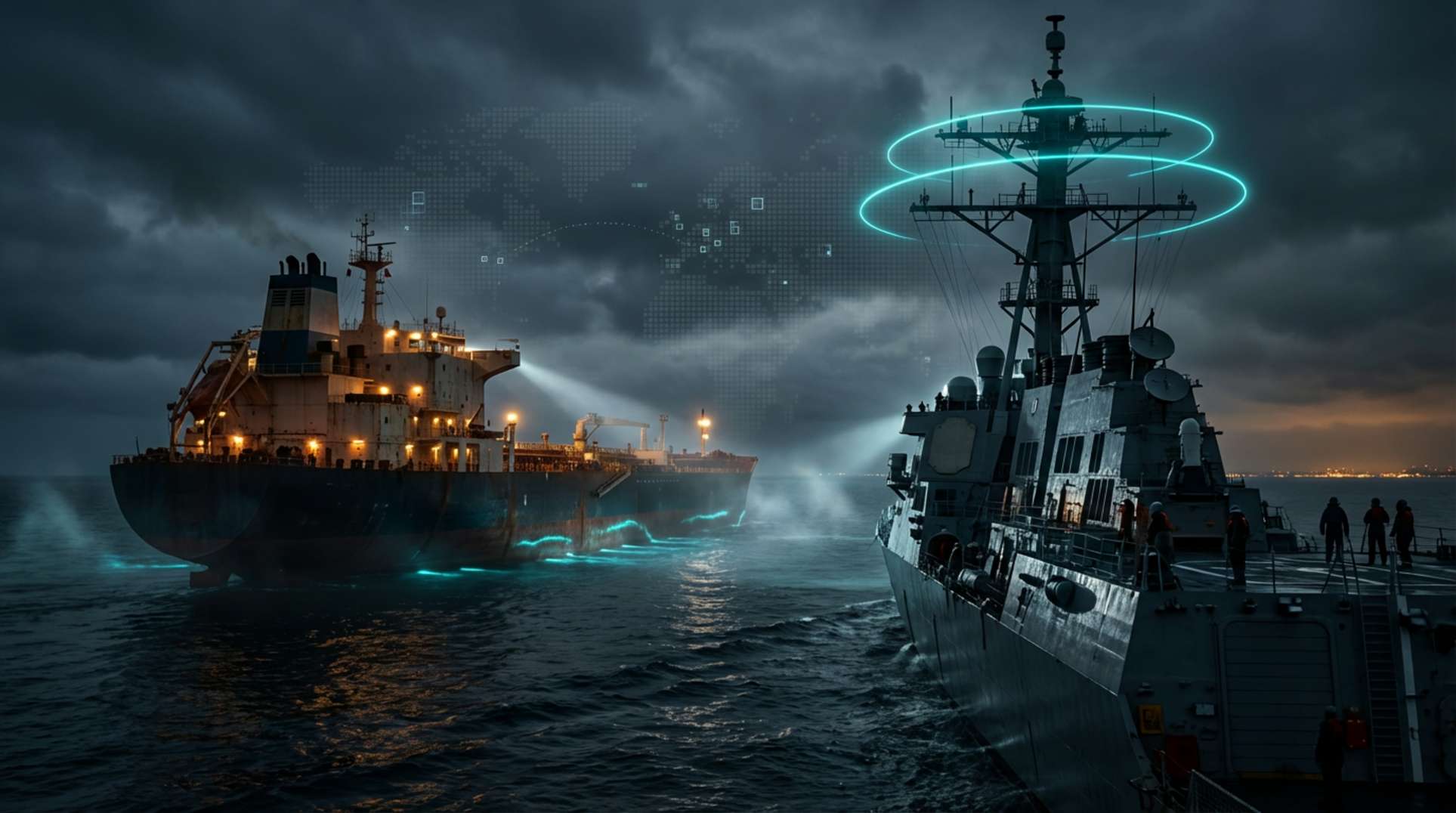
Picture the southern Caribbean in mid-November 2025, where the night sky presses down like a heavy curtain over endless black waves. The air hangs thick with salt and tension, broken only by the low hum of engines cutting through the dark. Out there, in the approaches near Aruba and the Venezuelan coast, the USS Stockdale— a sleek Arleigh Burke-class destroyer— holds position. Its radar sweeps the horizon, locking onto a lone tanker, the Russian-flagged Seahorse, which drifts with unusual hesitation. AIS signals flicker erratically: turnarounds, long stretches of idling, captured in satellite snapshots that hint at something more than routine passage. The scene unfolds slowly, a maritime chess game under the cover of night, where shadows and silence speak louder than any broadcast.
What Witnesses and Analysts Report
Maritime trackers and independent analysts have pieced together a consistent picture from the edges. Sources like gCaptain and United24Media describe how the USS Stockdale positioned itself directly in the Seahorse’s path, prompting the tanker to veer off and linger in the central Caribbean. These reports, drawn from vessel-tracking data, carry weight among those monitoring global shipping lanes. Some analysts see this as a deliberate move to deter sanction evasion, a quiet enforcement of international pressures on Russia’s shadow fleet. Others frame it as standard naval presence, perhaps tied to anti-narcotics operations in the region— a posture that’s common but rarely spotlighted.
On social channels and alternative media, the story escalates. Claims swirl of a full blockade or even a ‘declaration of war,’ amplified in headlines that blend fact with frenzy. Take that YouTube title screaming about Trump, Russian oil, and ‘Silver Insanity’— it’s not rooted in official statements, and it weaves in unrelated market chatter. We respect the energy in these spaces; folks are connecting dots in real time. But reliability varies, and these narratives often gain traction through sheer volume, not verified ties.
Did the USS Stockdale actually block the Seahorse?
What evidence backs up the incident reports?
How did U.S. officials respond to the event?
Is the Seahorse part of Russia’s shadow fleet?
Does this incident signal a declaration of war?
Advertisement
Frequently Asked Questions
Did the USS Stockdale actually block the Seahorse?
Vessel-tracking data and reports from gCaptain and United24Media indicate the destroyer maneuvered into the tanker's path, leading to the Seahorse turning away and idling. Satellite imagery supports this sequence, though no official confirmation of a formal blockade exists.
What evidence backs up the incident reports?
AIS tracks and Sentinel-2 satellite imagery provide the core evidence, cited by maritime outlets like gCaptain and United24Media. These show the tanker's turnaround and loitering in mid-November 2025, with later data confirming its entry into Venezuelan waters.
How did U.S. officials respond to the event?
No public statements from the Department of Defense or Southern Command document a formal interdiction. Some reports note they declined to comment, leaving room for interpretations based on sanctions enforcement and naval presence.
Is the Seahorse part of Russia's shadow fleet?
Some outlets report the Seahorse as sanctioned by the UK and EU, fitting patterns of Russia's shadow fleet used to evade restrictions. Industry sources like Fortune and Reuters document dozens of such idle tankers since 2023, though exact manifests aren't public.
Does this incident signal a declaration of war?
No authoritative reporting links the event to any 'declaration of war' or presidential action. Sensational headlines blend it with unrelated topics, but the data points to a maritime maneuver without official escalation claims.
The Pentagon Released More UAP Files—but Not the Data Needed to Solve Them
The Pentagon’s fifth UAP release reveals cold orbs and a giant triangle—but missing sensor data keeps its strangest cases unresolved and untested.
Aug 17, 2026 • 10 min read
Ancient Civilizations
1957 Electrogravitics Secret: The Classified Research Program Whose Watchers Have All ‘Gone’
A viral essay claims that classified electrogravitics research made real progress in the 1950s — and that everyone who knew the truth about it has since disappeared from the public record. The story is spreading through high-strangeness forums.
May 14, 2026 • 7 min read
Conspiracy Theories
Japan Just Confirmed It Has UAP Footage, and Is Analyzing Pentagon Files Near Its Borders
Japan’s formal entry into the UAP transparency wave signals an international domino effect. What the country knows about UAP encounters near Japanese territory and why it matters now.
May 14, 2026 • 5 min read
Advertisement
Timelines, Tracks, and Hard Data
The hard evidence anchors this story in mid-November 2025, specifically from November 13 to 21, as detailed by gCaptain and United24Media. The USS Stockdale (DDG-106), an Arleigh Burke-class destroyer, is the confirmed U.S. vessel involved (per gCaptain and United24Media reports). Opposing it: the Seahorse, flagged Russian and flagged by some as sanctioned, reportedly hauling naphtha or fuel toward Venezuela— though public manifests remain elusive.
AIS vessel-tracking data and Sentinel-2 satellite imagery form the backbone, revealing anomalies like abrupt turnarounds and prolonged idling. This fits into a broader pattern of Russia’s ‘shadow fleet,’ with outlets like Fortune, Bloomberg, and Reuters noting dozens— sometimes pegged at 53— of idle tankers evading sanctions since 2023. Later tracking shows the Seahorse slipping into Venezuelan waters by late November.
From the institutional side, silence reigns. No public statement from the Department of Defense or U.S. Southern Command confirms a formal interdiction involving the Seahorse— some reports note they simply declined to comment. This vacuum sits against a backdrop of sanctions: EU and UK lists have targeted tankers and firms since 2023, feeding into efforts to track Russia’s shadow fleet that dodges price caps.
Community observers fill the gap with their reads. Some see the Stockdale’s move as targeted pressure on sanction-busters, backed by the tanker’s course change. Others view it as everyday naval signaling, not escalation. The data shows correlation— a warship appears, a tanker diverts— but not causation. Legal details? Rules of engagement, any attempted boarding? Those remain in the shadows, widening the space for interpretation. We note the official quiet as just another piece of the puzzle, not the final word.
Lines That Don’t Connect: What the Sensational Headlines Add
Sensational headlines thrive by stitching loose threads into a single blast. That YouTube screamer— ‘⚡BREAKING: TRUMP DECLARES WAR! Russian Oil Tanker SHOWDOWN! SILVER INSANITY!!!’— mashes the Seahorse standoff with wild market talk and political hype, none of it linked by solid evidence. No credible source connects this maritime encounter to a presidential war declaration or silver trades; searches through primary reports turn up empty on those fronts.
Why does this packaging stick? It’s the attention game— bold claims hook viewers, and our pattern-seeking minds fill in the blanks. In communities like ours, where we’ve long sifted through manipulated narratives, it’s fair to call out these fusions without dismissing the curiosity driving them. They amplify real events but often stretch connections beyond what’s verifiable.
Advertisement
What It All Might Mean
Boiling it down, the evidence holds: AIS and satellite data, corroborated by maritime outlets, capture a U.S. destroyer prompting a sanctioned tanker’s detour in mid-November 2025, with the Seahorse eventually reaching Venezuela. That’s the firm ground.
But holes persist. Was there boarding or seizure? What’s on the manifest— exact cargo, buyer? What legal playbook guided the Navy? Any backchannel talks with Russia or Venezuela? These matter because incidents like this straddle sanctions, naval muscle, and info wars that can spin routine ops into war drums, influencing policy and how we see global tensions.
For next steps, dig deeper: Pull raw AIS exports for the Seahorse, grab those cited Sentinel-2 images, cross-check OFAC, UK, and EU sanction lists for the tanker or its owners. And push for an on-the-record from Southern Command or DoD— because patterns like this deserve clarity.
Frequently Asked Questions
Vessel-tracking data and reports from gCaptain and United24Media indicate the destroyer maneuvered into the tanker’s path, leading to the Seahorse turning away and idling. Satellite imagery supports this sequence, though no official confirmation of a formal blockade exists.
AIS tracks and Sentinel-2 satellite imagery provide the core evidence, cited by maritime outlets like gCaptain and United24Media. These show the tanker’s turnaround and loitering in mid-November 2025, with later data confirming its entry into Venezuelan waters.
No public statements from the Department of Defense or Southern Command document a formal interdiction. Some reports note they declined to comment, leaving room for interpretations based on sanctions enforcement and naval presence.
Some outlets report the Seahorse as sanctioned by the UK and EU, fitting patterns of Russia’s shadow fleet used to evade restrictions. Industry sources like Fortune and Reuters document dozens of such idle tankers since 2023, though exact manifests aren’t public.
No authoritative reporting links the event to any ‘declaration of war’ or presidential action. Sensational headlines blend it with unrelated topics, but the data points to a maritime maneuver without official escalation claims.
↑
06
Lines That Don’t Connect: What the Sensational Headlines Add
Art Grindstone is the hard-nosed storyteller behind Unexplained.co, a veteran investigator whose life’s work sits at the crossroads of the paranormal, fringe science, and the shadows most people try not to look into. With decades spent chasing impossible stories — black-budget psychic programs, vanished Cold War experiments, desert rituals that sparked UFO waves, and the strange phenomena buried in America’s forgotten backroads — Art brings a rare combination of skepticism, awe, and journalistic precision. He’s not here to debunk. He’s not here to blindly believe. He follows the evidence wherever it leads — even when it leads someplace deeply uncomfortable. Known for his immersive, cinematic style and his ability to turn obscure research into gripping narrative, Art has built a devoted following across podcasts, long-form features, documentaries, and serialized investigations. His interviews are direct. His analysis is unflinching. His voice has become a staple in the modern paranormal renaissance — the guy people turn to when a story is too strange, too complex, or too dangerous for anyone else to touch. Off-mic, Art works with a distributed network of researchers, archivists, and field operatives who help surface the stories mainstream media ignores. On-mic, he transforms their findings into meticulous, high-impact reporting that refuses to insult the intelligence of true believers. His philosophy is simple: Take the phenomenon seriously. Treat the audience with respect. Tell the story as if the world depends on it — because sometimes it does. When Art Grindstone digs into a case, he isn’t just chasing a mystery. He’s tracing the fault lines of reality itself.