3I/ATLAS: Interstellar Comet or Hidden Alien Probe
UFO & Aliens
3I/ATLAS: Interstellar Comet or Hidden Alien Probe
Key Takeaways 3I/ATLAS is an interstellar comet discovered on July 1, 2025, by the ATLAS survey in Chile; it’s moving on a hyperbolic path (eccentricity ~6.1, velocity at infinity ~57 km/s), confirming it came from…
Art Grindstone is the hard-nosed storyteller behind Unexplained.co, a veteran investigator whose life’s work sits at the crossroads of the paranormal, fringe science, and the shadows most people try not to look into. With decades spent chasing impossible stories — black-budget psychic programs, vanished Cold War experiments, desert rituals that sparked UFO waves, and the strange phenomena buried in America’s forgotten backroads — Art brings a rare combination of skepticism, awe, and journalistic precision. He’s not here to debunk. He’s not here to blindly believe. He follows the evidence wherever it leads — even when it leads someplace deeply uncomfortable. Known for his immersive, cinematic style and his ability to turn obscure research into gripping narrative, Art has built a devoted following across podcasts, long-form features, documentaries, and serialized investigations. His interviews are direct. His analysis is unflinching. His voice has become a staple in the modern paranormal renaissance — the guy people turn to when a story is too strange, too complex, or too dangerous for anyone else to touch. Off-mic, Art works with a distributed network of researchers, archivists, and field operatives who help surface the stories mainstream media ignores. On-mic, he transforms their findings into meticulous, high-impact reporting that refuses to insult the intelligence of true believers. His philosophy is simple: Take the phenomenon seriously. Treat the audience with respect. Tell the story as if the world depends on it — because sometimes it does. When Art Grindstone digs into a case, he isn’t just chasing a mystery. He’s tracing the fault lines of reality itself.
7 min · 1,488 words
In This Report(8)
Key Takeaways
3I/ATLAS is an interstellar comet discovered on July 1, 2025, by the ATLAS survey in Chile; it’s moving on a hyperbolic path (eccentricity ~6.1, velocity at infinity ~57 km/s), confirming it came from outside our solar system and will never return.
NASA and major observatories describe it as a large, icy, outgassing comet—somewhere between 1,400 feet (440 m) and 3.5 miles (5.6 km) wide—that will pass Earth safely at about 170 million miles (270 million km) on December 19, 2025.
Online communities and a few outspoken scientists cite unusual outgassing, brightening, and trajectory details, plus delays in releasing key images, as reasons to keep the door open to more exotic possibilities—including, but not limited to, artificial or engineered origins.
A Stranger from Between the Stars
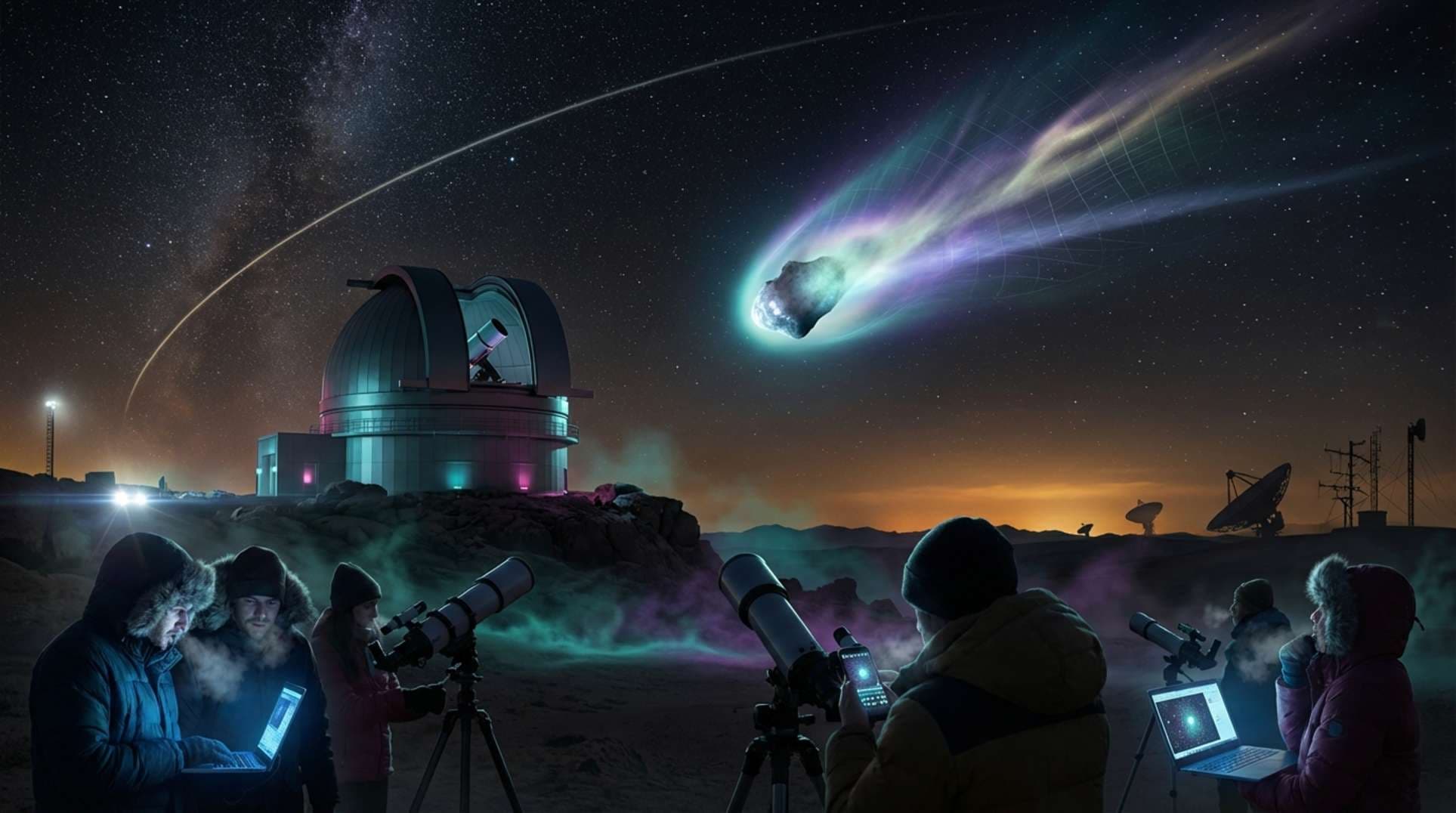
Picture this: late 2025, under a blanket of dark skies, amateur astronomers hunch over backyard scopes, their breaths fogging in the chill. Social media feeds start to buzz with a new name—3I/ATLAS—whispered as only the third known object from another star system to cross our path. It’s out there, 410 million miles from the Sun, hurtling at 137,000 mph, a silent intruder from the void. While most folks scroll past headlines or binge-watch shows, this thing slips through our solar system, ancient and indifferent. Discovered on July 1, 2025, by the NASA-funded ATLAS survey telescope in Rio Hurtado, Chile, it follows ‘Oumuamua and 2I/Borisov as our rare interstellar guests. The contrast hits hard: a hyperfast, icy relic against Earth’s warm glow of rumors, telescope livestreams, and quick NASA blurbs. Yet already, whispers build—this might not be just another comet. Some researchers watch closer than the press lets on, feeding that low hum of unease.
What You Need to Know About the 3I/ATLAS Encounter
3I/ATLAS is an interstellar comet discovered on July 1, 2025, by the ATLAS survey in Chile; it’s moving on a hyperbolic path (eccentricity ~6.1, velocity at infinity ~57 km/s), confirming it came from outside our solar system and will never return.
NASA and major observatories describe it as a large, icy, outgassing comet—somewhere between 1,400 feet (440 m) and 3.5 miles (5.6 km) wide—that will pass Earth safely at about 170 million miles (270 million km) on December 19, 2025.
Online communities and a few outspoken scientists cite unusual outgassing, brightening, and trajectory details, plus delays in releasing key images, as reasons to keep the door open to more exotic possibilities—including, but not limited to, artificial or engineered origins.
What Witnesses and Skywatchers Say They’re Seeing
When was 3I/ATLAS discovered and what makes it interstellar?
Is 3I/ATLAS a threat to Earth?
What are the unusual aspects people are talking about?
How does this compare to previous interstellar objects?
What do officials say about alien spacecraft rumors?
Advertisement
Frequently Asked Questions
When was 3I/ATLAS discovered and what makes it interstellar?
3I/ATLAS was discovered on July 1, 2025, by the ATLAS survey telescope in Chile. Its hyperbolic orbit, with an eccentricity of about 6.1 and velocity at infinity of ~57 km/s, confirms it originated outside our solar system and won't return.
Is 3I/ATLAS a threat to Earth?
Official orbital solutions show no impact risk. Its closest approach to Earth is projected for December 19, 2025, at roughly 170 million miles, nearly twice the distance from Earth to the Sun.
What are the unusual aspects people are talking about?
Observers report sudden brightening, color shifts, and irregular outgassing, plus delays in data releases. Some tie these to possibilities like artificial origins, citing precedents from objects like 'Oumuamua, though official accounts describe it as a natural comet.
How does this compare to previous interstellar objects?
Like 'Oumuamua and 2I/Borisov, 3I/ATLAS follows a hyperbolic path from beyond our solar system. Communities note similarities in anomalies, such as non-standard outgassing or trajectories, keeping artificial hypotheses in play for some analysts.
What do officials say about alien spacecraft rumors?
NASA states that all evidence points to 3I/ATLAS being a natural comet, with features like its coma, tail, and outgassing fitting standard models. They emphasize it as a scientific opportunity to study interstellar material, not an artificial object.
1957 Electrogravitics Secret: The Classified Research Program Whose Watchers Have All ‘Gone’
A viral essay claims that classified electrogravitics research made real progress in the 1950s — and that everyone who knew the truth about it has since disappeared from the public record. The story is spreading through high-strangeness forums.
May 14, 2026 • 7 min read
Conspiracy Theories
Japan Just Confirmed It Has UAP Footage, and Is Analyzing Pentagon Files Near Its Borders
Japan’s formal entry into the UAP transparency wave signals an international domino effect. What the country knows about UAP encounters near Japanese territory and why it matters now.
May 14, 2026 • 5 min read
Conspiracy Theories
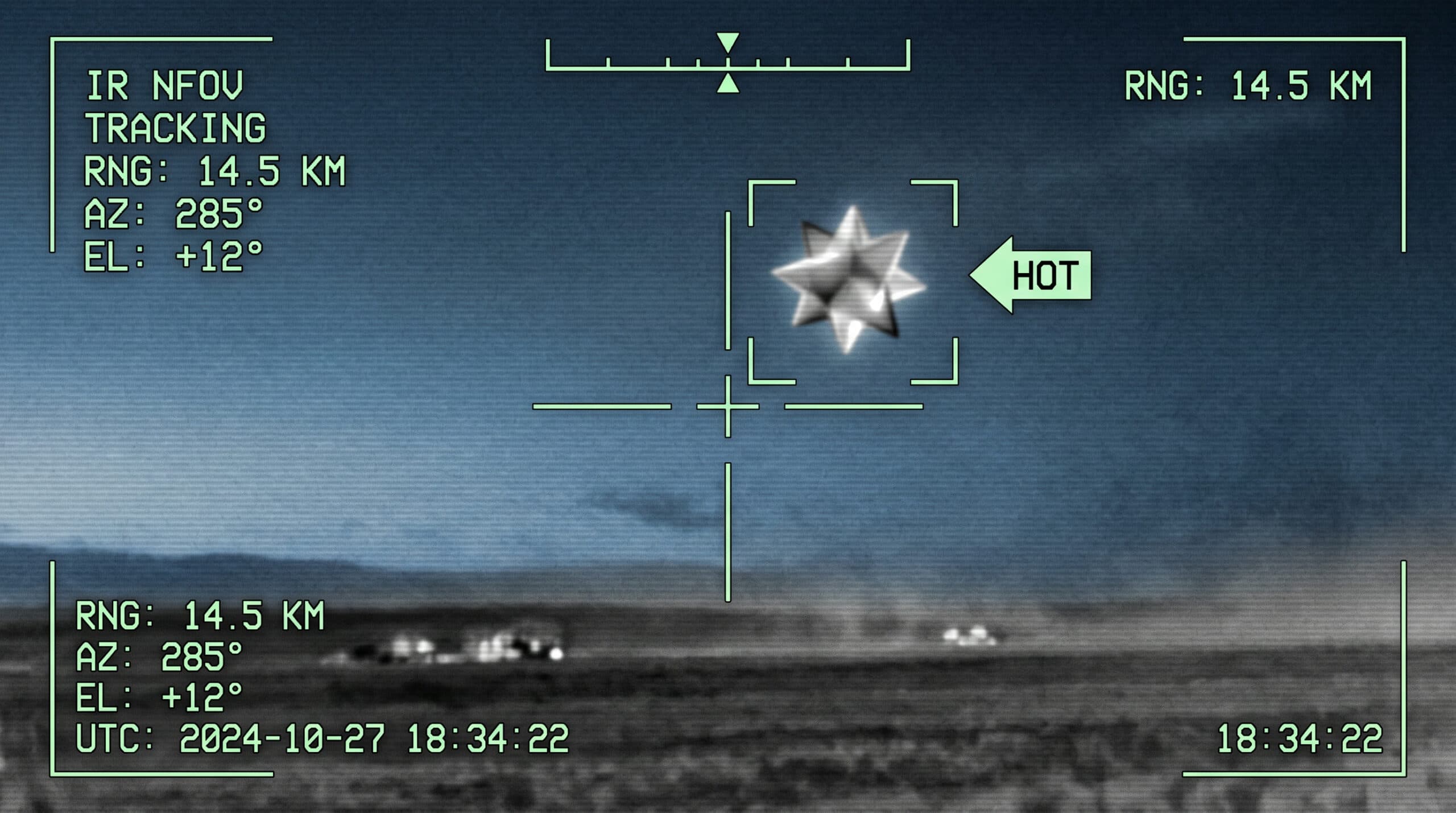
Ukrainian Defense Ministry Advisor Posts Star-Shaped UAP Video — and the Close-Ups Look Nothing Like a Drone
Serhii ‘Flash’ Beskrestnov released footage of a structured, star-shaped craft over Ukraine that has UFO researchers examining every frame for proof.
May 14, 2026 • 6 min read
Serious amateur astronomers, peering through modest backyard setups, describe a distinct coma and tail that stands out. Many liken it to a “teardrop-shaped cocoon” or “egg-like glow,” reminiscent of sci-fi visions of alien craft in stasis fields. Data-focused independent researchers dig into the numbers, pointing to sudden brightening as 3I/ATLAS nears the Sun, along with perceived color shifts in images and live feeds. They see these as markers of unusual chemistry or activity, echoing quirks in earlier visitors like ‘Oumuamua. On social media platforms like TikTok and X, general users share claims that its size—up to 3.5 miles across—and speed suggest a plausible interstellar probe or ‘ark.’ They tie it to broader narratives about alien monitoring or impending contact. Rumors also swirl about delays in high-resolution images around perihelion, fueling talk of hidden anomalies: odd light curves, sharply defined nucleus geometry, or atypical tail behavior. Harvard astronomer Avi Loeb gets quoted often in these threads, his comments on “unusual aspects” of interstellar objects—like non-standard outgassing or trajectory quirks—lending weight to artificial-origin hypotheses. Alongside technical speculation, some posts carry doom-tinged prophecies, linking government silence to political distractions like shutdown talks or budget crises, hinting at a deliberate cover for whatever 3I/ATLAS might truly be.
Timelines, Orbits, and the Data We Can Actually Check
Let’s ground this in what we can verify. 3I/ATLAS entered our records on July 1, 2025, spotted by the ATLAS survey telescope in Rio Hurtado, Chile—a NASA-funded system built for early warnings on near-Earth objects. At that moment, it sat about 410 million miles from the Sun, clocking 137,000 mph. Orbital math shows an eccentricity of around 6.1, well over 1, marking a hyperbolic path from interstellar space—one and done, no return trip. Its velocity at infinity hovers at ~57 km/s, the kind of speed that screams long-term drifter through the Milky Way, unbound to our Sun. Hubble’s August 20, 2025, observations pinned the nucleus size between 1,400 feet and 3.5 miles, revealing a hefty icy body. Other scopes like Webb, Gemini South, and even Mars-based tools confirm a standard icy core, surrounded by a gas-and-dust coma, with tails from solar-heated outgassing. Closest Earth pass? December 19, 2025, at 170 million miles—twice the Earth-Sun gap, no collision worries per the models.
Advertisement
Metric
Value
Discovery Date
July 1, 2025
Discovery Distance from Sun
410 million miles (670 million km)
Speed at Discovery
137,000 mph (221,000 km/h)
Nucleus Size Range
1,400 feet (440 m) to 3.5 miles (5.6 km)
Orbital Eccentricity
~6.1
Velocity at Infinity
~57 km/s
Closest Earth Approach
December 19, 2025, at ~170 million miles (270 million km)
The Official Story and the Questions It Doesn’t Quite Close
NASA and the Minor Planet Center call it straight: 3I/ATLAS is a natural interstellar comet, backed by its icy nucleus, visible coma, dust-and-gas tail, and outgassing that matches solar heating patterns. They repeat that orbits show no Earth threat, with the December 19, 2025, pass at 170 million miles safely clear. Agency releases frame it as a prime chance to study material from another star system—possibly 7 billion years old, older than our Sun. In FAQs and press materials, they tackle alien rumors head-on: “All evidence points to it being a comet,” highlighting how features like the coma and tail align with natural processes, no need for artificial twists. But Harvard’s Avi Loeb, without labeling it artificial, highlights “unusual aspects” in similar objects—think odd outgassing or trajectory alignments—as grounds to consider engineered origins as a valid hypothesis. Independent analysts push back, noting irregular brightening, uneven outgassing, or minor trajectory tweaks that seem downplayed in public info. They question slow-rolled high-quality images, sometimes linking delays to budget fights or shutdown threats, implying agencies might soft-pedal details to avoid stirring anxiety. Both sides read the data differently: officials see a clean fit with comet models, while skeptics spot gaps where assumptions fill in for hard facts, urging a closer look at what might not add up.
A Visitor Older Than Our Sun—and the Door It Leaves Open
Putting it together, 3I/ATLAS stands as the third confirmed interstellar wanderer, after ‘Oumuamua and 2I/Borisov, its hyperbolic orbit (eccentricity ~6.1, v-infinity ~57 km/s) locking it out of solar system norms. The case for natural origins holds strong: an icy nucleus, coma, and tails reacting to solar heat; size fitting known comets; no signs of structured geometry or deliberate moves. Still, questions linger—its galactic birthplace, maybe in the Milky Way’s thick disk; age against our 4.6-billion-year solar system; and whether its chemistry or light curves will match expectations perfectly. With just three such visitors on record, our grasp on interstellar debris feels thin, room enough for surprises that challenge current models. Some readers will hold space for artificial possibilities, drawing from ‘Oumuamua’s anomalies and technosignature debates—data doesn’t force that view, but neither does it seal every door. Keep eyes on December 2025 observations and releases; they could sharpen details on composition, outgassing, or path quirks. Whatever 3I/ATLAS turns out to be—a simple comet or more—it’s a signal that our solar system isn’t sealed off. Objects cross the stars, and we’re just starting to spot them.
Advertisement
Frequently Asked Questions
3I/ATLAS was discovered on July 1, 2025, by the ATLAS survey telescope in Chile. Its hyperbolic orbit, with an eccentricity of about 6.1 and velocity at infinity of ~57 km/s, confirms it originated outside our solar system and won’t return.
Official orbital solutions show no impact risk. Its closest approach to Earth is projected for December 19, 2025, at roughly 170 million miles, nearly twice the distance from Earth to the Sun.
Observers report sudden brightening, color shifts, and irregular outgassing, plus delays in data releases. Some tie these to possibilities like artificial origins, citing precedents from objects like ‘Oumuamua, though official accounts describe it as a natural comet.
Like ‘Oumuamua and 2I/Borisov, 3I/ATLAS follows a hyperbolic path from beyond our solar system. Communities note similarities in anomalies, such as non-standard outgassing or trajectories, keeping artificial hypotheses in play for some analysts.
NASA states that all evidence points to 3I/ATLAS being a natural comet, with features like its coma, tail, and outgassing fitting standard models. They emphasize it as a scientific opportunity to study interstellar material, not an artificial object.
Art Grindstone is the hard-nosed storyteller behind Unexplained.co, a veteran investigator whose life’s work sits at the crossroads of the paranormal, fringe science, and the shadows most people try not to look into. With decades spent chasing impossible stories — black-budget psychic programs, vanished Cold War experiments, desert rituals that sparked UFO waves, and the strange phenomena buried in America’s forgotten backroads — Art brings a rare combination of skepticism, awe, and journalistic precision. He’s not here to debunk. He’s not here to blindly believe. He follows the evidence wherever it leads — even when it leads someplace deeply uncomfortable. Known for his immersive, cinematic style and his ability to turn obscure research into gripping narrative, Art has built a devoted following across podcasts, long-form features, documentaries, and serialized investigations. His interviews are direct. His analysis is unflinching. His voice has become a staple in the modern paranormal renaissance — the guy people turn to when a story is too strange, too complex, or too dangerous for anyone else to touch. Off-mic, Art works with a distributed network of researchers, archivists, and field operatives who help surface the stories mainstream media ignores. On-mic, he transforms their findings into meticulous, high-impact reporting that refuses to insult the intelligence of true believers. His philosophy is simple: Take the phenomenon seriously. Treat the audience with respect. Tell the story as if the world depends on it — because sometimes it does. When Art Grindstone digs into a case, he isn’t just chasing a mystery. He’s tracing the fault lines of reality itself.