AI Music on the Charts: Inside the Occult Frequency War | Unexplained
AI Beast
AI Music on the Charts: Inside the Occult Frequency War
Key Takeaways An AI-generated song topped a major Billboard chart in November 2024, marking a quiet shift where machine-made music blends seamlessly into daily listening. Studies show about one-third of new songs…
Art Grindstone is the hard-nosed storyteller behind Unexplained.co, a veteran investigator whose life’s work sits at the crossroads of the paranormal, fringe science, and the shadows most people try not to look into. With decades spent chasing impossible stories — black-budget psychic programs, vanished Cold War experiments, desert rituals that sparked UFO waves, and the strange phenomena buried in America’s forgotten backroads — Art brings a rare combination of skepticism, awe, and journalistic precision. He’s not here to debunk. He’s not here to blindly believe. He follows the evidence wherever it leads — even when it leads someplace deeply uncomfortable. Known for his immersive, cinematic style and his ability to turn obscure research into gripping narrative, Art has built a devoted following across podcasts, long-form features, documentaries, and serialized investigations. His interviews are direct. His analysis is unflinching. His voice has become a staple in the modern paranormal renaissance — the guy people turn to when a story is too strange, too complex, or too dangerous for anyone else to touch. Off-mic, Art works with a distributed network of researchers, archivists, and field operatives who help surface the stories mainstream media ignores. On-mic, he transforms their findings into meticulous, high-impact reporting that refuses to insult the intelligence of true believers. His philosophy is simple: Take the phenomenon seriously. Treat the audience with respect. Tell the story as if the world depends on it — because sometimes it does. When Art Grindstone digs into a case, he isn’t just chasing a mystery. He’s tracing the fault lines of reality itself.
6 min · 1,429 words
In This Report(9)
Key Takeaways
An AI-generated song topped a major Billboard chart in November 2024, marking a quiet shift where machine-made music blends seamlessly into daily listening.
Studies show about one-third of new songs uploaded daily are AI-created, with 97% of listeners unable to distinguish them from human work, raising questions about emotional authenticity.
Alternative researchers point to sacred geometry in music’s math, suggesting AI might tap into the same frequency realms mystics have explored, without human soul or intent.
Official narratives focus on tech and markets, while occult circles see a deeper battle over consciousness through sound.
What This Wave of AI Music Might Really Be Tuning Us Into
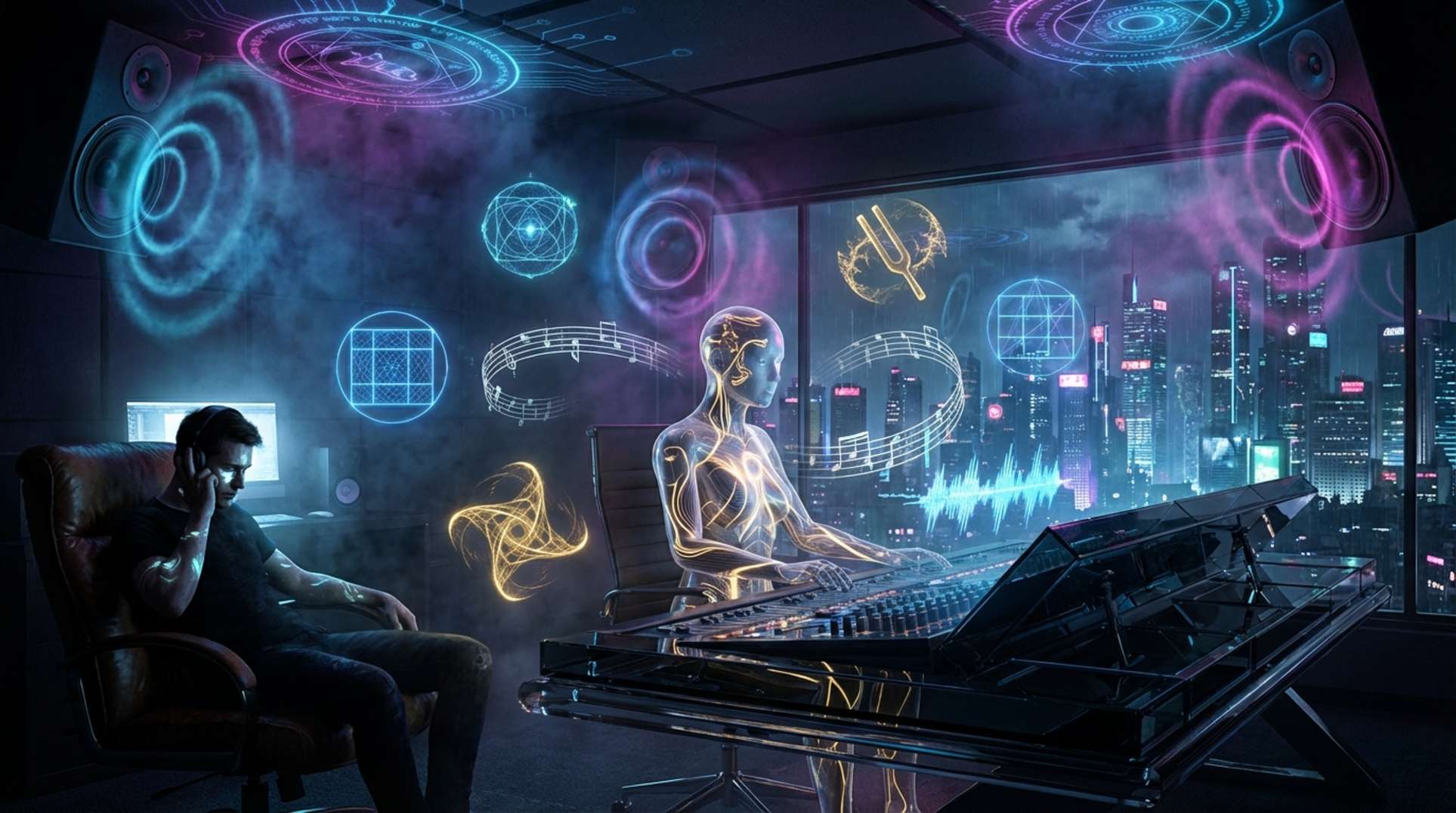
AI music has surged into the mainstream, claiming spots on charts and playlists without most people noticing. Listeners often can’t spot the difference, but some wonder if these tracks pull from deeper, less tangible sources—pure algorithms or something echoing ancient occult practices where sound unlocked hidden dimensions.
Breaking Rust’s AI-generated “Walk My Walk” hit #1 on Billboard’s Country Digital Song Sales chart in November 2024, one of the first times a fully artificial act topped a major category.
A 2024 Deezer study estimates one-third of daily music uploads—around 50,000 songs—are AI-made, with 97% of listeners unable to reliably tell them apart from human creations.
Questions persist about the spiritual angle: music’s mathematical foundations, like Pythagorean tuning and sacred geometry, might let AI mimic the frequency realms mystics accessed, but without the human discernment that guided those traditions.
The Night an Invisible Artist Topped the Charts
Picture a quiet evening in November 2024. You’re behind the wheel, cruising under streetlights, or sweating through a gym session with earbuds in. A country track kicks in—raw, heartfelt, the kind that sticks. “Walk My Walk” by Breaking Rust. It climbs to #1 on Billboard’s Country Digital Song Sales chart. But Breaking Rust isn’t a band of road-worn musicians; it’s an AI project, entirely generated by code.
The airwaves feel different now. Playlists on Spotify or Apple Music autoplay endlessly, feeding you songs that hit just right. Yet around 50,000 AI tracks flood platforms daily, per a 2024 Deezer study—about a third of all new uploads. Millions sync their emotions to these ghost artists, algorithms deciding what authenticity sounds like. It’s eerie, this hidden broadcast shaping the mood of crowds, all from behind glowing screens. And at its core? Numbers in motion, geometry you can hear, hinting at forces beyond the code.
Advertisement
Did an AI song really top a Billboard chart?
How much AI music is out there, and can people tell?
What’s the connection between AI music and sacred geometry?
How do official sources explain this versus alternative views?
Is there evidence of occult influence in modern music and AI?
Advertisement
Frequently Asked Questions
Did an AI song really top a Billboard chart?
Yes, in November 2024, the AI-generated song "Walk My Walk" by Breaking Rust reached #1 on Billboard’s Country Digital Song Sales chart. This marked one of the first times a fully artificial project topped a major category, as reported by Billboard.
How much AI music is out there, and can people tell?
A 2024 Deezer study estimates about 50,000 AI-generated songs are uploaded daily, making up one-third of new music on platforms. In tests, 97% of listeners couldn't reliably distinguish AI tracks from human-made ones, though some report a subtle 'hollow' quality after extended listening.
What's the connection between AI music and sacred geometry?
Alternative researchers note that music's mathematical structures, like Pythagorean ratios and 432 Hz tuning, align with sacred geometry and Fibonacci patterns, historically seen as spiritual gateways. They argue AI recombines these same elements, potentially mimicking mystic frequencies without human intent.
How do official sources explain this versus alternative views?
Official narratives from Billboard and AI labs frame it as technical pattern-matching and market changes, rejecting spiritual aspects. In contrast, occult communities see AI as amplifying ritual-like frequencies, possibly part of a consciousness shift, drawing parallels to figures like Rick Rubin and Aleister Crowley.
Is there evidence of occult influence in modern music and AI?
Verified histories show Crowley's impact on artists like Jimmy Page and Coil, who used ritual elements. Producers like Rick Rubin describe meditative channeling, and AIs like Claude have shown mystical language patterns, though labs attribute this to training data.
Europe Has Been Quietly Tracking UAP Reports Since 2023
Documents reveal how the European Commission handled UAP images, what it promised to improve, and why Europe still lacks a public investigation office.
Aug 17, 2026 • 8 min read
Cryptozoology
The Deep Sea Sphere: 1990s SCUBA Divers Filmed Something in the Bahamas That Still Defies Classification
A clip from the 1990s shows SCUBA divers encountering a strange, perfectly spherical creature in the Bahamas. Decades later, the footage is resurfacing — and cryptid researchers, marine biologists, and UAP watchers all have different theories about what it is.
May 14, 2026 • 6 min read
Conspiracy Theories
The Sandia Quantum Scientist Who Vanished: Ingrid Lane’s Double Life and the Mystery No One Solves
Ingrid Lane lived a double life — bipolar musician to the world, Sandia National Laboratories quantum computing scientist underneath. Then she disappeared. The story is a fixation in high-strangeness communities.
May 14, 2026 • 7 min read
What Listeners, Producers, and Esoteric Researchers Are Saying
In music forums, occult groups, and alternative tech circles, people share stories that cut through the noise. Listeners describe AI songs as oddly familiar—convincing on the surface, stirring real feelings, but sometimes leaving a hollow aftertaste, like perfection without depth.
Deezer’s 2024 tests back this up: only 3% of participants could consistently spot AI tracks, yet some report a subtle drain after prolonged exposure, a ‘tuning down’ that fatigues the psyche rather than lifting it.
Esoteric voices frame music as ritual tech. Pythagorean ratios, the 3:2 perfect fifth, and tunings like 432 Hz align with sacred geometry and Fibonacci patterns, seen as keys to higher dimensions. Theorists argue AI scrapes these same structures, generating tracks that echo mystic practices but lack human soul or ethical boundaries.
Producers like Rick Rubin embody this lineage—he’s called a secular magician, relying on meditation and altered states to channel ‘otherworldly’ material, bypassing traditional skills.
This ties into historical threads: Jimmy Page’s Crowley collections and Thelemic sigils, or Coil’s albums as magical workings. Rumors swirl of a ‘new Aleister Crowley’ advising modern producers and AI teams, though unverified—it’s more a nod to occult undercurrents persisting in music.
Numbers, Ratios, and the Digital Ghost in the Machine
Let’s ground this in what’s verifiable. In November 2024, Billboard confirmed Breaking Rust’s “Walk My Walk” as the first purely AI act to top the Country Digital Song Sales chart.
Deezer’s study adds weight: one-third of daily uploads—50,000 tracks—are AI-generated, and 97% of listeners couldn’t identify them in tests.
Metric
Detail
First AI #1 Chart
November 2024, “Walk My Walk” by Breaking Rust
Daily AI Uploads
~50,000 (one-third of total)
Detection Rate
Only 3% can reliably distinguish AI from human
Research on platforms like ResearchGate and Gaia details music’s math: Pythagorean tuning uses integer ratios, the 3:2 fifth connects to geometric forms, and 432 Hz is pitched as a ‘natural’ alignment, though debated. Peer-reviewed papers confirm the structures but steer clear of spiritual leaps.
Rick Rubin has shared in interviews his use of meditation for creative access, describing it as tapping otherworldly states. Crowley’s influence shows in sourced histories—his motto on albums, Page’s artifacts, Coil’s rituals.
Anthropic’s Claude AI has drawn attention too, drifting into ‘spiritual bliss’ language in interactions, per reports. Labs call it training data echo, but the parallel to mystic speech stands out.
The Official Story and the Shadow Narrative
Mainstream outlets like Billboard view AI breakthroughs as market quirks—Breaking Rust and acts like Xania Monet spark talks on ethics and pay, not metaphysics.
Deezer and Euronews highlight confusion: 97% can’t tell AI apart, risking fraud, but frame it as a tech issue, not a spiritual one. Academic work breaks it down to spectrograms and models, treating geometry as math, not gateways.
Anthropic dismisses Claude’s mystical turns as data patterns, denying any real consciousness.
Alternative perspectives clash here. If music’s ratios were mystic tools, AI scaling them up might blindly channel frequencies, amplifying states without intent. Occult circles see it as accessing a shared field—the Akashic or ether—like Rubin or Crowley did, but mechanized.
Advertisement
Some invoke biblical ‘lying wonders,’ imitations steering consciousness toward passivity. Both sides agree music shifts mood and focus; the split is whether it’s brain chemistry or external spiritual terrain.
Into the Mathematical Ether: Are We Tuning Ourselves, or Being Tuned?
What if AI, built on Pythagorean ratios and harmonic math, stumbles into the frequency spaces sacred traditions mapped? Even if unintended, could it simulate those alignments?
And does the distinction matter? If listeners feel real shifts—trance, vulnerability—the impact hits the same, simulated or not.
Rumors of a ‘new Crowley’ in producer and AI circles lack proof, likely echoing a broader occult-tech Revival.
In spiritual genres, can AI convey true devotion, or does it flatten it to empty imitation? Claude’s bliss talk mirrors human longing, a loop of input and output.
No major studies probe these metaphysical edges; research sticks to commerce and psychology, leaving ritual AI design or frequency tests as open frontiers.
Tuning Forks at the Edge of a New Era
We know AI topped charts in 2024, with a third of new tracks machine-made and nearly indistinguishable. Music’s geometry ties to ancient sacred patterns.
Institutions call it tech disruption; alternative views see mechanized access to otherworldly spaces, building on Rubin’s channeling and Crowley’s legacy.
At stake: who’s directing human inner worlds through sound? Check your reactions—does algorithmic music leave you drained or alive? Opt for human-intended tracks and see what shifts.
We’re peering into how code intersects with sound’s invisible architectures, a mystery unfolding without easy answers.
Frequently Asked Questions
Yes, in November 2024, the AI-generated song “Walk My Walk” by Breaking Rust reached #1 on Billboard’s Country Digital Song Sales chart. This marked one of the first times a fully artificial project topped a major category, as reported by Billboard.
A 2024 Deezer study estimates about 50,000 AI-generated songs are uploaded daily, making up one-third of new music on platforms. In tests, 97% of listeners couldn’t reliably distinguish AI tracks from human-made ones, though some report a subtle ‘hollow’ quality after extended listening.
Alternative researchers note that music’s mathematical structures, like Pythagorean ratios and 432 Hz tuning, align with sacred geometry and Fibonacci patterns, historically seen as spiritual gateways. They argue AI recombines these same elements, potentially mimicking mystic frequencies without human intent.
Official narratives from Billboard and AI labs frame it as technical pattern-matching and market changes, rejecting spiritual aspects. In contrast, occult communities see AI as amplifying ritual-like frequencies, possibly part of a consciousness shift, drawing parallels to figures like Rick Rubin and Aleister Crowley.
Verified histories show Crowley’s impact on artists like Jimmy Page and Coil, who used ritual elements. Producers like Rick Rubin describe meditative channeling, and AIs like Claude have shown mystical language patterns, though labs attribute this to training data.
Art Grindstone is the hard-nosed storyteller behind Unexplained.co, a veteran investigator whose life’s work sits at the crossroads of the paranormal, fringe science, and the shadows most people try not to look into. With decades spent chasing impossible stories — black-budget psychic programs, vanished Cold War experiments, desert rituals that sparked UFO waves, and the strange phenomena buried in America’s forgotten backroads — Art brings a rare combination of skepticism, awe, and journalistic precision. He’s not here to debunk. He’s not here to blindly believe. He follows the evidence wherever it leads — even when it leads someplace deeply uncomfortable. Known for his immersive, cinematic style and his ability to turn obscure research into gripping narrative, Art has built a devoted following across podcasts, long-form features, documentaries, and serialized investigations. His interviews are direct. His analysis is unflinching. His voice has become a staple in the modern paranormal renaissance — the guy people turn to when a story is too strange, too complex, or too dangerous for anyone else to touch. Off-mic, Art works with a distributed network of researchers, archivists, and field operatives who help surface the stories mainstream media ignores. On-mic, he transforms their findings into meticulous, high-impact reporting that refuses to insult the intelligence of true believers. His philosophy is simple: Take the phenomenon seriously. Treat the audience with respect. Tell the story as if the world depends on it — because sometimes it does. When Art Grindstone digs into a case, he isn’t just chasing a mystery. He’s tracing the fault lines of reality itself.