Giant Fireballs Across the US, Why Meteor Season Keeps Turning Into UFO and Doomsday Speculation | Unexplained
UFO & Aliens
Giant Fireballs Across the US, Why Meteor Season Keeps Turning Into UFO and Doomsday Speculation
A deep investigation into the recent wave of bright fireballs across the United States, why they trigger UFO sightings and apocalypse fears, and what the evidence actually supports.
Art Grindstone is the hard-nosed storyteller behind Unexplained.co, a veteran investigator whose life’s work sits at the crossroads of the paranormal, fringe science, and the shadows most people try not to look into. With decades spent chasing impossible stories — black-budget psychic programs, vanished Cold War experiments, desert rituals that sparked UFO waves, and the strange phenomena buried in America’s forgotten backroads — Art brings a rare combination of skepticism, awe, and journalistic precision. He’s not here to debunk. He’s not here to blindly believe. He follows the evidence wherever it leads — even when it leads someplace deeply uncomfortable. Known for his immersive, cinematic style and his ability to turn obscure research into gripping narrative, Art has built a devoted following across podcasts, long-form features, documentaries, and serialized investigations. His interviews are direct. His analysis is unflinching. His voice has become a staple in the modern paranormal renaissance — the guy people turn to when a story is too strange, too complex, or too dangerous for anyone else to touch. Off-mic, Art works with a distributed network of researchers, archivists, and field operatives who help surface the stories mainstream media ignores. On-mic, he transforms their findings into meticulous, high-impact reporting that refuses to insult the intelligence of true believers. His philosophy is simple: Take the phenomenon seriously. Treat the audience with respect. Tell the story as if the world depends on it — because sometimes it does. When Art Grindstone digs into a case, he isn’t just chasing a mystery. He’s tracing the fault lines of reality itself.
13 min · 2,828 words
In This Report(17)
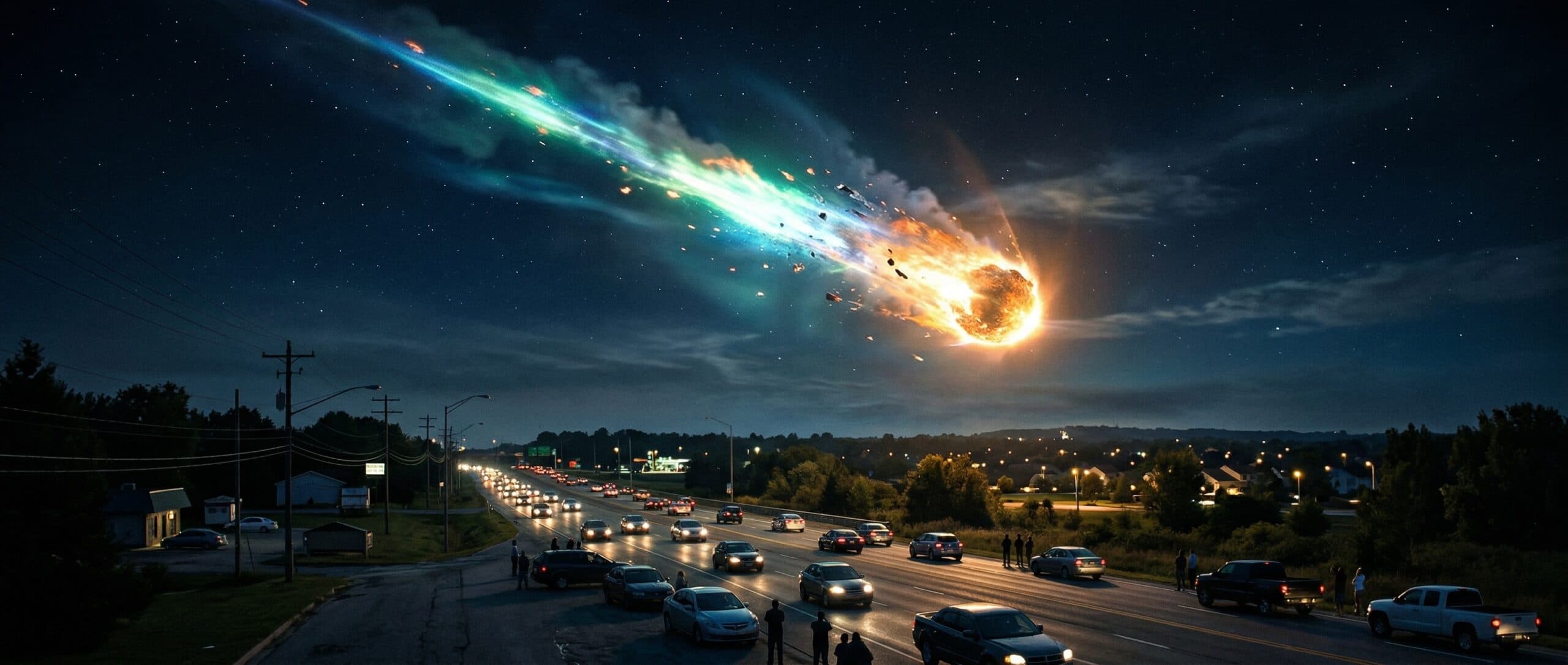
When a bright object tears across the sky, glows green or blue, and seems to explode over a highway, suburb, or open field, most people do not experience it as a lesson in atmospheric entry physics. They experience it as a rupture. For a few seconds, the ordinary sky stops behaving normally. Dashcams catch it. Doorbell cameras catch it. Someone hears a boom. Someone else swears it changed direction. Within minutes, the explanations begin to split into camps: meteor, missile, UFO, warning sign, omen.
That pattern is playing out again across the United States. Recent fireball sightings over the Northeast and Canada on March 17, 2026, along with additional American Meteor Society reports in early April over the Southwest, Texas, and the Mid-Atlantic, have reignited a familiar cycle of fascination and fear. NASA itself addressed the surge on March 26, 2026, noting that the northern hemisphere is in peak “fireball season” and that bright meteor sightings often rise between February and April. In other words, the sky is not necessarily becoming stranger. It is becoming more visible, more recorded, and more narratively unstable.
This is what makes the current wave worth a full pillar treatment. The story is not only that giant fireballs are showing up across the US. It is that every sighting now lands in a culture primed for escalation. A meteor becomes a possible craft. A sonic boom becomes evidence of interception. A bright atmospheric breakup becomes a sign that something is wrong with the planet, the government, or the future itself. Readers who have followed how NASA glitches turn into conspiracy stories or how old sky anomalies get revived as modern evidence will recognize the same conversion process here. The object enters the atmosphere as a meteor. It enters the internet as a mystery.
Japan Just Confirmed It Has UAP Footage, and Is Analyzing Pentagon Files Near Its Borders
Japan’s formal entry into the UAP transparency wave signals an international domino effect. What the country knows about UAP encounters near Japanese territory and why it matters now.
May 14, 2026 • 5 min read
Conspiracy Theories
Japan Just Confirmed It Has UAP Footage — and Is Analyzing Pentagon Files Near Its Borders
Japan’s formal entry into the UAP transparency wave signals an international domino effect. What the country knows about UAP encounters near Japanese territory and why it matters now.
May 13, 2026 • 5 min read
Conspiracy Theories
Obama Says UFO Disclosure Won’t Happen — ‘Government Is Terrible at Keeping Secrets’
Former President Obama’s unexpected remarks on UFO disclosure and government secrecy are spreading across Reddit and UAP forums. Is it an off-hand joke or a genuine signal from a former commander-in-chief?
Recent fireball reports have made the sky feel newly unstable
The current conversation did not emerge from a single isolated incident. It built from repeated sightings. NASA’s March 26, 2026 feature “It’s Fireball Season! Answering Your Meteor Questions” pointed directly to multiple recent states where bright meteors had drawn attention, including Texas, Ohio, California, and Michigan. The agency also highlighted a particularly dramatic daytime fireball observed the morning of March 17, 2026 across the northeastern United States and Canada, describing it as an object nearly six feet wide and about seven tons in mass before it fragmented over Ohio.
That alone is enough to trigger a cultural response. When people hear that a multi-ton object blazed through the atmosphere over populated areas, the event does not stay in the lane of astronomy for long. It brushes against older fears almost immediately: impact events, military secrecy, cosmic warning signs, and hidden objects entering the atmosphere unnoticed. The fact that several more reported fireballs followed in early April only deepened the sense that something unusual was underway.
The American Meteor Society has logged recent fireball witness reports over the Mid-Atlantic, Florida and Mississippi, Arizona-California-Nevada, and Texas. These are not proof of an incoming catastrophe. They are proof that a lot of people have recently looked up, seen something extraordinary, and felt the need to report it. But in a hyper-networked environment, repeated extraordinary visuals quickly create the impression of acceleration. It begins to feel as though the sky itself is entering a new phase.
Fireballs are real atmospheric events, not automatically signs of danger
A fireball is not just any shooting star. It is a meteor bright enough to outshine Venus, usually caused by a larger-than-average meteoroid entering Earth’s atmosphere at tremendous speed. As it compresses the air in front of it and heats up, it can flare brilliantly, fragment, and sometimes produce a delayed boom. NASA notes that the terms fireball and bolide are often used interchangeably in public-facing explanations, even though technical distinctions can matter in scientific contexts.
That scientific explanation is important because it clarifies what people are actually seeing. A fireball is not evidence that a craft is intentionally maneuvering overhead. It is not evidence of a missile strike. It is not, by itself, evidence of an extinction-level threat. Most meteoroids that create these displays are too small to survive atmospheric entry intact in a hazardous way. Even the dramatic Ohio event cited by NASA was presented as a manageable meteorite-producing fragmentation event, not as a civilization-threatening near miss.
Still, understanding the mechanism does not eliminate the emotional impact. A sky event can be perfectly explainable and still feel apocalyptic. That tension is part of why these stories endure. A fireball belongs to a category of phenomena that science explains clearly but human perception experiences viscerally. The same split often drives stories about strange sounds in the atmosphere or recurring sky anomalies that seem to exceed ordinary expectations in the moment.
Spring is one of the times of year when fireballs feel more common
NASA’s March 26 article makes an important point that should sit near the top of any responsible piece on this subject. The northern hemisphere is in peak fireball season between roughly February and April, with rates potentially rising by 10% to 30% around the weeks of the March equinox. Scientists do not fully agree on every reason why, but the pattern itself is not new. The sky is not suddenly inventing fireballs in 2026. The season is helping produce more of the brightest meteors, and public attention is amplifying the rest.
That means one of the strongest apocalyptic interpretations already runs into a problem. A cluster of sightings does not necessarily imply that Earth is moving into a uniquely dangerous bombardment period. It may simply mean we are in a known seasonal window, during a time when almost everyone carries a high-resolution camera and social platforms reward dramatic interpretation. More eyes, more lenses, and more reposting create the emotional impression of escalation, even when the underlying astronomy is broadly understood.
This gap between statistical normality and emotional abnormality matters. It is also what allows some stories to drift so easily into conspiratorial territory. If the average person does not know about fireball season, then repeated sightings can look like a hidden pattern. Once that happens, the event leaves the realm of skywatching and enters the realm of suspicion.
Recent US fireball cases show how fast awe turns into speculation
The Ohio-associated March 17 event is the obvious anchor because NASA elevated it in its own explanation. But it is not the only recent case adding momentum. The American Meteor Society logged a fireball seen over DC, New Jersey, and Virginia around April 2, 2026, another over Florida and Mississippi the same day, another over Arizona, California, and Nevada on April 5, and another over Texas on April 7. The Texas report included estimated magnitudes as bright as -20 from one witness, which helps explain why a single short-lived event can dominate local conversation.
These reports show the same pattern over and over. A bright flash appears. Witnesses in multiple states compare notes. Some mention fragmentation, color, or delayed sound. Then the interpretive spread begins. If the event looked smooth and straight, people call it a meteor. If it appeared oddly brilliant, too low, too green, too long-lasting, or somehow directional, a different vocabulary emerges. The object becomes “weird,” “not natural,” or “too controlled.”
That jump from unusual to unnatural is one reason this subject sits so close to unexplained.co territory. Earlier site coverage of the Great Ohio meteor event and asteroid airburst risks already showed how quickly a luminous event becomes a vessel for larger fears. People are not simply observing rocks burning up. They are testing whether the sky can still be trusted.
Some witnesses read fireballs as UFOs because brightness, silence, and speed feel nonhuman
A classic UFO interpretation does not require a craft with visible structure. It only requires something in the sky that feels too bright, too fast, too silent, too erratic, or too physically implausible for a casual observer. Fireballs do well on several of those fronts. They can appear suddenly, produce dramatic colors, vanish in fragments, and leave witnesses with only partial recall of trajectory or duration. Under stress, memory compresses. Distance is hard to judge. So is altitude.
That is why meteor events and UFO culture have always overlapped. Many famous sky scares begin with a real aerial event that feels more intentional than it is. In the social media era, this overlap has become even stronger, because video clips circulate stripped of context. A clip of a brilliant streak over a neighborhood, divorced from timestamp, location, and expert interpretation, looks like raw anomaly footage. That dynamic also drives stories like The Triangle Above the Pines and older cases such as the Westall UFO mystery, where witness certainty and atmospheric mood become inseparable from the event itself.
None of that means witnesses are foolish. It means human beings interpret rare sky events through the stories already available to them. In a culture saturated with disclosure talk, UAP hearings, and decades of cinematic alien imagery, fireballs do not land on neutral ground. They land inside a ready-made symbolic system.
Apocalypse readings emerge because fire from the sky has always felt like a message
Long before modern astronomy, blazing objects in the sky were read as omens of war, plague, regime change, divine anger, or cosmic reordering. That symbolism never fully disappeared. It simply migrated. Today, instead of court astrologers and medieval chroniclers, we have TikTok prophecy accounts, doom-focused YouTube channels, and algorithmic panic loops that splice meteor clips into broader stories about collapse.
This is where the current fireball wave connects directly to the apocalypse cluster already thriving online. Readers who have watched April 2026 prophecy culture spread, or seen how end-times timelines converge online, will recognize the structure immediately. A dramatic sky event becomes visual validation for a prediction ecosystem that was already waiting for proof.
In that ecosystem, the fireball does not have to do much. It only has to arrive at the right emotional moment. Once it does, it can be framed as the beginning of judgment, a warning about pole shift, a sign of secret warfare, or evidence that “they” are preparing the public for something bigger. The event itself remains brief. The symbolic life built around it can last for weeks.
Social media now turns local sky events into national mythology within hours
The most important difference between a modern fireball and one seen a century ago is not the object. It is the speed of narrative formation. A witness no longer tells neighbors and perhaps a local paper. They upload a clip, add a caption, choose a theory, and release it into a network built to reward certainty, alarm, and novelty. By the time astronomers or meteor trackers provide context, the emotional meaning of the event has often already hardened.
Advertisement
This is why even ordinary celestial events now feel culturally radioactive. The same mechanics that transform a fireball into a UFO also transform it into a government cover-up or an omen of collapse. Clips get recopied with worse compression and stronger claims. Context gets replaced by text overlays. Someone adds ominous music. Someone claims they heard jets. Someone else insists no meteor can move like that. Very quickly, the event stops being a local report and starts behaving like national folklore.
That process has parallels all across the unexplained ecosystem. We have seen it in viral CERN sky portal videos, in revived anomaly clips, and in the repeated way institutional ambiguity is treated as evidence of concealment. The internet does not merely spread these stories. It edits them into stronger versions of themselves.
A skeptical reading explains the sightings without draining them of wonder
The strongest skeptical explanation is also the most boring at first glance and the most useful on second reading. Bright meteors are real. Spring fireball season is real. Multiple sightings across the US can happen within a short window without implying an unprecedented threat. Witnesses are often sincere, but visual impressions under surprise conditions are notoriously difficult to interpret. That combination accounts for most of what the public is seeing and sharing right now.
But skepticism should not become a flattening reflex. A meteor can still be astonishing. A fireball can still shake houses, leave meteorites, or become a local event people remember for years. The goal is not to sneer at awe. The goal is to separate the astonishing from the unsupported. When that discipline disappears, everything bright becomes secret, everything loud becomes military, and everything rare becomes apocalyptic.
Good unexplained writing lives in that tension. It respects witness experience, acknowledges the emotional force of the event, and still asks the hard question: what does the evidence actually support? In the case of the recent fireballs, the evidence points overwhelmingly toward natural atmospheric events amplified by digital culture, not toward alien intervention or imminent planetary catastrophe.
The deeper story is not the meteors themselves, but the fear structure wrapped around them
That is why this topic matters beyond astronomy. Fireball stories reveal how modern audiences process uncertainty. We live in an era where trust in institutions is low, apocalyptic language is common, and sky events arrive preloaded with old symbolic force. When something luminous falls from above, people do not ask only what it was. They ask what it means, who is hiding the truth, and whether it confirms a larger pattern they already suspect.
In that sense, giant fireballs across the US are functioning as cultural mirrors. They reflect our appetite for disclosure, our vulnerability to omen-thinking, and our habit of turning incomplete information into worldview-level evidence. That is why the same event can produce three entirely different emotional responses at once: wonder, conspiracy, and dread.
The fireball is real. The doomsday reading is interpretive. The UFO reading is speculative. The viral panic is social. All four can live inside the same clip, the same comment thread, and the same article. That overlap is what makes the subject feel so alive right now.
These fireball stories belong to a wider culture of anxious skywatching and unstable interpretation
Once you see the pattern, it appears everywhere. NASA feed glitches become alien chatter. Old observatory photographs become revived anomaly evidence. Prophecy communities treat celestial events as confirmation. Witnesses describe a luminous object, and online audiences decide whether it belongs to astronomy, disclosure, religion, or doom. The object itself matters. But the interpretive ecosystem matters more.
That is why fireball stories fit so naturally alongside modern UFO discourse and apocalypse culture. They occupy the exact threshold where explanation exists but emotional certainty does not. A sky full of cameras has not made us calmer. In many ways, it has made us more combustible. Every bright event now arrives with instant replay, mass commentary, and competing cosmologies ready to claim it.
The result is a modern folklore machine. A meteor enters the atmosphere. A narrative enters the bloodstream. And for a few days, the country stares upward, wondering whether the oldest fear of all, fire from the sky, has come back with a new digital language.
Frequently Asked Questions
Why are so many fireballs being seen across the US right now?
NASA says the northern hemisphere is in peak fireball season from roughly February through April, and bright meteor sightings can rise around the weeks of the March equinox. More cameras and faster social sharing also make the events feel more frequent than they once did.
Are these giant fireballs a sign of an asteroid threat?
Not usually. Most fireballs are caused by relatively small meteoroids burning up in the atmosphere. Some can drop meteorites, but most do not represent civilization-scale danger.
Why do some people think fireballs are UFOs?
Because fireballs can appear unusually bright, colorful, fast, and disorienting. Without context, video clips and eyewitness impressions can make a natural atmospheric event seem controlled or unnatural.
Why are fireballs linked to doomsday or prophecy stories?
Fire in the sky has been interpreted as an omen for centuries. Modern prophecy communities and viral social platforms keep that symbolic tradition alive, especially during periods of social anxiety.
What explains the current wave best?
The best-supported explanation is a combination of seasonal fireball activity, sincere eyewitness reporting, and an online culture that rapidly turns dramatic sky events into larger narratives about secrecy, warning, or collapse.
Art Grindstone is the hard-nosed storyteller behind Unexplained.co, a veteran investigator whose life’s work sits at the crossroads of the paranormal, fringe science, and the shadows most people try not to look into. With decades spent chasing impossible stories — black-budget psychic programs, vanished Cold War experiments, desert rituals that sparked UFO waves, and the strange phenomena buried in America’s forgotten backroads — Art brings a rare combination of skepticism, awe, and journalistic precision. He’s not here to debunk. He’s not here to blindly believe. He follows the evidence wherever it leads — even when it leads someplace deeply uncomfortable. Known for his immersive, cinematic style and his ability to turn obscure research into gripping narrative, Art has built a devoted following across podcasts, long-form features, documentaries, and serialized investigations. His interviews are direct. His analysis is unflinching. His voice has become a staple in the modern paranormal renaissance — the guy people turn to when a story is too strange, too complex, or too dangerous for anyone else to touch. Off-mic, Art works with a distributed network of researchers, archivists, and field operatives who help surface the stories mainstream media ignores. On-mic, he transforms their findings into meticulous, high-impact reporting that refuses to insult the intelligence of true believers. His philosophy is simple: Take the phenomenon seriously. Treat the audience with respect. Tell the story as if the world depends on it — because sometimes it does. When Art Grindstone digs into a case, he isn’t just chasing a mystery. He’s tracing the fault lines of reality itself.