The Unexplained Company Logo
Infrasound and Hauntings: The Frequency Ghost Myth

Infrasound and Hauntings: The Frequency Ghost Myth

Art Grindstone

December 3, 2025

Key Takeaways from the Frequency Files

  • Laboratory and experimental work has repeatedly flagged a cluster of low frequencies (near ~18–19 Hz) that correlate with reports of ‘haunting’ sensations in some settings (Tandy & Lawrence, 1998; Goldsmiths Haunt project used 18.9 Hz and 22.3 Hz).
  • Institutional reviews (WHO 2018; multiple systematic reviews) find limited, inconsistent evidence that sub-audible infrasound at typical environmental levels causes unique physiological harm — strongest links are to annoyance, sleep disruption and stress pathways rather than a specific infrasound pathology.
  • Open, consequential unknowns remain: what mechanism would let inaudible infrasound reliably produce apparitions in some people but not others, what real-world dose/configuration matters, and whether AI-generated music or production choices could be engineered at scale to steer mood or states without disclosure.

A Low Hum in the Room

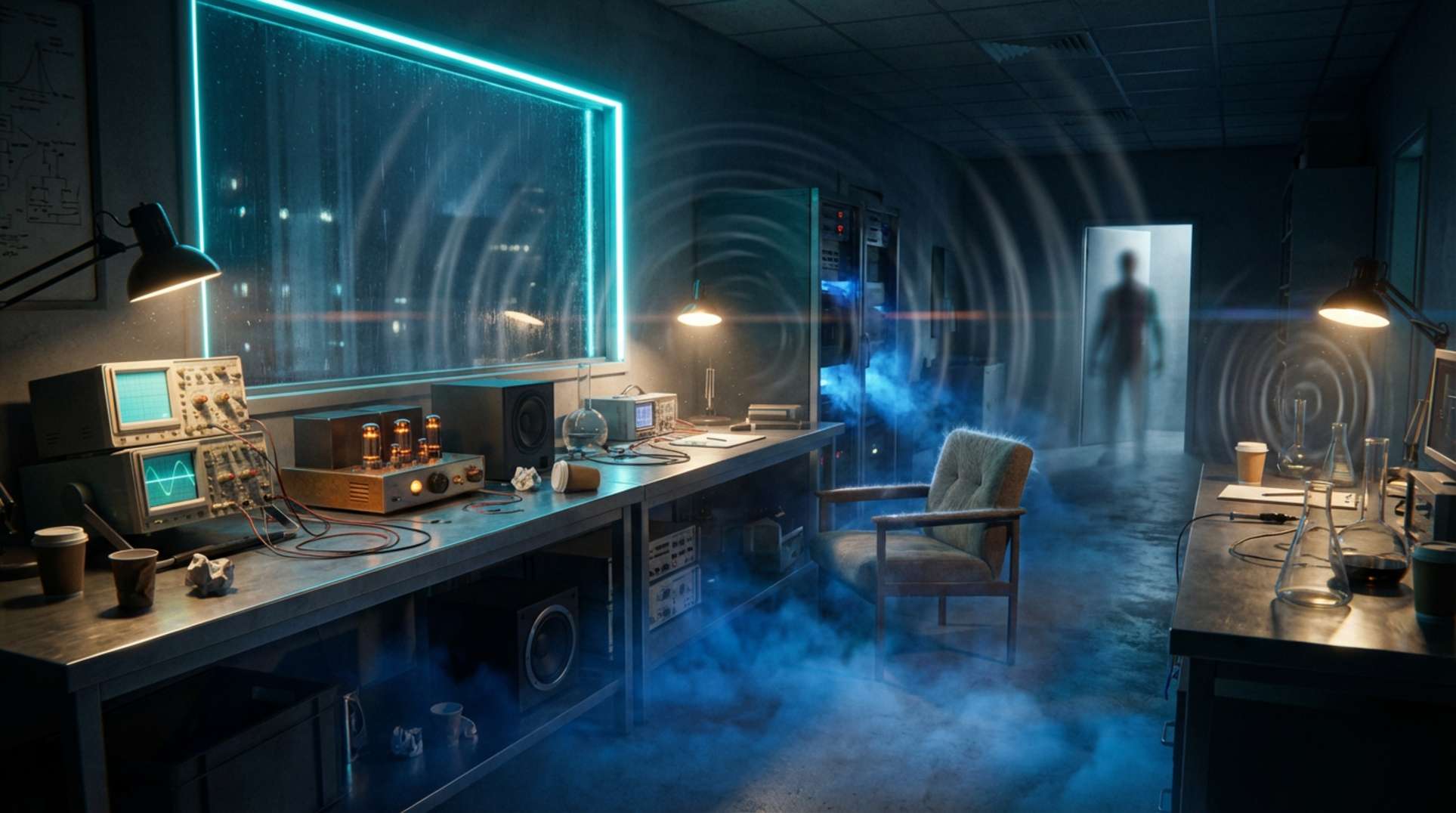
It started in the lab, late one evening. Vic Tandy and his colleagues felt it before they understood it—a creeping cold that settled into the bones, shadows flickering at the edge of sight, and that unmistakable sense of something watching from the corners. The air smelled of stale coffee and metal dust, the kind of quiet where every creak echoes. Then, measurements revealed the culprit: an infrasound peak humming through the room, inaudible but insistent (Tandy & Lawrence, 1998).

Across reports, the experiences share a pattern. People describe a sudden presence, like an unseen figure brushing past. Visual glitches appear in the periphery—fleeting shapes that vanish when you turn. Nausea hits, or a wave of unexplained sadness, paired with cold spots that chill the skin. It’s the uncanny quiet that amplifies it, where the absence of sound feels alive.

Today, this ties into a broader cultural thread. Producers, meditators, and artists like Rick Rubin talk about sound as something spiritual, a force that shapes reality. It shifts how we listen, turning odd sensations into signs of deeper layers at work.

What Witnesses and Analysts Report

In haunted spots, the stories align. Witnesses speak of fear crashing in without warning, a felt presence that raises hairs on the neck, body tremors, cold patches, and quick visual distortions—all tied to a specific place. Tandy’s lab staff described exactly this before anyone checked the frequencies (Tandy & Lawrence, 1998).

Near wind turbines, residents share their own accounts: persistent headaches, broken sleep, a pulsing inside the body, and dizzy spells. These reports fuel advocacy groups, even as debates rage over what’s really causing them.

Sound-healing circles and New Age practitioners turn to Solfeggio frequencies—396 Hz for releasing fear, 417 Hz for change, 528 Hz for supposed DNA repair. They share these as tools for restoration, though mainstream biology hasn’t backed the claims.

Figures like Rick Rubin frame sound production as a spiritual act, influencing mood and mind. This gives frequency ideas a cultural weight, making them feel like hidden knowledge worth exploring.

Timelines, Tracks, and Hard Data

The evidence builds from key studies and measurements. Here’s a quick reference:

FrequencySourceClaimed EffectMeasured Amplitude (if available)
~18.9 HzTandy & Lawrence, ‘A Ghost in the Machine’ (Journal of the Society for Psychical Research, April 1998)Correlated with haunting sensations like sensed presence and visual anomaliesPeak in investigated laboratory (not specified)
18.9 Hz and 22.3 HzGoldsmiths ‘Haunt’ experimental study (French et al.)Small increases in anomalous experiences under lab conditionsDeliberately used components (amplitudes not detailed in summary)
≈18 HzDTIC report (ADA030476)Eyeball resonant frequency, potentially linked to visual distortionsSmall amplification factor; complex coupling
Sub-audible infrasound (general)WHO Environmental Noise Guidelines (2018) and literature reviewsLimited evidence for adverse health outcomes; links to annoyance and sleep disruptionTypical environmental levels (inconsistent)
Solfeggio (e.g., 528 Hz)Modern New Age attributions (Puleo/Horowitz)DNA repair and restorative propertiesN/A (claims lack peer-reviewed validation)

These points anchor the discussion in what’s been tested and published.

Official Story vs. What the Data Suggests

Institutions like the WHO maintain that infrasound is real but doesn’t reliably cause specific harms at everyday levels. Their guidelines stress reducing noise to cut annoyance and sleep issues, not some unique infrasound disease (WHO 2018).

Acoustics experts echo this caution. Sources abound—from traffic to appliances—but lab effects don’t always replicate, and the mechanisms stay unclear.

Defense reports, like the DTIC’s on eye resonance around 18 Hz, get cited for explaining visions. Yet they highlight the limits: small effects, tricky real-world links, nothing conclusive.

Communities see it differently. They connect frequencies to sacred shifts or fear states, experiences passed through stories and reinforced by culture. It’s not just data; it’s felt truth.

With AI music, the worry grows. Could algorithms bake in mood-altering sounds without users knowing? This opens ethical gaps that science hasn’t fully mapped.

What It All Might Mean

We can stand on this: Frequencies around 18-19 Hz show up in haunted reports and trigger effects in some experiments. Culture colors how we read them.

But proof lags for a clear mechanism making infrasound spark hallucinations selectively. Why some feel it, others don’t—that’s the gap.

Watch these questions: How does it work—through eyes, balance, or stress? What doses and shapes matter? Expectation’s role? And AI’s potential to scale sonic influence?

It touches ethics in ads, public spaces, streaming. If sound sways us unseen, we need transparency rules.

Whether the hum is physics, psychology, or a little of both, we should want to know—and to know the hands that tune it.

Frequently Asked Questions

Studies like Tandy & Lawrence (1998) measured an 18.9 Hz infrasound peak in a lab where staff reported cold sensations, visual anomalies, and a sensed presence. The Goldsmiths Haunt project used 18.9 Hz and 22.3 Hz, noting small increases in anomalous experiences. These provide empirical anchors, though replication varies.

The WHO (2018) and systematic reviews find limited, inconsistent evidence for unique physiological harm from typical sub-audible infrasound. Strongest ties are to annoyance, sleep disruption, and stress, not a specific pathology. Policy focuses on reducing overall noise exposure.

Key unknowns include mechanisms for infrasound causing apparitions in some but not others, real-world dose and configuration details, and whether AI could engineer music to steer moods without disclosure. This raises ethical stakes for transparency in production and streaming.

Rubin and others describe sound production in spiritual terms, amplifying frequency-based explanations. This cultural framing influences how people interpret sensations, blending with occult ideas like Solfeggio frequencies, though these lack mainstream scientific support.

Claims of restorative or DNA-healing properties for frequencies like 528 Hz stem from modern New Age sources like Puleo and Horowitz. They lack historical basis or peer-reviewed biological validation, remaining experiential rather than empirically proven.