Interstellar Maelstrom: What Really Hit Earth in 2025
UFO & Aliens
Interstellar Maelstrom: What Really Hit Earth in 2025
Key Takeaways 3I/ATLAS (C/2025 N1) was discovered on 1 July 2025 and made its closest approach to Earth on 19 December 2025 at roughly 1.798 AU, or about 269 million km. Agencies like NASA, ESA, and JPL tracked it…
Art Grindstone is the hard-nosed storyteller behind Unexplained.co, a veteran investigator whose life’s work sits at the crossroads of the paranormal, fringe science, and the shadows most people try not to look into. With decades spent chasing impossible stories — black-budget psychic programs, vanished Cold War experiments, desert rituals that sparked UFO waves, and the strange phenomena buried in America’s forgotten backroads — Art brings a rare combination of skepticism, awe, and journalistic precision. He’s not here to debunk. He’s not here to blindly believe. He follows the evidence wherever it leads — even when it leads someplace deeply uncomfortable. Known for his immersive, cinematic style and his ability to turn obscure research into gripping narrative, Art has built a devoted following across podcasts, long-form features, documentaries, and serialized investigations. His interviews are direct. His analysis is unflinching. His voice has become a staple in the modern paranormal renaissance — the guy people turn to when a story is too strange, too complex, or too dangerous for anyone else to touch. Off-mic, Art works with a distributed network of researchers, archivists, and field operatives who help surface the stories mainstream media ignores. On-mic, he transforms their findings into meticulous, high-impact reporting that refuses to insult the intelligence of true believers. His philosophy is simple: Take the phenomenon seriously. Treat the audience with respect. Tell the story as if the world depends on it — because sometimes it does. When Art Grindstone digs into a case, he isn’t just chasing a mystery. He’s tracing the fault lines of reality itself.
5 min · 1,142 words
In This Report(7)
Key Takeaways
3I/ATLAS (C/2025 N1) was discovered on 1 July 2025 and made its closest approach to Earth on 19 December 2025 at roughly 1.798 AU, or about 269 million km. Agencies like NASA, ESA, and JPL tracked it closely and confirmed no impact threat.
Earth passes through the Sun’s neutral interstellar helium focusing cone each early December. This is a detectable but extremely thin flow of atoms, documented by missions like SOHO and STEREO, posing no direct hazard to life or weather.
Multiple planets formed striking conjunctions and a ‘planet parade’ from December 2025 into January 2026. Visually impressive, but gravitational effects on Earth remain negligible.
What lingers: Could these three separate factors create any combined heliospheric or geophysical signal? This stays open, calling for checks on data like Kp/Dst indices, neutron monitors, ACE/DSCOVR readings, and TEC maps.
A Night the Sky Felt Crowded
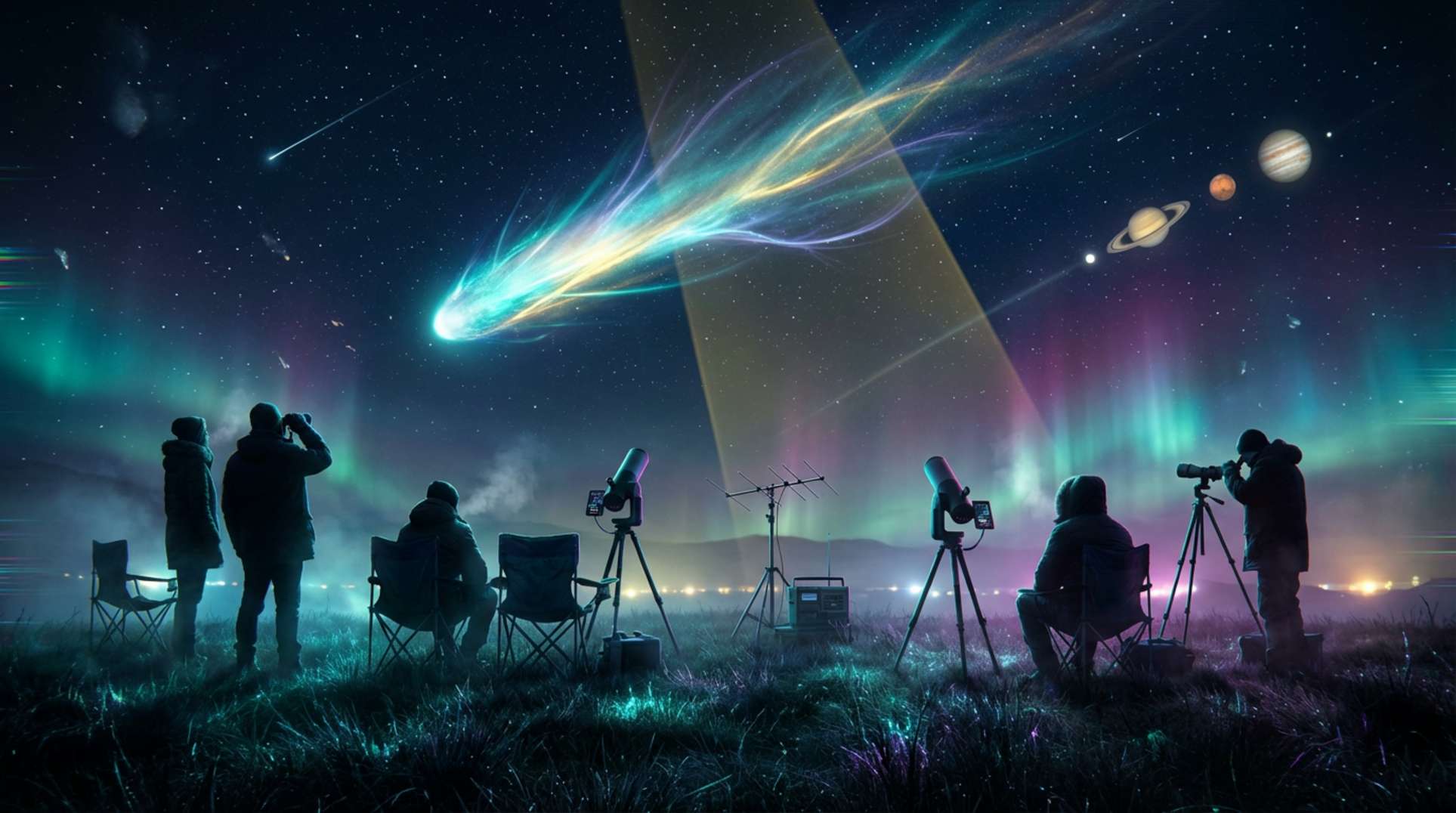
The end of 2025 brought skies alive with activity. Watchers gathered under clear nights, binoculars in hand, tracking the comet 3I/ATLAS as it emerged from solar conjunction. Planets lined up in a rare parade, visible to the naked eye and through simple scopes, as guides from NASA Skywatching and EarthSky highlighted the show.
After its perihelion in late October and a period hidden by the Sun, the comet reappeared in November and December. Professionals pointed Hubble, JWST, and ExoMars at it, while amateurs with Unistellar setups and backyard rigs captured their own views.
Social channels buzzed. Fresh images from institutions mixed with crowdsourced shots, building a shared excitement. Even routine events felt charged in this collective watch.
Advertisement
What Witnesses and Analysts Report
In online forums and independent channels, the overlap drew sharp attention. Commentators and researchers dubbed it the ‘Interstellar Maelstrom,’ suggesting possible energetic shifts from the comet’s path, the helium cone transit, and the planetary alignments. YouTube videos and public posts framed it as a moment of transformation.
Witnesses shared accounts of heightened electromagnetic sensations, odd aurora sightings, and instrument glitches. Some pointed to 3I/ATLAS showing non-gravitational acceleration or magnetic quirks, turning these into testable ideas discussed across platforms.
Coordinated efforts through IAWN, plus Unistellar and backyard observers, fed data and speculation alike. Institutional shots from JWST and HST only fueled the talk.
What exactly happened in late 2025 with these sky events?
Is there evidence for the ‘Interstellar Maelstrom’ effects?
How did officials respond to the claims?
What can readers do to verify this themselves?
Did the comet show any real anomalies?
Frequently Asked Questions
What exactly happened in late 2025 with these sky events?
In December 2025, comet 3I/ATLAS made its closest Earth approach, Earth transited the helium focusing cone, and planets aligned in a visible parade. These were tracked by agencies and amateurs, creating a buzz in online communities.
Is there evidence for the 'Interstellar Maelstrom' effects?
Community reports include electromagnetic sensations and instrument anomalies, but official data shows individual events as benign. Combined effects remain unproven, needing checks on geomagnetic and plasma data.
How did officials respond to the claims?
NASA, ESA, and JPL maintained that the comet posed no threat, the helium cone is tenuous, and alignments are visual only. They emphasized tracking and fact pages to counter speculation.
What can readers do to verify this themselves?
Access JPL Horizons for orbital data, review geomagnetic indices like Kp/Dst, and check neutron monitor and TEC maps for December 2025–January 2026. Cross-reference with eyewitness timings for patterns.
Did the comet show any real anomalies?
Some claim non-gravitational acceleration or magnetic effects, but these need astrometric analysis. Current models attribute comet behavior to outgassing, though data checks could reveal more.
The Pentagon Released More UAP Files—but Not the Data Needed to Solve Them
The Pentagon’s fifth UAP release reveals cold orbs and a giant triangle—but missing sensor data keeps its strangest cases unresolved and untested.
Aug 17, 2026 • 10 min read
UFO & Aliens
Europe Has Been Quietly Tracking UAP Reports Since 2023
Documents reveal how the European Commission handled UAP images, what it promised to improve, and why Europe still lacks a public investigation office.
Aug 17, 2026 • 8 min read
Ancient Civilizations
1957 Electrogravitics Secret: The Classified Research Program Whose Watchers Have All ‘Gone’
A viral essay claims that classified electrogravitics research made real progress in the 1950s — and that everyone who knew the truth about it has since disappeared from the public record. The story is spreading through high-strangeness forums.
May 14, 2026 • 7 min read
Geophysicist Stefan Burns led the charge, hosting a Q&A where he posed questions about linked effects. He urged the community to dig into data, treating these claims as serious leads worth pursuing.
Timelines, Tracks, and Hard Data
Let’s anchor this in facts. 3I/ATLAS was spotted on 1 July 2025, hit perihelion around 30 October at about 1.4 AU, and skimmed closest to Earth on 19 December at 1.798 AU—roughly 269 million km. Sources like NASA, ESA, TheSkyLive, and JPL back this up.
The helium focusing cone? Earth crosses it every early December, a subtle stream observed by SOHO and STEREO. It’s thin, far less dense than our atmosphere or magnetosphere, per peer-reviewed papers on pickup ions.
The planet parade stretched from late 2024 into 2025, with groupings peaking in December and January 2026, as noted in NASA Skywatching, EarthSky, and StarWalk calendars.
Tracking came from HST, JWST, ExoMars, Mars Express, and amateur networks. Ephemerides are public via ESA, NASA, and JPL Horizons.
To compare scales, here’s a quick reference:
Event
Dates
Closest Distance to Earth
Key Observers
Primary Source
3I/ATLAS Comet
Discovery: 1 July 2025; Perihelion: ~30 Oct 2025; Earth Approach: 19 Dec 2025
For combined effects, look at geomagnetic indices like Kp and Dst, neutron monitor counts for cosmic rays, solar wind data from ACE, DSCOVR, and Wind, ionospheric TEC maps, and JPL Horizons for astrometry and non-gravitational fits.
Official Story vs. What the Data Suggests
Agencies like NASA, ESA, and JPL describe 3I/ATLAS as a tracked interstellar visitor, no threat in sight. The helium cone is a known, faint feature, and planetary lineups are just visual— no physical pull on Earth, per their fact pages and SOHO/STEREO docs.
Yet community voices see potential in the timing: maybe amplified heliospheric effects or magnetic oddities in the comet. These ideas need astrometric checks and peer review to hold up.
Advertisement
To test, pull JPL Horizons orbital solutions and uncertainties for 3I. Scan geomagnetic indices and neutron monitors from December 2025 to January 2026. Match ionospheric TEC and magnetometer logs to amateur observation times. Check spacecraft reports for pickup-ion spikes during the cone transit.
Current data shows small, familiar effects individually. No big signal yet, but that limits scale, not possibility.
What It All Might Mean
The core evidence stands: documented dates for 3I/ATLAS, the helium cone’s annual timing, and the planet parade’s visibility, all confirmed by NASA, ESA, SOHO, STEREO, IAWN, and amateur sources.
Open questions persist. Did the overlap spark any measurable response in the magnetosphere, cosmic rays, or ionosphere? Do comet ‘anomalies’ demand new models, or fit within outgassing norms? JPL Horizons and peer analysis will tell.
For follow-up: Gather JPL ephemeris and non-gravitational fits. Pull time series for Kp/Dst, neutron monitors, ACE/DSCOVR, TEC, and ground magnetometers from December 2025–January 2026. Align eyewitness reports with logs.
This matters beyond physics—it’s cultural. Real events can spark powerful stories. Solid data checks build trust, separating real patterns from hype.
As for Stefan Burns’ Q&A: He framed the ‘Interstellar Maelstrom’ as a convergence worth watching for energetic links. Possible mechanisms? Subtle heliospheric interactions, if any. He recommends datasets like geomagnetic indices and plasma readings. Key questions: Any spike in cosmic ray fluxes? Do comet trajectories show unexplained deviations? How do ionospheric changes align with the timelines?
Frequently Asked Questions
In December 2025, comet 3I/ATLAS made its closest Earth approach, Earth transited the helium focusing cone, and planets aligned in a visible parade. These were tracked by agencies and amateurs, creating a buzz in online communities.
Community reports include electromagnetic sensations and instrument anomalies, but official data shows individual events as benign. Combined effects remain unproven, needing checks on geomagnetic and plasma data.
NASA, ESA, and JPL maintained that the comet posed no threat, the helium cone is tenuous, and alignments are visual only. They emphasized tracking and fact pages to counter speculation.
Access JPL Horizons for orbital data, review geomagnetic indices like Kp/Dst, and check neutron monitor and TEC maps for December 2025–January 2026. Cross-reference with eyewitness timings for patterns.
Some claim non-gravitational acceleration or magnetic effects, but these need astrometric analysis. Current models attribute comet behavior to outgassing, though data checks could reveal more.
Art Grindstone is the hard-nosed storyteller behind Unexplained.co, a veteran investigator whose life’s work sits at the crossroads of the paranormal, fringe science, and the shadows most people try not to look into. With decades spent chasing impossible stories — black-budget psychic programs, vanished Cold War experiments, desert rituals that sparked UFO waves, and the strange phenomena buried in America’s forgotten backroads — Art brings a rare combination of skepticism, awe, and journalistic precision. He’s not here to debunk. He’s not here to blindly believe. He follows the evidence wherever it leads — even when it leads someplace deeply uncomfortable. Known for his immersive, cinematic style and his ability to turn obscure research into gripping narrative, Art has built a devoted following across podcasts, long-form features, documentaries, and serialized investigations. His interviews are direct. His analysis is unflinching. His voice has become a staple in the modern paranormal renaissance — the guy people turn to when a story is too strange, too complex, or too dangerous for anyone else to touch. Off-mic, Art works with a distributed network of researchers, archivists, and field operatives who help surface the stories mainstream media ignores. On-mic, he transforms their findings into meticulous, high-impact reporting that refuses to insult the intelligence of true believers. His philosophy is simple: Take the phenomenon seriously. Treat the audience with respect. Tell the story as if the world depends on it — because sometimes it does. When Art Grindstone digs into a case, he isn’t just chasing a mystery. He’s tracing the fault lines of reality itself.