Neil deGrasse Tyson vs UFOs: What the Space Data Hides
UFO & Aliens
Neil deGrasse Tyson vs UFOs: What the Space Data Hides
What You Need to Know Before We Fall In Black holes pack extreme density: one with Earth’s mass fits into a 9 mm radius, while a golf ball-sized version (about 21 mm across) could weigh several times more than our…
Art Grindstone is the hard-nosed storyteller behind Unexplained.co, a veteran investigator whose life’s work sits at the crossroads of the paranormal, fringe science, and the shadows most people try not to look into. With decades spent chasing impossible stories — black-budget psychic programs, vanished Cold War experiments, desert rituals that sparked UFO waves, and the strange phenomena buried in America’s forgotten backroads — Art brings a rare combination of skepticism, awe, and journalistic precision. He’s not here to debunk. He’s not here to blindly believe. He follows the evidence wherever it leads — even when it leads someplace deeply uncomfortable. Known for his immersive, cinematic style and his ability to turn obscure research into gripping narrative, Art has built a devoted following across podcasts, long-form features, documentaries, and serialized investigations. His interviews are direct. His analysis is unflinching. His voice has become a staple in the modern paranormal renaissance — the guy people turn to when a story is too strange, too complex, or too dangerous for anyone else to touch. Off-mic, Art works with a distributed network of researchers, archivists, and field operatives who help surface the stories mainstream media ignores. On-mic, he transforms their findings into meticulous, high-impact reporting that refuses to insult the intelligence of true believers. His philosophy is simple: Take the phenomenon seriously. Treat the audience with respect. Tell the story as if the world depends on it — because sometimes it does. When Art Grindstone digs into a case, he isn’t just chasing a mystery. He’s tracing the fault lines of reality itself.
7 min · 1,504 words
In This Report(8)
What You Need to Know Before We Fall In
Black holes pack extreme density: one with Earth’s mass fits into a 9 mm radius, while a golf ball-sized version (about 21 mm across) could weigh several times more than our planet, challenging everything we think we know about matter.
NASA has confirmed over 5,000 exoplanets, with billions more likely in the Milky Way—many in habitable zones where life could thrive; Tyson calls it unrealistic to think we’re alone, yet he pushes back on UFOs as evidence of aliens without stronger proof.
Mainstream science sticks to data on black holes, exoplanets, and UAPs, but online communities question if our tools and senses are blind to deeper truths—or if institutions are holding back key details on UFOs and unknown physics.
We’ve imaged a black hole’s shadow in 2019 and measured Sagittarius A* at 4 million solar masses, yet mysteries linger in black hole mechanics, the search for alien life, and the origins of many UAP reports.
Listening to the Cosmos with Broken Senses
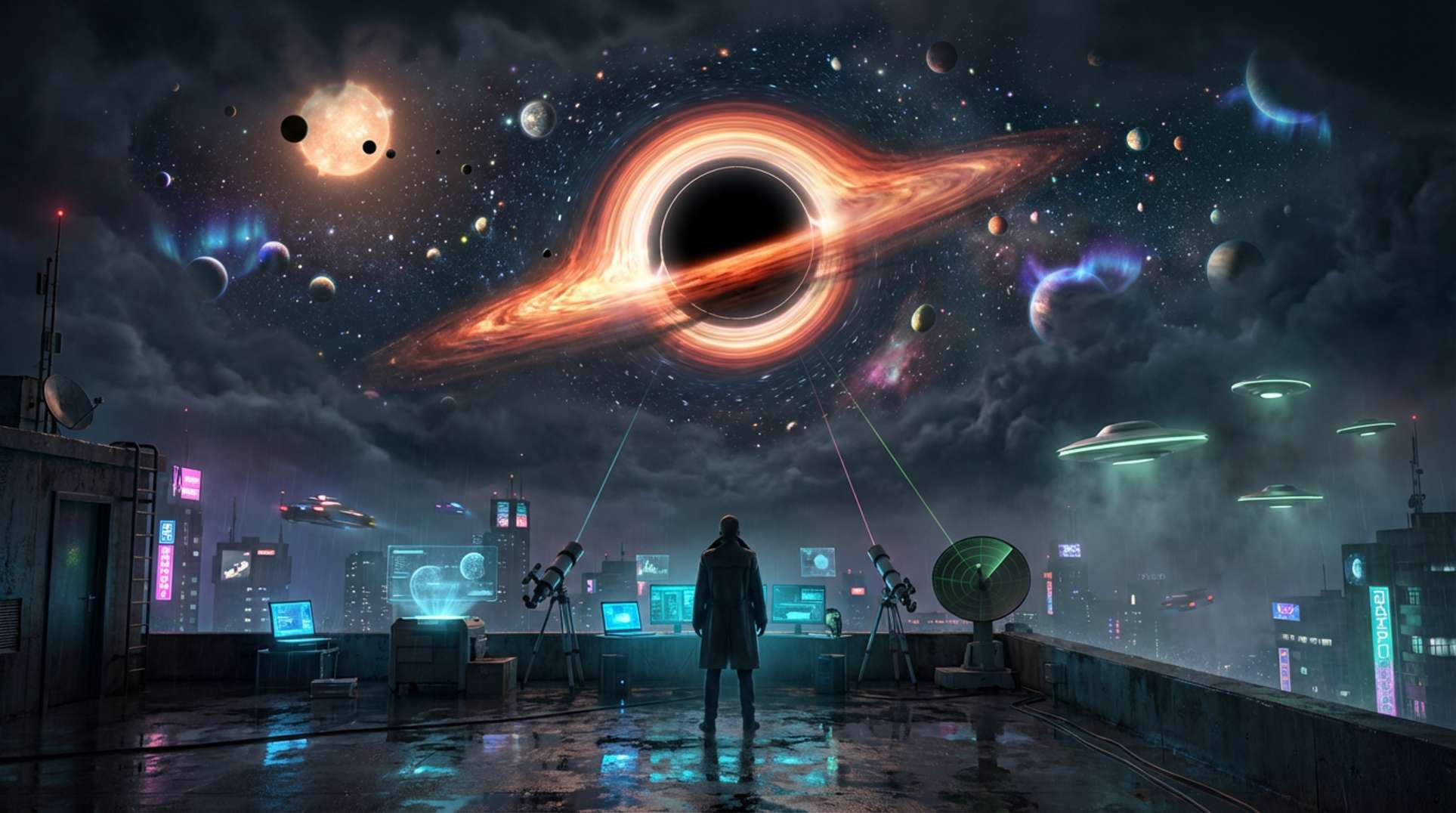
Picture Neil deGrasse Tyson on a dimly lit stage, spotlight cutting through the haze, as he drops a bombshell: a point in space no bigger than a marble could outweigh the entire Earth. The audience leans in, but outside, the world buzzes with Pentagon UAP hearings, leaked fighter jet videos, and stories of lights in the sky that defy explanation. Tyson stays calm, insisting our senses—tuned for spotting predators on ancient plains—fall short when facing warped spacetime or quantum weirdness. Science, he says, acts as our upgrade, letting instruments peer into realities our eyes can’t touch. Yet in this era of viral cockpit footage and abduction tales, his call to trust the tech over blurry sightings raises a sharp question: if our perceptions are so flawed, what cosmic tricks are black holes, potential aliens, or those elusive UAPs playing on us right now?
Tyson hammers the point with vivid examples: squeeze Earth’s mass into a 9 mm sphere, and you’ve got a black hole. Bump it to golf ball size—21 mm across—and its mass balloons to several Earths. These aren’t abstractions; they’re reminders that the universe operates on rules that shatter human intuition. Our senses evolved for survival, not for grasping gravity’s extremes or invisible cosmic structures. Meanwhile, public fascination surges with military pilots describing craft that zip without thrust, hearings admitting unexplained aerial phenomena, and communities sharing decades of encounters. Tyson counters that anecdotes and fuzzy images don’t cut it for claiming alien visitors. Still, if instruments reveal black holes and distant worlds we can’t see unaided, maybe they’re also missing—or we’re not looking hard enough at—the anomalies that keep skywatchers up at night.
What exactly is Neil deGrasse Tyson’s stance on black holes and alien life?
How do black holes form according to mainstream science?
Why do some communities disagree with Tyson’s skepticism on UFOs?
What evidence supports the existence of exoplanets?
Are there still mysteries around black holes?
Advertisement
Frequently Asked Questions
What exactly is Neil deGrasse Tyson's stance on black holes and alien life?
Tyson views black holes as real, observable objects predicted by general relativity and confirmed through events like the 2019 imaging of a black hole's shadow. He believes alien life is statistically likely given billions of exoplanets, many in habitable zones, but he insists there's no solid evidence that UFOs or UAPs represent extraterrestrial visitors.
How do black holes form according to mainstream science?
Massive stars over 20 solar masses exhaust their fuel, explode as supernovae, and if the core exceeds three solar masses, gravity collapses it into a black hole. Supermassive black holes like Sagittarius A* reside at galaxy centers and can reach millions or billions of solar masses.
Why do some communities disagree with Tyson's skepticism on UFOs?
Many in UFO/UAP communities argue that eyewitness reports from pilots and military personnel, along with potential classified data, deserve more serious consideration. They feel Tyson's dismissal overlooks behaviors in sightings that defy known physics, possibly hinting at advanced tech or new science.
What evidence supports the existence of exoplanets?
NASA has confirmed over 5,000 exoplanets using methods like transit photometry and radial velocity measurements. Estimates suggest billions more in the Milky Way, with many in habitable zones where conditions could support liquid water and potentially life.
Are there still mysteries around black holes?
Yes, phenomena like rapid flares near Sagittarius A* remain not fully understood, possibly involving complex plasma physics or magnetic processes. Even with advanced imaging and measurements, black hole behavior continues to challenge and expand our models.
The Pentagon Released More UAP Files—but Not the Data Needed to Solve Them
The Pentagon’s fifth UAP release reveals cold orbs and a giant triangle—but missing sensor data keeps its strangest cases unresolved and untested.
Aug 17, 2026 • 10 min read
UFO & Aliens
Europe Has Been Quietly Tracking UAP Reports Since 2023
Documents reveal how the European Commission handled UAP images, what it promised to improve, and why Europe still lacks a public investigation office.
Aug 17, 2026 • 8 min read
Ancient Civilizations
1957 Electrogravitics Secret: The Classified Research Program Whose Watchers Have All ‘Gone’
A viral essay claims that classified electrogravitics research made real progress in the 1950s — and that everyone who knew the truth about it has since disappeared from the public record. The story is spreading through high-strangeness forums.
May 14, 2026 • 7 min read
What Tyson, Witnesses, and Skywatchers Are Really Talking About
Tyson keeps it straightforward: black holes emerge from general relativity’s equations, backed by real observations. They form when stars heavier than 20 solar masses burn out, explode in supernovae, and leave cores over three solar masses that gravity crushes into oblivion. On exoplanets, he points to the numbers—billions in our galaxy, many in zones where water could flow—making solitude in the cosmos seem improbable. But he draws a line: statistical likelihood isn’t proof, and UFOs lack the hard data to confirm alien tech.
Advertisement
Contrast that with what hits forums and eyewitness networks. People describe craft pulling instant accelerations, hairpin turns, or vanishing acts that laugh at physics as we know it—no sonic booms, no visible propulsion. These aren’t casual observers; many track astrophysics closely, arguing their experiences outstrip current models. Some call Tyson too quick to dismiss, pushing for more weight on pilot testimonies, historical patterns, and classified footage that might reveal more. They reference voices like Michio Kaku, who entertains UAPs as possible extraterrestrial probes, especially after Pentagon reports label some incidents truly unidentified. Communities suspect interdimensional angles or hidden human tech, feeling that official skepticism ignores a puzzle with pieces scattered across black-budget programs and unexplained skies.
Timelines, Telescopes, and the Physics We Can Put Numbers On
Mainstream data grounds the conversation. The Schwarzschild radius shows black hole extremes: compress Earth’s mass, and the radius shrinks to 9 mm. A golf ball-sized black hole, at 21 mm, packs mass several times Earth’s. Formation follows a clear path—massive stars over 20 solar masses supernova, and cores above three solar masses collapse under gravity. Supermassive versions like Sagittarius A*, at 4 million solar masses, sit at galaxy centers, with some elsewhere reaching billions.
The 2019 Event Horizon Telescope captured a black hole’s shadow, turning theory into visuals. Exoplanet counts top 5,000 confirmed by NASA, with billions estimated in the Milky Way—plenty in habitable zones. Tyson echoes this: life’s probable out there, but UAPs don’t meet the bar for alien proof without better evidence.
Metric
Value
Schwarzschild Radius for Earth-Mass Black Hole
~9 mm
Mass of Sagittarius A*
~4 million solar masses
Number of Confirmed Exoplanets
Over 5,000
Date of First Black Hole Image
2019
These figures solidify black holes and exoplanets as fact, but UAPs stay in the gray—unreached by the same rigorous metrics.
When Official Stories Meet Lived Experience
NASA frames black holes through relativity, spotting them via gravity’s pull and glowing gas edges. Exoplanets show up in transit dips or star wobbles, with stats favoring life elsewhere—but no confirmed alien signals. On UAPs, caution rules: unidentified isn’t alien, and more data’s needed over guesses. Tyson aligns here, open to extraterrestrials in theory but demanding instrument-grade proof for specific claims.
Communities push back. Pilots and military vets report sightings that demand attention, not dismissal as sensory slips. They suspect classified radar and imagery hold clearer views, locked away from public science. If our tools miss layers of reality, advanced visitors might exploit that, flickering in like black hole flares we barely understand. This clash highlights a core rift: institutions lean on what’s verifiable, while experiencers argue their accounts fill gaps that data alone can’t. Figures like Kaku get nods for bridging to bolder ideas, contrasting Tyson’s institutional guardrails.
Inside the Event Horizon of Our Ignorance
The event horizon marks where light can’t escape—a fitting symbol for what we can’t yet see. Flares near Sagittarius A* puzzle experts, hinting at plasma dances or magnetic twists still under debate. If we’ve built tools to glimpse black holes and exoplanets, imagine what smarter beings might craft to scan hidden dimensions or energies.
Advertisement
UAP reports tease similar unknowns: craft with physics-defying moves that could signal untapped laws or tech. With billions of planets, many life-friendly, the silence raises questions—rarity of smarts? Self-erasure? Or are we just not tuned in? Some bet classified UAP files could flip the script, though others note black projects explain plenty. Tyson’s proof threshold keeps things grounded, but it doesn’t seal off possibilities; it maps where claims need to level up.
Breathing Stardust, Sharing Air, and Why the Mystery Persists
Tyson reminds us we’re stardust—heavy elements from ancient stars and supernovae, the same furnaces birthing black holes. Each breath mixes molecules shared with every human ever, tying us to history’s vast chain. We know black holes exist, from shadows imaged in 2019 to Sagittarius A*’s colossal mass. Exoplanets number in the thousands confirmed, billions probable, many ripe for life.
Yet UAP sources, intelligent life’s spread, and hidden physics remain open. Skepticism of official lines and wild claims both have roles; our senses and tools evolve, carving space for breakthroughs. The universe hides layers beyond our grasp—in that space, science and mystery push forward together.
Frequently Asked Questions
Tyson views black holes as real, observable objects predicted by general relativity and confirmed through events like the 2019 imaging of a black hole’s shadow. He believes alien life is statistically likely given billions of exoplanets, many in habitable zones, but he insists there’s no solid evidence that UFOs or UAPs represent extraterrestrial visitors.
Massive stars over 20 solar masses exhaust their fuel, explode as supernovae, and if the core exceeds three solar masses, gravity collapses it into a black hole. Supermassive black holes like Sagittarius A* reside at galaxy centers and can reach millions or billions of solar masses.
Many in UFO/UAP communities argue that eyewitness reports from pilots and military personnel, along with potential classified data, deserve more serious consideration. They feel Tyson’s dismissal overlooks behaviors in sightings that defy known physics, possibly hinting at advanced tech or new science.
NASA has confirmed over 5,000 exoplanets using methods like transit photometry and radial velocity measurements. Estimates suggest billions more in the Milky Way, with many in habitable zones where conditions could support liquid water and potentially life.
Yes, phenomena like rapid flares near Sagittarius A* remain not fully understood, possibly involving complex plasma physics or magnetic processes. Even with advanced imaging and measurements, black hole behavior continues to challenge and expand our models.
Art Grindstone is the hard-nosed storyteller behind Unexplained.co, a veteran investigator whose life’s work sits at the crossroads of the paranormal, fringe science, and the shadows most people try not to look into. With decades spent chasing impossible stories — black-budget psychic programs, vanished Cold War experiments, desert rituals that sparked UFO waves, and the strange phenomena buried in America’s forgotten backroads — Art brings a rare combination of skepticism, awe, and journalistic precision. He’s not here to debunk. He’s not here to blindly believe. He follows the evidence wherever it leads — even when it leads someplace deeply uncomfortable. Known for his immersive, cinematic style and his ability to turn obscure research into gripping narrative, Art has built a devoted following across podcasts, long-form features, documentaries, and serialized investigations. His interviews are direct. His analysis is unflinching. His voice has become a staple in the modern paranormal renaissance — the guy people turn to when a story is too strange, too complex, or too dangerous for anyone else to touch. Off-mic, Art works with a distributed network of researchers, archivists, and field operatives who help surface the stories mainstream media ignores. On-mic, he transforms their findings into meticulous, high-impact reporting that refuses to insult the intelligence of true believers. His philosophy is simple: Take the phenomenon seriously. Treat the audience with respect. Tell the story as if the world depends on it — because sometimes it does. When Art Grindstone digs into a case, he isn’t just chasing a mystery. He’s tracing the fault lines of reality itself.