

Key Takeaways
- A large solar filament erupted around 15 July 2025, carving a dramatic ‘dark scar’ on the Sun, reported as roughly 250,000 miles (about 400,000 km) long, according to sources like Space.com and Petapixel.
- NASA‘s SDO imagery in AIA wavelengths, along with Goddard SVS visualizations, captured the event as a filament eruption—cooler plasma held by magnetic fields was disrupted, leaving a glowing channel from ripped field lines, per NASA sources.
- A CME was spotted in coronagraph imagery from SOHO/LASCO and others, initially assessed as mostly directed away from Earth with no major geomagnetic impacts expected; however, details on CME speed, mass, magnetic orientation, and any weak flank effects remain open for further scrutiny, based on reports from Gizmodo, Orbital Today, and NOAA SWPC.
When the Sun Tore a Scar Across Its Face
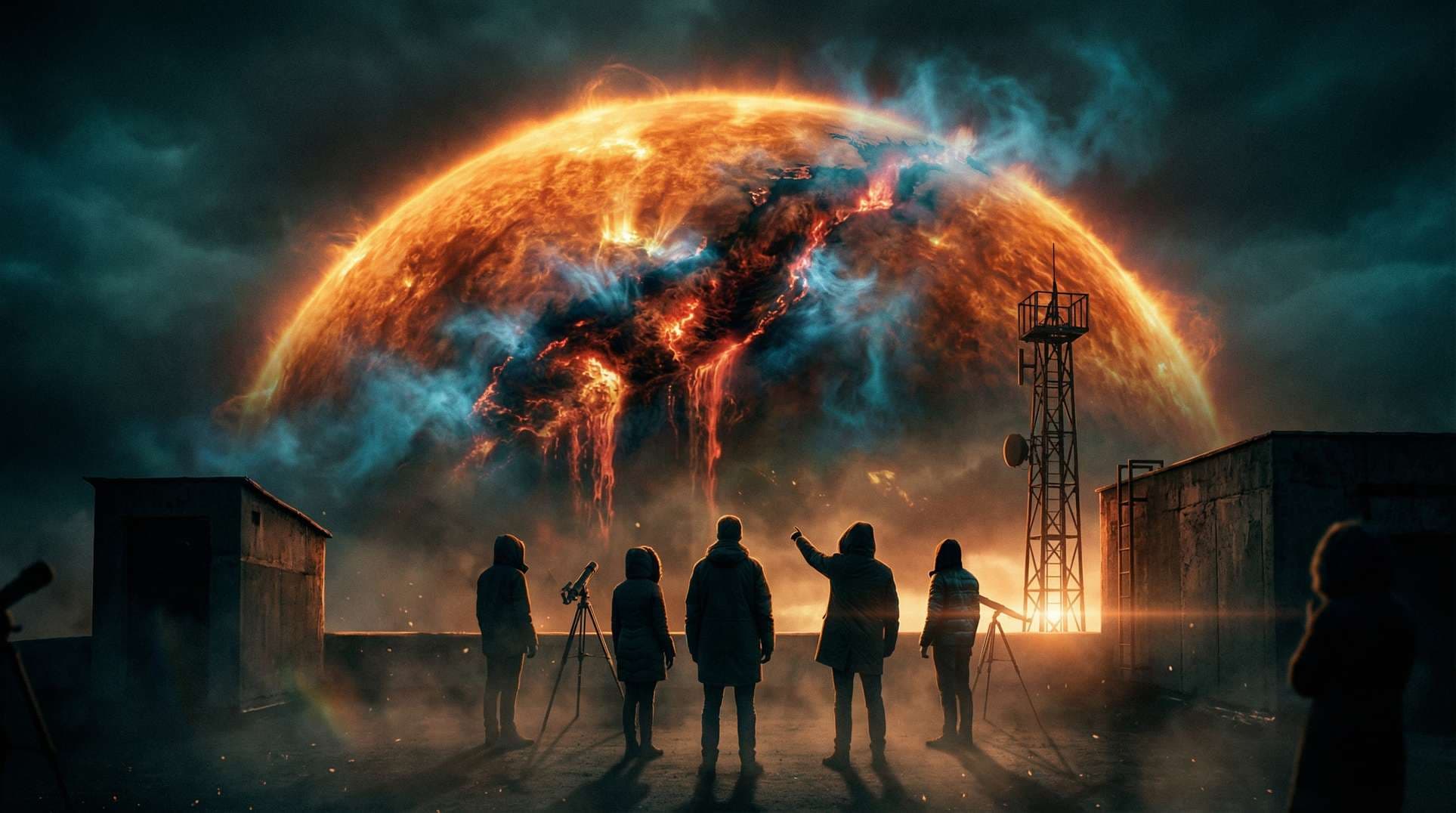
The footage hit like a shockwave. Around 15 July 2025, NASA’s SDO captured the eruption in AIA wavelengths, turning raw data into time-lapse clips that spread fast. A long, glowing trench sliced across the Sun’s surface, with plasma cascading down like molten rain. Social feeds erupted too—hobbyist astronomers and space-watchers shared stills and videos, dubbing it a ‘canyon of fire’ or ‘dark scar.’ The planet stared at its star, flinching under the weight of something vast and unpredictable. Coverage from Space.com and NASA SVS amplified the visuals, pulling in eyes from everywhere. Community posts poured in within minutes, blending awe with urgent questions about what might come next.
What Witnesses and Analysts Report
Across forums and feeds, observers zeroed in on the SDO time-lapses. They showed the filament snapping, plasma draining away—raw material that fueled quick interpretations. Some trackers flagged the CME as potentially heading our way, sparking talk of auroras or other effects. Others drew parallels to the 2013 ‘Canyon of Fire’ event, seeing familiar patterns in the visuals. Voices like Tony Phillips from SpaceWeather.com and aurora photographer Vincent Ledvina carried weight, sharing details on X/Twitter and discussing possible sky shows. The pattern was clear: fast sharing ignited speculation, clashing with the slower grind of institutional analysis from multiple angles.
Timelines, Tracks, and Hard Data
The event unfolded on 15 July 2025, as reported by Space.com. The feature stretched about 250,000 miles (400,000 km), with walls around 12,400 miles (20,000 km) high—numbers echoed in media and SpaceWeather commentary. Key assets included NASA’s SDO for AIA imagery and time-lapses, Goddard SVS for visualizations, and SOHO/LASCO for coronagraph views of the CME. Initial analysis pointed the CME mostly away from Earth, per Gizmodo and Orbital Today, with NOAA SWPC handling operational forecasts. To pin this down, check post-event bulletins from SWPC, along with ACE/DSCOVR/GOES data and Kp/Dst indices for 15–18 July 2025.
What exactly happened on the Sun on 15 July 2025? Was there any impact on Earth from this event? How did the community react compared to official reports? What evidence supports the descriptions of this solar scar? Why should we keep watching events like this?