Solar Micronova & Pole Shift: What Really Happened
Prophecy
Solar Micronova & Pole Shift: What Really Happened
Key Takeaways S0 News published a video titled “Solar Flare, Micronova Bombshell, Pole Shift Discoveries | S0 News Dec.29.2025” on YouTube on December 29, 2025. NOAA SWPC issued specific watches and alerts in December…
Art Grindstone is the hard-nosed storyteller behind Unexplained.co, a veteran investigator whose life’s work sits at the crossroads of the paranormal, fringe science, and the shadows most people try not to look into. With decades spent chasing impossible stories — black-budget psychic programs, vanished Cold War experiments, desert rituals that sparked UFO waves, and the strange phenomena buried in America’s forgotten backroads — Art brings a rare combination of skepticism, awe, and journalistic precision. He’s not here to debunk. He’s not here to blindly believe. He follows the evidence wherever it leads — even when it leads someplace deeply uncomfortable. Known for his immersive, cinematic style and his ability to turn obscure research into gripping narrative, Art has built a devoted following across podcasts, long-form features, documentaries, and serialized investigations. His interviews are direct. His analysis is unflinching. His voice has become a staple in the modern paranormal renaissance — the guy people turn to when a story is too strange, too complex, or too dangerous for anyone else to touch. Off-mic, Art works with a distributed network of researchers, archivists, and field operatives who help surface the stories mainstream media ignores. On-mic, he transforms their findings into meticulous, high-impact reporting that refuses to insult the intelligence of true believers. His philosophy is simple: Take the phenomenon seriously. Treat the audience with respect. Tell the story as if the world depends on it — because sometimes it does. When Art Grindstone digs into a case, he isn’t just chasing a mystery. He’s tracing the fault lines of reality itself.
6 min · 1,293 words
In This Report(8)
Key Takeaways
S0 News published a video titled “Solar Flare, Micronova Bombshell, Pole Shift Discoveries | S0 News Dec.29.2025” on YouTube on December 29, 2025.
NOAA SWPC issued specific watches and alerts in December 2025 for geo-active events, like a G3 geomagnetic-storm WATCH for December 9, 2025, but late December forecasts showed mostly quiet-to-unsettled conditions with typical Kp indices of 1–3 for December 27–29, 2025.
The term ‘micronova’ describes localized thermonuclear bursts on accreting white dwarfs, based on papers and press from April 2022; no peer-reviewed evidence suggests our Sun produces micronovae that threaten Earth.
WMM2025 was released, showing continued secular movement of magnetic north toward Siberia—a modeled, measured drift, not an instantaneous catastrophic pole flip.
Unresolved: Community reports linking solar activity, ‘micronova’ language, and accelerated pole shift into an imminent collapse narrative lack a demonstrated physical causal chain in peer-reviewed geophysics or solar physics.
A Cold Night, A Quickening Sky
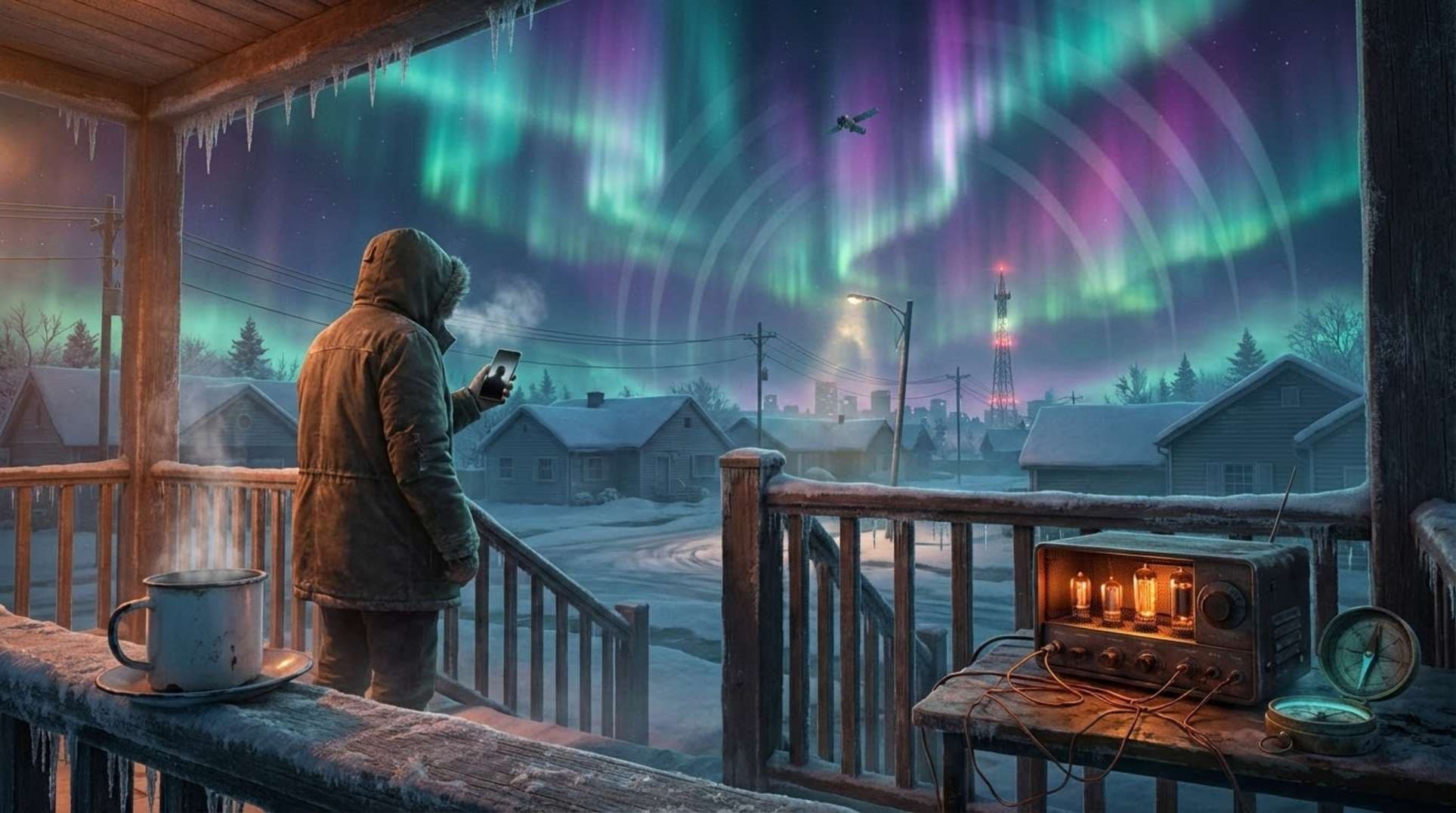
Picture this: It’s late December 2025, and you’re stepping out onto a frost-covered porch in some quiet suburb. The sky lights up—not with holiday decorations, but with shimmering auroras dancing overhead. Forums buzz with urgent posts, livestreams crackle with warnings, and videos spread like wildfire. Community-shared sightings flood in from SpaceWeather.com and SpaceWeatherLive, capturing those eerie lights during geomagnetic windows. Channels like S0 News drop dramatic updates on December 29, tying recent solar activity to buzzwords like ‘micronova’ and magnetic pole headlines. Public interest spikes, fueled by visible auroras, reports of local radio interference, and easy-to-access plots like Kp indices and GOES X-ray data that anyone can pull up in real time. The air feels charged, questions hang heavy. What’s stirring up there, and why now?
What Witnesses and Analysts Report
Across the boards and channels, watchers and preparedness groups are piecing together a narrative that’s got everyone on edge. Claims circulate that a ‘solar micronova’ could hit, posing real threats to Earth—language that’s bubbled up from community discussions, echoed by commentators and even some tabloid pieces. Then there’s the talk of the magnetic poles flipping imminently, with WMM updates cited as proof, showing up in forum threads and blogs focused on survival prep. Observers post about local oddities: unexpected auroras lighting the night, brief power blips disrupting daily life, and radio signals cutting out mid-broadcast. These aren’t just stories; they’re real reports from people on the ground. Amplifiers include the S0 News episode from December 29, recurring themes from Observer Ranch and Space Weather News, and tabloid articles quoting independent voices. It’s a web of experiences and interpretations, shared respectfully among those tracking the signs.
What exactly happened with solar activity in late December 2025?
evidence for a ‘micronova’ from our Sun?
What’s the deal with the magnetic pole shift?
How can I verify these claims myself?
Did officials downplay any risks?
Advertisement
Frequently Asked Questions
What exactly happened with solar activity in late December 2025?
Late December 2025 featured mostly quiet-to-unsettled conditions, with Kp indices at 1–3 and localized aurora sightings reported by the community. NOAA SWPC forecasts confirmed no major storms for December 27–29, though earlier in the month a G3 watch was issued for December 9.
Is there any evidence for a 'micronova' from our Sun?
No peer-reviewed evidence supports micronovae occurring on our Sun or threatening Earth; the term refers to bursts on accreting white dwarfs, as detailed in 2022 papers and press releases. Community claims linking it to solar flares lack a demonstrated physical mechanism.
What's the deal with the magnetic pole shift?
WMM2025 documents the ongoing drift of magnetic north toward Siberia, a measured secular trend, not an imminent flip. Official sources like NOAA NCEI emphasize this as a modeled process, diverging from community narratives of sudden catastrophe.
How can I verify these claims myself?
Cross-check reports against datasets like GOES X-ray plots, ACE/DSCOVR solar-wind data, Kp/Ap indices, and WMM2025 notes. Archive eyewitness posts with timestamps and compare them to official timelines for matches or gaps.
Did officials downplay any risks?
Agencies issued standard watches based on data, acknowledging real impacts like radio interference during active periods. They maintain no evidence for imminent collapse, but visible effects can feel alarming, highlighting needs for better communication and infrastructure prep.
Europe Has Been Quietly Tracking UAP Reports Since 2023
Documents reveal how the European Commission handled UAP images, what it promised to improve, and why Europe still lacks a public investigation office.
Aug 17, 2026 • 8 min read
Ancient Civilizations
1957 Electrogravitics Secret: The Classified Research Program Whose Watchers Have All ‘Gone’
A viral essay claims that classified electrogravitics research made real progress in the 1950s — and that everyone who knew the truth about it has since disappeared from the public record. The story is spreading through high-strangeness forums.
May 14, 2026 • 7 min read
Conspiracy Theories
Ukrainian Defense Ministry Advisor Posts Star-Shaped UAP Video — and the Close-Ups Look Nothing Like a Drone
Serhii ‘Flash’ Beskrestnov released footage of a structured, star-shaped craft over Ukraine that has UFO researchers examining every frame for proof.
May 14, 2026 • 6 min read
Timelines, Tracks, and Hard Data
To sort through this, let’s map the claims against the timelines and datasets available. We pull from NOAA SWPC watches and warnings, GOES X-ray plots, ACE/DSCOVR solar-wind data, Kp/Ap indices, WMM2025 release notes, and the 2022 micronova papers. The S0 News video uploaded on YouTube December 29, 2025, links solar flares, ‘micronova’ ideas, and pole shift finds—use its timestamps for specific quotes. SWPC had a G3 geomagnetic-storm WATCH for December 9, 2025, but forecasts for December 27–29 stayed quiet-to-unsettled with Kp at 1–3, per SpaceWeatherLive and EarthSky coverage on December 28. Solar telemetry from GOES shows flare records, while ACE/DSCOVR tracks wind speed, density, and Bz. WMM2025 from NOAA NCEI details magnetic north’s coordinates and ongoing drift. The 2022 micronova discovery, via ESO release and Reuters, confirms these events on white dwarfs at about 10^-6 the energy of classical novae.
Advertisement
Date/Time (UTC)
Reported Claim/Event
SWPC Advisory or GOES/ACE Reading
Ground Kp/Ap at Time
Source URL for Verification
Dec 9, 2025
G3 geomagnetic-storm activity
G3 WATCH issued
Kp up to 5 (inferred from watch)
SWPC news archive
Dec 27–29, 2025
Quiet-to-unsettled conditions with aurora reports
Routine forecasts
Kp = 1–3
SpaceWeatherLive 3-day forecast
Dec 29, 2025 (upload)
Solar flare and micronova claims in video
GOES X-ray flux plots show minor flares
Kp = 1–3
YouTube S0 News video
April 2022
Micronova discovery announced
N/A (astrophysics papers)
N/A
ESO release and Reuters summary
2025 (WMM release)
Magnetic north drift toward Siberia
WMM2025 model update
N/A
NOAA NCEI announcement
Official Story vs. How People Read the Signals
Agencies lay it out one way; the community sees patterns that don’t always match. NOAA SWPC bases its watches on satellite and model data—from GOES, SOHO, SDO, to ENLIL—issuing public products with measured indices. Geophysics bodies like NOAA NCEI and BGS describe WMM2025 as tracking secular drift, not signaling a sudden catastrophic flip. Astronomy groups, including ESO and Durham, define micronova as a white-dwarf event from April 2022, with no mechanism identified for our Sun. Yet in the community, terms blend: S0 News timestamps show ‘micronova’ equated to a solar super-eruption, and pole motion read as imminent crustal shift. Specific phrases in the December 29 video conflate these. Still, agencies sometimes skim over context, and real effects like auroras or radio noise can hit hard, feeling urgent even without backing for long-term doom.
Open Threads and Tests That Still Matter
Plenty remains open, but we can test it collaboratively. No peer-reviewed work ties short-term solar flares or CMEs to abrupt geomagnetic dipole shifts or rapid geographic pole changes. Gaps persist in data like time-stamped utility outage logs, satellite incident reports, and ground magnetometer archives to confirm any December 2025 infrastructure hits. For verification, cross-check eyewitness accounts of auroras or radio anomalies with GOES X-ray, ACE/DSCOVR timelines, and Kp/Ap indices—archive those posts and videos with timestamps. As reporters, we can request exact timestamps and quotes from S0 News for notes, and compile primary datasets like GOES, ACE/DSCOVR, Kp, and WMM2025 for side-by-side views. Remember, subjective experiences—those lights, those glitches—count as data points worth chasing, investigated without dismissal.
What It All Might Mean
Sorting the signals, some conclusions hold firm. Micronova isn’t a Sun-based threat to Earth, per current literature. WMM2025 tracks ongoing drift, not an imminent flip. Late December 2025 saw quiet-to-unsettled solar activity, with localized auroras but no sustained G1+ storms in forecasts for the 27th to 29th. Real space-weather risks to radio, satellites, and grids do exist—agencies warn for that reason—so monitoring and building resilience matter. For next steps, we’ll annotate S0 News claims with timestamps and source matches, seek utility and satellite statements on December incidents, and share a packet of raw datasets for community checks. Readers, keep separating timed, provable impacts from speculative links. Demand data, push for clarity—from observers and institutions alike.
Frequently Asked Questions
Late December 2025 featured mostly quiet-to-unsettled conditions, with Kp indices at 1–3 and localized aurora sightings reported by the community. NOAA SWPC forecasts confirmed no major storms for December 27–29, though earlier in the month a G3 watch was issued for December 9.
No peer-reviewed evidence supports micronovae occurring on our Sun or threatening Earth; the term refers to bursts on accreting white dwarfs, as detailed in 2022 papers and press releases. Community claims linking it to solar flares lack a demonstrated physical mechanism.
WMM2025 documents the ongoing drift of magnetic north toward Siberia, a measured secular trend, not an imminent flip. Official sources like NOAA NCEI emphasize this as a modeled process, diverging from community narratives of sudden catastrophe.
Cross-check reports against datasets like GOES X-ray plots, ACE/DSCOVR solar-wind data, Kp/Ap indices, and WMM2025 notes. Archive eyewitness posts with timestamps and compare them to official timelines for matches or gaps.
Agencies issued standard watches based on data, acknowledging real impacts like radio interference during active periods. They maintain no evidence for imminent collapse, but visible effects can feel alarming, highlighting needs for better communication and infrastructure prep.
Art Grindstone is the hard-nosed storyteller behind Unexplained.co, a veteran investigator whose life’s work sits at the crossroads of the paranormal, fringe science, and the shadows most people try not to look into. With decades spent chasing impossible stories — black-budget psychic programs, vanished Cold War experiments, desert rituals that sparked UFO waves, and the strange phenomena buried in America’s forgotten backroads — Art brings a rare combination of skepticism, awe, and journalistic precision. He’s not here to debunk. He’s not here to blindly believe. He follows the evidence wherever it leads — even when it leads someplace deeply uncomfortable. Known for his immersive, cinematic style and his ability to turn obscure research into gripping narrative, Art has built a devoted following across podcasts, long-form features, documentaries, and serialized investigations. His interviews are direct. His analysis is unflinching. His voice has become a staple in the modern paranormal renaissance — the guy people turn to when a story is too strange, too complex, or too dangerous for anyone else to touch. Off-mic, Art works with a distributed network of researchers, archivists, and field operatives who help surface the stories mainstream media ignores. On-mic, he transforms their findings into meticulous, high-impact reporting that refuses to insult the intelligence of true believers. His philosophy is simple: Take the phenomenon seriously. Treat the audience with respect. Tell the story as if the world depends on it — because sometimes it does. When Art Grindstone digs into a case, he isn’t just chasing a mystery. He’s tracing the fault lines of reality itself.