Key Takeaways 3I/ATLAS is the third confirmed interstellar object after 1I/ʻOumuamua (2017) and 2I/Borisov (2019); it’s on a hyperbolic (unbound) trajectory, meaning it came from outside the Solar System and will never…
Art Grindstone is the hard-nosed storyteller behind Unexplained.co, a veteran investigator whose life’s work sits at the crossroads of the paranormal, fringe science, and the shadows most people try not to look into. With decades spent chasing impossible stories — black-budget psychic programs, vanished Cold War experiments, desert rituals that sparked UFO waves, and the strange phenomena buried in America’s forgotten backroads — Art brings a rare combination of skepticism, awe, and journalistic precision. He’s not here to debunk. He’s not here to blindly believe. He follows the evidence wherever it leads — even when it leads someplace deeply uncomfortable. Known for his immersive, cinematic style and his ability to turn obscure research into gripping narrative, Art has built a devoted following across podcasts, long-form features, documentaries, and serialized investigations. His interviews are direct. His analysis is unflinching. His voice has become a staple in the modern paranormal renaissance — the guy people turn to when a story is too strange, too complex, or too dangerous for anyone else to touch. Off-mic, Art works with a distributed network of researchers, archivists, and field operatives who help surface the stories mainstream media ignores. On-mic, he transforms their findings into meticulous, high-impact reporting that refuses to insult the intelligence of true believers. His philosophy is simple: Take the phenomenon seriously. Treat the audience with respect. Tell the story as if the world depends on it — because sometimes it does. When Art Grindstone digs into a case, he isn’t just chasing a mystery. He’s tracing the fault lines of reality itself.
6 min · 1,390 words
In This Report(8)
Key Takeaways
3I/ATLAS is the third confirmed interstellar object after 1I/ʻOumuamua (2017) and 2I/Borisov (2019); it’s on a hyperbolic (unbound) trajectory, meaning it came from outside the Solar System and will never return.
Core observables: discovered July 1, 2025 by the ATLAS telescope in Chile at about 4.5 AU from the Sun; perihelion on October 29, 2025 at about 1.4 AU (just inside Mars’ orbit); closest approach to Earth around 1.8 AU (~170 million miles) and no impact risk according to NASA and ESA.
The genuine questions: unusually high CO2 abundance in its coma, detectable nickel emissions, its steady activity without major breakups, and how upcoming Hubble/James Webb images might confirm a purely natural comet—or deepen the debate over artificial or exotic origins.
Nineteen Days Before the Visitor Arrives
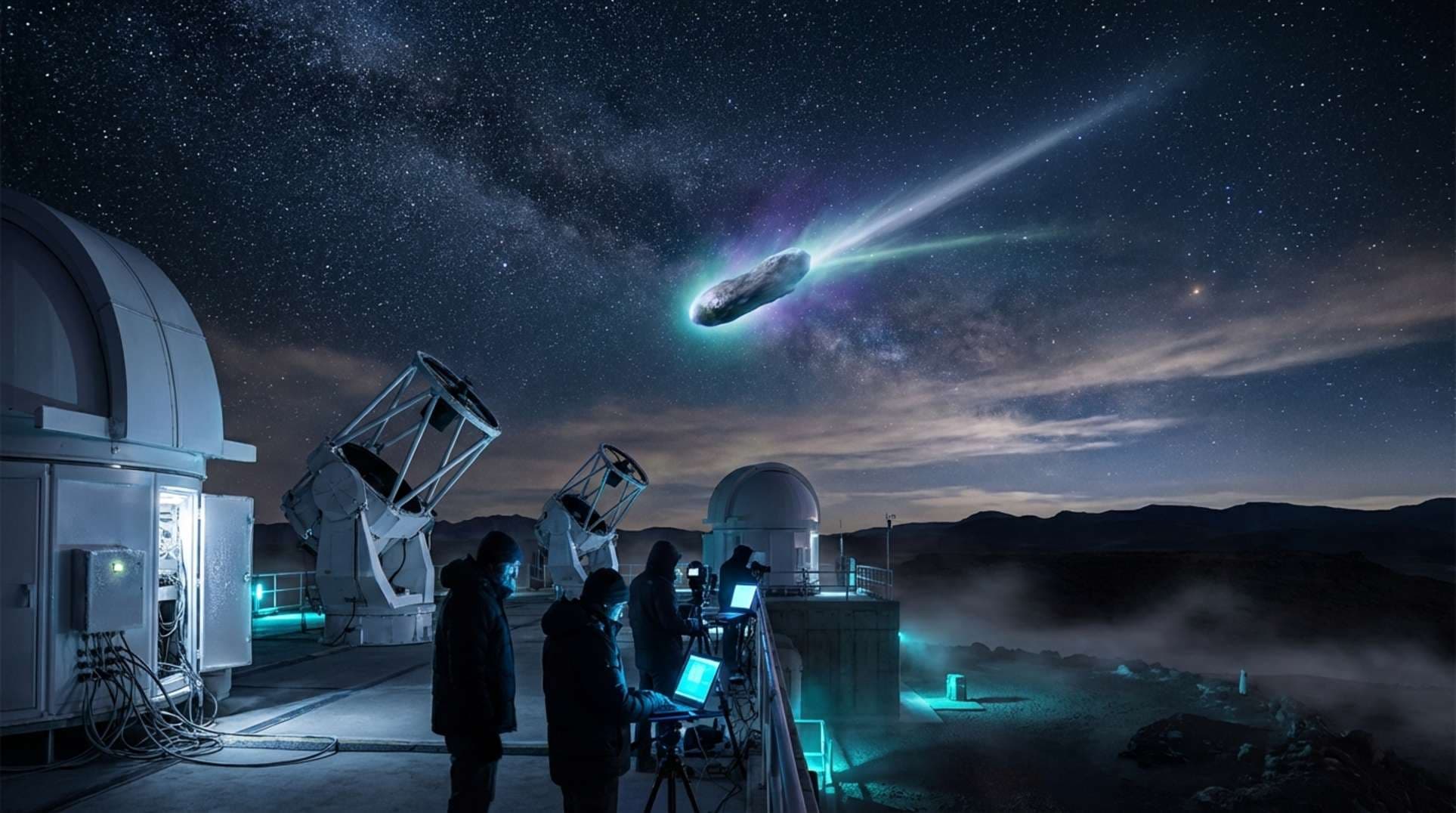
The clocks are ticking. Observatories around the world hum through the night, telescopes trained on a faint streak cutting across the stars. Online forums buzz with countdowns, users refreshing feeds for the latest spectra or snapshots. We’re just 19 days from 3I/ATLAS’s closest pass to Earth, the window when Hubble and the James Webb Space Telescope will deliver their clearest views of this interstellar wanderer. There’s an undercurrent of unease in the air—memories of ʻOumuamua’s unexplained acceleration and Borisov’s more familiar comet traits linger, framing this new arrival as part of something bigger, unresolved.
Picture it: amateur scopes stacking images under dark skies, Reddit threads exploding with dissections of every pixel. At speeds reaching 153,000 mph near perihelion, this Manhattan-sized object barrels through, staying a safe 1.8 AU away. Yet the wait feels heavy. What will those high-res images reveal about its nucleus and coma? We’ve been here before, peering into the unknown, wondering if what’s coming is just rock and ice—or a sign of something more.
What People Around the World Say They’re Seeing
Across platforms like Reddit, X, TikTok, and dedicated forums, the discussions run hot. Many are piecing together patterns, questioning if 3I/ATLAS is more than a natural comet—perhaps an artificial craft, a probe, or even a mothership releasing smaller units as it traverses the outer system. These ideas draw from visual clues and behaviors that don’t quite fit the standard mold.
Advertisement
Amateurs report a “weird tail” with anti-tail features—dust seeming to point toward the Sun instead of away—along with brightness fluctuations in the coma that appear more controlled than the erratic crumbling of typical comets. Some link it to broader lore, speculating ties to events like the 1908 Tunguska explosion, imagining prior passes or debris, even as the observed hyperbolic path rules out Solar System origins.
What is 3I/ATLAS and why is it significant?
Is 3I/ATLAS a threat to Earth?
What evidence suggests it might not be a natural comet?
When will we get better data on 3I/ATLAS?
How do official explanations differ from community interpretations?
Advertisement
Frequently Asked Questions
What is 3I/ATLAS and why is it significant?
3I/ATLAS is the third confirmed interstellar object, following ʻOumuamua and Borisov, on a hyperbolic trajectory from outside our Solar System. Its significance lies in unusual features like high CO2 abundance and nickel emissions, sparking debates over natural versus artificial origins, especially with upcoming high-res images from Hubble and James Webb.
Is 3I/ATLAS a threat to Earth?
According to NASA and ESA, it poses no impact risk, with closest approach at about 1.8 AU or 170 million miles. Official assessments emphasize this as a closed question, though some observers question if anomalies are being downplayed.
What evidence suggests it might not be a natural comet?
Community reports highlight steady activity without breakups, anti-tail features resembling directed jets, unusual chemistry like high CO2 and nickel, and potential image inconsistencies. Figures like Avi Loeb have speculated on artificial possibilities, such as probe deployment, though mainstream views hold it's a natural object until proven otherwise.
When will we get better data on 3I/ATLAS?
We're 19 days from its closest pass, when Hubble and James Webb are set to capture sharpest images. New spectra and analyses from missions like MAVEN, Psyche, and Lucy will add details, with some data hitting public archives for independent review.
How do official explanations differ from community interpretations?
Agencies describe it as a natural comet with exciting but explainable traits, like tail geometry from viewing angles. Observers see patterns suggesting artificiality, such as controlled activity or engineered materials, pointing to a trust gap fueled by past handling of anomalies.
The Pentagon Released More UAP Files—but Not the Data Needed to Solve Them
The Pentagon’s fifth UAP release reveals cold orbs and a giant triangle—but missing sensor data keeps its strangest cases unresolved and untested.
Aug 17, 2026 • 10 min read
UFO & Aliens
Europe Has Been Quietly Tracking UAP Reports Since 2023
Documents reveal how the European Commission handled UAP images, what it promised to improve, and why Europe still lacks a public investigation office.
Aug 17, 2026 • 8 min read
Ancient Civilizations
1957 Electrogravitics Secret: The Classified Research Program Whose Watchers Have All ‘Gone’
A viral essay claims that classified electrogravitics research made real progress in the 1950s — and that everyone who knew the truth about it has since disappeared from the public record. The story is spreading through high-strangeness forums.
May 14, 2026 • 7 min read
There’s talk of image inconsistencies too: differences between raw frames and the polished versions from agencies, raising suspicions of color tweaks or composites that might hide details. Avi Loeb’s comments add weight—he’s suggested interstellar objects could deploy probes near planets like Jupiter, which resonates here as a nod from academia to what many feel intuitively. And a recurring theme emerges: these visitors show up, officials downplay anything unusual, but anomalies persist, fueling the sense of a pattern that’s been ignored too long.
Timelines, Tracks, and the Hard Numbers on 3I/ATLAS
Let’s ground this in the verifiable data. 3I/ATLAS was first detected on July 1, 2025, by the ATLAS telescope in Chile, initially pegged as a cometary body at about 4.5 AU from the Sun. Its hyperbolic orbit—eccentricity over 1—confirms it’s not bound to our Sun, hailing from interstellar space.
Key milestones: perihelion hit on October 29, 2025, at 1.4 AU, just inside Mars’ orbit. Closest to Earth? Around 1.8 AU, or 170 million miles. Speeds peaked at 153,000 mph near the Sun, fitting for an object slung through the gravity well. The nucleus is estimated at 10–20 km across, roughly Manhattan-sized, with an active coma and evolving dust tail visible since at least May 2025.
Spectra reveal high CO2 in the coma and nickel emissions—standouts that spark both scientific interest and speculation. Missions like MAVEN, Psyche, and Lucy have grabbed opportunistic data, cross-verifying ground observations.
Metric
Details
Discovery Date
July 1, 2025
Perihelion Date
October 29, 2025
Closest Approach to Earth
~1.8 AU (170 million miles)
Maximum Observed Speed
~153,000 mph (246,000 km/h)
Distance at Discovery
~4.5 AU (410 million miles)
Estimated Size
10–20 km diameter
How the Agencies Explain It—and How Others Read the Same Data
On the orbit: The official line says it’s a natural interstellar comet on a hyperbolic trajectory, ejected from another star system, with ice and dust responding to solar heat. Engaged observers interpret this as potentially masking a guided path, noting how the steady track avoids easy dismissal of artificial navigation.
On composition: Agencies see the high CO2 and nickel as markers of a unique formation environment, exciting for science. Observers counter that these ratios resemble engineered materials or exhaust, not just random cosmic quirks, especially given the object’s stability.
On morphology: Tail and anti-tail are chalked up to viewing angles and dust alignment, common in comets. But skeptics highlight the features’ sharpness and persistence, suggesting directed jets or thrusters rather than passive ejection.
On imaging: Official releases emphasize composited, color-mapped visuals for clarity, with some raw data available. Communities point to discrepancies between versions, arguing this echoes past missions where edits hid sensitive details, leaving trust issues in play.
The Gaps in the Data—and the Questions No One Can Yet Answer
Plenty remains open, acknowledged on all sides. The exact stellar nursery of 3I/ATLAS is unknown—its CO2 richness and nickel hint at a colder, distinct birthplace, but without more, it’s guesswork.
Advertisement
Dynamically, we lack its full galactic backstory; models offer probabilities, but no precise trail. Its steady activity, avoiding major breakups despite size and solar proximity, puzzles even experts, defying easy simulations.
With only three interstellar objects known, ‘normal’ is undefined—what seems odd in 3I/ATLAS might prove standard as more arrive. And until Hubble and Webb’s peak images drop, nucleus details are fuzzy, forcing extrapolations that could swing either way with new data.
These aren’t traps but the edge of what we know. Speculation fills the voids, and incoming observations might reshape everything.
What 3I/ATLAS Might Still Be Hiding
We know this much: 3I/ATLAS is interstellar, hyperbolic, clocking 153,000 mph at perihelion, and keeping 1.8 AU from Earth. Teams worldwide confirm its comet-like traits.
But the edges intrigue—elevated CO2, nickel, and intact passage through perihelion mark it as unusual, even among rarities. Cover-up claims lack direct proof, yet history shows agencies favoring safe stories, breeding skepticism.
Watch for Hubble/Webb shots, refined spectra, and emerging papers; public archives will let you dig in. Strong artificial signs? Non-gravitational shifts beyond outgassing, geometric structures, or cross-instrument oddities. Natural lean? Consistent comet models fitting all data.
Either way, it pushes us to sit with the unknown, chasing truth over comfort. Stay tuned—the next weeks could change the conversation.
Frequently Asked Questions
3I/ATLAS is the third confirmed interstellar object, following ʻOumuamua and Borisov, on a hyperbolic trajectory from outside our Solar System. Its significance lies in unusual features like high CO2 abundance and nickel emissions, sparking debates over natural versus artificial origins, especially with upcoming high-res images from Hubble and James Webb.
According to NASA and ESA, it poses no impact risk, with closest approach at about 1.8 AU or 170 million miles. Official assessments emphasize this as a closed question, though some observers question if anomalies are being downplayed.
Community reports highlight steady activity without breakups, anti-tail features resembling directed jets, unusual chemistry like high CO2 and nickel, and potential image inconsistencies. Figures like Avi Loeb have speculated on artificial possibilities, such as probe deployment, though mainstream views hold it’s a natural object until proven otherwise.
We’re 19 days from its closest pass, when Hubble and James Webb are set to capture sharpest images. New spectra and analyses from missions like MAVEN, Psyche, and Lucy will add details, with some data hitting public archives for independent review.
Agencies describe it as a natural comet with exciting but explainable traits, like tail geometry from viewing angles. Observers see patterns suggesting artificiality, such as controlled activity or engineered materials, pointing to a trust gap fueled by past handling of anomalies.
Art Grindstone is the hard-nosed storyteller behind Unexplained.co, a veteran investigator whose life’s work sits at the crossroads of the paranormal, fringe science, and the shadows most people try not to look into. With decades spent chasing impossible stories — black-budget psychic programs, vanished Cold War experiments, desert rituals that sparked UFO waves, and the strange phenomena buried in America’s forgotten backroads — Art brings a rare combination of skepticism, awe, and journalistic precision. He’s not here to debunk. He’s not here to blindly believe. He follows the evidence wherever it leads — even when it leads someplace deeply uncomfortable. Known for his immersive, cinematic style and his ability to turn obscure research into gripping narrative, Art has built a devoted following across podcasts, long-form features, documentaries, and serialized investigations. His interviews are direct. His analysis is unflinching. His voice has become a staple in the modern paranormal renaissance — the guy people turn to when a story is too strange, too complex, or too dangerous for anyone else to touch. Off-mic, Art works with a distributed network of researchers, archivists, and field operatives who help surface the stories mainstream media ignores. On-mic, he transforms their findings into meticulous, high-impact reporting that refuses to insult the intelligence of true believers. His philosophy is simple: Take the phenomenon seriously. Treat the audience with respect. Tell the story as if the world depends on it — because sometimes it does. When Art Grindstone digs into a case, he isn’t just chasing a mystery. He’s tracing the fault lines of reality itself.