Key Takeaways 3I/ATLAS is an interstellar (hyperbolic) comet discovered by the ATLAS survey and reported to the Minor Planet Center on 1 July 2025 (NASA). Multiple teams observed sudden jetting, rapid brightening, and…
Art Grindstone is the hard-nosed storyteller behind Unexplained.co, a veteran investigator whose life’s work sits at the crossroads of the paranormal, fringe science, and the shadows most people try not to look into. With decades spent chasing impossible stories — black-budget psychic programs, vanished Cold War experiments, desert rituals that sparked UFO waves, and the strange phenomena buried in America’s forgotten backroads — Art brings a rare combination of skepticism, awe, and journalistic precision. He’s not here to debunk. He’s not here to blindly believe. He follows the evidence wherever it leads — even when it leads someplace deeply uncomfortable. Known for his immersive, cinematic style and his ability to turn obscure research into gripping narrative, Art has built a devoted following across podcasts, long-form features, documentaries, and serialized investigations. His interviews are direct. His analysis is unflinching. His voice has become a staple in the modern paranormal renaissance — the guy people turn to when a story is too strange, too complex, or too dangerous for anyone else to touch. Off-mic, Art works with a distributed network of researchers, archivists, and field operatives who help surface the stories mainstream media ignores. On-mic, he transforms their findings into meticulous, high-impact reporting that refuses to insult the intelligence of true believers. His philosophy is simple: Take the phenomenon seriously. Treat the audience with respect. Tell the story as if the world depends on it — because sometimes it does. When Art Grindstone digs into a case, he isn’t just chasing a mystery. He’s tracing the fault lines of reality itself.
5 min · 1,194 words
In This Report(8)
Key Takeaways
3I/ATLAS is an interstellar (hyperbolic) comet discovered by the ATLAS survey and reported to the Minor Planet Center on 1 July 2025 (NASA).
Multiple teams observed sudden jetting, rapid brightening, and spectral features; some authors describe these as consistent with cryovolcanic-style eruptions or rapid surface activation as the object warmed.
OSIRIS-REx samples from Bennu (returned Sept 24, 2023; lab papers 2024–2025) show abundant organics, phyllosilicates, magnetite and prebiotic precursors — relevant analogues but not evidence of life.
Unresolved: whether 3I/ATLAS’s activity represents true internal cryovolcanism, a surface sublimation process, or a hybrid; and whether small bodies like this could host environments or magnetic processes sufficient for prebiotic chemistry or life.
A Quiet Wake-Up Call in Deep Space
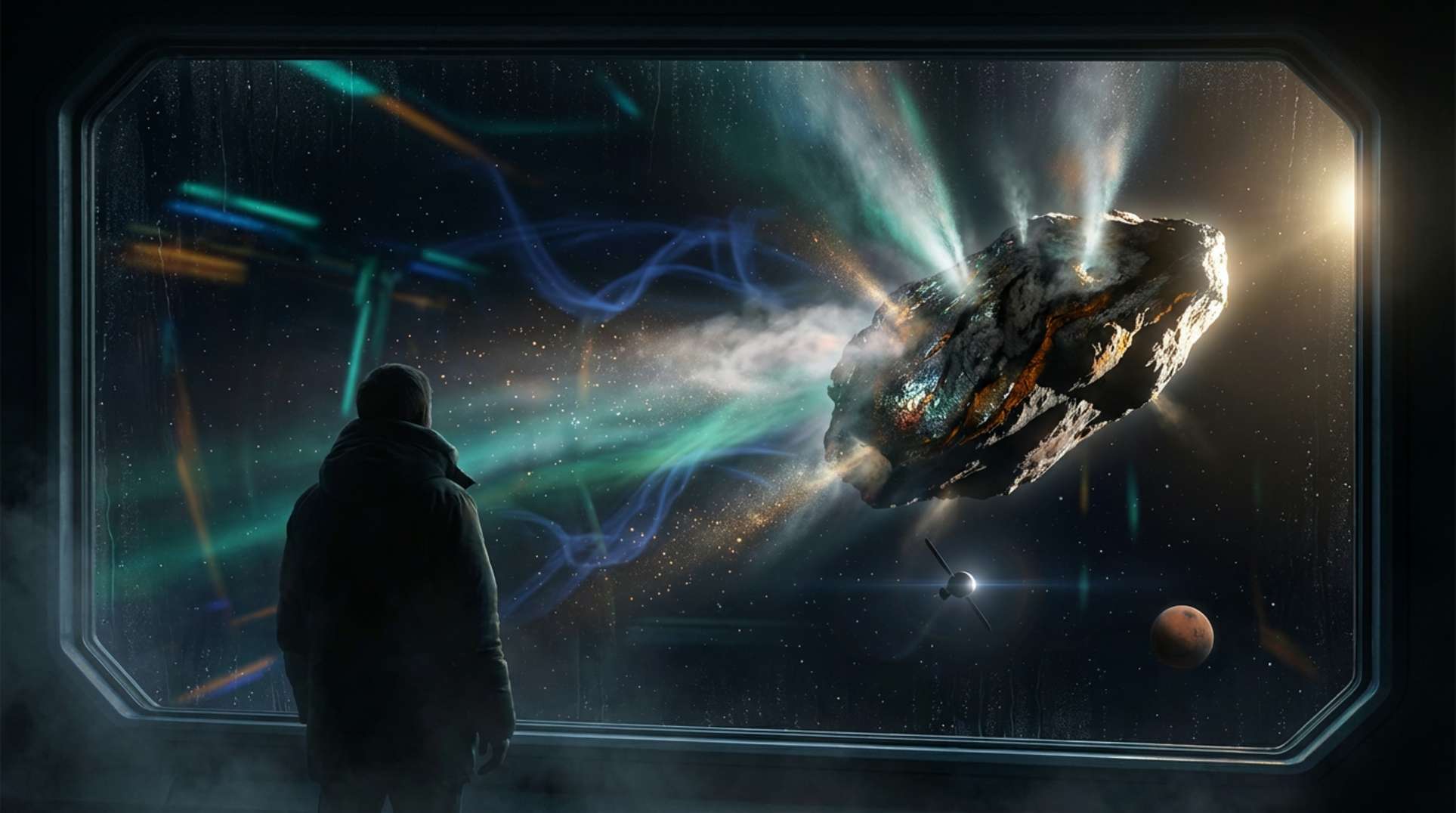
Picture it: a frozen wanderer from beyond our solar system, hurtling through the void for eons, silent and dark. Then, as it sweeps into the inner reaches, closing in on the Sun, something shifts. Perihelion hits around 29–30 October 2025, at about 203 million km from that blazing star. Solar conjunction blocks much of our Earth-based view during the closest pass, leaving gaps in the optical record.
Before that, it grazed near Mars on ~3 October 2025, just 0.194 AU away, clocking speeds up to 137,000 mph at discovery and accelerating as it dove inward. Hubble and other space assets caught glimpses—images from Psyche and mission updates show the approach in stark detail. The cold intruder, indifferent to our gaze, suddenly flares. Jets erupt. Brightness spikes. What was dormant now roars to life, a dramatic turn that raises questions we can’t ignore.
What Witnesses and Independent Analysts Reported
Across online forums and video channels, reports poured in from those tracking the skies. Independent researchers like Stefan Burns highlighted a surge in activity once 3I/ATLAS hit ~2.5 AU, calling it a global cryovolcanic event. In one video, Burns points to timing and spectral shifts: “This isn’t just ice turning to gas; we’re seeing eruptions that could generate organics or even local magnetic fields—prime for seeding life.”
Advertisement
Amateur astronomers echoed this in places like r/HighStrangeness, sharing images of jets and debating the Interstellar Seed Hypothesis. One forum post noted, “The rapid brightening screams cryovolcanism, not plain sublimation—think metal-rich reactions driving exotic outgassing.” Meanwhile, r/space and r/astronomy users urged caution, sticking to primary data: “Jets are clear in the spectra, but let’s not jump to panspermia without isotopic proof.”
What exactly happened with 3I/ATLAS?
Is there evidence linking this to life or seeding?
How did officials respond to the event?
What are the biggest unknowns?
How can I follow up on this?
Advertisement
Frequently Asked Questions
What exactly happened with 3I/ATLAS?
3I/ATLAS, an interstellar comet, was discovered on 1 July 2025 and showed sudden jetting and brightening as it approached the Sun, with perihelion around 29–30 October 2025. Observations suggest cryovolcanic-style activity, but the exact mechanism remains unclear.
Is there evidence linking this to life or seeding?
Spectral data show carbonaceous materials and organics similar to Bennu samples, which contain prebiotic precursors but no life. Independent analysts propose seeding hypotheses, but these are speculative without direct proof like complex isotopes or magnetic fields.
How did officials respond to the event?
NASA classified it as interstellar, coordinated observations, and stated it poses no threat to Earth. They emphasize careful data analysis and caution against overinterpretation, contrasting with community views on cryovolcanism and seeding.
What are the biggest unknowns?
Key gaps include whether the activity is true cryovolcanism or surface sublimation, if small bodies can generate magnetic fields, and how compositional similarities to Bennu inform interstellar chemistry. Solar conjunction limited perihelion data.
How can I follow up on this?
Check arXiv preprints, NASA mission updates, and forums like r/space for new data. Advocate for future missions with magnetometry and coma analysis to test hypotheses.
1957 Electrogravitics Secret: The Classified Research Program Whose Watchers Have All ‘Gone’
A viral essay claims that classified electrogravitics research made real progress in the 1950s — and that everyone who knew the truth about it has since disappeared from the public record. The story is spreading through high-strangeness forums.
May 14, 2026 • 7 min read
Conspiracy Theories
Japan Just Confirmed It Has UAP Footage, and Is Analyzing Pentagon Files Near Its Borders
Japan’s formal entry into the UAP transparency wave signals an international domino effect. What the country knows about UAP encounters near Japanese territory and why it matters now.
May 14, 2026 • 5 min read
Conspiracy Theories
Ukrainian Defense Ministry Advisor Posts Star-Shaped UAP Video — and the Close-Ups Look Nothing Like a Drone
Serhii ‘Flash’ Beskrestnov released footage of a structured, star-shaped craft over Ukraine that has UFO researchers examining every frame for proof.
May 14, 2026 • 6 min read
Content creators amplified these ideas, framing the comet as a potential carrier of prebiotic materials. They cite CO detections and water signals as hints of deeper processes, pushing narratives of intentional seeding without claiming proof. These voices build their cases on shared observations, respecting the data while exploring bold edges.
Timelines, Tracks, and Hard Data
The facts anchor everything. Discovery came on 1 July 2025, reported to the Minor Planet Center via NASA’s ATLAS survey. Perihelion followed on ~29–30 October 2025 at ≈203 million km from the Sun, with Earth conjunction cutting optical monitoring. Closest Earth approach is forecasted for ~19 December 2025 at ≈1.8 AU. The Mars flyby happened ~3 October 2025 at 0.194 AU.
Nucleus size estimates range from ≳440 m to ≤5.6 km, based on observational limits from NASA teams. Velocity at discovery: ~137,000 mph (~221,000 km/h), on a hyperbolic orbit confirming its interstellar roots. Spectra show carbonaceous and metal-bearing signatures, with CO and water detections; preprint papers invoke cryovolcanism as a model.
For context, OSIRIS-REx returned Bennu samples on 24 Sept 2023, with 2024–2025 analyses revealing organics, phyllosilicates, magnetite, sugars, and prebiotic precursors—no life, but clear building blocks (NASA, NTRS, Smithsonian).
NASA labels 3I/ATLAS interstellar, coordinates observations, and insists it poses no Earth threat. Agency statements stress data collection: “We’re gathering spectra and images carefully—activity is notable, but interpretations need rigor” (NASA science page).
A spectrophotometric preprint echoes this, reporting primitive carbonaceous reflectance and proposing cryovolcanism as an analogy: “Jets align with volatile eruptions, but we can’t confirm internal sources without more data” (Astrobiology coverage).
Independents push further. Stefan Burns and forum analysts see global cryovolcanism, linking it to magnetic fields and seeding: “This could be a life factory” (video paraphrase). Direct observations back jets and brightening, but mechanisms split: sublimation (official lean) vs. internal eruptions (community view). Bennu overlaps in composition, yet interstellar origins differ—no shared history assumed. Peer caution contrasts community boldness; evidence supports activity, not speculative leaps.
How Far Can the Evidence Carry the Seed Hypothesis?
Could a body this small—sub-km to a few km—hold internal reservoirs for true cryovolcanism? Physics scaling suggests doubts; pressure might not build enough without larger mass. Magnetic fields? Possible if metal reactions churn, but measurements are absent.
Advertisement
Chemically, Bennu’s organics and precursors offer parallels, yet thermal histories diverge. Prebiotic chemistry needs sustained conditions—jets might create fleeting microenvironments, but evidence is thin. Imagine ejected fragments with complex isotopes; that could hint at seeding.
To test: in situ magnetometry, coma analysis for organics, fragment detection. Solar conjunction hid perihelion details, though spacecraft like Psyche grabbed data. Planetary scientists note: “Small bodies activate, but magnetism and habitability stretch feasibility” (geophysicist quote). Speculative, yes—but gaps invite scrutiny.
What It All Might Mean
Strongest points: hyperbolic orbit proves interstellar travel, jets and spectra confirm activation with carbonaceous metals, Bennu samples show small bodies carry organic complexity and altered minerals.
unknowns loom. Is it sublimation or cryovolcanism? Can these objects spark magnetic fields or viable niches? Similarities to Bennu—shared processes or fluke?
Track arXiv updates, mission datasets, push for magnetometry in future probes. Here’s an invite: dig into the sources, test the ideas. The patterns tease panspermia possibilities, demanding bold questions and sharp evidence.
Frequently Asked Questions
3I/ATLAS, an interstellar comet, was discovered on 1 July 2025 and showed sudden jetting and brightening as it approached the Sun, with perihelion around 29–30 October 2025. Observations suggest cryovolcanic-style activity, but the exact mechanism remains unclear.
Spectral data show carbonaceous materials and organics similar to Bennu samples, which contain prebiotic precursors but no life. Independent analysts propose seeding hypotheses, but these are speculative without direct proof like complex isotopes or magnetic fields.
NASA classified it as interstellar, coordinated observations, and stated it poses no threat to Earth. They emphasize careful data analysis and caution against overinterpretation, contrasting with community views on cryovolcanism and seeding.
Key gaps include whether the activity is true cryovolcanism or surface sublimation, if small bodies can generate magnetic fields, and how compositional similarities to Bennu inform interstellar chemistry. Solar conjunction limited perihelion data.
Check arXiv preprints, NASA mission updates, and forums like r/space for new data. Advocate for future missions with magnetometry and coma analysis to test hypotheses.
↑
06
How Far Can the Evidence Carry the Seed Hypothesis?
Art Grindstone is the hard-nosed storyteller behind Unexplained.co, a veteran investigator whose life’s work sits at the crossroads of the paranormal, fringe science, and the shadows most people try not to look into. With decades spent chasing impossible stories — black-budget psychic programs, vanished Cold War experiments, desert rituals that sparked UFO waves, and the strange phenomena buried in America’s forgotten backroads — Art brings a rare combination of skepticism, awe, and journalistic precision. He’s not here to debunk. He’s not here to blindly believe. He follows the evidence wherever it leads — even when it leads someplace deeply uncomfortable. Known for his immersive, cinematic style and his ability to turn obscure research into gripping narrative, Art has built a devoted following across podcasts, long-form features, documentaries, and serialized investigations. His interviews are direct. His analysis is unflinching. His voice has become a staple in the modern paranormal renaissance — the guy people turn to when a story is too strange, too complex, or too dangerous for anyone else to touch. Off-mic, Art works with a distributed network of researchers, archivists, and field operatives who help surface the stories mainstream media ignores. On-mic, he transforms their findings into meticulous, high-impact reporting that refuses to insult the intelligence of true believers. His philosophy is simple: Take the phenomenon seriously. Treat the audience with respect. Tell the story as if the world depends on it — because sometimes it does. When Art Grindstone digs into a case, he isn’t just chasing a mystery. He’s tracing the fault lines of reality itself.