

Key Takeaways
- The verifiable record shows documented space-weather activity in mid-January 2026, with NOAA/SWPC issuing elevated geomagnetic watches and forecasts up to Kp ≈5 for January 17–18, alongside an X1.9 solar flare and a likely full-halo CME.
- Independent analysts assert that this solar activity, combined with planetary alignments, could trigger major earthquakes through energetic convergences, raising probabilities for seismic events.
- What remains unresolved is any widely accepted mechanism linking solar storms or alignments to high-magnitude earthquakes globally; such claims need rigorous statistical and physical proof to hold up.
A Day the Sky Stuttered
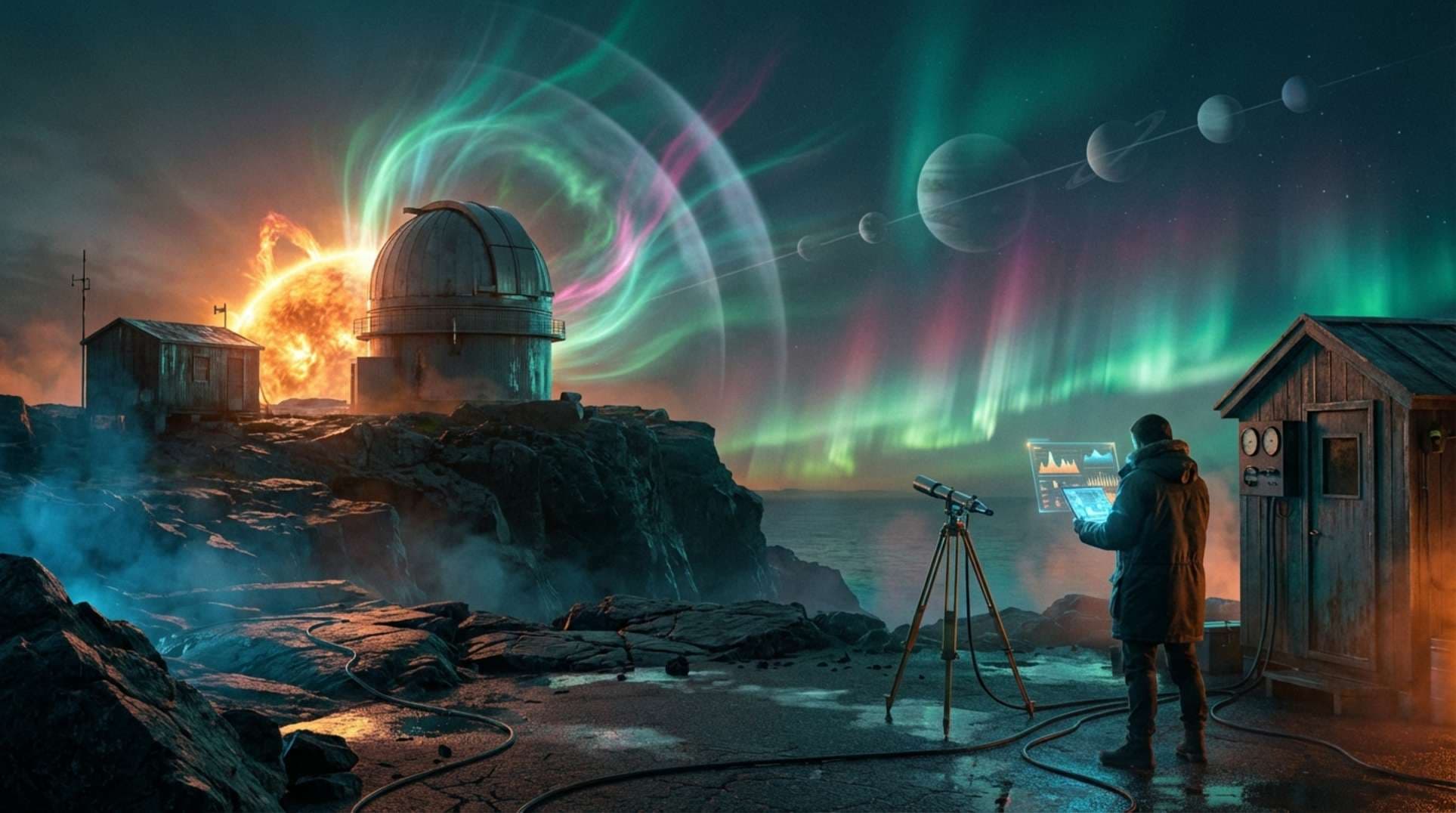
The air hummed with tension that mid-January day in 2026. Alerts pinged across devices as NOAA’s Space Weather Prediction Center rolled out geomagnetic watches, forecasting Kp levels climbing to 5. Online, forums lit up with shared images of shimmering auroras stretching farther south than usual. News outlets and observatories broadcast visuals of a massive X1.9 flare erupting from the sun, its long-duration fury captured in NASA visualizations, hinting at a full-halo coronal mass ejection barreling toward Earth. Communities on YouTube, X, Rumble, and Reddit amplified the warnings, debating the implications in real time. This came amid the fresh deployment of the SWFO-L1 and SOLAR-1 magnetometers, enhancing our observational edge just as the event unfolded.
What Witnesses and Analysts Report
Voices from the community carried weight that day. Stefan Burns dropped a video on January 18, 2026, titled “BREAKING – Earth just Passed the Tipping Point,” where he outlined an energetic convergence blending planetary geometry, solar activity, and Earth’s own resonance. He and like-minded researchers argue that alignments amp up tidal and energetic forces, while solar flares and geomagnetic pulses might couple into the planet’s systems, potentially triggering fault ruptures. They mark certain dates as tipping points, sharing timelines, geometry charts, and energy index plots across YouTube, podcasts, personal sites, X, and Rumble. Reactions varied—supporters echoed the forecast windows and precursor signals, stirring genuine concern, while debates flared on Reddit and professional forums, pushing for stronger stats and mechanisms.
Timelines, Tracks, and Hard Data
Let’s get forensic with the records. NOAA/SWPC’s 3-day geomagnetic forecasts and alerts showed peaks around Kp 5 for January 17–18, 2026—check their products directly for confirmation. The X1.9 flare from AR4341 kicked off around 17:27 UTC on January 18, peaking and winding down by 18:51 UTC, with coronagraphs signaling a full-halo CME, as per NASA visualizations and Watchers.news reports. For context, the SWFO-L1 and SOLAR-1 magnetometers were operational by then, feeding real-time data from L1. Pulling the Kp/AP time-series for January 15–21, 2026, reveals observed values aligning with forecasts. USGS seismic catalogs for the 72 hours bracketing January 18 list several events, but no unusual clustering stands out statistically.
What exactly happened with the solar activity in January 2026? Did this event cause any earthquakes? How did officials respond to the space-weather event? What evidence supports the alternative claims? How can I verify the data myself?