Key Takeaways Timewave Zero, or Novelty Theory, maps time as a fractal based on the I Ching’s 64 hexagrams and 384 changing lines, first outlined in The Invisible Landscape in 1975. McKenna linked a ‘zero date’ to…
Art Grindstone is the hard-nosed storyteller behind Unexplained.co, a veteran investigator whose life’s work sits at the crossroads of the paranormal, fringe science, and the shadows most people try not to look into. With decades spent chasing impossible stories — black-budget psychic programs, vanished Cold War experiments, desert rituals that sparked UFO waves, and the strange phenomena buried in America’s forgotten backroads — Art brings a rare combination of skepticism, awe, and journalistic precision. He’s not here to debunk. He’s not here to blindly believe. He follows the evidence wherever it leads — even when it leads someplace deeply uncomfortable. Known for his immersive, cinematic style and his ability to turn obscure research into gripping narrative, Art has built a devoted following across podcasts, long-form features, documentaries, and serialized investigations. His interviews are direct. His analysis is unflinching. His voice has become a staple in the modern paranormal renaissance — the guy people turn to when a story is too strange, too complex, or too dangerous for anyone else to touch. Off-mic, Art works with a distributed network of researchers, archivists, and field operatives who help surface the stories mainstream media ignores. On-mic, he transforms their findings into meticulous, high-impact reporting that refuses to insult the intelligence of true believers. His philosophy is simple: Take the phenomenon seriously. Treat the audience with respect. Tell the story as if the world depends on it — because sometimes it does. When Art Grindstone digs into a case, he isn’t just chasing a mystery. He’s tracing the fault lines of reality itself.
5 min · 1,086 words
In This Report(8)
Key Takeaways
Timewave Zero, or Novelty Theory, maps time as a fractal based on the I Ching’s 64 hexagrams and 384 changing lines, first outlined in The Invisible Landscape in 1975.
McKenna linked a ‘zero date’ to December 21, 2012, often specified as 6:00 a.m. in La Chorrera, Colombia, though he passed in 2000 and occasionally downplayed its literal meaning; critics like Matthew Watkins pointed out arbitrary steps in the math, while supporters like Peter Meyer and John Sheliak developed software and variants.
Unresolved issues include whether ‘novelty’ can be measured objectively for testing, if mathematical critiques hold up against revisions, and how much of the perceived acceleration stems from real cultural shifts versus pattern-seeking.
A Glimpse into the Amazon’s Timeless Shadows
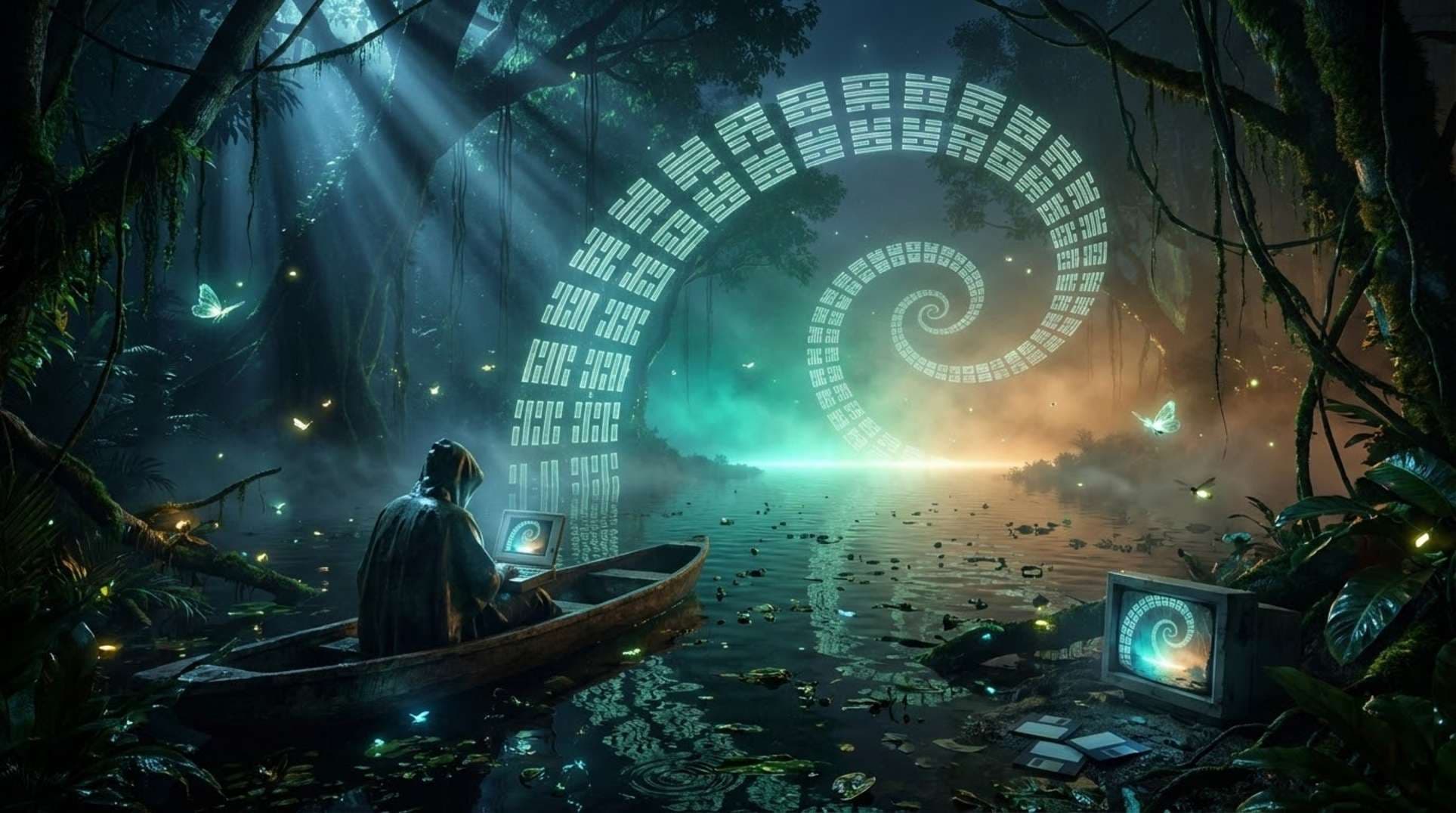
In the dense Amazon jungle of 1971, Terence McKenna and his brother Dennis chased visions that would reshape their understanding of time. Amid hallucinogenic experiments in La Chorrera, an idea took root: time as a waveform, building toward a peak of infinite novelty. Fast-forward to the digital age, and this concept evolves into the Timewave—a fractal graph plotted on computers, shared across bulletin boards, and tied to the Mayan calendar’s end on December 21, 2012.
Picture the contrast: humid nights filled with otherworldly insights versus glowing screens in the 1990s, where enthusiasts mapped history’s twists onto descending waves. As 2012 neared, headlines screamed doomsday, but the waveform whispered something subtler—a convergence point, laced with mystery and a quiet undercurrent of dread.
Voices from the Community and the Skeptics
McKenna described Novelty Theory as a chart of history’s increasing complexity, with ‘novelty’ spiking at key moments. Followers split on its use: some saw it as a tool for forecasting events, others as a metaphor for personal and cultural shifts. Reports from the community often highlight synchronicities around the turn of the millennium or in 2012 itself—not world-ending cataclysms, but a felt acceleration in ideas, tech, and connections.
Advertisement
Experiencers speak of qualitative changes, like waves of innovation crashing faster. Enthusiasts built on this, creating Timewave software with McKenna and Peter Meyer in the 1980s and 1990s, still discussed in forums with alternate versions. Critics, including mathematicians, label it numerology, spotting apophenia in the patterns. Matthew Watkins’ 1994 objection called out arbitrary choices in the math. Even McKenna hedged in later talks, suggesting it might not be a strict prediction, which fuels ongoing debates.
Tracking the Dates and the Data
What exactly is Timewave Zero?
Did anything happen on December 21, 2012?
What do critics say about the Timewave?
Why does this theory still matter?
How was the Timewave created?
Frequently Asked Questions
What exactly is Timewave Zero?
Timewave Zero is a fractal map of time based on the I Ching's structure, developed by Terence McKenna to chart increasing 'novelty' in history. It was first described in The Invisible Landscape in 1975 and linked to a zero point on December 21, 2012.
Did anything happen on December 21, 2012?
No singular global event matched apocalyptic predictions, but some in the community reported personal synchronicities and a sense of cultural acceleration. Official sources treated it as a Mayan calendar cycle end without catastrophe.
What do critics say about the Timewave?
Critics like Matthew Watkins argue the mathematical transforms are arbitrary, calling it numerology or pattern-fitting after the fact. Enthusiasts have produced revisions, but debates continue on its reproducibility and predictive power.
Why does this theory still matter?
It highlights intersections of mysticism, math, and cultural change, influencing discussions on synchronicity and acceleration. For those exploring fringe science, it raises questions about testing extraordinary claims.
How was the Timewave created?
It stems from McKenna's 1971 Amazon experiences, transformed into a fractal waveform using I Ching hexagrams. Software versions were developed with Peter Meyer in the 1980s and 1990s, with archives still available.
Two New Loch Ness Reports Bring 2026 Sightings to 13—But What Was Actually Seen?
Two new reported encounters bring the 2026 Loch Ness sighting count to 13. Here is what the reports establish—and what they do not.
Aug 26, 2026 • 6 min read
Articles
Two New Loch Ness Reports Bring 2026 Sightings to 13: But What Was Actually Seen?
Two new reported encounters bring the 2026 Loch Ness sighting count to 13. Here is what the reports establish and what they do not.
Aug 24, 2026 • 6 min read
Articles
Hidden in Every Human Genome: Two ‘Ghost’ Ancestors Science Has Never Found
A new Science study finds that everyone alive carries DNA from at least one unknown human ancestor. The fossils are still missing—but the genetic signal spans the globe.
Aug 21, 2026 • 9 min read
The concept first surfaced in print through Terence and Dennis McKenna’s The Invisible Landscape in 1975. At its core, the Timewave draws from the I Ching’s 64 hexagrams and 384 lines, transformed into a fractal map of time.
McKenna worked with Peter Meyer to develop Timewave Zero software through the 1980s and 1990s; you can still find archived versions and applets online, like those in fractal-timewave repositories. The zero point was pegged to December 21, 2012, down to 6:00 a.m. local time in La Chorrera, with a final cycle spanning about 67.29 years or 24,576 days.
Matthew Watkins hit back in 1994 with his objection, questioning the math’s foundations and sparking revisions. McKenna died on April 3, 2000, missing the date entirely. Outlets like the Smithsonian, National Geographic, NASA, and Scientific American framed 2012 as just a Mayan calendar rollover, issuing pieces to counter apocalyptic fears.
Official Narratives Against the Wave’s Pull
Experts on Maya culture stress that December 21, 2012 marked the close of the 13th baktun in the Long Count—no ancient texts foretell global doom. NASA stepped in to debunk linked myths, from rogue planets like Nibiru to pole reversals and solar flares, calling them baseless.
Science writers place Novelty Theory outside rigorous methods, highlighting flaws in its construction. Yet community members push back with refined algorithms from Meyer and Sheliak, arguing these address the gaps. Interpretations vary widely: some take it literally, others poetically, as a lens on tech-driven change. The official side holds firm on methodology, but enthusiasts point to the diversity of readings as a strength, not a weakness.
Uncharted Paths in the Timewave
One core puzzle: how do you turn ‘novelty’ into something measurable, testable beyond hindsight? Revisions by Watkins, Meyer, and Sheliak beg for a detailed breakdown—compare the original transforms line by line to see if objections stick or if tweaks just shift the goalposts.
McKenna’s own words evolved; later interviews show him treating it more as a thought experiment than prophecy. Dig into those transcripts for clarity. Then there’s the broader view: internet booms and global links explain much of the ‘acceleration’—how to tease apart everyday trends from something stranger?
Advertisement
For next steps, gather the math and critiques, annotate them side by side. Set up pre-registered tests: match wave peaks to a fixed list of events and run the stats. That could sharpen the picture.
The Echoes of a Fractal Horizon
At its heart, Timewave Zero stands as a fractal derived from the I Ching, publicly tied by McKenna to December 21, 2012, with software shared through collaborators. The math remains disputed—Watkins’ points versus later fixes show the technical fray.
Culturally, it fueled talks of synchronicity and end-times tension, lingering in online spaces. For those tracking the unexplained, it probes how we spot patterns in history, blending fringe ideas with questions of belief and proof. It reminds us: even unproven maps can reveal the terrain of human curiosity.
Frequently Asked Questions
Timewave Zero is a fractal map of time based on the I Ching’s structure, developed by Terence McKenna to chart increasing ‘novelty’ in history. It was first described in The Invisible Landscape in 1975 and linked to a zero point on December 21, 2012.
No singular global event matched apocalyptic predictions, but some in the community reported personal synchronicities and a sense of cultural acceleration. Official sources treated it as a Mayan calendar cycle end without catastrophe.
Critics like Matthew Watkins argue the mathematical transforms are arbitrary, calling it numerology or pattern-fitting after the fact. Enthusiasts have produced revisions, but debates continue on its reproducibility and predictive power.
It highlights intersections of mysticism, math, and cultural change, influencing discussions on synchronicity and acceleration. For those exploring fringe science, it raises questions about testing extraordinary claims.
It stems from McKenna’s 1971 Amazon experiences, transformed into a fractal waveform using I Ching hexagrams. Software versions were developed with Peter Meyer in the 1980s and 1990s, with archives still available.
Art Grindstone is the hard-nosed storyteller behind Unexplained.co, a veteran investigator whose life’s work sits at the crossroads of the paranormal, fringe science, and the shadows most people try not to look into. With decades spent chasing impossible stories — black-budget psychic programs, vanished Cold War experiments, desert rituals that sparked UFO waves, and the strange phenomena buried in America’s forgotten backroads — Art brings a rare combination of skepticism, awe, and journalistic precision. He’s not here to debunk. He’s not here to blindly believe. He follows the evidence wherever it leads — even when it leads someplace deeply uncomfortable. Known for his immersive, cinematic style and his ability to turn obscure research into gripping narrative, Art has built a devoted following across podcasts, long-form features, documentaries, and serialized investigations. His interviews are direct. His analysis is unflinching. His voice has become a staple in the modern paranormal renaissance — the guy people turn to when a story is too strange, too complex, or too dangerous for anyone else to touch. Off-mic, Art works with a distributed network of researchers, archivists, and field operatives who help surface the stories mainstream media ignores. On-mic, he transforms their findings into meticulous, high-impact reporting that refuses to insult the intelligence of true believers. His philosophy is simple: Take the phenomenon seriously. Treat the audience with respect. Tell the story as if the world depends on it — because sometimes it does. When Art Grindstone digs into a case, he isn’t just chasing a mystery. He’s tracing the fault lines of reality itself.